

Honda Civic Si History: Every Generation Ranked Worst to Best
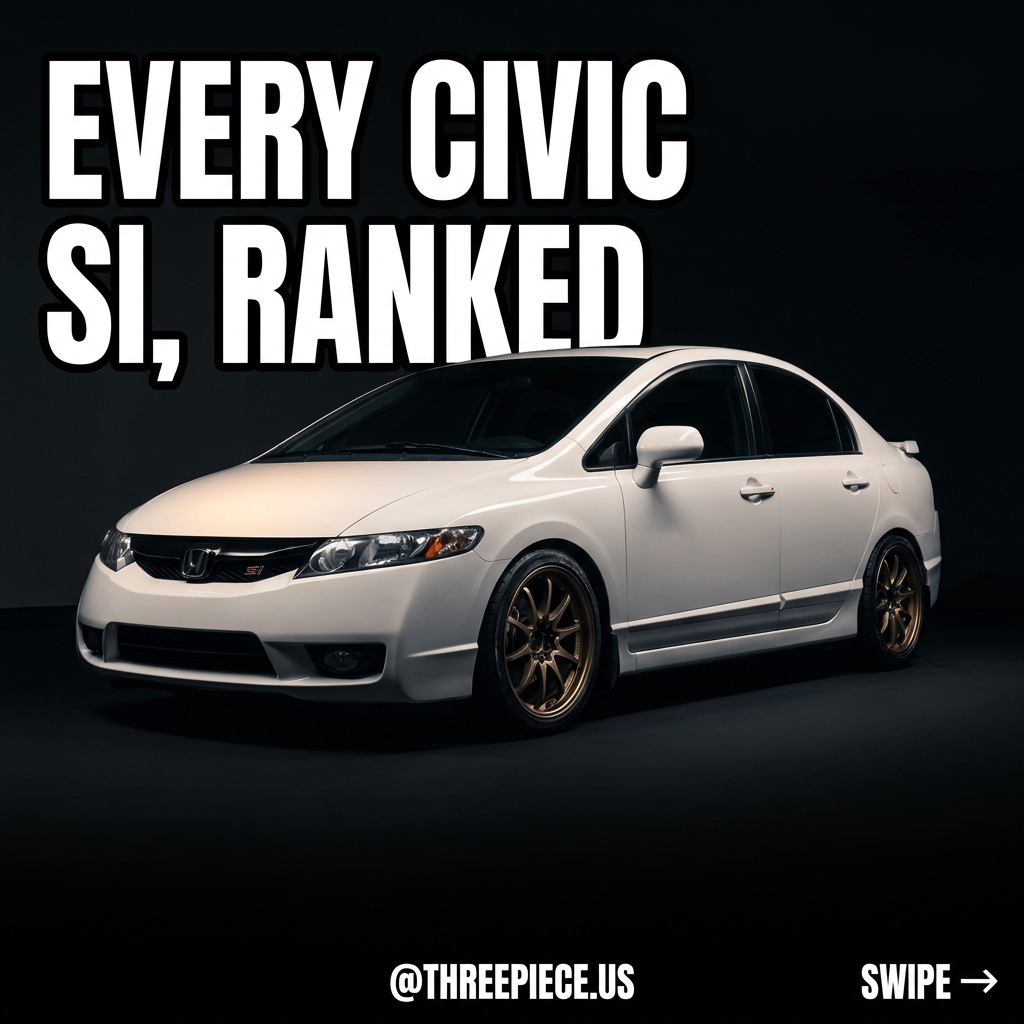
The Honda Civic Si has been in production for nearly four decades, and every generation starts the same argument: which one is the real Si? The answer depends entirely on whether you value raw mechanical theater or the car that actually gets you to work without drama. Here's every Civic Si generation ranked — not by spec sheets, but by what each car feels like when you're the one holding the wheel.
Quick links
- Tier 3 — The Foundations (3rd & 4th Gen)
- Tier 2 — The Middle Children (EP3, 9th Gen K24, Turbo Era)
- Tier 1B — The 5th Gen EH3: VTEC Arrives
- Tier 1A — The 8th Gen FA5/FG2: Last NA Screamer
- No. 1 — The EM1: The One They All Chase
- Wheels & Fitment Across Civic Si Generations
- Suspension: The Mod That Changes Everything
- The Verdict
Tier 3 — The Foundations (3rd & 4th Gen, 1986–1991)
The earliest Civic Si models are more historically interesting than they are fast. The 3rd-gen "Civic S" debuted with a 1.5L SOHC making roughly 91 hp — respectable for 1986, irrelevant by any modern measure. The 4th-gen ED7 bumped displacement to 1.6L (D16A6), 108 hp, ~6,500 rpm redline, added 16 valves, and gave the chassis slightly sportier suspension tuning.
What saves these cars from irrelevance is weight. They're featherlight, the steering has zero filtration, and they handle with a purity that Honda has spent every generation since trying to engineer back into heavier platforms. Mechanically, the D-series is bulletproof — oil leaks, worn ball joints, and tired bushings past 100k are about as bad as it gets. But unless you're building a period-correct vintage Honda, these are museum pieces, not driver's cars you'd rank against a K-series.
Tier 2 — The Middle Children
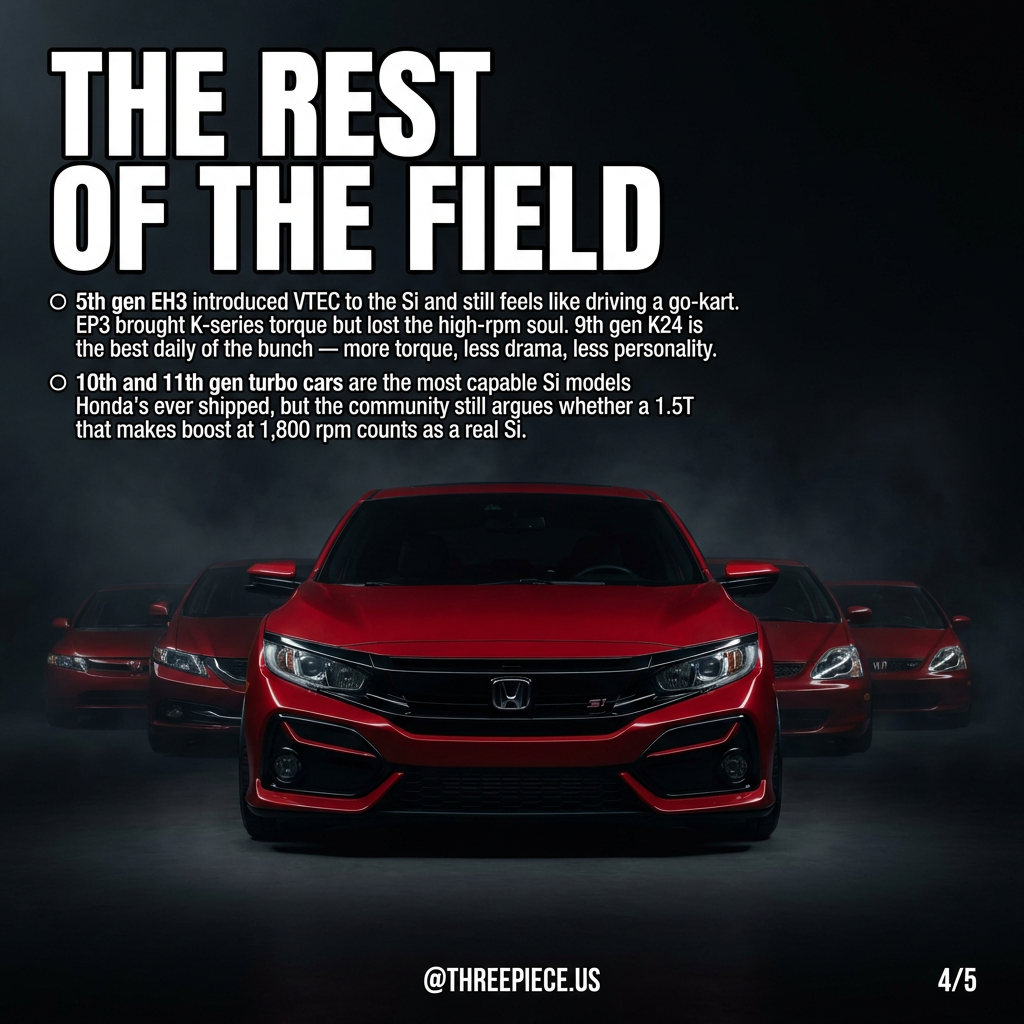
EP3 (2002–2005): K-Series Torque, Missing Soul
The EP3 is the Si that forum arguments were built for. Honda moved to the 2.0L K20A3 — still 160 hp but with 132 lb-ft of torque peaking at 5,000 rpm instead of screaming for its power near redline. The hatchback body was practical, the center-mounted gauge cluster was genuinely weird in the best way, and the car was easier to live with than any Si before it.
The problem: the K20A3 is the economy K-series head. It doesn't respond to bolt-ons the way a K20A2 does. Real power requires cams, head work, or a full swap. Enthusiasts who came from the B16 felt cheated — more torque, less theater. The EP3 is a better commuter than the EM1 and a worse Si. That tension is exactly why people still argue about it twenty years later.
9th Gen (2012–2016): The Sensible One
Honda bumped displacement again to 2.4L (K24Z7), 201 hp, 170 lb-ft, dropped the redline to ~7,500 rpm, and built the most comfortable, most refined Si to date. Highway passing became effortless. The transmission lost the 3rd-gear synchro lottery that plagued the 8th gen. It's the Si you'd recommend to someone who needs a daily driver that's slightly more interesting than a base Civic.
It's also the Si nobody puts on a poster. The K24's tuning ceiling is lower than the K20's, the chassis is heavier, and the character that made earlier Si models feel special got smoothed out in the name of livability. Good car. Forgettable Si.
10th & 11th Gen (2017–Present): The Turbo Debate
The 1.5L DOHC VTEC Turbo (L15B7) makes 205 hp and 192 lb-ft, delivers boost by 1,800 rpm, and is objectively the most capable Si Honda has ever shipped. The chassis is sharper than the 9th gen, the six-speed manual's rev-match is satisfying, and the interior finally feels like it belongs in a car that costs what the Si costs.
But the community still argues whether a turbocharged 1.5L that makes its power before you've even left the neighborhood counts as a real Si. The high-rpm VTEC crossover — that moment where the cam profile switches and the engine transforms — is gone. In its place: smooth, linear, competent boost delivery. The turbo Si is the better car. Whether it's the better Si depends on why you fell in love with Honda in the first place.
Real ownership concerns on the 10th gen: oil dilution in cold climates from fuel condensing on cold cylinder walls during short trips, and A/C condenser failures that typically run $800–$1,200 to repair. Budget for both if you're shopping one.
Tier 1B — The 5th Gen EH3 (1992–1995): VTEC Arrives
The 5th-gen Si introduced VTEC to the American Si lineup — SOHC configuration only, but it was enough. The D16Z6 made 125 hp at 7,200 rpm with 106 lb-ft, added rear disc brakes, and delivered a smoother, more refined power curve than the 4th gen while still rewarding high-rpm driving.
These cars still feel like go-karts. The chassis is light enough that 125 hp feels like more than it should, and the VTEC engagement — even in SOHC form — gives you a tangible reason to hold gears. Longevity is excellent with regular oil changes, though oil burn creeps in with age and aggressive rev habits. Watch for cracked plastic intake manifolds and worn camshaft lobes on cars that lived on cheap oil.
For the 5th-gen EG chassis, the Fortune Auto 500 Series Coilovers for the 1992–1995 Civic (EG) USDM at $1,799 are a proper foundation — fully adjustable damping that transforms the already-nimble EG into something that tracks as well as it canyon-carves.
Tier 1A — The 8th Gen FA5/FG2 (2006–2011): The Last NA Screamer
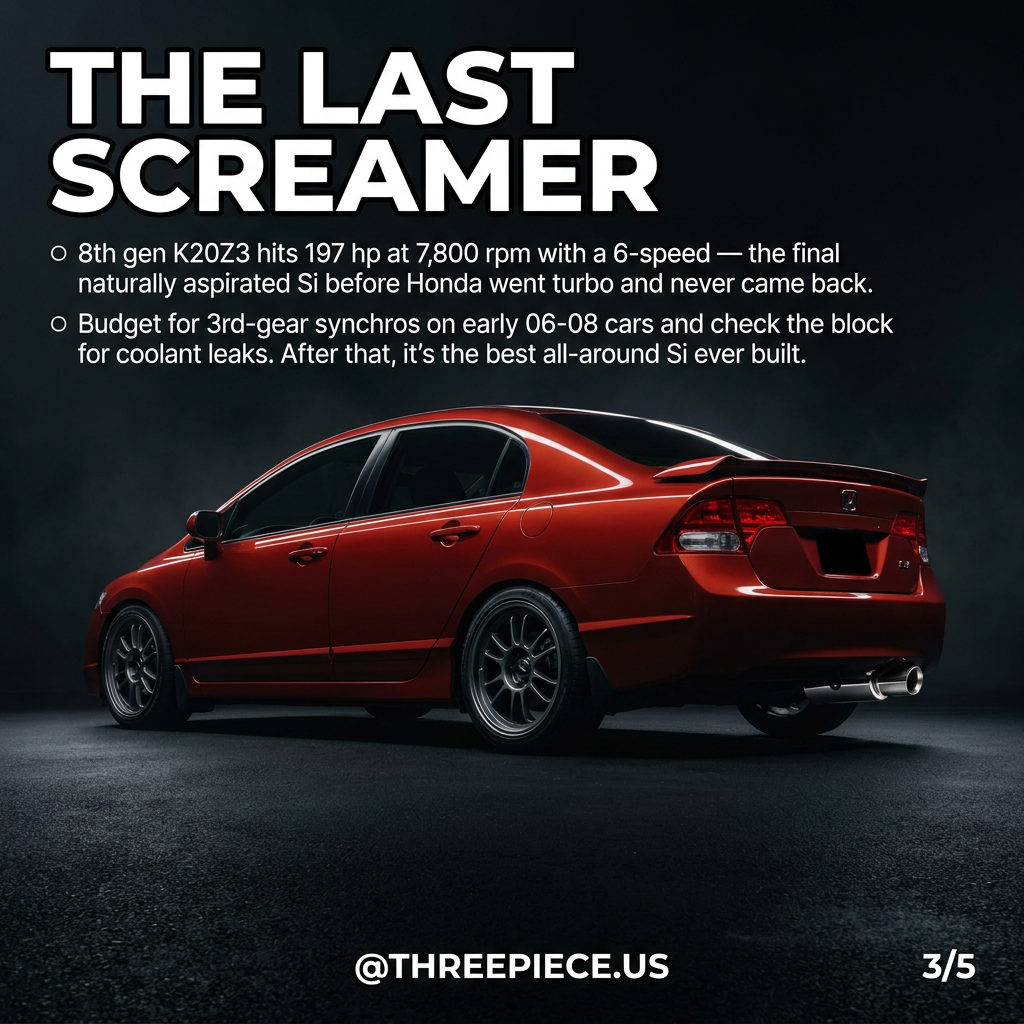
The 8th-gen Si is where Honda perfected the naturally aspirated K-series formula and then walked away from it forever. The K20Z3 makes 197 hp at 7,800 rpm and 139 lb-ft at 6,200 rpm through a six-speed manual — the first Si to get one. It was also the first Si sedan in the U.S. market (2007), and the chassis was genuinely good enough to justify the added weight.
This is the Si that rewards you for wringing it out. The powerband is empty below 4,000 rpm and euphoric above 6,000. The six-speed's ratios are tight enough to keep you in the meat of the curve, and the suspension — while not track-ready in stock form — has the geometry to handle serious upgrades. For the FA/FG chassis, the Fortune Auto 500 Series Coilovers for the 2006–2011 Civic 8 (FA/FG) at $1,799 are the move — separate-style rear with full height and damping adjustment.
But you need to know what you're buying. Early 2006–2008 cars have two documented issues that aren't optional reading:
- Cracked engine blocks on early production units — coolant leaks that lead to overheating. Pull the plugs, check for milky oil, pressure-test the cooling system before you hand over cash.
- 3rd-gear synchro grinding, especially cold. The 2006–2007 transmissions are the worst offenders. 2008+ models got improved synchromesh, and the 2009–2011 cars are generally considered sorted.
Paint quality is also suspect on certain colors — Fiji Blue and blacks are known for clearcoat peeling on roofs and A-pillars. None of this is a dealbreaker if you buy smart, but it means the 8th gen rewards patient shoppers who inspect before they deposit.
No. 1 — The EM1 (1999–2000): The One They All Chase
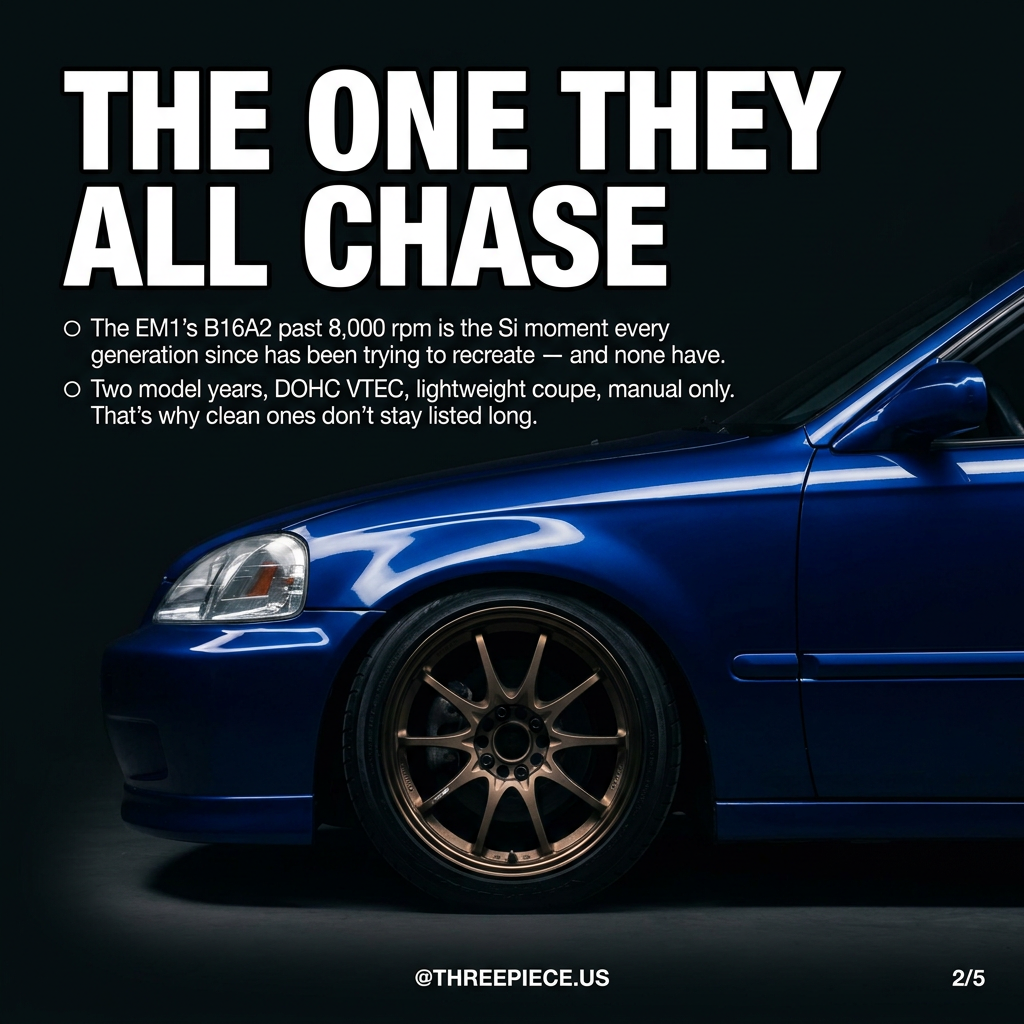
Two model years. One body style. Manual only. DOHC B16A2 making 160 hp at 8,000 rpm and 111 lb-ft at 7,000 rpm. Fully independent suspension, four-wheel discs, and a curb weight low enough that every one of those 160 horses counts.
The EM1 is the Si that every generation since has been measured against — and every generation since has lost that measurement. Not on power, not on features, not on lap times. On feeling. The B16A2 past VTEC crossover is the most emotionally violent thing Honda has ever put in a car under $20,000. The engine goes from polite to unhinged in a single cam lobe switch, and it keeps pulling until you either shift or run out of nerve at 8,000+ rpm.
Clean EM1s don't sit on listings. They get shared in group chats, and they're gone before the seller finishes writing the ad. The chassis rewards lightweight builds and high-RPM tuning, and the B-series parts ecosystem is deep enough that you'll never be stuck waiting on a part. Just respect the redline — rod bolts and cam journals don't forgive overrevving, and clutches wear fast if you're launching hard.
For the EK-chassis EM1, the Fortune Auto 500 Series Coilovers for the 1996–2000 Civic 6 (EK) at $1,799 are the suspension upgrade that matches the engine's intensity — because stock EK suspension on a car this responsive is leaving half the chassis on the table.
Wheels & Fitment Across Civic Si Generations
Civic Si fitment is one of the most discussed topics in the Honda community because the bolt pattern and hub bore have shifted across generations, and getting the stance right on a car this light requires precision — not guesswork.
The earlier EG and EK/EM1 chassis run 4x100 bolt pattern, which opens up a world of classic JDM wheel options. The Work Emotion series is a natural fit — lightweight, aggressive face designs, and available in sizes that work on compact Hondas without looking like they were borrowed from a bigger car. The Work Emotion T5R starting at $396 is one of the most popular choices on EK builds for a reason: the six-spoke design fills the fender without overwhelming the body lines, and the flow-formed construction keeps unsprung weight where it should be on a car this light.
For the 8th-gen FA/FG and later, you're looking at 5x114.3 bolt pattern, which dramatically expands your options. A 17x8 +35 or 18x8.5 +35 setup is the sweet spot depending on whether you prioritize ride quality or visual presence. Browse 17" wheels in 5x114.3 for the 8th gen's ideal tire-to-fender relationship, or step up to 18" wheels in 5x114.3 for the later turbo cars.
If you're building an EM1 or EG with Work Wheels, the Work Emotion CR Kiwami at $270 per wheel is the entry point into a wheel that looks like it costs twice the price — concave face, motorsport lineage, and a weight that respects what the B16 and D16 are trying to do. For the builder chasing a three-piece setup, the Work Emotion CR 3P at $895.50 per wheel is the endgame — fully customizable width, offset, and finish, built to your exact spec.
Don't forget the details that separate a built car from a parts-bin car. Hubcentric rings eliminate vibration on Honda hubs that rarely match aftermarket wheel bores exactly, and proper lug nuts in the correct seat type keep everything where it should be at 8,000 rpm.
Suspension: The Mod That Changes Everything
Every Si generation benefits more from suspension than from intake/exhaust bolt-ons. The stock springs and dampers on even the best Si models are compromises — Honda tunes for comfort on American roads, not for the cornering potential the chassis actually has. A proper coilover setup unlocks the car the engineers wanted to build but the product planners wouldn't sign off on.
For the 4th-gen EF chassis — the earliest Si that people still actively build — the Fortune Auto 500 Series Coilovers for the 1988–1991 Civic (EF) at $1,799 are a serious upgrade that matches the car's lightweight character with adjustable damping and ride height. On a car that weighs under 2,200 lbs, the difference between stock struts and a properly valved coilover is the difference between a fun car and a weapon.
The full suspension catalog covers most Honda chassis codes — EF, EG, EK, FA/FG — so you can match the right setup to your generation without guessing on spring rates or damper travel.
The Verdict
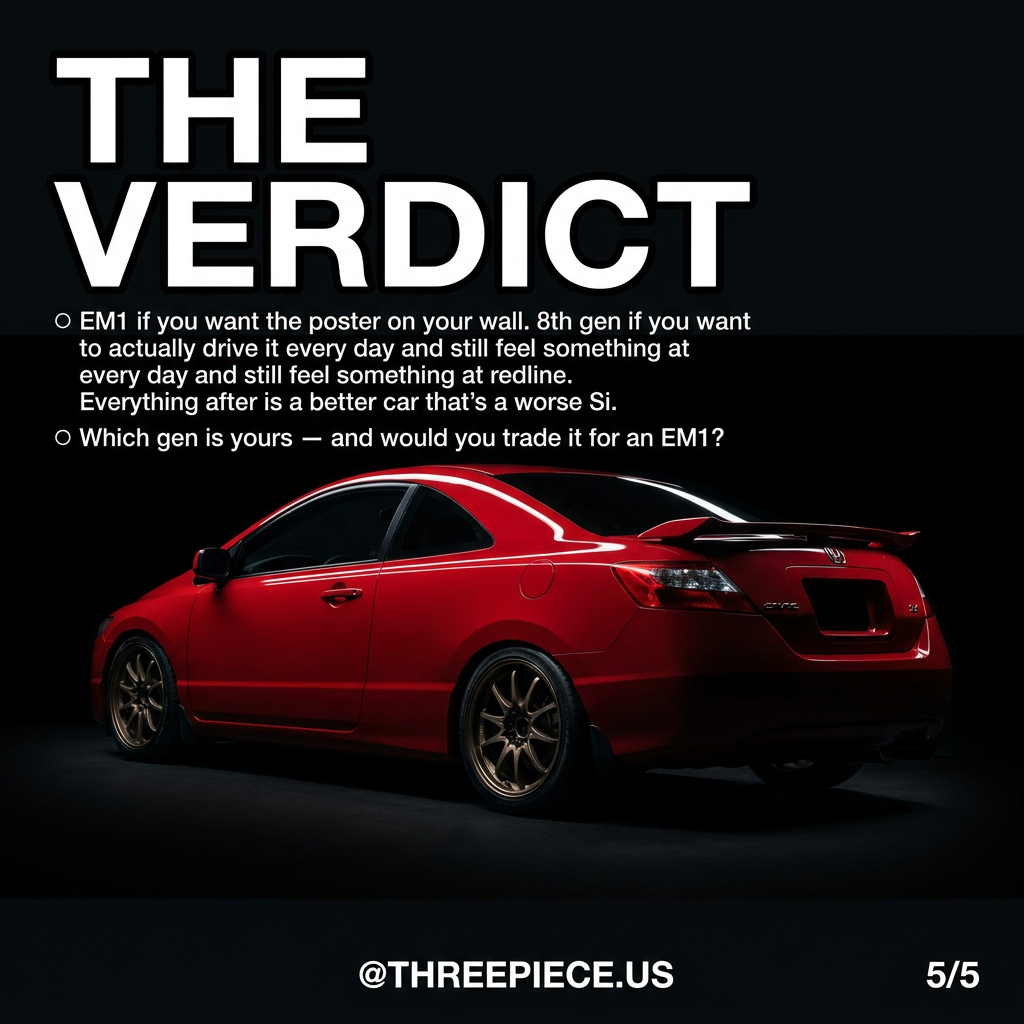
EM1 if you want the poster on your wall. 8th gen if you want to drive it every day and still feel something at redline. Everything after 2011 is a better car that's a worse Si — and that's not an insult, it's the tension that makes this nameplate matter.
The real question isn't which generation is objectively best. It's which generation made you fall in love with Honda before you could afford one. That answer says more about you than any dyno sheet ever will.
Check the ThreePiece vehicle gallery for built Civic Si examples across generations, and browse the full wheel catalog when you're ready to give yours the set it deserves.
Which gen Si is yours — and would you trade it straight-up for a clean EM1?