

NB Miata Lightweight Wheels: 13 Lbs Per Corner Changes Everything
Every NB Miata owner eventually stares at a spreadsheet of intake manifolds and header combos trying to will another 15 horsepower out of the BP-4W, and every single one of them is starting in the wrong place. The mod that actually transforms the NB isn't under the hood — it's at the corners. Owners who've dropped 10–13 lbs of unsprung mass per corner all report the same thing: the car finally wakes up. Quicker turn-in, sharper braking, snappier throttle response, and a chassis that rotates mid-corner like Mazda always intended. You didn't touch the motor. You just stopped making the suspension fight unnecessary weight.

Quick links
- Why unsprung mass matters more than horsepower on the NB
- Where the weight actually goes (and how to lose it)
- The tire trap nobody mentions
- Real numbers: before and after
- What to buy and what to skip
- Why this comes before any power mod
Why unsprung mass matters more than horsepower on the NB
The NB Miata weighs roughly 2,400 lbs with a driver. The 1.8L makes somewhere between 140–142 hp depending on year and how honest you are with yourself. You're not making this car fast in a straight line — not without forced induction and a budget that would buy a faster car outright. But Mazda handed you one of the most communicative, balanced chassis ever sold at this price point, and the quickest way to unlock what's already there is to reduce the mass your suspension has to manage.
Unsprung mass — wheels, tires, brake rotors, calipers, hubs — is everything between the road and the springs. When that mass is heavy, your dampers can't react fast enough to surface changes. The tire spends more time airborne over bumps. Turn-in feels lazy because the suspension has to overcome inertia before the contact patch actually changes direction. Remove 13 lbs per corner and you're taking 52 lbs off the parts of the car that matter most for handling. That's not the same as removing 52 lbs of sound deadening from the trunk. It's dramatically more impactful.
If you want to understand how tire compound and construction interact with this equation, that's worth reading too — because lighter rotating mass means your tire's grip characteristics show up more clearly in the seat of your pants.
Where the weight actually goes (and how to lose it)
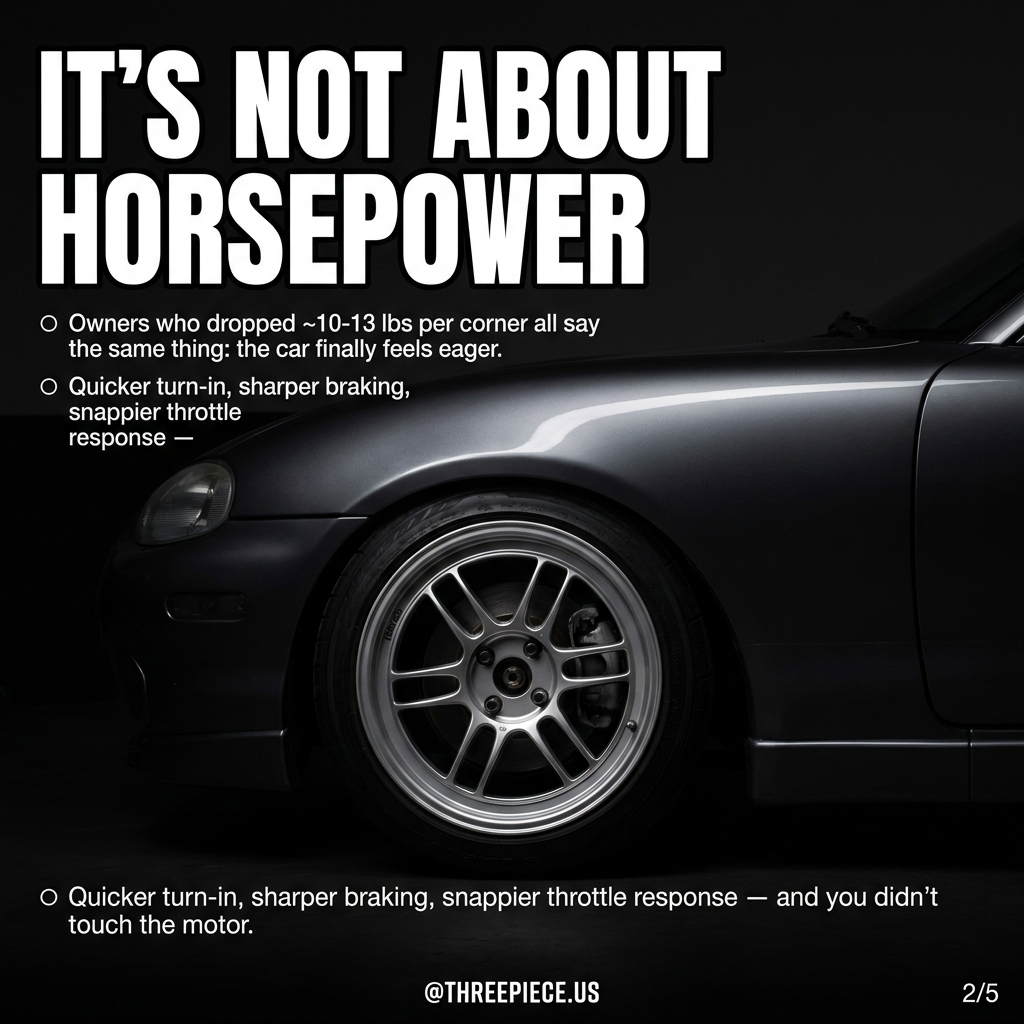
The biggest single chunk of unsprung weight on any NB corner is the wheel-and-tire assembly. Stock NB wheels run 14–16 lbs depending on the specific 14" or 15" variant. That sounds reasonable until you realize plenty of owners "upgrade" to heavy 16" or 17" cast aftermarket wheels that weigh 18–24 lbs each. One forum member documented swapping from 24-lb VOXX MGA wheels down to ~13-lb Konig Heliums — an 11-lb savings per corner from the wheel alone, before touching anything else.
The recipe for hitting that 10–13 lb per corner threshold looks like this:
- Wheels: Swap to a quality lightweight 15x7 or 15x8 flow-formed set. Expect 5–9 lbs saved per corner versus typical cast replacements. Browse 15" wheels in 4x100 to see what fits the NB's bolt pattern.
- Brake rotors: Lightweight slotted or wave-cut rotors can shave 2–4 lbs per corner over stock cast iron pieces. One documented NB build pulled 12.1 lbs off each front corner by combining lightweight wheels, lighter rotors, and aftermarket calipers.
- Tires: This is where people sabotage themselves (more on that below).
If you're running a 3-piece set on an NB — and yes, people do — the advantage is that forged aluminum construction gets you strength at weights cast wheels can't touch. A forged 6061-T6 barrel is a solid block of aerospace aluminum with everything that isn't the wheel carved away. That's how you run a wider face without gaining weight.
The tire trap nobody mentions
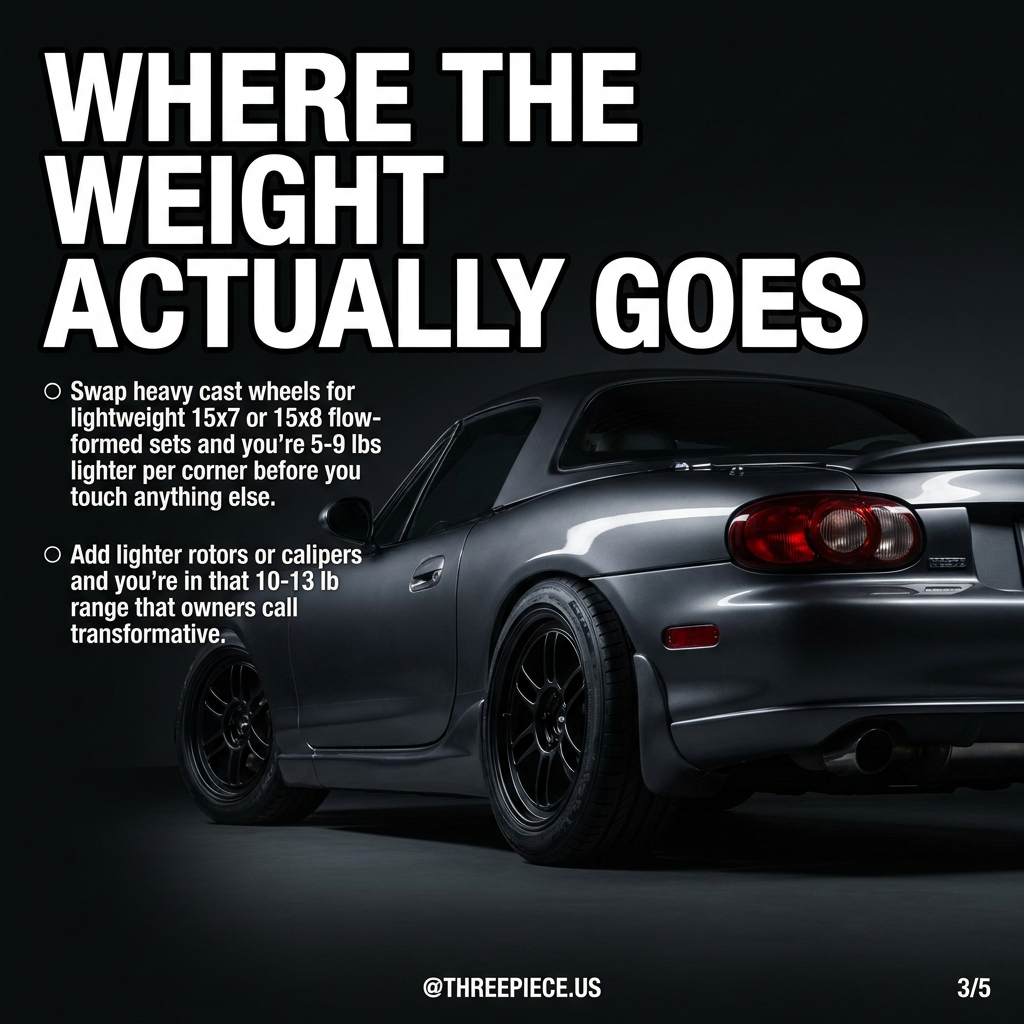
This is the part that wrecks builds. One NB owner on the Miata forums documented swapping to featherweight wheels, then mounting heavy all-season tires — and netted almost zero weight savings. All that money spent on lighter wheels, completely negated by a tire that weighed several pounds more per corner than the performance option.
A typical 205/50R15 performance tire weighs around 18–20 lbs. A cheap all-season in the same size can hit 23–25 lbs. That 5-lb difference per corner is enough to erase half your wheel upgrade. The lesson: shop the tire by weight, not just by treadwear rating or price. Weigh your current setup on a bathroom scale before you order anything. Set a target number per corner, then work backward.
For the NB, 205/50R15 is the sweet spot for most builds — enough sidewall for compliance on rough roads, enough width for real grip. Check out 205/50R15 tires to compare options. If you're stepping up to a 15x8 wheel, a 225/45R15 fills the barrel properly without excessive stretch. Understanding how summer performance tires compare to all-seasons matters here — the performance tire is almost always lighter and grippier. You're not making a compromise. You're just buying the right part.
Budget $1,500–$3,000 for wheels, tires, and brake pieces done correctly. That's still cheaper than a turbo kit, and it doesn't require a tune, upgraded fuel system, or the nagging suspicion that your stock internals are living on borrowed time.
Real numbers: before and after
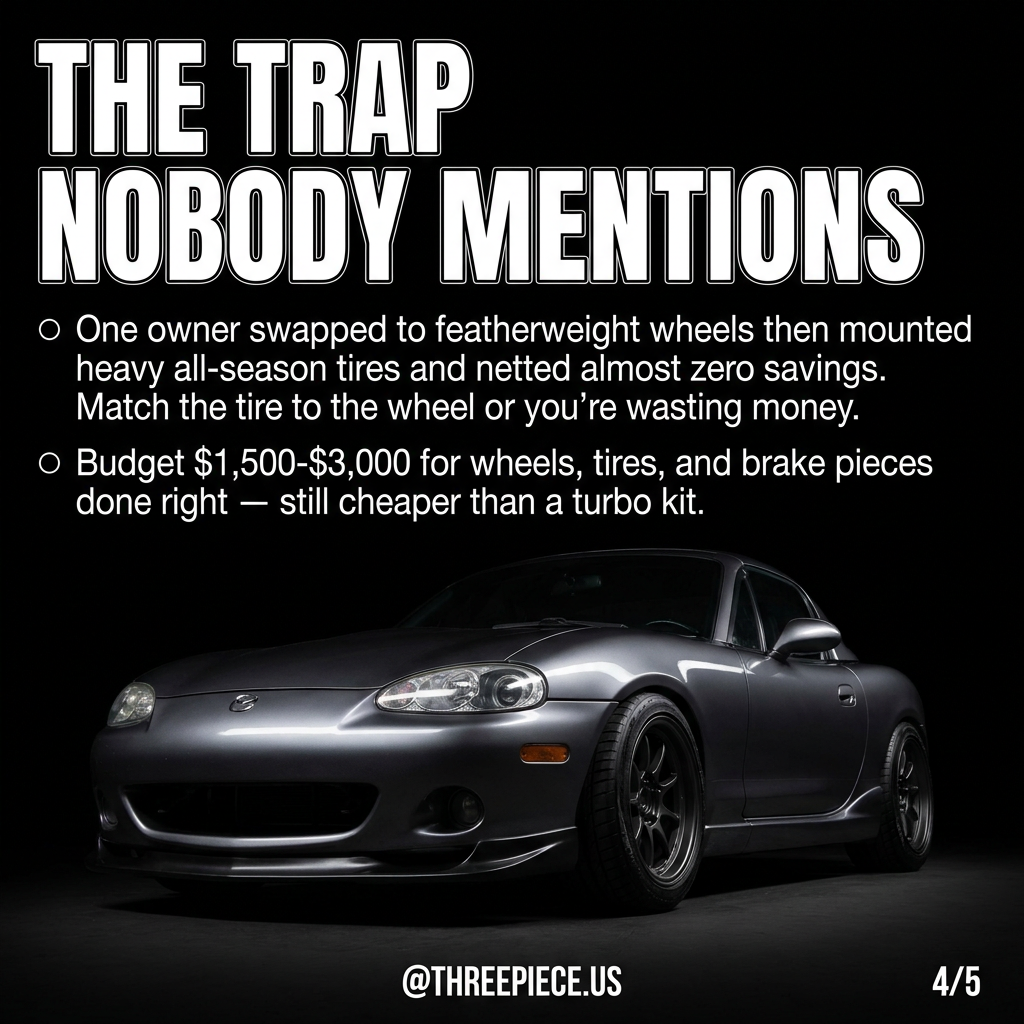
Grassroots Motorsports tested this directly. Approximately 11 lbs per corner lighter dropped their 0–60 time from 9.04 seconds to 8.61 seconds — nearly half a second — and shaved almost seven tenths on their test track. That's from unsprung mass alone. No power adder, no tune, no header.
Forum owners who've done similar reductions report:
- Turn-in: Noticeably quicker. The word "eager" comes up constantly. The car points where you look instead of negotiating with you first.
- Transitions: Less body roll induced by heavy corners. Slalom-style direction changes feel like a smaller, lighter car.
- Braking: Less rotating mass for the calipers to slow down. Owners report shorter stopping feel and less brake bias shift under hard braking.
- Ride quality: This is the trade-off. Less mass at the corner can mean the suspension feels more reactive to small bumps. Some owners describe it as "busier" on rough pavement. If you're daily driving on Michigan roads, know that going in.
For context on how wheel sizing affects fitment and feel, that guide breaks down the relationship between width, offset, and tire stretch — all of which matter when you're optimizing per-corner weight on a car this light. If you're considering a staggered setup, the NB actually works best with a square configuration for autocross and track use, keeping rotating mass consistent corner to corner.
What to buy and what to skip
The NB runs a 4x100 bolt pattern with a 54.1mm hub bore. That narrows your options compared to the 5-lug world, but it also means the wheels that do fit tend to be purpose-built for lightweight sport compacts.
What works:
- 15x7 +35 to +38 is the OEM-plus sweet spot. Fits without fender work on stock or mildly lowered cars. Pair with 205/50R15.
- 15x8 +25 to +30 for a wider, more aggressive stance. Requires checking clearance on stock struts and may need minor rolling on lowered cars. Pair with 225/45R15.
- Flow-formed construction at minimum. Cast wheels in these sizes often weigh 15–17 lbs, which barely saves anything over stock. Flow-formed gets you to 11–13 lbs in a 15x7.
What to skip:
- 17" wheels on an NB. You're adding unsprung mass, reducing sidewall (which hurts compliance on a car with already-firm stock suspension), and gaining nothing. The NB's fenders, brakes, and suspension geometry were designed around 14–15" wheels.
- Cheap cast reps that claim to be lightweight. If the listing doesn't include a verified weight, assume it's heavy. Weigh it yourself when it arrives — a bathroom scale and a bathroom floor is all you need.
If you're going all-in on a set that matches the NB's character, the Work Emotion T5R starting at $396 is a flow-formed wheel with real weight savings and a design that suits the NB's proportions without looking like it belongs on a different car. The Work Emotion CR Kiwami at $270 is another strong option — clean six-spoke face, proven lightweight construction. For builders who want the endgame set, the Work Emotion CR 3P at $895.50 gives you a true 3-piece forged wheel with custom width and offset options, which is how you dial in exactly the per-corner weight and fitment you want.
Finish the details with proper hubcentric rings — the NB's 54.1mm hub bore needs them with most aftermarket wheels to eliminate vibration — and 90-degree valve stems at $3.80 if your wheel's barrel makes straight stems a nightmare to air up at the track. Proper lug nuts are a detail people skip until they're fighting corrosion at the worst possible time.
Why this comes before any power mod
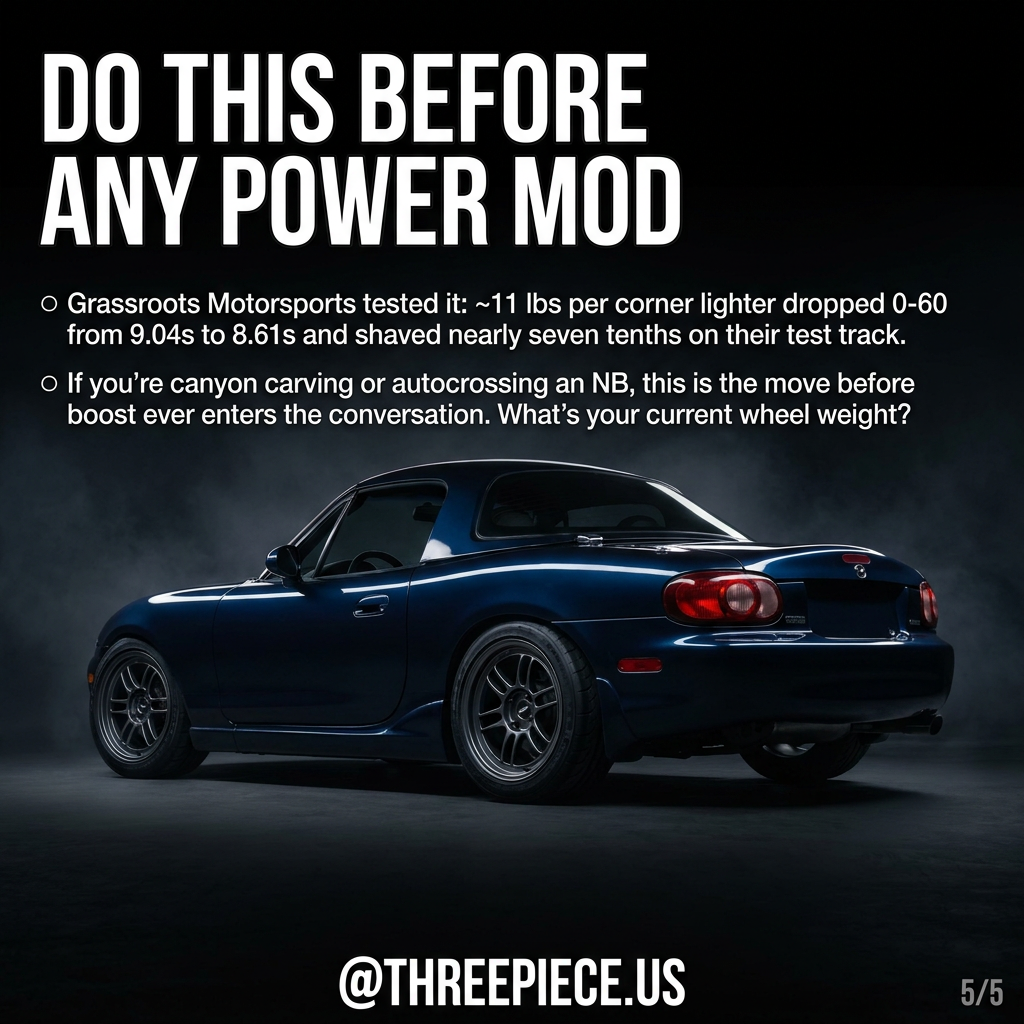
Here's the argument nobody wants to hear at 1 AM while browsing exhaust setups: the NB Miata's chassis is the car. The motor is an accessory. Every dollar you spend making the chassis work better — lighter corners, better damping, stickier rubber — compounds. Every dollar you spend chasing horsepower on a naturally aspirated 1.8L delivers diminishing returns into a platform that was never designed to be fast in a straight line.
Drop 13 lbs per corner, then add coilovers (the suspension category has options for multiple platforms), then upgrade to a 200-treadwear tire. Then talk about power. By that point you'll have a car that rotates on command, brakes later, and carries more speed through every corner — and you'll realize the motor was never the bottleneck. The chassis was being held back by what was bolted to it.
The NB community has known this for years. The guys running consistent 1:XX lap times at your local track day aren't the ones with the loudest exhaust. They're the ones who did the weight math first. Check the vehicle gallery for build inspiration, and if you're curious how the same lightweight-corners philosophy applies to other platforms, the SW20 MR2 build and the FA20 BRZ/FR-S guide both touch on why chassis balance beats raw power on lightweight platforms.
What's your current wheel weight — and what's your target?