

FA20 Flex Fuel Kit: Is E85 Worth It on a BRZ or FR-S?
The FA20 flex fuel debate splits the BRZ / FR-S / GT86 community right down the middle. One side swears it's the single best dollar-per-horsepower mod left on a naturally aspirated boxer. The other side says you're buying a $500 ethanol content sensor that does nothing until you've already spent three grand on supporting mods. Both sides have receipts — and both are partially right. Here's how the real numbers shake out, what the builds actually cost, and where the money makes sense versus where it's wasted.

Quick links
- What a flex fuel kit actually is
- Real dyno numbers: before and after
- Total cost to do it right
- Failure modes nobody warns you about
- The honest verdict
- Finishing the build: wheels and fitment
What a Flex Fuel Kit Actually Is
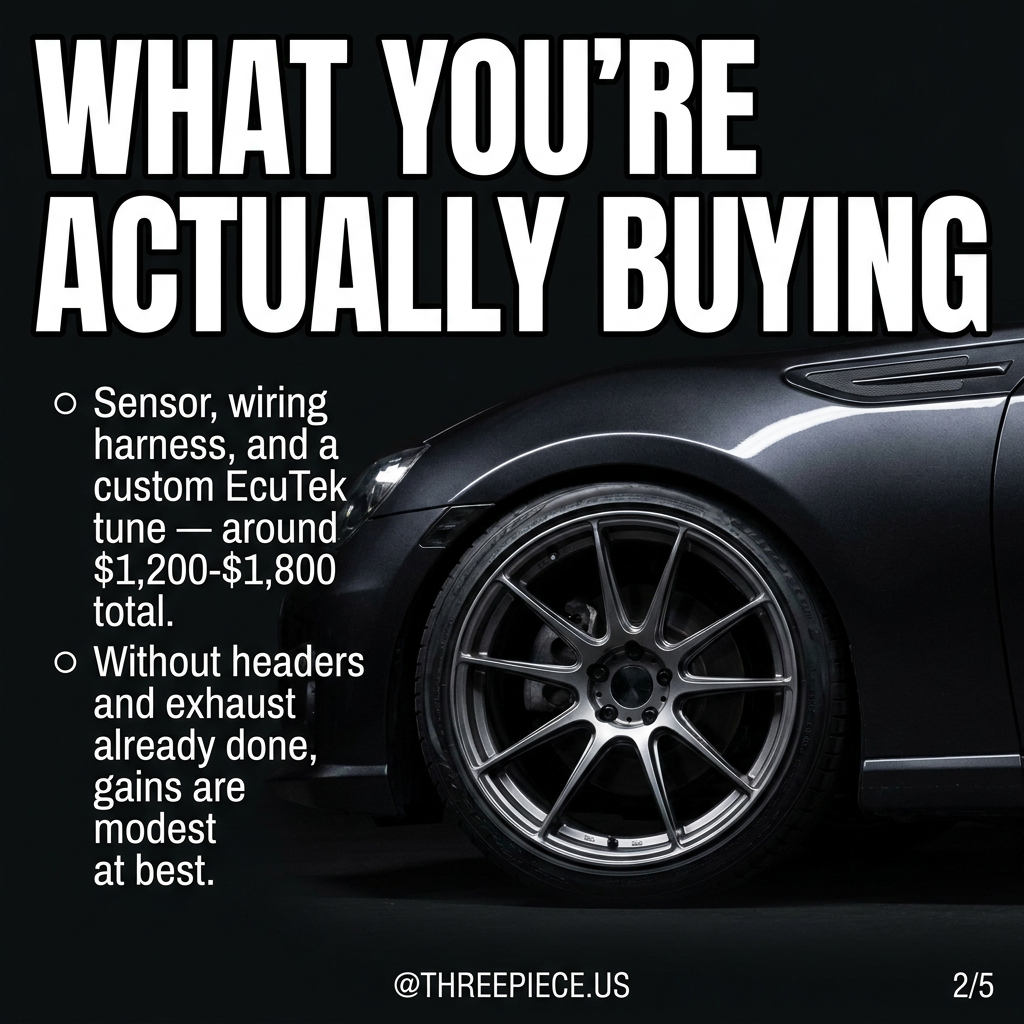
Strip away the marketing and a flex fuel conversion on the FA20 is three things: an ethanol content sensor, a wiring harness or CAN-gateway adapter, and a custom EcuTek tune with continuous flex fuel mapping. The sensor reads the ethanol percentage in your fuel line in real time, feeds that data to the ECU, and the tune adjusts ignition timing, fuel trims, and (in some calibrations) cam timing on the fly. That's it. There's no magic hardware making more power — the power comes from ethanol's higher octane rating (roughly 105 equivalent) letting the tuner add timing the FA20 can't safely run on 93.
This is where the critical distinction lives. Without a tune that actually uses that extra knock resistance, the sensor is just an expensive gauge. And without exhaust modifications that let the engine breathe well enough to capitalize on the additional timing, you're leaving most of the gains on the table. If you're still on stock headers and a stock front pipe, the FA20's exhaust-side restriction is the bottleneck — not the fuel. Our Scion FR-S ZN6 build guide walks through exactly why mod order matters on this platform.
Real Dyno Numbers: Before and After
Here's where forum speculation ends and actual dyno sheets start talking. The pattern across documented FA20 builds is remarkably consistent:
- Stock or mild bolt-ons + 93 octane: roughly 155–165 whp depending on dyno correction and altitude.
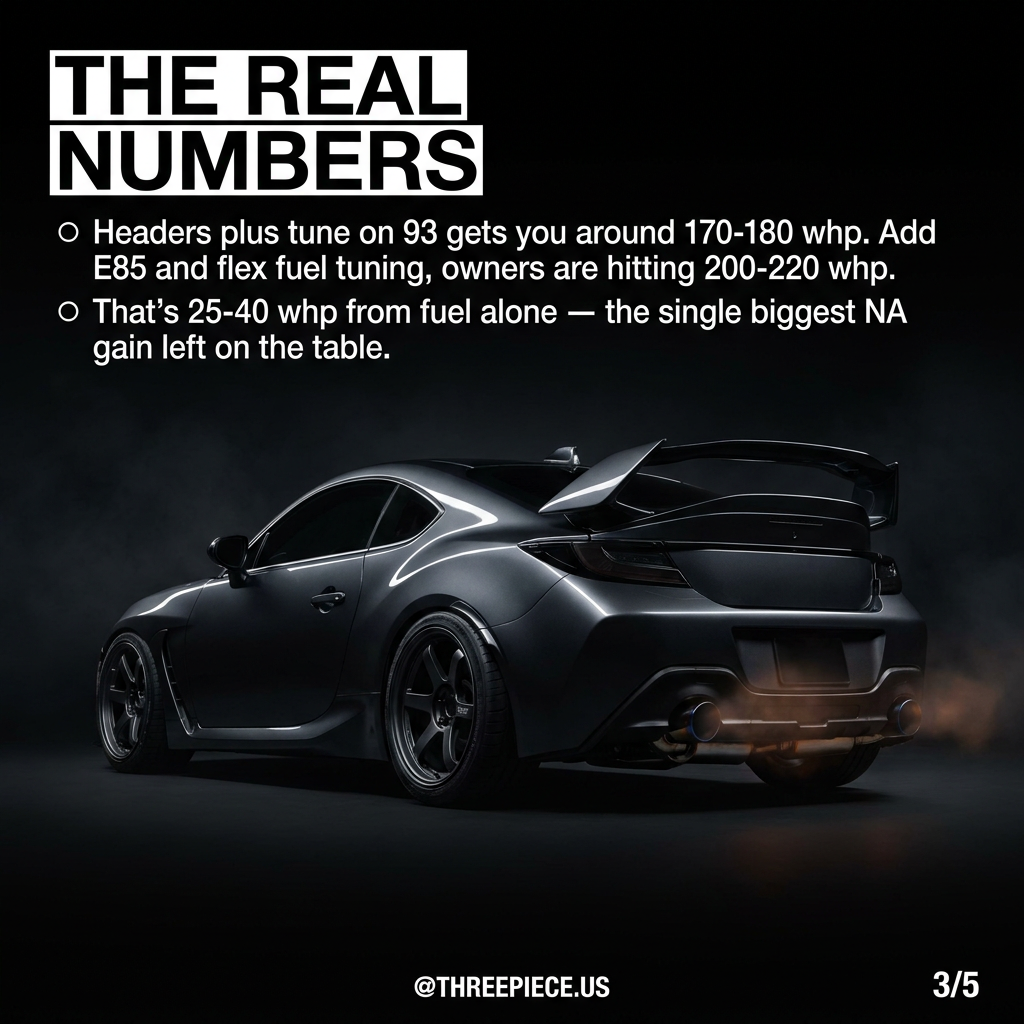
- Headers + front pipe + tune on 93: owners consistently land around 170–180 whp. The header swap alone is the single biggest gain on pump gas because it addresses the FA20's unequal-length exhaust manifold restriction.
- Same bolt-on setup + flex fuel on E60–E85: documented pulls show 200–220 whp. That's 25–40 whp from fuel and tuning alone — on a motor that most people consider "tapped out" naturally aspirated.
One well-documented CSG-tuned build running SME 4-2-1 headers, a JDL 2.5" front pipe, Fujitsubo catback, and a JDM airbox on approximately E62 showed over a 30% increase in peak horsepower versus the intake-and-exhaust baseline. The torque curve filled in dramatically above 4,000 rpm — which is exactly where the FA20's infamous midrange dip lives on pump gas. The tuner also raised the rev limit to approximately 7,800 rpm, giving the car a completely different character at the top end.
For turbo FA20 builds, the gains scale even harder. An HKS GTIII-RS turbo kit tested on 98 RON versus E85 picked up an additional ~36 hp at the wheels just from the fuel switch — roughly a 15–20% bump over the same turbo setup on pump gas. But that's a different budget conversation entirely.
The takeaway: on a naturally aspirated FA20 with proper supporting mods, flex fuel is the single biggest remaining power gain available. Nothing else you bolt on will add 25–40 whp for the money. If you want to understand how 200-treadwear tires compare to summer performance rubber for actually putting that power down, that's worth reading before you add grip to match the new output.
Total Cost to Do It Right
Here's the honest budget breakdown. Flex fuel isn't a standalone mod — it's a finishing touch on a platform that needs to be ready for it. The real cost includes everything required to actually see those dyno numbers:
- Equal-length headers (4-2-1): $1,000–$1,500. This is non-negotiable. The stock unequal-length manifold is the biggest restriction on the FA20, and no amount of ethanol fixes a breathing problem. Popular choices include the JDL, Tomei, and Ace brands.
- Front pipe / overpipe: $500–$800. The 2.5" JDL overpipe is common in documented builds. This pairs with the header to open up midrange flow.
- Catback exhaust: $500–$900. Less critical for peak power than the header/front pipe combo, but it completes the exhaust path and most owners do it in the same stage.
- Flex fuel kit (sensor + harness): $400–$600. Brands like Visconti, Gerald Just Projects, and PenguinTech all make plug-and-play kits for the FA20. The sensor itself is usually a Continental unit; the harness and CAN integration are what you're paying for.
- Custom EcuTek tune: $500–$1,000. This includes the EcuTek license (if you don't already own one) and a custom protune from a reputable tuner. Do not run an off-the-shelf map with flex fuel. The whole point is that the tune adjusts continuously — a fixed E85 map with variable ethanol content is how you get misfires.
Realistic all-in total: $2,900–$4,800 depending on brand choices and whether you're starting from completely stock. If you already have headers and a tune, the flex fuel addition is roughly $900–$1,600 for the kit plus re-tune — which makes the dollar-per-horsepower math genuinely compelling at roughly $25–$60 per whp gained.
For context, a turbo kit on the FA20 runs $4,000–$7,000+ before supporting fuel system and tuning costs. Flex fuel on a bolt-on car gets you into the 200+ whp range while keeping the NA character, the linear power delivery, and the reliability window that makes the platform appealing in the first place.
Failure Modes Nobody Warns You About
The flex fuel community online skews heavily toward success stories. Here's the other side — the stuff that shows up in forum threads six months after install:
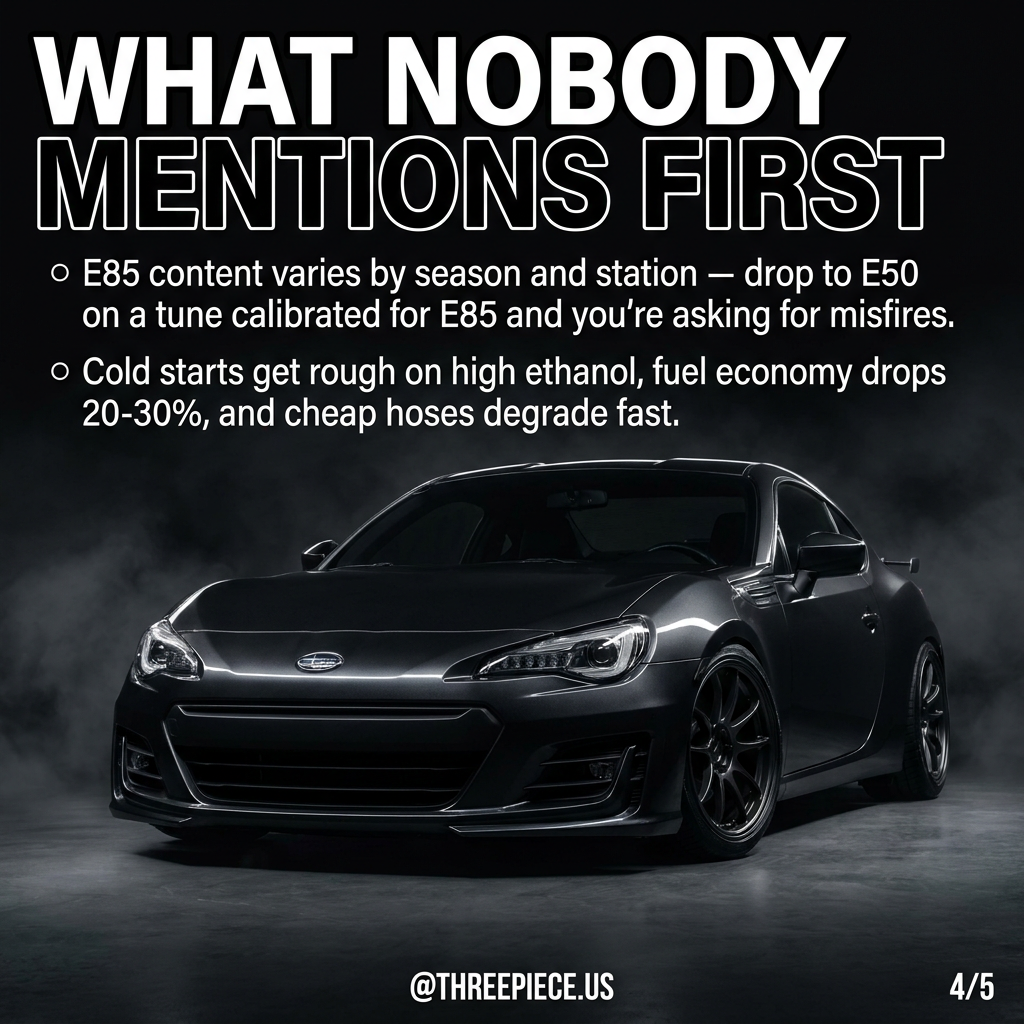
Ethanol content variance is real. E85 at the pump is not always 85% ethanol. It varies by season, region, and supplier — sometimes dropping to E50 or lower in winter months. If your tune is calibrated for E85 and you fill up with E51, the ignition timing targets are too aggressive for the actual knock resistance of the fuel. The result: misfires, rough running, and potential engine damage. This is exactly why a true flex fuel setup with a content sensor and continuous mapping exists — but even then, the sensor needs to be functioning correctly and the tune needs proper failsafes built in.
Cold starts get worse. Ethanol requires significantly more fuel to atomize at low temperatures. High ethanol blends on cold mornings mean extended cranking, rough idle until the engine warms up, and occasionally fouled plugs if the injectors can't deliver enough volume. This is manageable but annoying — and nobody mentions it in the "I gained 35 whp" posts.
Fuel economy takes a hit. Ethanol has roughly 30% less energy density than gasoline by volume. Expect your already-mediocre FA20 fuel economy to drop 20–30% on high ethanol blends. If you're daily driving, that math adds up fast — especially if E85 isn't significantly cheaper than 93 in your area.
Fuel system stress. The stock FA20 fuel pump and injectors can handle moderate ethanol blends, but running consistent E85 pushes them toward their limits. Owners making 200+ whp on E85 frequently report that the stock fuel system is maxed out. Upgraded injectors or a fuel pump become the next bottleneck — and another $300–$600 you didn't budget for.
Hose and seal degradation. Ethanol is hygroscopic and corrosive to certain rubber compounds. Cheap fuel hoses, non-ethanol-rated O-rings, and older fuel system components can degrade over time. This isn't an immediate failure — it's a slow one that shows up as fuel smell, weeping connections, or a check engine light months later. The Evo X vs STI reliability breakdown covers similar fuel system stress concerns on another platform where ethanol pushes stock components to the edge.
The Honest Verdict
Flex fuel on the FA20 is absolutely worth it — but only if you've already built the platform to use it. Here's the decision tree:
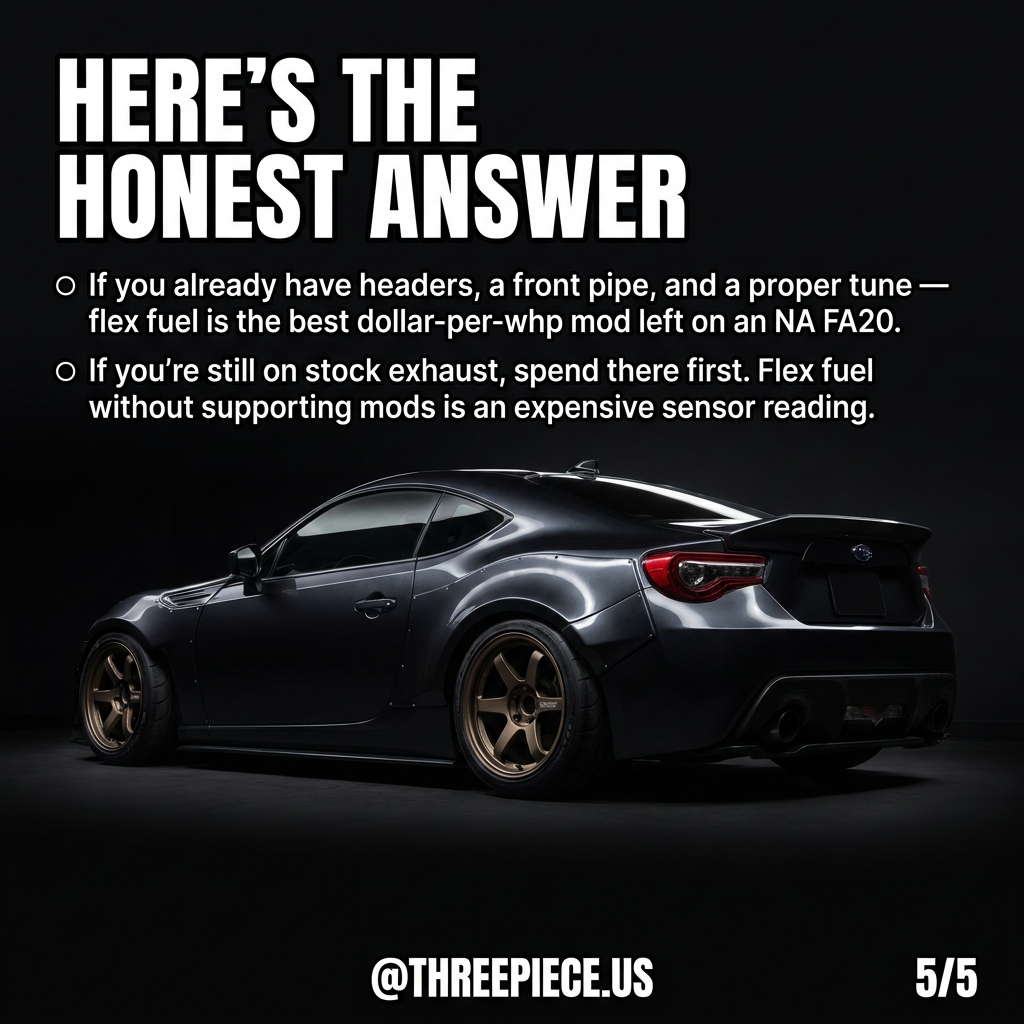
If you already have headers, a front pipe, and a quality EcuTek protune: flex fuel is the best money you can spend. Adding the sensor, harness, and re-tune for ~$900–$1,600 gets you 25–40 whp on a motor that's otherwise plateaued on pump gas. There is no other mod at this price point that moves the needle this much on a naturally aspirated FA20. This is the endgame for NA power on this platform.
If you're still on stock exhaust: spend there first. Flex fuel without supporting mods is genuinely an expensive sensor reading. The FA20's stock manifold is the restriction, not the fuel octane. Headers plus a tune on 93 octane will get you 170–180 whp and set the stage for flex fuel to actually deliver. Our BRZ / FR-S wheel fitment guide is worth bookmarking for when you're ready to match the mechanical upgrades with proper wheel and tire sizing.
If E85 isn't reliably available in your area: the math doesn't work. A flex fuel kit that sits on pump gas 90% of the time is a $1,000+ investment returning nothing. Check station availability before you buy. And if you're blending your own ethanol at the pump (mixing E85 with 93 to target E50–E60), understand that you're adding another variable the tune needs to handle — which is exactly what the continuous flex map does, but only if the sensor is reading accurately.
The FA20 is a motor that rewards methodical building. Headers first, tune second, flex fuel third. Skip a step and you're leaving money on the dyno.
Finishing the Build: Wheels and Fitment
Once the FA20 is making 200+ whp, the next conversation is putting it down — and that starts with wheels and tires. The ZN6/ZC6 platform runs a 5x100 bolt pattern, and the sweet spot for aftermarket fitment on a lowered BRZ or FR-S is 18x9.5 +38 to +45 square, wrapped in 255/35R18 rubber. That setup fills the fenders without requiring aggressive camber or fender work on most coilover setups.
The Work Emotion T5R starting at $396 is one of the most popular flow-formed options on the platform — lightweight, strong, and available in the right offsets for the 86 chassis. If you want more aggressive concavity, the Work Emotion CR2P at $432 gives you a two-piece construction with deeper face options. For the full three-piece experience, the Work Emotion CR 3P at $895.50 lets you spec exact width, offset, and lip depth — which is how you get that perfect flush fitment without compromise.
Browse 18" wheels in 5x100 to see what's available for the platform, and pair them with 255/35R18 tires for the ideal square setup. If you're running a staggered configuration, check the full BRZ fitment guide for rear width and offset recommendations.
If you're going three-piece, don't forget the details that make the build feel finished. 90-degree valve stems at $3.80 each keep air fills clean behind deep-dish lips, and a ThreePiece.us license plate frame at $9.99 is the kind of detail that shows you care about the whole car, not just the dyno sheet. Check out the vehicle gallery for real builds on this platform to see how different wheel specs actually sit.
The FA20 flex fuel conversation is ultimately about squeezing every last horsepower out of a platform that wasn't designed to be fast — it was designed to be fun. The right mod order, the right tune, and the right wheel and tire package turn a 200-horsepower boxer into something that punches way above its displacement. Just do it in the right order.
Already running flex fuel on your FA20? Drop your ethanol blend and dyno numbers below — and whether you went headers-first or flex-first.