
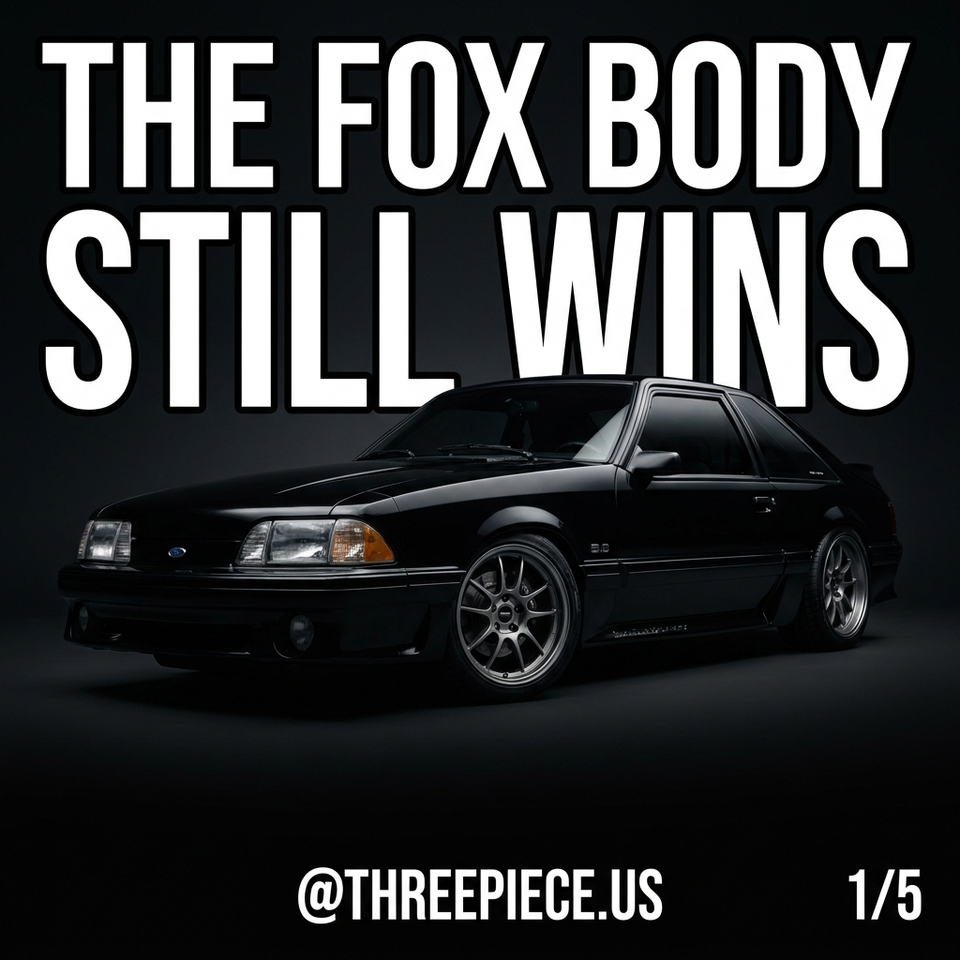
Rank the Ford Mustang generations honestly and the Fox body ends up on top, which is going to upset every S550 owner who has never driven a car that weighs in the low 3,000s with a pushrod 5.0 HO in front of them. Every Mustang since has been heavier, safer, faster on paper, and further from the point. This is a Mustang history and generation ranking written for people who buy wheels, not for people who quote 0-60 times from a magazine.

Quick links
- The first Mustang was a Falcon in a nicer suit
- Mustang II: the generation that saved the nameplate
- Why the Fox body still owns everything
- SN95 and New Edge: the awkward middle child
- The 2011-2014 GT is the value sweet spot
- S550: better car, less character
- The ranking, and where your money goes
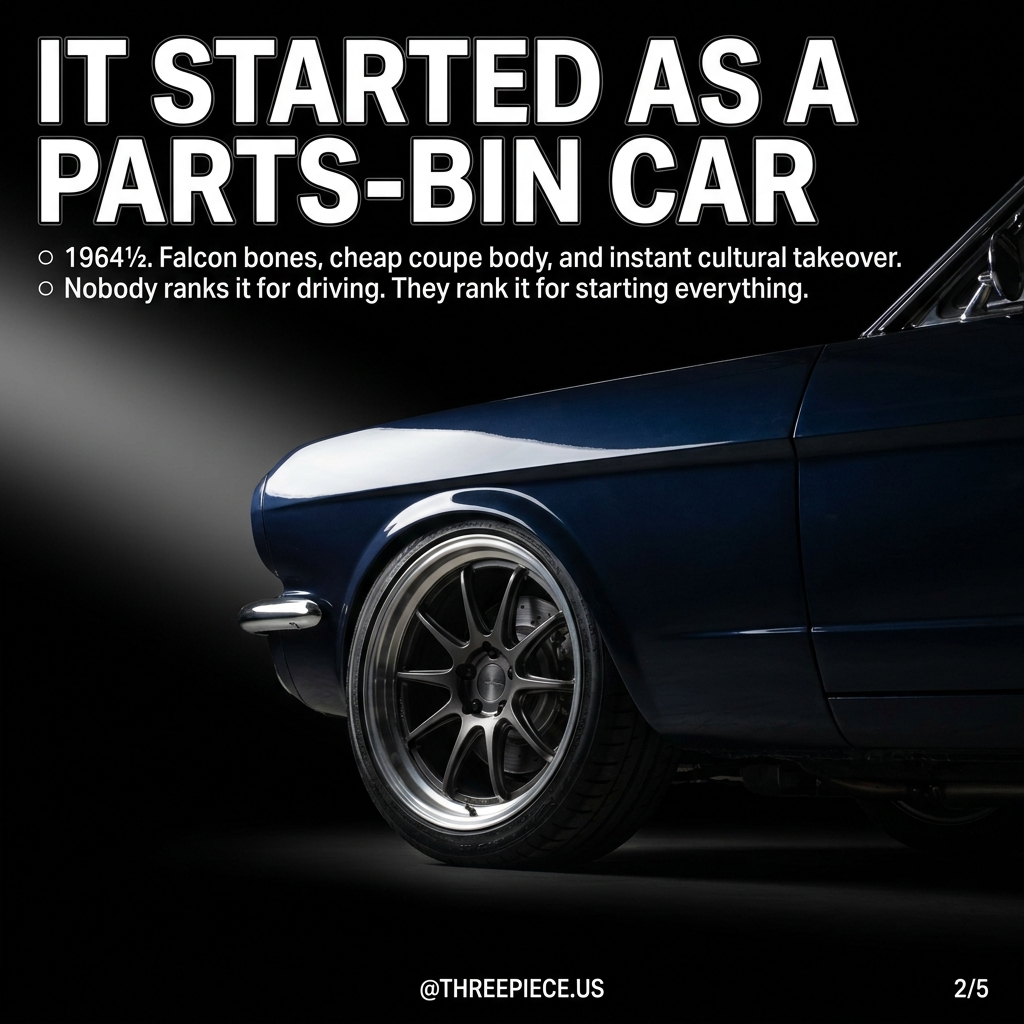
The first Mustang was a Falcon in a nicer suit
The 1964½ car is a cultural monument and a mediocre driver's car. Falcon platform, Falcon suspension, cheap coupe body, options list long enough to bankrupt a teenager. Nobody ranks it for how it drives — they rank it for starting an entire category out of the corporate parts bin. That's the important detail for the rest of this list: the Mustang has always been assembled from whatever was on the shelf. That's the character, not the flaw.
It also set the template every generation after it followed: cheap to buy, cheap to modify, endless aftermarket. Same reason the NA Miata became untouchable on the other side of the world.
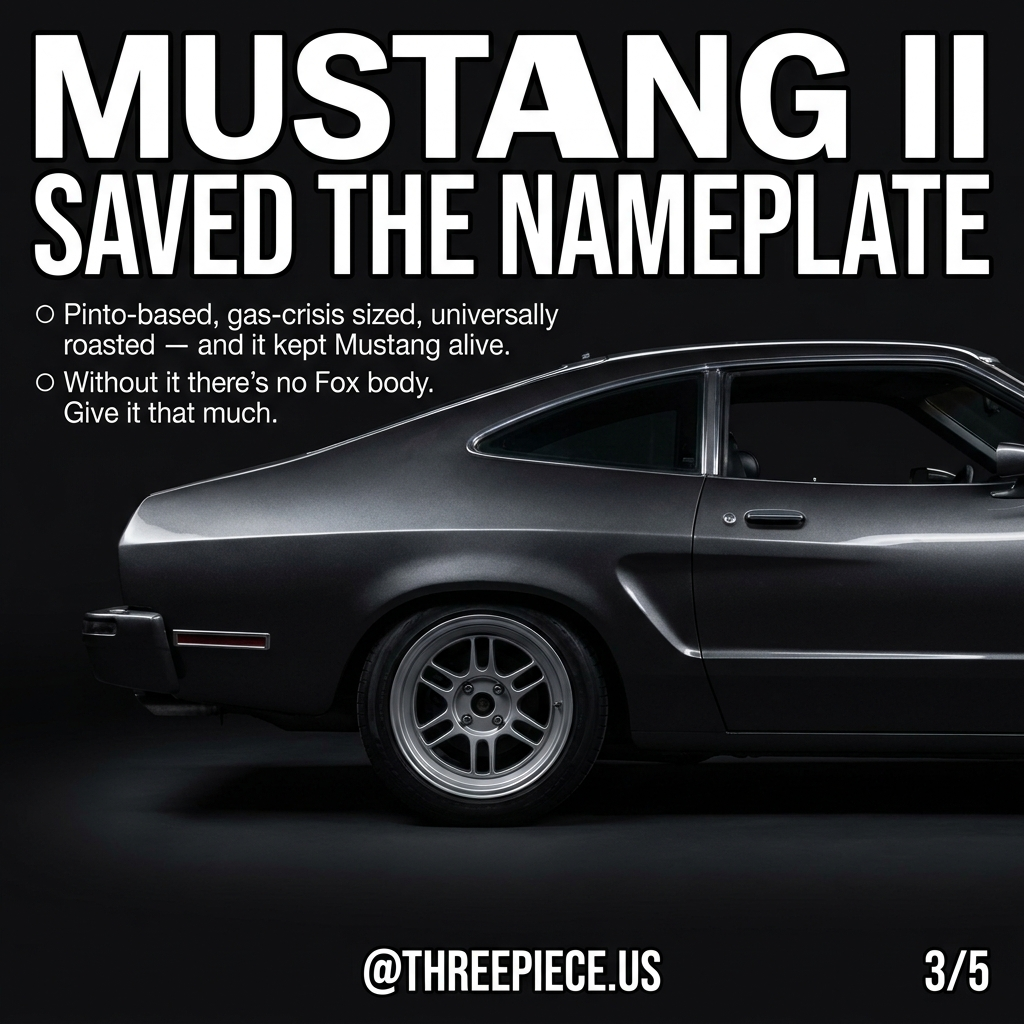
Mustang II: the generation that saved the nameplate
Pinto-adjacent, gas-crisis sized, universally roasted — and it sold. Hard. Without the 1974-1978 Mustang II moving metal through the worst period American performance has ever had, there is no Fox body, no SVO, no Coyote, no Mustang at all. It gets last place on the driving ranking and a permanent seat at the table on the history ranking. Fox front suspension geometry is still the go-to street rod front end swap, and that geometry traces straight back through this car.
If you own one: leave it alone, put a set of period-correct wheels on it, and let people be confused. Half the fun of an odd-generation build is watching people at a show try to place it. Plenty of that energy in our vehicle gallery.
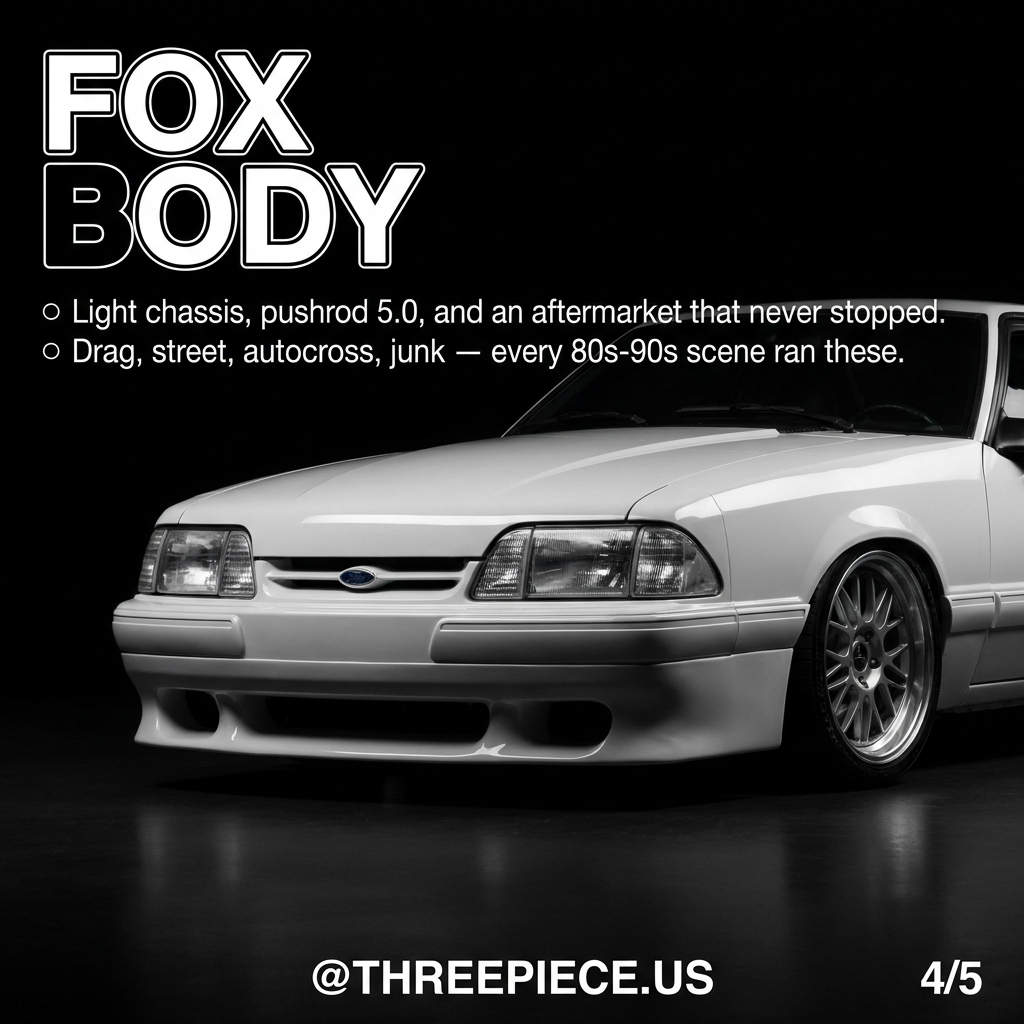
Why the Fox body still owns everything
1979-1993. Light chassis, simple 5.0 HO making 225 hp in the late cars, and an aftermarket that never once stopped producing parts. Drag, street, autocross, grudge racing, burnout contests, junk builds — every scene from 1985 to now has run these. You can rebuild the whole front end in a weekend with hand tools, which is exactly why so many of them are still on the road while more sophisticated performance cars from the same era sit waiting on a $2,400 module.
Wheel side, know this before you order anything: Fox bodies are 4x10⁸ (4x4.25") right up until the 1993 SVT Cobra went 5x114.3. The four-lug pattern is why nearly every serious Fox build starts with a 5-lug conversion before the first wheel order — the selection difference between 4x10⁸ and 5x114.3 is night and day. Once you're converted, 17x9 in 5x114.3 is the classic street/track answer and looks correct on the body instead of cartoonish.
Going drag-biased? Read our drag radial fitment guide before you buy a rear wheel, because overall diameter and backspacing decide whether a 315/35R17 actually clears your quad shocks or ruins an inner fender lip. If the car is a corner car instead, our breakdown on picking a 200TW tire for HPDE and autocross matters more than another 20 hp.
SN95 and New Edge: the awkward middle child
1994-2004 is where the Mustang gained weight and lost the plot for a few years — and also where it produced two of the best factory Mustangs ever built. The 2003-2004 Terminator Cobra with the supercharged 4.6 and its 390 hp factory rating is a legitimately serious car, and the Mach 1 and Bullitt models are aging into real money. The base V6 New Edge cars, meanwhile, are the cheapest way into a RWD V8 swap platform in America and nobody talks about it.
The value trap here is real: a rough Terminator costs more to sort than a clean S197. Spend your money on the good example, not the project. Same lesson we hit in the E46 M3 vs E90 335i argument — buy the car that's already right.
The 2011-2014 GT is the value sweet spot
If you want the Fox body feeling without the four-lug tax, this is the buy. Coyote 5.0, 412 hp for 2011-2012 and 420 hp for 2013-2014, MT82 six-speed, 5x114.3 with a 70.5mm bore, and a live rear axle that everybody complains about right up until they see the drag times. Used prices are still soft compared to nearly everything else with that power-to-price ratio.
Fitment: square 19x10 is the target once you sort the rear, and 19x10 in 5x114.3 with a 275/35R19 is the setup that makes an S197 look intentional instead of stock-with-lowering-springs.
Suspension is where the S197 transforms. The Function and Form Type 3 coilover kit for the S197 at $1,590 is the entry point that still gives you real adjustability. Step up to the Fortune Auto 500 Series for the 2005-2014 Mustang at $1,799 if you want rebuildable, revalvable dampers, or the Fortune Auto 510 Series S197 kit at $2,399 for the separately adjustable compression and rebound setup if the car sees track time. More options in our suspension catalog.

S550: better car, less character
The 2015+ car with independent rear suspension is objectively the better machine. It corners, it rides, it's quicker everywhere, and it's the first Mustang you can genuinely drive hard on a road course without apologizing. It's also the heaviest and most insulated Mustang there's ever been, which is exactly the complaint. Great car. Less of an event.
If you're in one, we've already covered the two mods worth doing first: our S550 coilover guide and the best cold air intakes for the S550. For sizing, the 2015-2023 Mustang wheel fitment guide has the offsets that actually clear. Hardware-wise the Fortune Auto 500 Series for the S550 at $1,968.11 is the same rebuildable platform as the S197 kit.
The ranking, and where your money goes
1. Fox body — lightest, simplest, most fun per dollar. 2. S197 Coyote (2011-2014) — the value pick, no contest. 3. S550 — best driver, least soul. 4. First-gen — the icon, not the machine. 5. SN95/New Edge — two great cars hiding in a decade of mediocre ones. 6. Mustang II — last on merit, first on gratitude.
Whichever one you land on, the wheel decision is the one you'll look at every day. If you're deciding between cast, flow-formed, and forged, our take on the real value of forged wheels is worth ten minutes, and the full wheel catalog is where the 5x114.3 options live. For 3-piece builds, we stock the M7 assembly hardware, silicone sealant at $10.99, and full refinishing service for the set you already found. Similar generational argument, different chassis? We ranked every WRX STI generation too.
Now settle it: 5-lug swap first, or coilovers first — what order did you actually do it in on your Fox body?