

Subaru WRX STI History: Every Generation Ranked
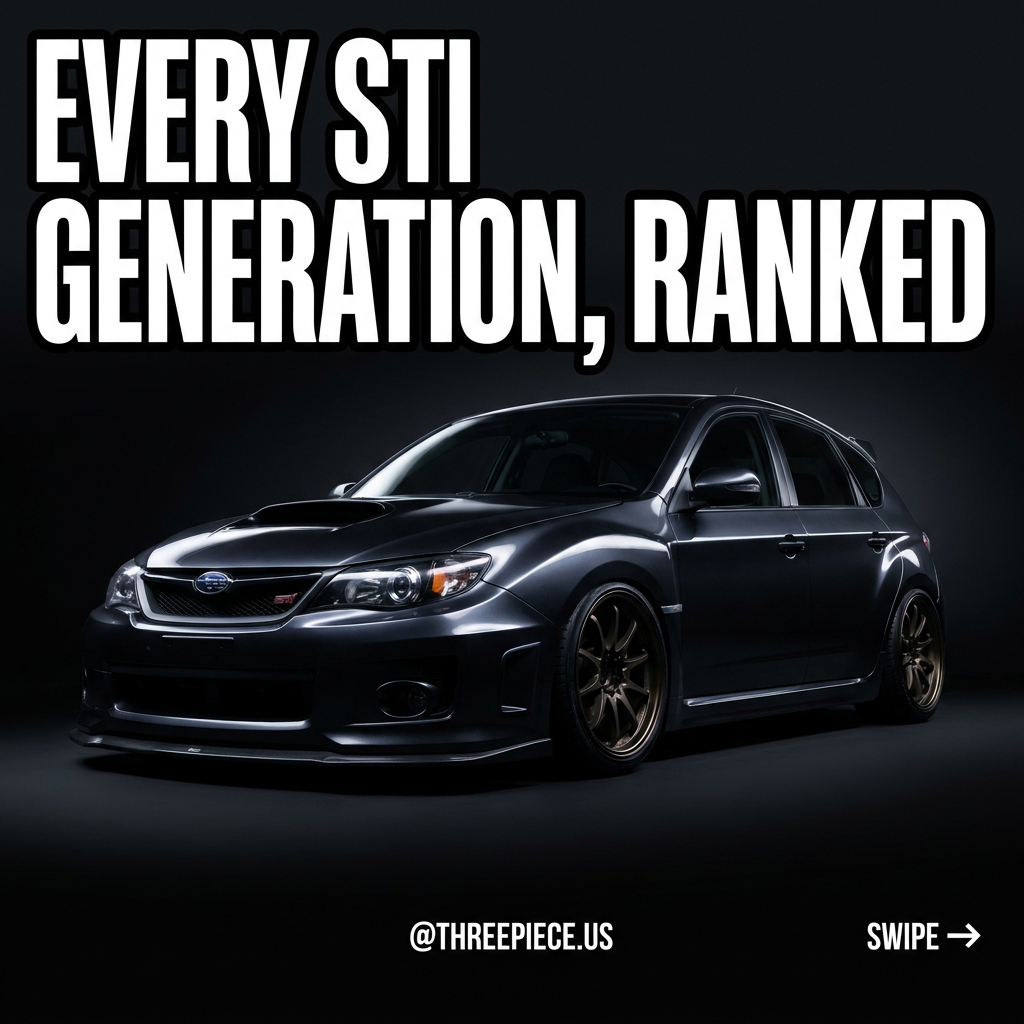
The Subaru WRX STI is one of the few cars where the generational argument never actually cooled off. Every STI generation added something and gave something up, and the ranking depends entirely on whether you want a homologation special or a car you can drive to work in February. This is the honest version of WRX STI history — GC8 through the VA Final Edition — ranked by what they actually are in 2025, not what the brochure claimed.
Quick links
- GC8: the rally receipt (1994-2000)
- GD: the golden era (2002-2007)
- GR/GV: the widebody nobody wanted, then everybody did
- VA: refined, quick, and quietly divisive
- The ranking
- Bolt patterns, fitment, and what to buy
- Final verdict
GC8: the rally receipt (1994-2000)
The GC8 was never a product plan — it was paperwork. Subaru needed a homologated street car to go rallying, so you got a 2,710 lb sedan making roughly 247 hp from the EJ20 turbo with 228 lb-ft arriving at 3,500 rpm. Version III introduced DCCD in Japan, which is the single most important thing the GC8 handed forward to every STI after it.
Then there's the 22B: 400 units, a 2.2L EJ22 at roughly 280 PS, widebody arches, and a market value that now functions less like a used car price and more like a mortgage. Every generation after it gets measured against a car 99% of enthusiasts will never sit in — which is a slightly unfair fight.
Ownership reality: EJ20 ringlands don't love boost, head gaskets start seeping around 80,000-100,000 km on abused cars, and imported chassis rust from the inside out. Budget $2,000-$4,000 for head studs, gaskets, and porting before you make real power. If you like the idea of a raw, small, AWD homologation car but want a cheaper entry, our Evo IX buyer's guide is the other half of this conversation.

GD: the golden era (2002-2007)
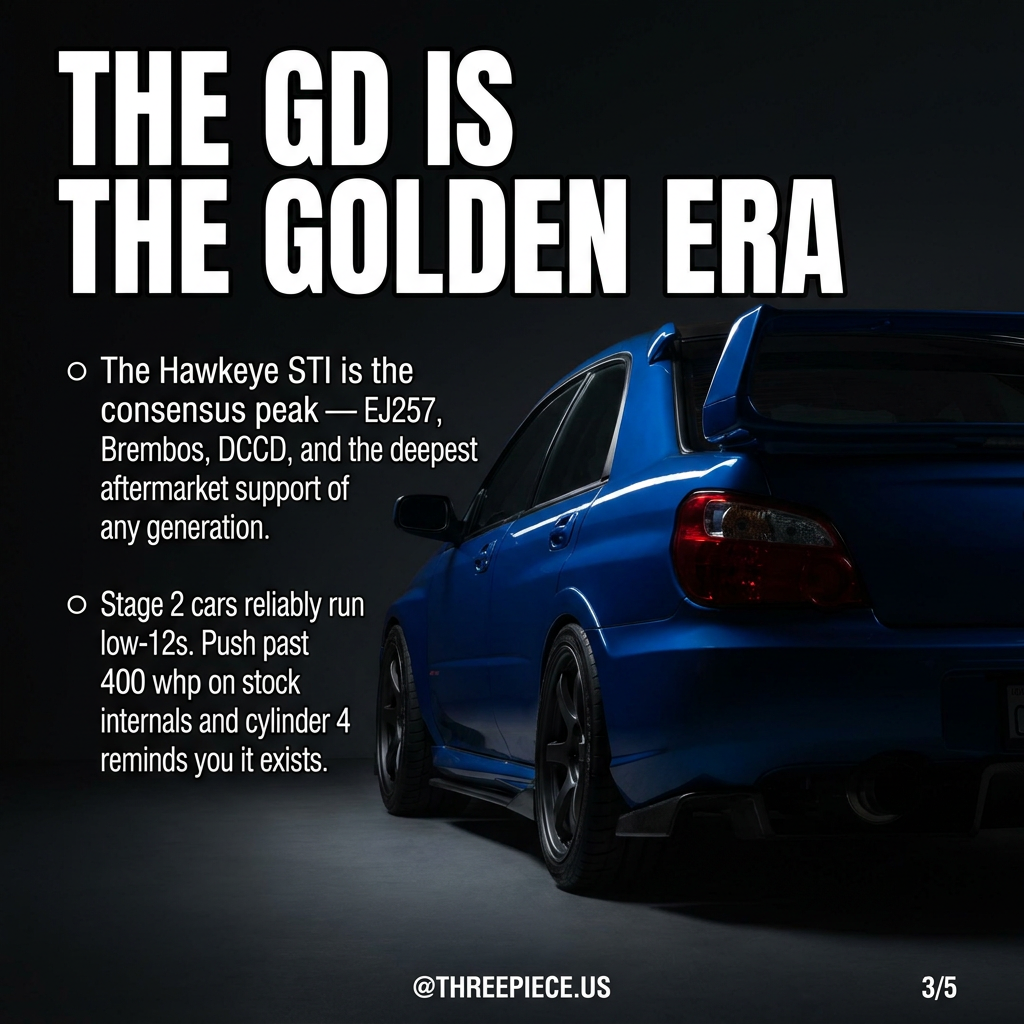
The GD is the consensus peak and it's genuinely not close. The US got the real STI in 2004: EJ257, a claimed 305 hp and 290 lb-ft, 4-piston Brembo fronts, a proper 6-speed, and driver-adjustable DCCD. Three faces across the run — Bugeye (2002-03), Blobeye (2004-05), Hawkeye (2006-07) — and the year-to-year changes matter more than people admit.
2005 is the pivot year: the STI moved to a 5x114.3 hub, gained slightly wider wheels, and picked up aluminum control arms and lateral links. 2006 shifted the AWD torque split from 35:65 to 41:59. 2007 got taller 2nd-4th ratios plus wastegate and ECU revisions. Stock US GD STIs typically dyno 270-290 whp, and a clean Stage 2 car with a downpipe and a real tune runs low-12s all day. Push past roughly 400 whp on stock internals and cylinder 4's ringland will introduce itself.
The GD is also the generation with the deepest aftermarket support of any STI — which is why suspension is the first real mod, not the third. Fortune Auto 500 Series Coilovers for the 2004 STI (GDB) run $1,799, and the 2005-2007 GDB-E/F kit is $1,918.36 — rebuildable, revalvable, and a completely different car on a back road. Browse the full suspension catalog if you're comparing spring rates.
GR/GV: the widebody nobody wanted, then everybody did
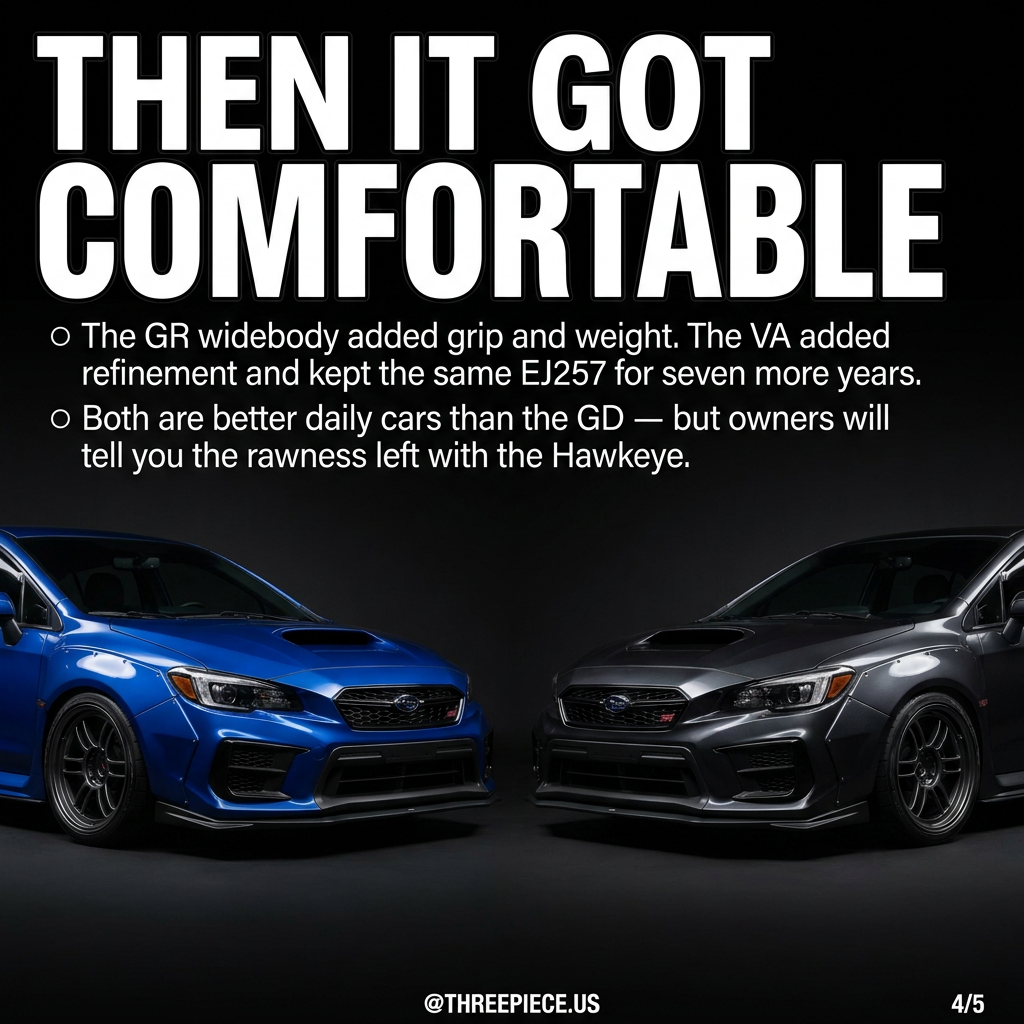
The 2008-2014 GR hatch was roasted on arrival for being softer, heavier, and hatchback-shaped. A decade later it's the sleeper pick, and clean hatches are commanding GD money. Wider track, stiffer shell, EJ257 carried over, and the last STI that still felt like it wanted an argument with you.
Two things to check before you buy: the same #4 ringland vulnerability under boost, and the GR hatch's known rear strut tower cracking and seam separation — repairs land between $800 and $3,500, so put a light on that area before money changes hands. If the chassis is solid, Fortune Auto 500 Series Coilovers for the 2008-2014 GRB at $1,799 fix the factory tune's biggest complaint — body motion — without wrecking the ride.
The GR is also the generation where wheel choice changes the car's entire read. Wide fenders + a conservative offset looks like a rental; wide fenders + a proper lip does not. Our vehicle gallery is the fastest way to calibrate.
VA: refined, quick, and quietly divisive
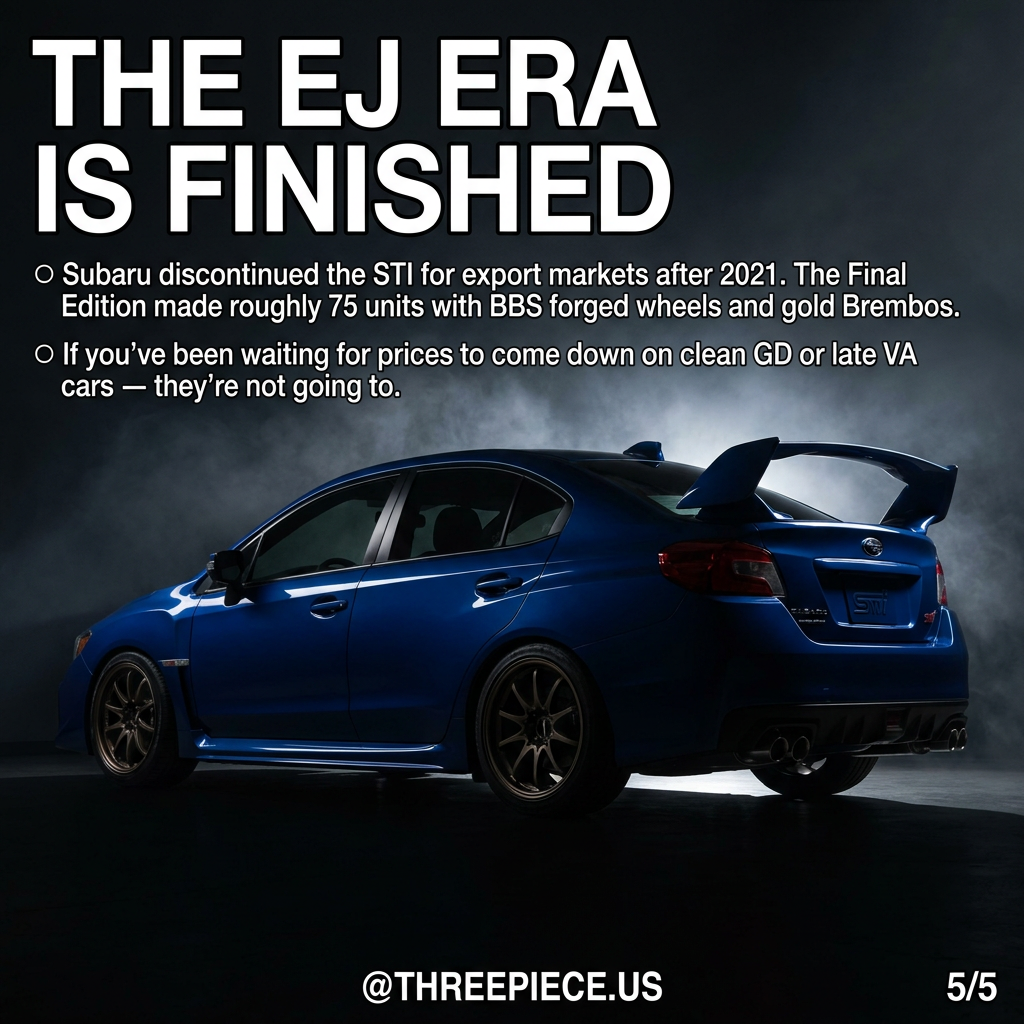
The 2015-2021 VA split from the Impreza platform and kept the EJ257 for seven more years while the WRX moved to the FA. Output stayed at roughly 305 hp / 290 lb-ft, and the 2018 refresh brought revised suspension tuning, upgraded Brembos, 19-inch wheels, and a fully electronic DCCD with no mechanical viscous center diff. The final EJ25 Final Edition — roughly 75 units globally with BBS forged gold wheels and silver calipers — closed the book.
Known issues are documented and expensive: spun rod bearings on EJ257 across 2004-2021 cars ($5,000-$12,000), ringland repairs ($3,000-$7,000), steering rack leaks ($900-$2,200), power steering line leaks ($250-$900), and oil starvation in sustained hard cornering. Early 2015-2016 cars collected the most complaints; later ones are meaningfully better if the service history is real.
For VA suspension, the Fortune Auto 500 Series for the 2015+ STI (VA2) is $2,163.13, and the non-STI VA1 WRX kit is $1,799. Cross-shopping brands? Read our 2015-2021 WRX coilover breakdown first. And if you're still deciding between platforms entirely, Golf R vs WRX STI makes the uncomfortable case for the other AWD hatch.
The ranking
1. GD (Hawkeye, 2006-07) — best steering feel, best AWD split, deepest parts support, lightest of the modern STIs.
2. GC8 / 22B — the most honest STI ever built, and the most punishing to own.
3. GR hatch (2008-2014) — the value pick that isn't a value pick anymore. Check the strut towers.
4. VA (2018-2021) — the best daily and the fastest point-to-point in stock form; the least emotional.
5. VA (2015-2016) — same promise, worse execution, most owner complaints.
Subaru ended STI export production after 2021 and the VB WRX moved to the FA24DIT with no export STI. Nothing is coming to reset these prices. If you've been waiting on clean GDs or late VAs to soften — they aren't going to. The generational-ranking exercise works the same way on other platforms; see our Civic Si generation ranking for the FWD version of this fight.
Bolt patterns, fitment, and what to buy
Know your hub before you shop. GC8 and 2002-2004 cars are 5x100; the STI moved to 5x114.3 in 2005 and stayed there through GR and VA. Hub bore is 56.1mm across the board, so hubcentric rings are mandatory on most aftermarket wheels.
Proven targets: 17x9 +38 with 255/40R17 on a GD for autocross and track duty, or 18x9.5 +38 with 265/35R18 for a street GR/VA that still clears Brembos. Start with Volk Racing 21A 5x114.3 18X9.5+0 Bronze or Volk Racing 21A 5x114.3 18X9.5+0 Bronze, then match rubber in 255/40R17 or 265/35R18. Deciding compound? Track vs street tires and how to read UTQG ratings both apply here.
For the wheel itself: the Work Emotion T7R at $432 is the sane track-and-street answer, while the Work Emotion CR 3P at $895.50 is where a Hawkeye build stops looking like a build and starts looking finished. Browse the full Work Emotion lineup or the wider Work Wheels catalog, and if you're going 3-piece, our Work Meister S1 3P review explains why the barrel spec matters more than the face. Running a set already? Refinishing and M7 assembly hardware from $10 keep them presentable through another Subaru winter.
Final verdict
The STI didn't get worse — it got approved. The GC8 was a rally receipt, the GD was engineers driving mountain roads at 2am, the GR was the last one that wanted to fight you, and the VA was a very good car built to satisfy a very different brief. The EJ era is finished, the values reflect it, and the only remaining decision is which chassis you want to spend money on.
If that's a Hawkeye: coilovers first, wheels second, and skip the 400 whp fantasy until the block is built. Start with a Fortune Auto 500 Series kit and a set of Volk Racing 21A 5x114.3 18X9.5+0 Bronze. Then tell us which generation you'd actually park in your garage — and whether the 22B still deserves to be the yardstick.