
Dodge Viper History: Every Generation Ranked for 2026
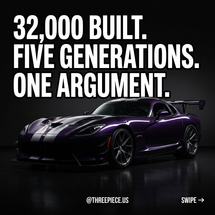
The Dodge Viper ran for 25 years, spanned five generations, and Dodge only built about 32,000 of them. Every single one came with a V10 displacing at least 8.0 liters, a manual transmission, and a near-total disregard for driver comfort. The Viper history argument isn't whether the car matters — it's which generation nailed the formula. We're ranking all five, from the doorhandle-less original to the ACR that embarrassed exotics at the Nürburgring, and breaking down the real ownership trade-offs the spec sheets never mention.
Quick links
- How the Viper happened
- Every generation at a glance
- Gen I (1992–1995): The concept car they sold to the public
- Gen II (1996–2002): The golden era nobody argues against
- Gens III & IV (2003–2010): The overlooked middle children
- Gen V (2013–2017): The best Viper — or the least Viper?
- Every generation's catch
- Viper wheel fitment & tire sizing
- The final ranking
How the Viper happened
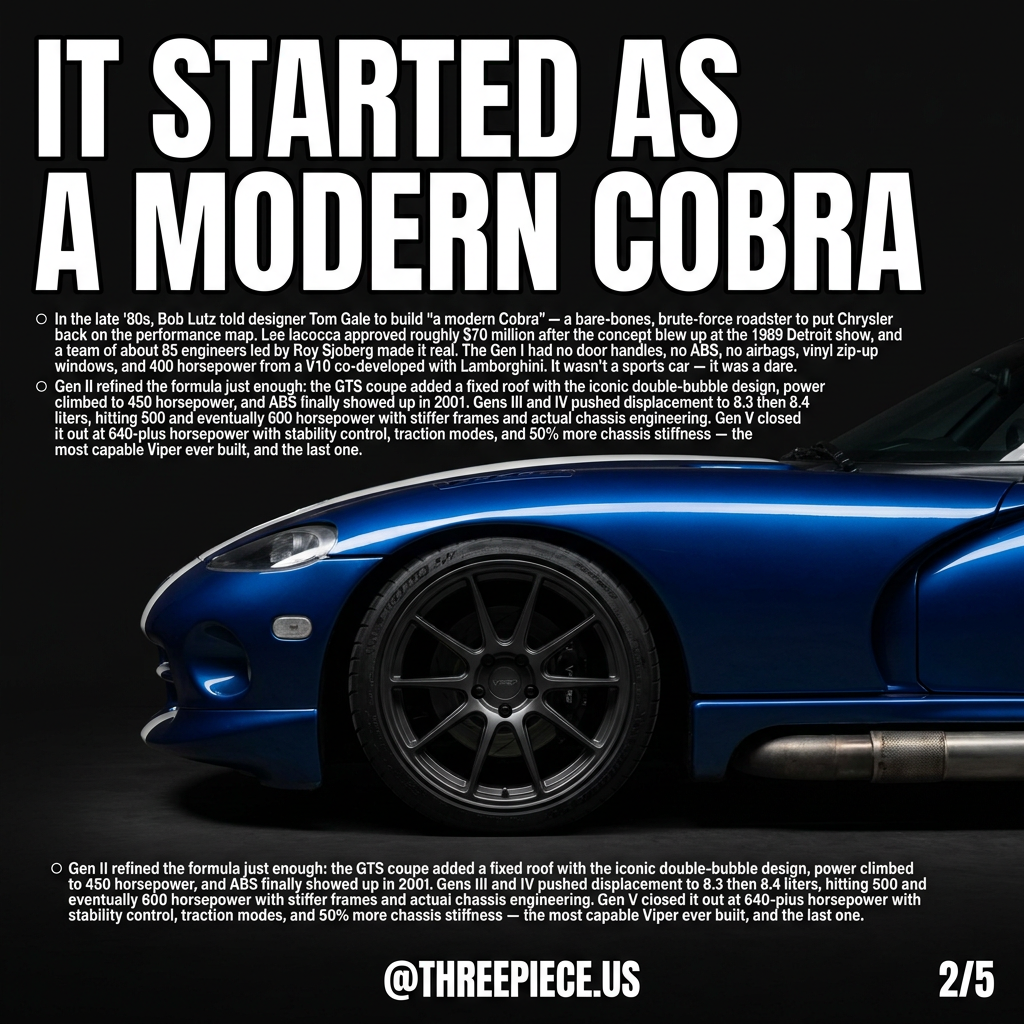
In the late 1980s, Bob Lutz told designer Tom Gale to build "a modern Cobra" — a bare-bones, brute-force roadster that would put Chrysler back on the performance map. Lee Iacocca approved roughly $70 million after the concept exploded at the 1989 Detroit Auto Show, and a team of about 85 engineers led by Roy Sjoberg turned it into a production car. The engine was a pushrod V10 co-developed with Lamborghini, and the car shipped with no door handles, no ABS, no airbags, and vinyl zip-up windows. It wasn't a sports car — it was a dare. If you appreciate that kind of reckless ambition from an American manufacturer, our Dodge Challenger SRT 392 buying guide covers the modern descendant of that same philosophy.
Every generation at a glance
Before we rank them, here's the spec progression that matters:
- Gen I SR-I (1992–1995): 8.0L V10, 400 hp / 465 lb-ft, ~3,350 lbs, RT/10 roadster only
- Gen II SR-II (1996–2002): Updated 8.0L V10, 450 hp / 490 lb-ft, GTS coupe with double-bubble roof, ABS from 2001
- Gen III ZB-I (2003–2006): 8.3L V10, 500 hp / 525 lb-ft, SRT-10 badge, stiffer frame, roadster + coupe
- Gen IV ZB-II (2008–2010): 8.4L V10, 600 hp / 560 lb-ft, variable valve timing on exhaust, reduced cabin heat
- Gen V VX-I (2013–2017): Refined 8.4L V10, 640–645 hp / 600 lb-ft, 50% more chassis stiffness, stability control, ACR variant
Production ended in 2017. That's it — 25 years, five generations, and a car that never once tried to be anything other than absurdly powerful and deliberately uncomfortable. For context on how other iconic nameplates evolved over similar timelines, check out our Ford Mustang history ranking — the Mustang took a very different path.
Gen I (1992–1995): The concept car they sold to the public
The Gen I Viper is not a car you daily. It's a car you survive. 400 horsepower through the rear wheels with no traction control, no ABS, and no electronic anything. The side-exit exhaust cooked paint off the door sills and melted rubber seals. The soft side curtains meant highway driving felt like riding in a tent strapped to a missile. Owners on VCA forums describe it as the most visceral driving experience available from any American manufacturer, period — but they also describe it as the one they park more than they drive.
The V10 itself is a tank. The problem is the paper head gaskets that leak by 20,000–30,000 miles. If the previous owner skipped the MLS (multi-layer steel) gasket upgrade, budget $3,000–$6,000 for an engine-out rebuild. Cylinder liner movement is a rarer but documented issue once heads come off. Modding is simple — headers, exhaust, ignition upgrades, and the gasket swap — because the engine management is primitive and the wiring harness is minimal. That simplicity is the Gen I's secret weapon for long-term ownership.
Gen II (1996–2002): The golden era nobody argues against
Here's where it gets interesting. The Gen V wins every objective performance metric, but the enthusiast community nearly always calls the Gen II SR-II the golden era. The 1999–2002 GTS and ACR variants had the lowest weight relative to their output, zero electronic nannies, direct race heritage from the GTS-R program that dominated Le Mans, and a driving experience that long-term owners describe as the definitive analog Viper.
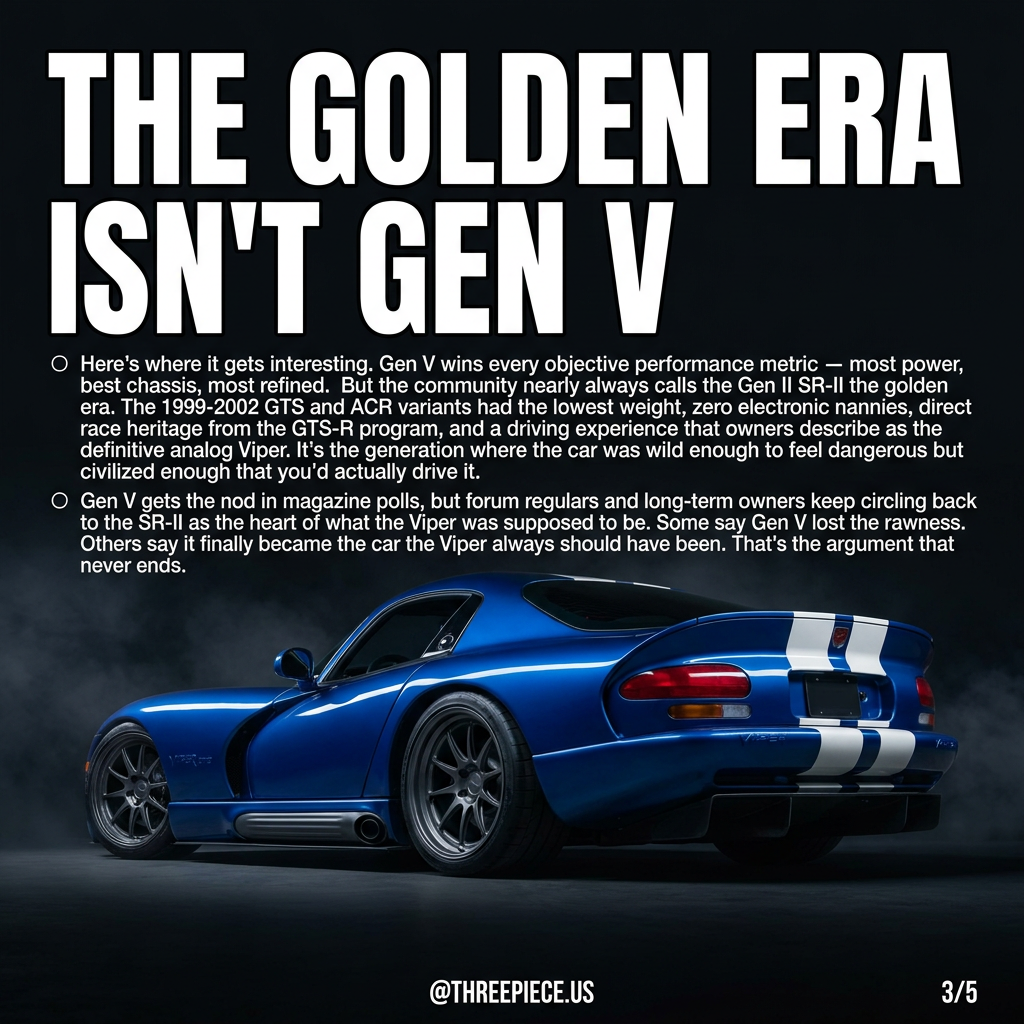
The GTS coupe introduced the iconic double-bubble roof — originally designed to clear helmets — along with rear-exit exhaust and a fixed roof that dramatically improved chassis rigidity. Power climbed to 450 hp / 490+ lb-ft. ABS arrived in 2001, which some purists consider the beginning of the end and others consider the bare minimum for a car with this much torque.
The catch: differential wear under hard launches is well-documented. The OEM diff can't always handle 490 lb-ft through aggressive street launches, and owners frequently upgrade to a Quaife or aftermarket LSD. First and reverse gear synchros wear under abuse — there are deep forum threads on this across Dodge Forum and VCA. But the V10 itself remains bulletproof if you keep it cool and change fluids on schedule. If you're comparing analog-era sports cars in this price bracket, our best V8 under $20K roundup covers some alternatives, though nothing in that bracket matches the Viper's sheer drama.
Gens III & IV (2003–2010): The overlooked middle children
The Gen III SRT-10 bumped displacement to 8.3 liters, redesigned the heads, lightened the internals, and delivered 500 hp / 525 lb-ft through a substantially stiffer frame with revised suspension geometry. On paper, it's the biggest single-generation leap in Viper history. In practice, it sits in an awkward middle ground: more refined than the Gen II but without the analog purity that makes the SR-II special, and less capable than the Gen V that would follow.
The Gen IV pushed further — 8.4 liters, 600 hp / 560 lb-ft — with cam-in-cam variable valve timing on the exhaust lobes, dual throttle bodies, and a revised engine management system (Venom ECU). The side exhaust crossover was eliminated, which finally addressed the cabin heat problem that plagued every previous generation. But 2008 models carried coil and valve programming failures that left some cars with unfixable power loss — a known issue on VCA forums that makes early Gen IVs a riskier buy.
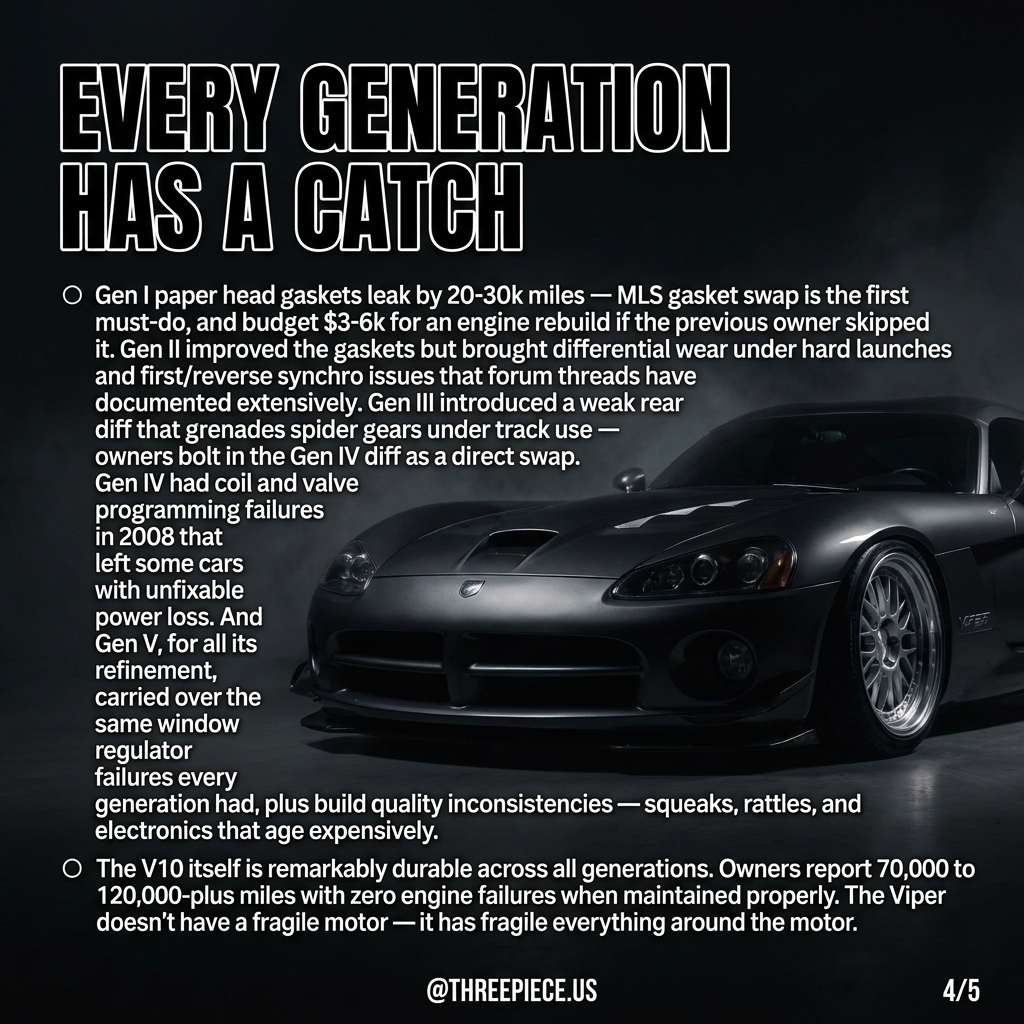
The Gen III's biggest documented weakness is the rear differential. Spider gears grenade under track use, and the fix is well-established: bolt in the Gen IV diff as a direct swap, which costs a few thousand dollars. Oil cooler and power steering hose leaks are common on aging Gen IIIs, and window regulator failures — a problem that spans every single Viper generation — will cost $400–$500 per side. Owners on VCA report 70,000–120,000+ miles with zero engine failures when properly maintained, which tells you everything about the V10's durability versus everything bolted around it. For a similar deep-dive on a platform that also gets overlooked in its middle years, read our Infiniti G Series history ranking.
Gen V (2013–2017): The best Viper — or the least Viper?
The Gen V is objectively the most complete Viper ever built. 640–645 hp / 600 lb-ft from the refined 8.4L V10, 50% more chassis stiffness than the Gen IV, stability control with multiple traction modes, and the ACR variant that set production-car lap records at tracks across the country. It's the generation that finally made the Viper a genuine track weapon rather than just a straight-line monster with a reputation for punishing bad inputs.
But forum regulars and long-term owners keep circling back to a persistent criticism: the Gen V lost the rawness. The stability control, the refined chassis, the improved NVH — all of it made the car faster and safer, but some argue it diluted the experience that defined the Viper in the first place. It's the same tension you see in every performance car lineage: the latest version is always the "best" by the numbers, but the version the community romanticizes is rarely the newest one. Our Miata history ranking explores the exact same dynamic — the NA is slower than everything that followed, and it's still the one people can't stop talking about.
The Gen V also carried over the window regulator failures that plagued every generation, plus build quality inconsistencies — squeaks, rattles, and electronics that age expensively. For a car that cost $87,000–$120,000+ new, that's harder to forgive than it is on a $60,000 Gen II.
Every generation's catch
No Viper generation is maintenance-free. Here's the quick-reference failure map:
- Gen I: Paper head gaskets leak by 20–30k miles. MLS gasket swap is the first must-do. Budget $3,000–$6,000 for engine-out work if skipped.
- Gen II: Differential wear under hard launches. Synchro wear on first/reverse. Gaskets improved but not eliminated.
- Gen III: Rear diff spider gears grenade under track use. Oil cooler and PS hose leaks. Window regulators ($400–$500/side).
- Gen IV: 2008 coil and valve programming failures. Otherwise the most mechanically sorted of the older gens.
- Gen V: Window regulators (still). Build quality inconsistencies. Electronics that age expensively.
The V10 itself is remarkably durable across all five generations. Owners consistently report 70,000–120,000+ miles with zero engine failures when maintained properly. The Viper doesn't have a fragile motor — it has fragile everything around the motor. If you want to understand how brake pad choice affects a car like this under track abuse, our semi-metallic brake pad breakdown is worth reading before your first HPDE event.
Viper wheel fitment & tire sizing
The Viper runs a staggered setup across every generation, and the bolt pattern is 5x115 — a pattern shared with almost nothing else in the performance world. That limits aftermarket options significantly, which is why 3-piece wheels are the go-to for Viper owners who want something beyond the OEM offerings. A 3-piece wheel lets you spec the exact width and offset you need without being locked into the handful of one-piece options available in 5x115. For a deeper understanding of how staggered sizing works, read our hub-centric vs. lug-centric wheel guide — proper centering matters even more on a car with this much torque.
Typical sizing across generations:
- Gen I–II: 17x10 front / 17x13 rear on OEM. Aftermarket owners commonly run 18x10 / 18x12 or 18x11 / 18x13.
- Gen III–IV: 18x10 front / 19x13 rear on OEM SRT-10. Aftermarket pushes to 19x10 / 19x12 or wider.
- Gen V: 18x10 front / 19x13 rear on base; ACR ran 19x12 front / 19x14 rear with massive Kumho Ecsta V720 rubber.
Browse 18-inch wheels in 5x115 or 19-inch wheels in 5x115 to see what's currently available. For tire pairing, 275/35R18 fronts and 345/30R19 rears are common Gen III–IV setups. If you're running a 3-piece setup and need replacement lips or barrels, American Wheel Lips – Step at $399 and American Wheel Barrels – Step at $399 cover most American-made 3-piece wheel rebuilds. For custom-spec builds, Custom Wheel Lips – Step starting at $399 let you dial in the exact depth you need for a proper staggered Viper fitment.
Don't forget the small stuff: 90-degree valve stems at $3.80 are practically mandatory behind the deep-dish rears on a Viper, and silicone sealant at $10.99 is essential for any 3-piece wheel assembly. Check the ThreePiece vehicle gallery for real-world examples of how owners are fitting aftermarket wheels on these platforms.
The final ranking
Here's where we land after weighing performance, ownership experience, community sentiment, and long-term value:
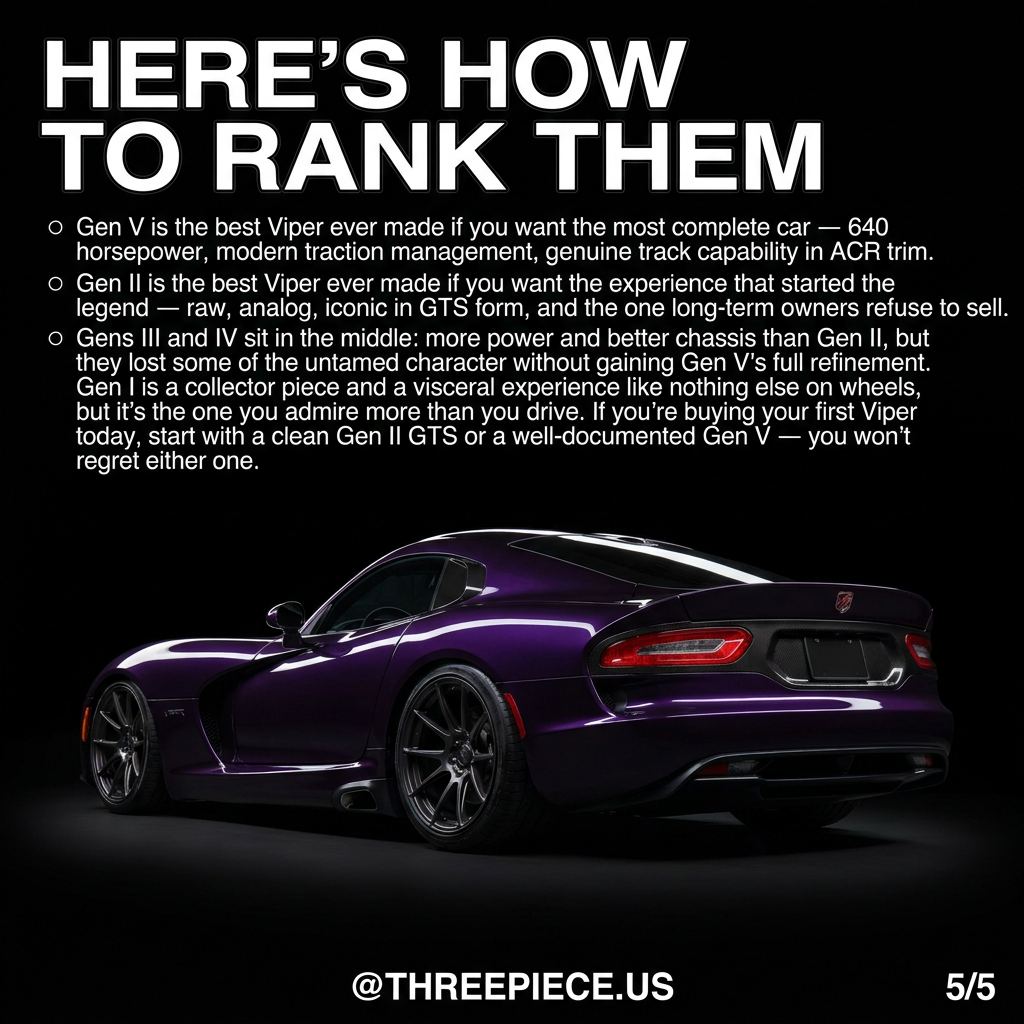
- Gen II GTS (1996–2002) — The heart of the Viper. Raw, analog, race-bred, and the generation long-term owners refuse to sell. The GTS-R heritage, the double-bubble roof, and the complete absence of electronic intervention make this the Viper at its most honest. Values reflect it — clean GTS examples are climbing steadily.
- Gen V ACR (2013–2017) — The most capable Viper ever built, and the ACR is a genuine supercar competitor. If you want lap times and modern capability, nothing else in the lineup comes close. But it traded some of the rawness that defined the car.
- Gen IV (2008–2010) — 600 hp, improved electronics, reduced cabin heat, and the last truly unhinged Viper. Avoid early 2008 models with the coil/valve issues and you get the best balance of power and analog character.
- Gen III (2003–2006) — The biggest single-generation performance leap, but it sits in no-man's-land: not raw enough to be iconic, not refined enough to be modern. The diff weakness is a real ownership cost. Undervalued right now, which makes it the smart money play.
- Gen I (1992–1995) — A collector piece and a visceral experience like nothing else on wheels. But it's the one you admire more than you drive. Head gasket issues and the complete lack of creature comforts make it a weekend-only proposition at best.
If you're buying your first Viper today, start with a clean Gen II GTS or a well-documented Gen V — you won't regret either one. And when you're ready to give it the wheels it deserves, browse the full wheel catalog at ThreePiece.us or explore wheel parts and accessories for your 3-piece rebuild. For more generation-by-generation breakdowns on iconic platforms, check out our Lexus IS history ranking and best V8 under $15K guide.