

Dodge Challenger SRT 392 Buying Guide: Why 2026 Is the Year
The Dodge Challenger SRT 392 is the last naturally aspirated, 485-horsepower, rear-drive American muscle car you'll ever be able to buy new. Production is finished. Dodge has moved on to electric. And clean 2015–2018 examples with documented service history are already getting harder to find in the low-to-mid $30–40K range. If you've been circling one, 2026 is the window — prices have flattened, the problem areas are well-documented, and the aftermarket is deeper than it's ever been. Here's everything you need to know before you sign.

Quick links
- Why the 392 and not the Hellcat
- What you're actually getting for the money
- Known failure points: what breaks and when
- Transmission: ZF 8-speed vs Tremec 6-speed
- Mod and tuning ecosystem
- Wheel fitment and tire sizing
- Pre-purchase checklist
- Final verdict: go find a clean one
Why the 392 and Not the Hellcat
The Hellcat gets all the attention, but the SRT 392 is the smarter buy in 2026 — and it's not even close. Clean Hellcats are commanding $50–65K+ depending on mileage and spec, and they carry significantly higher insurance premiums, tire costs, and supercharger maintenance overhead. The 392 delivers 485 hp and 475 lb-ft of torque from a naturally aspirated 6.4L Hemi that runs 12.6-second quarter miles bone stock. That's Hellcat-adjacent performance at a fraction of the ownership cost. If you want to understand the common issues on the supercharged side, read our breakdown of Dodge Charger Hellcat problems — many of the same platform concerns apply, plus the blower adds complexity.
Depreciation on well-kept SRT 392s has already flattened. The 2015–2018 models sit in a sweet spot: they carry the full SRT equipment package, they're easier to tune than later Stellantis-era cars, and they're priced $10–20K below comparable Hellcats. For context, if you're shopping V8s in this range, check our best V8 cars under $20K guide — the 392 is the next tier up and worth every dollar of the difference.
What You're Actually Getting for the Money
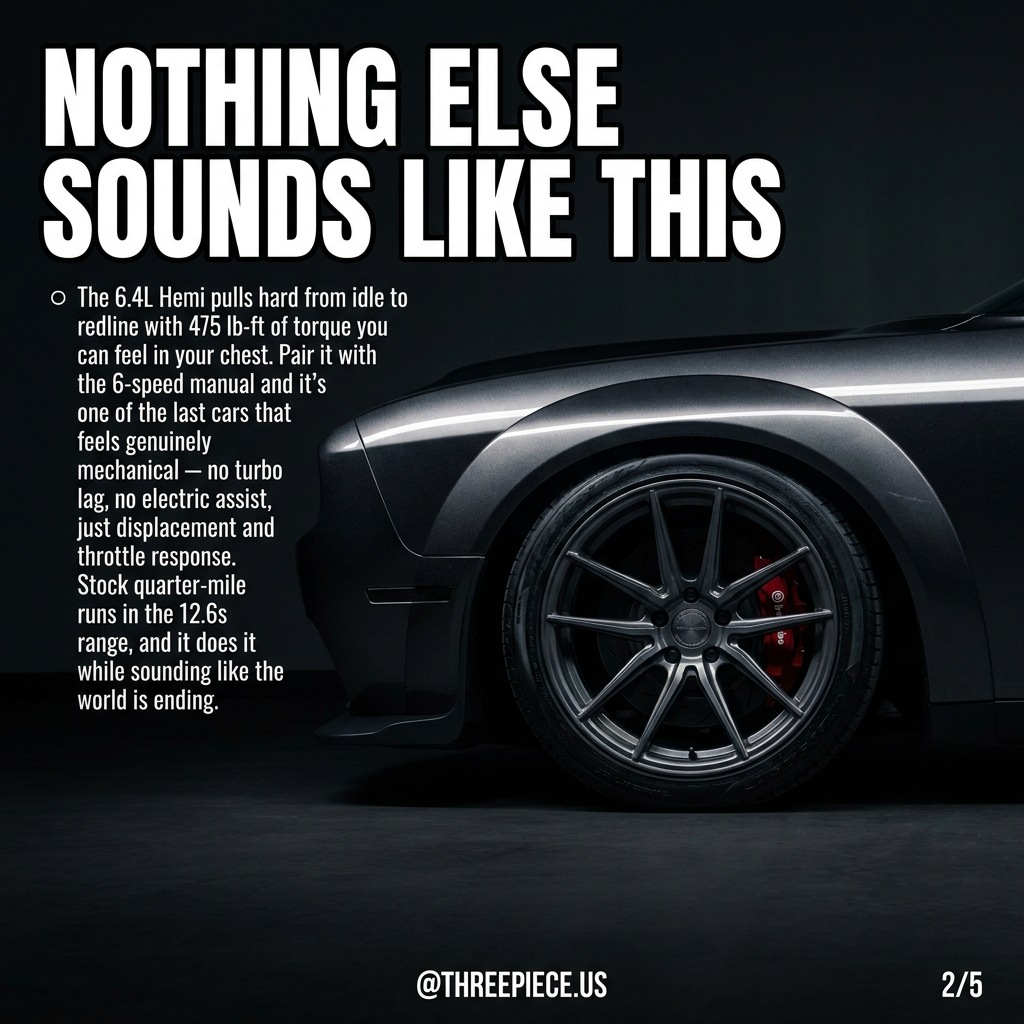
The SRT 392 isn't just a motor — it's a complete performance package from the factory. You get six-piston Brembo front calipers clamping 15.4-inch two-piece rotors, adaptive damping (on SRT models, not base Scat Packs), launch control, and line lock. The brakes alone are a $3,000+ upgrade on most platforms. If you're running big brakes like these, you'll want to understand pad compound choices — our guide on semi-metallic brake pad problems explains why most owners switch to ceramic or carbon-metallic compounds on the 392.
The 6.4L Hemi pulls hard from idle to redline with zero turbo lag, zero electric assist — just displacement and throttle response. Pair it with the Tremec T6060 6-speed manual and it's one of the last cars that feels genuinely mechanical. The ZF 8HP70 automatic is the more common choice and shifts faster than most drivers can, but the manual is the one collectors will want long-term. Either way, you're getting a proven drivetrain with deep parts availability.
Known Failure Points: What Breaks and When
The 6.4L Hemi is not bulletproof. It has specific, well-documented weak points that every buyer needs to understand before writing a check.
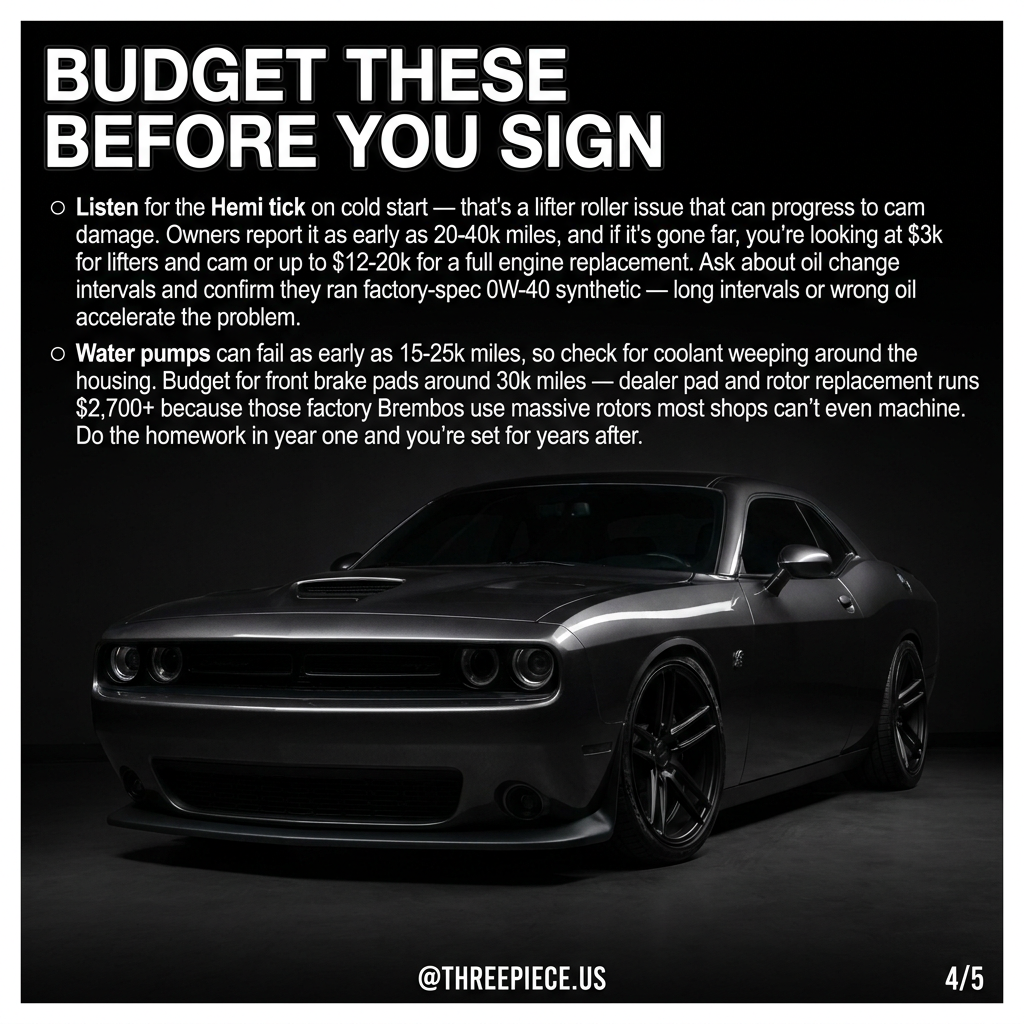
Lifter and cam failures ("Hemi Tick") — This is the big one. MDS (Multi-Displacement System) lifter rollers can seize or shed needle bearings as early as 20,000–40,000 miles. When a roller stops spinning, it scores the corresponding cam lobe. Left unchecked, this progresses to compression loss, misfires, and metal shavings in the oil. Replacing lifters and cam with heads intact runs approximately $3,000 in parts and labor. If the cam journals are gouged — which happens — you're looking at a full engine replacement: $12,000–$20,000 depending on the shop. One documented case: a 2016 SRT 392, stock auto, had lifter failure at just 21,000 miles and needed a complete engine swap under warranty.
Exhaust manifold studs snap from thermal cycling, causing exhaust leaks and a ticking noise that's often confused with the lifter tick. This is a moderate-cost repair but annoying if missed during inspection. Upgraded headers solve this permanently — the BBK Shorty Tuned Length Exhaust Headers at $535 are a direct bolt-on for the Hemi platform and eliminate the factory manifold stud problem entirely while adding flow.
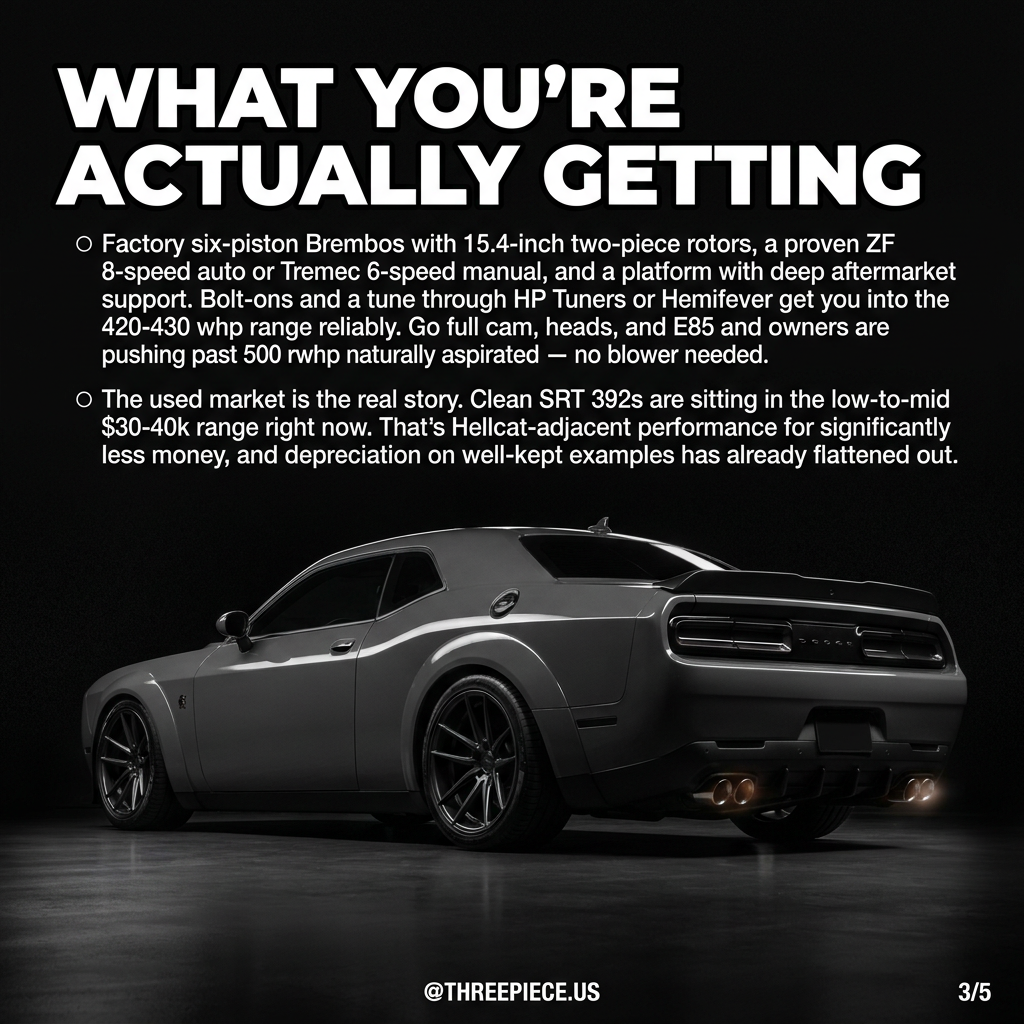
Water pump failures show up as early as 15,000–25,000 miles on some examples. Check for coolant weeping around the housing during any pre-purchase inspection. Intake manifold gasket leaks and valve train noise tied to MDS deactivation are also documented, with a 2024 TSB (bulletin 19-NA-219) specifically addressing worn roller/lobe issues on cylinders 1, 4, 6, and 7.
Transmission: ZF 8-Speed vs Tremec 6-Speed
The ZF 8HP70 automatic is the more common transmission in 392s. It's generally reliable but has documented issues with rough or delayed shifts between 3rd and 4th gear, especially when cold. Owners report P0733 "Gear 3 incorrect ratio" codes around 45,000 miles. Most cases resolve with a fluid and filter change plus TCM recalibration. More serious cases involve transmission overheating — "trans too hot" warnings with whining or grinding — typically caused by aggressive driving without adequate cooling. Budget for a fluid and filter service every 30,000 miles regardless of what the manual says.
The Tremec T6060 6-speed manual is rarer and more desirable, but it has its own risk: pilot bearing failure. When this goes, it can take the input shaft and crank with it. One documented 2015 6-speed owner faced approximately $20,000 in repairs at 67,000 miles for a combined engine and transmission job. Listen for vibrations, grinding when engaging first gear, or unusual noise from the bellhousing area. If the clutch has been replaced, ask whether the pilot bearing was done at the same time — if not, that's a red flag.
After any transmission replacement or major service, confirm the TCM adaptive learning was properly reset. Owners report persistent limp mode and harsh shifts when this step is skipped. This platform's drivetrain complexity is part of why simpler V8 platforms like the Pontiac G8 GT remain popular — but the 392 rewards the informed buyer with significantly more performance.
Mod and Tuning Ecosystem
The 392's tuning ecosystem is one of its strongest selling points. Because it's naturally aspirated, there's enormous headroom before you hit the limits of the stock bottom end.
Stage 1 (bolt-ons + tune): A cold air intake, long-tube headers, and a flash tune through HP Tuners or Hemifever gets you into the 420–430 whp range reliably. The tune also lets you disable MDS — which many owners do immediately to avoid the lifter failure risk entirely. The Corsa Apex DryFlow Metal Intake System for the 6.4L SRT at $406 is a direct-fit option that pairs well with a tune, or grab the Corsa Apex MaxFlow 5 Metal Intake at $392 for the oiled-filter variant. Both are designed specifically for the 2011–2017 Challenger SRT 6.4L.
Stage 2+ (cam, heads, E85): Go full cam and heads with E85 calibration and owners are pushing past 500 rwhp naturally aspirated — no blower needed. Upgraded non-MDS lifters (eliminating the failure-prone factory units), aftermarket camshafts, Manton pushrods, and cleaned/ported heads are the standard recipe. If you're curious about how air-fuel ratios change with E85 tuning, our AFR explainer covers the fundamentals. For owners considering forced induction down the line, our supercharger kits guide breaks down the real costs and gains.
An oil catch can is a smart early addition on the 392 — the Hemi's PCV system pushes oil vapor back into the intake, and on a car where lifter health depends on clean oil, reducing contamination is cheap insurance.
Wheel Fitment and Tire Sizing
The Challenger SRT 392 runs a 5x115 bolt pattern with a 71.5mm center bore. Factory wheel sizes are 20x9 +18 front and 20x9.5 +19 rear on standard-body cars, with the Widebody running 20x11 +2.5 all around. The Widebody's fender flares give you significantly more room to play with width and offset.
For aftermarket setups, a staggered 20x9.5 front / 20x10.5 rear configuration is the most popular among forum builds on standard-body cars. Widebody owners commonly run 20x10.5 front / 20x11 rear or even 20x11 square. If you're new to staggered setups, our Hellcat wheel setup guide covers the same platform and bolt pattern in detail. Browse 20-inch wheels in 5x115 to see what's currently available.
Tire sizing matters here — the 392 makes 475 lb-ft of torque and will shred inadequate rubber. Factory rear tires are 275/40R20, and most owners stepping up to wider wheels run 305/35R20 on the rear. Browse 275/40R20 tires for front replacements or 305/35R20 tires for wider rear setups. Budget approximately $1,200–$1,800 per set for quality performance rubber in these sizes.
If you're running 3-piece wheels on a Challenger, proper hub-centric fitment is critical on a car this heavy. Our guide on hub-centric vs lug-centric wheels explains why, and you can pick up hubcentric rings to ensure a vibration-free fit. For 3-piece wheel builds, M7 assembly bolts and M8 assembly bolts are available depending on your wheel spec.
Pre-Purchase Checklist
Print this out and bring it with you. These are the specific items that separate a clean 392 from someone else's problem.
- Cold-start listen: Start the car from cold and listen for a rhythmic ticking. If it's present and doesn't fully go away after warm-up, that's likely a lifter roller issue. Walk away or negotiate hard — cam damage may already be progressing.
- Oil records: Confirm the car ran factory-spec 0W-40 full synthetic with changes at 5,000–6,000 mile intervals. Long intervals or wrong oil viscosity accelerate lifter and cam wear. No records? Assume the worst.
- Transmission behavior: Drive the car cold. Pay attention to the 3→4 shift. Any delay, slip, or harshness is a red flag. Check for stored P0733 codes. Ask whether the transmission has been serviced or replaced — and if replaced, whether the TCM relearn was completed.
- Coolant system: Inspect the water pump housing for weeping or dried coolant residue. Check coolant level and condition. Water pump failures are documented as early as 15K miles.
- Exhaust manifold studs: Look for exhaust soot around the manifold-to-head junction. Snapped studs cause exhaust leaks that sound like a tick and can be misdiagnosed as a lifter issue.
- Manual transmission cars: Listen for vibration or crunch engaging first gear from a stop. Ask whether the pilot bearing has been replaced. If the clutch was done without the pilot bearing, budget for a redo.
- Brake pads: Factory Brembo pads wear out around 30,000 miles. Dealer pad and rotor replacement runs $2,700+ because those 15.4-inch rotors are too large for most shops to machine. Aftermarket pads save significantly.
Final Verdict: Go Find a Clean One
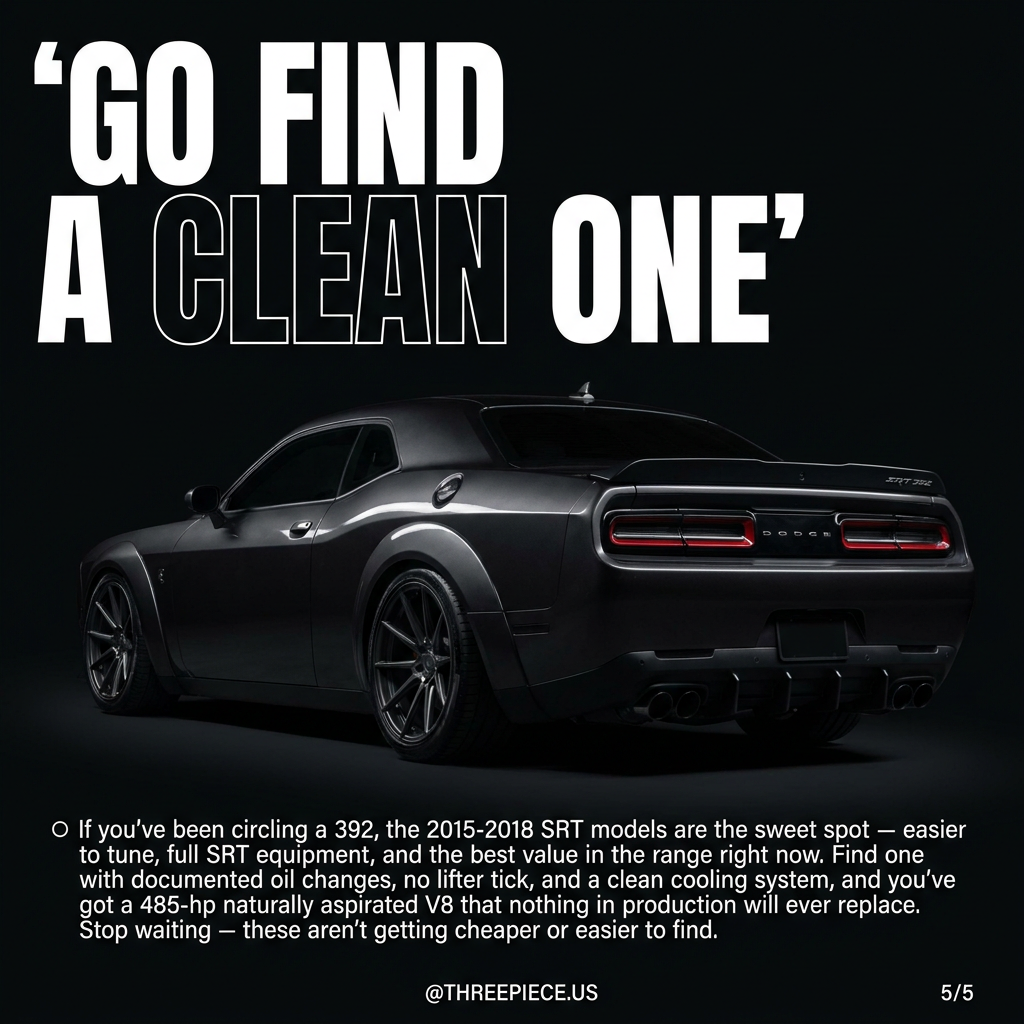
The 2015–2018 Dodge Challenger SRT 392 is the sweet spot in the range — full SRT equipment, easier to tune than later Stellantis-era PCMs, and the best value per horsepower on the used market right now. A clean example with documented oil changes, no lifter tick, and a healthy cooling system gives you a 485-hp naturally aspirated V8 that nothing in current production will ever replace. The problems are real but predictable — budget for lifter inspection, use the correct oil, and disable MDS early. Do the homework in year one and you're set for years after.
If you're building one out, start with wheels and intake. Browse new wheels for your setup, grab a Corsa Apex intake for the 6.4L, and check the vehicle gallery for build inspiration. These cars aren't getting cheaper or easier to find. Stop waiting.