
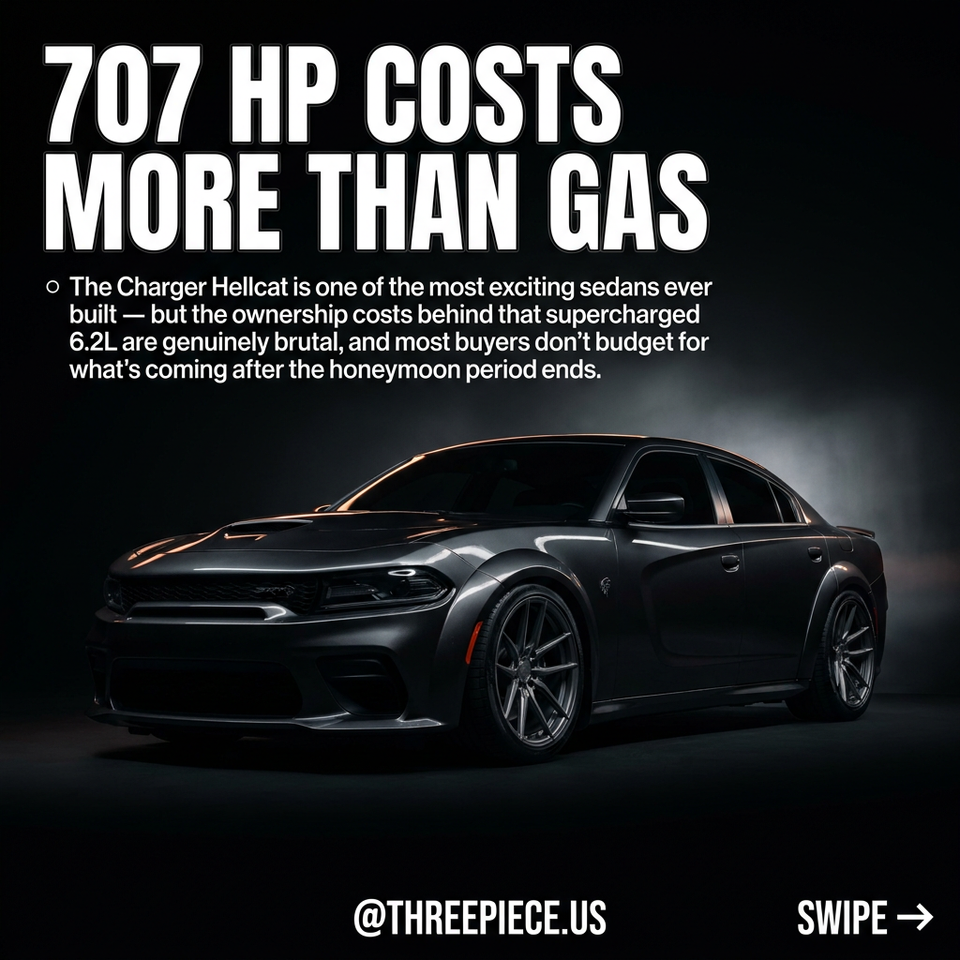
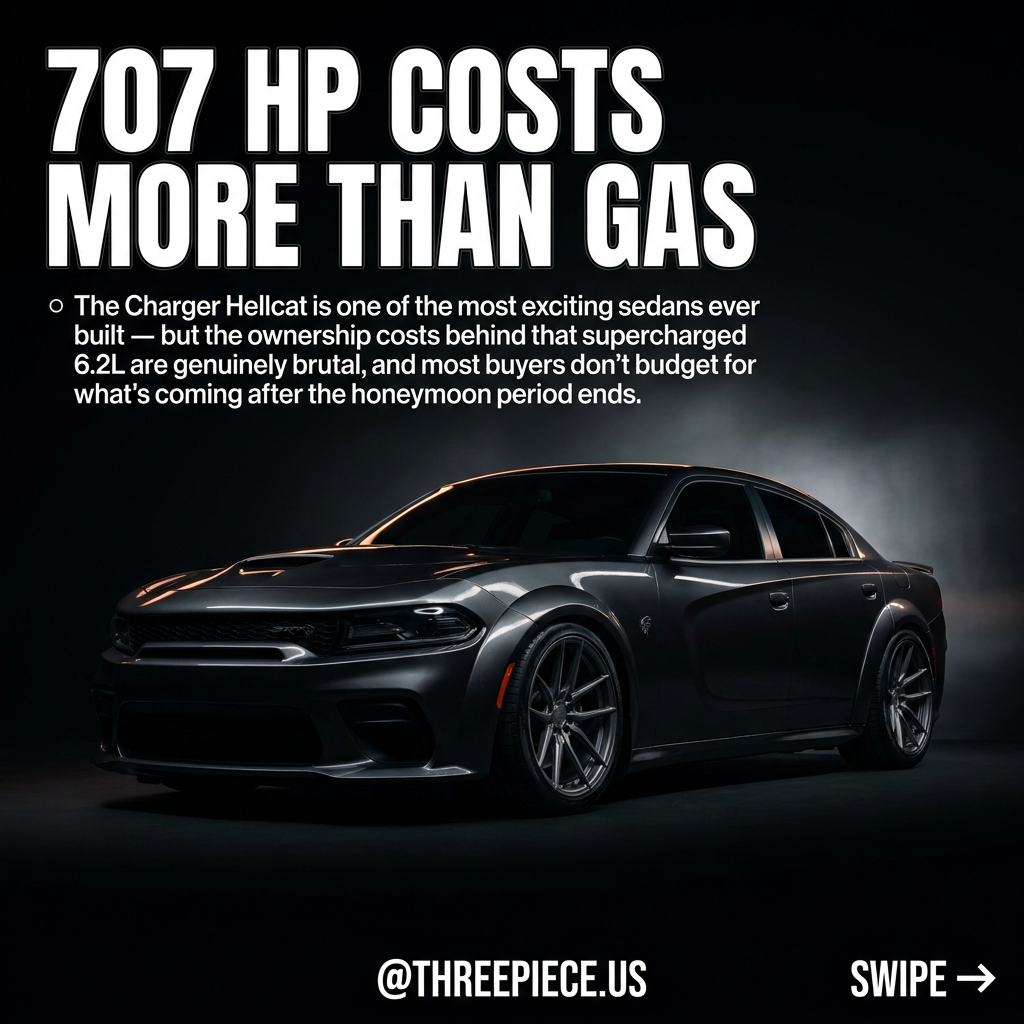
The Dodge Charger Hellcat is one of the most intoxicating sedans ever built — 707 horsepower, a supercharged 6.2L Hemi, and a factory exhaust note that rattles windows three blocks away. But behind the spec sheet is a reality that most buyers don't budget for. Supercharger bearing failures, $4,000 brake jobs, rear differential whine, and running costs that make German luxury cars look reasonable. Here are three documented, forum-backed reasons you should think twice before buying a Charger Hellcat — and who should still send it anyway.
Quick links
- The Supercharger Is a Ticking Clock
- Everything Wears Out Faster Than You Think
- Daily Driving Is a Financial Commitment
- Who Should Still Buy a Hellcat
- Hellcat Wheel Fitment and Upgrades
- Final Verdict
The Supercharger Is a Ticking Clock
This is the single most discussed mechanical failure across every Hellcat forum — and it's not a freak occurrence. Owners report supercharger bearing failures as early as 40,000–55,000 miles. The symptom is unmistakable: a metallic grinding sound at idle, described by multiple owners as "marbles in a can." On 2015–2016 model year cars, it's especially prevalent, but it shows up in later production runs too.
The root cause is well-documented. The snout bearing and rotor-shaft bearings in the IHI supercharger — particularly in early production units — were under-engineered. Loctite bolts can back out over time, allowing rotors to contact the case and wipe out the bearings. Dodge reportedly changed suppliers and updated part numbers after 2016, but that doesn't help the thousands of early cars on the used market right now. If you want to understand how forced induction costs scale across platforms, our supercharger kits cost and gains breakdown covers the broader picture.
The repair bill is where it gets painful. Rebuilding just the bearings or snout assembly runs $2,000–$3,000 at a performance shop. A full OEM supercharger assembly is $3,000–$5,000 used, or $8,000+ for newer or specialty units — plus labor. And here's the worst-case scenario that keeps Hellcat owners up at night: if the bearings seize and send metal shrapnel into the engine, you're staring at a potential rebuild north of $15,000. That's not a maintenance item. That's a catastrophic event on a car you bought because it was "affordable horsepower."

Everything Wears Out Faster Than You Think
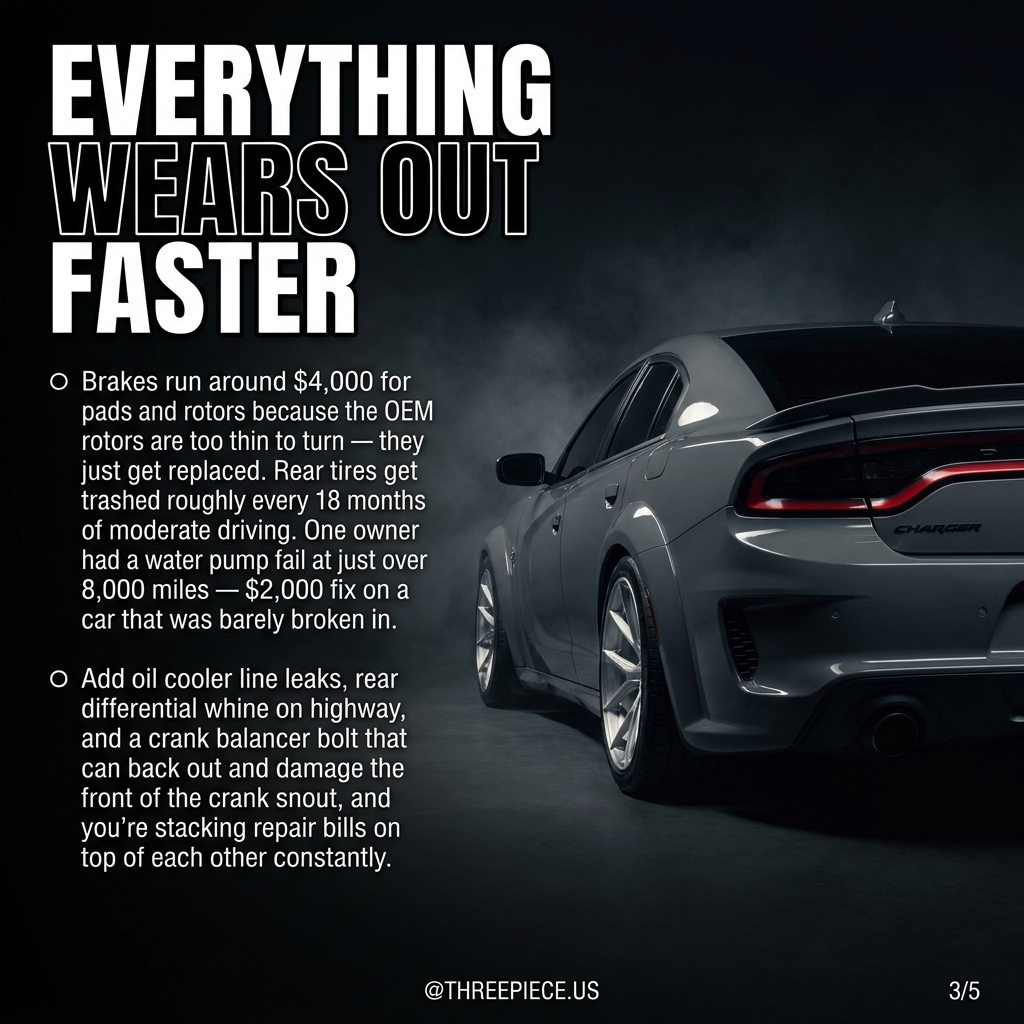
707 horsepower doesn't just accelerate the car — it accelerates the wear on every single component attached to it. Start with brakes: Hellcat owners on forums report brake jobs (pads and rotors) running approximately $4,000. The OEM rotors are too thin to turn on a lathe, so they just get replaced every time. That's not a performance upgrade cost — that's standard maintenance on a car with this much mass and power.
Rear tires get destroyed roughly every 18 months of moderate driving. You're running 275/40R20 rears from the factory, and the torque output combined with the car's 4,500+ pound curb weight means you're burning through rubber at an alarming rate. If you're running a Hellcat on 20s, browse 275/40R20 tires to see what's available for replacement — and budget accordingly.
Then there are the oil system issues. Hellcats built between February and May 2017 were subject to a recall for engine oil cooler lines that could separate. When that happens, oil sprays onto hot surfaces — creating a serious hazard. Outside the recall window, owners still report leaks from the plastic timing chain cover, oil filter housing, and oil cooler line connections. Upgrading to aluminum components often costs $400+ per housing. The Chase Bays 19 Row Oil Cooler at $205 is a solid aftermarket option for builds that need supplemental cooling capacity.
Add rear differential whine on highway (common on 2015–2017 cars, with replacement parts running $1,500–$3,000), a crank balancer bolt that can back out and damage the front of the crank snout, and one owner's report of a water pump failure at just 8,000 miles costing $2,000 — and you're stacking repair bills on top of each other constantly. For context on how other platforms handle similar issues, our N54 335i problems guide shows a comparable pattern of expensive forced-induction ownership.
Daily Driving Is a Financial Commitment
Let's talk about what daily driving a Hellcat actually looks like after the honeymoon period ends. You're burning premium fuel at single-digit city MPG when you're in it. Insurance premiums are significantly higher than a normal sedan — in many cases $200–$400/month more than a comparable V8 without the supercharged designation. And 4,500 pounds of rear-wheel-drive torque in rain or snow is, in one owner's words, "comically frustrating."
The interior doesn't help justify the running costs either. Owners report peeling trim pieces, headlight condensation, and loose wiring under the center console causing USB disconnects over bumps. For a car that stickered at $70,000+ new, the cabin quality doesn't match the price — it matches the $35,000 Charger R/T it shares a platform with. If you're cross-shopping V8 sedans and haven't considered the alternatives, our Pontiac G8 GT vs Charger R/T comparison is worth reading for perspective on what you actually need versus what you think you want.
There's also the depreciation angle. Because Dodge built so many Hellcats across multiple model years — plus Redeyes, Super Stocks, and Jailbreaks — the used market is saturated. Unless your car is low-mileage, well-documented, or a rare spec, expect values to continue sliding. That $40,000 used Hellcat might be a $28,000 car in three years after you've spent $15,000+ keeping it running.

Who Should Still Buy a Hellcat
None of this means the Hellcat is a bad car. It means it's a bad car for people who don't understand what they're signing up for. If you wrench yourself, keep detailed service records, and genuinely love the supercharged Hemi experience — nothing else sounds or feels like a Hellcat, and that's real. The 6.2L supercharged Hemi is a modern muscle legend, and the Charger body style gives you four doors and a usable trunk while making more power than a C6 Corvette Z06.
The right buyer has a $3,000–$5,000/year maintenance budget set aside, understands that tires and brakes are consumables on this platform, and ideally has a second vehicle for inclement weather. If you're building one properly, the Aeromotive 05-21 Charger/Challenger 450 Dual Drop-In Phantom Fuel System at $1,090 is a smart upgrade for anyone pushing beyond stock power levels — the factory fuel system is a known weak point once you start adding pulley swaps and tune. Pair it with the aFe MACH Force-XP Black Exhaust Tips for 15-19 Charger Hellcat at $359 for a cleaner look that actually fits the car. And check out our wildest Hellcat wheel setup guide if you want to see what a properly finished build looks like.
But if you're buying one as a reliable daily without a maintenance budget, look at a Scat Pack instead. You get 80% of the presence at a fraction of the ownership headache, and your wallet survives year two. The naturally aspirated 392 Hemi doesn't have supercharger bearings to worry about, doesn't eat tires as aggressively, and insurance is meaningfully cheaper.

Hellcat Wheel Fitment and Upgrades
If you do pull the trigger on a Hellcat, wheels and tires are going to be a recurring expense — so you might as well get the fitment right. The factory runs a staggered 20x9.5 front / 20x10.5 rear setup on 5x115 bolt pattern. That's a less common lug pattern, so your aftermarket options are narrower than 5x114.3 or 5x120 cars. Browse 20-inch wheels in 5x115 to see what's currently available.
Many owners step down to 18-inch wheels for track use or winter setups, which opens up tire options and reduces unsprung weight significantly. Check 18-inch wheels in 5x115 if you're considering a dedicated set. For anyone running a 3-piece setup, understanding what forged wheels actually are and why they matter is essential reading — especially on a car this heavy, where wheel strength and weight reduction have a measurable impact on brake and tire longevity.
Finish the build with proper hardware. Quality valve stems and hubcentric rings are small details that matter on a car making this much power. A 90 Degree Valve Stem at $3.80 each makes tire pressure checks painless on deep-dish setups. Visit our vehicle gallery to see real Hellcat builds with proper wheel fitment for inspiration.
Final Verdict: Know What You're Getting Into
The Dodge Charger Hellcat is a modern muscle legend — that part is undeniable. But "affordable" 707 horsepower is a myth. Between supercharger bearing failures that can cost $3,000–$15,000, brake jobs at $4,000, tires every 18 months, oil system leaks, rear differential issues, and insurance premiums that rival luxury cars, the true cost of ownership is dramatically higher than the sticker price suggests. If you're cross-shopping performance sedans and want to understand what other platforms offer, our coverage of the Nissan Z RZ34's problems and the underrated Acura TLX Type S offer interesting alternatives at different price points.
Go in with eyes open, a maintenance budget, and realistic expectations — and the Hellcat rewards you with an experience nothing else in the segment can match. Browse our full wheel catalog to find the right setup for your build, and check the wheel accessories page for everything you need to finish it properly.
Try wheels on your Dodge Charger: see the Dodge Charger bolt pattern, wheel sizes by year and wheel builds in our free wheel visualizer.