
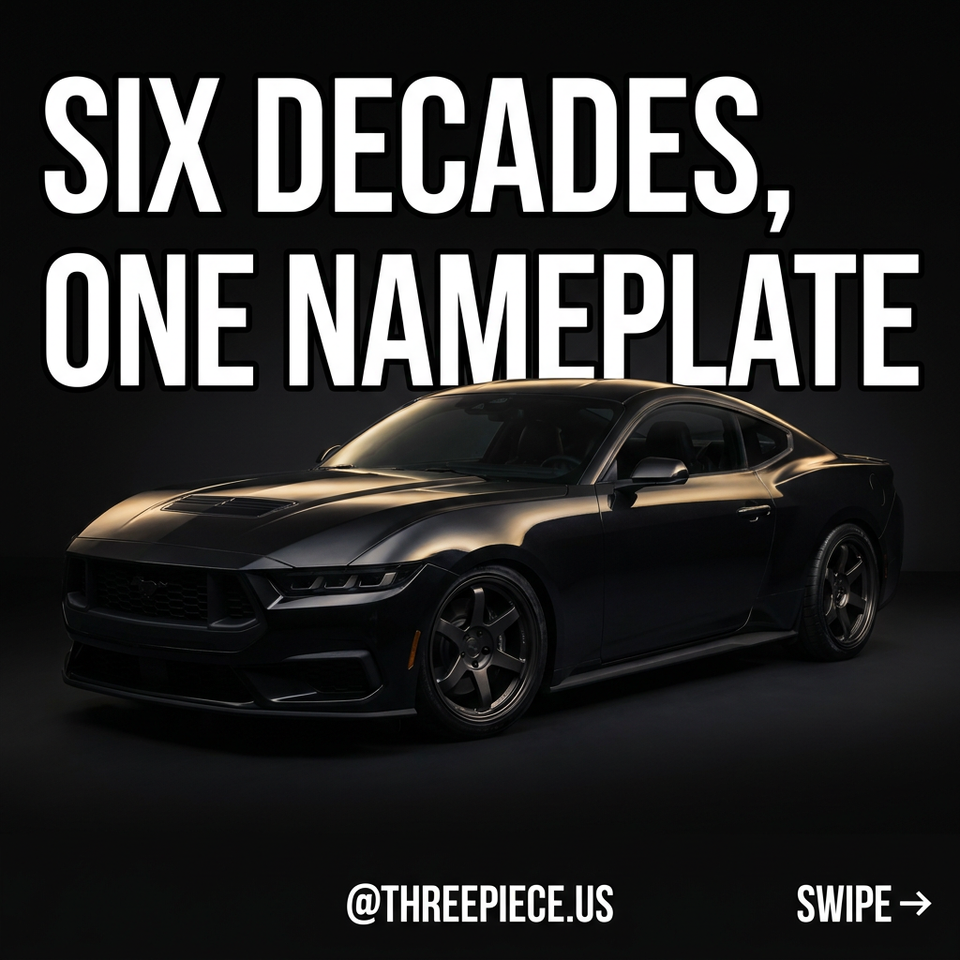
The Ford Mustang has been in continuous production since 1964, spanning seven generations and six decades. That kind of longevity breeds a lot of revisionist history — and a lot of bad takes. Not every Mustang is a classic. Some generations defined American performance, others nearly wrecked the nameplate entirely, and a few are quietly sitting at the best value they'll ever be. Here's every Mustang generation ranked by what actually matters to the people building and driving them.
Quick links
- The Two Real Peaks: 1969–1970 and 2011–2014
- The Fox Body Changed Everything
- Where It Gets Controversial: S550, SN-95, and the Mustang II
- The Mustang to Buy Right Now
- Mustang Wheel Fitment Across Generations
- Pick Your Era and Build
The Two Real Peaks: 1969–1970 and 2011–2014
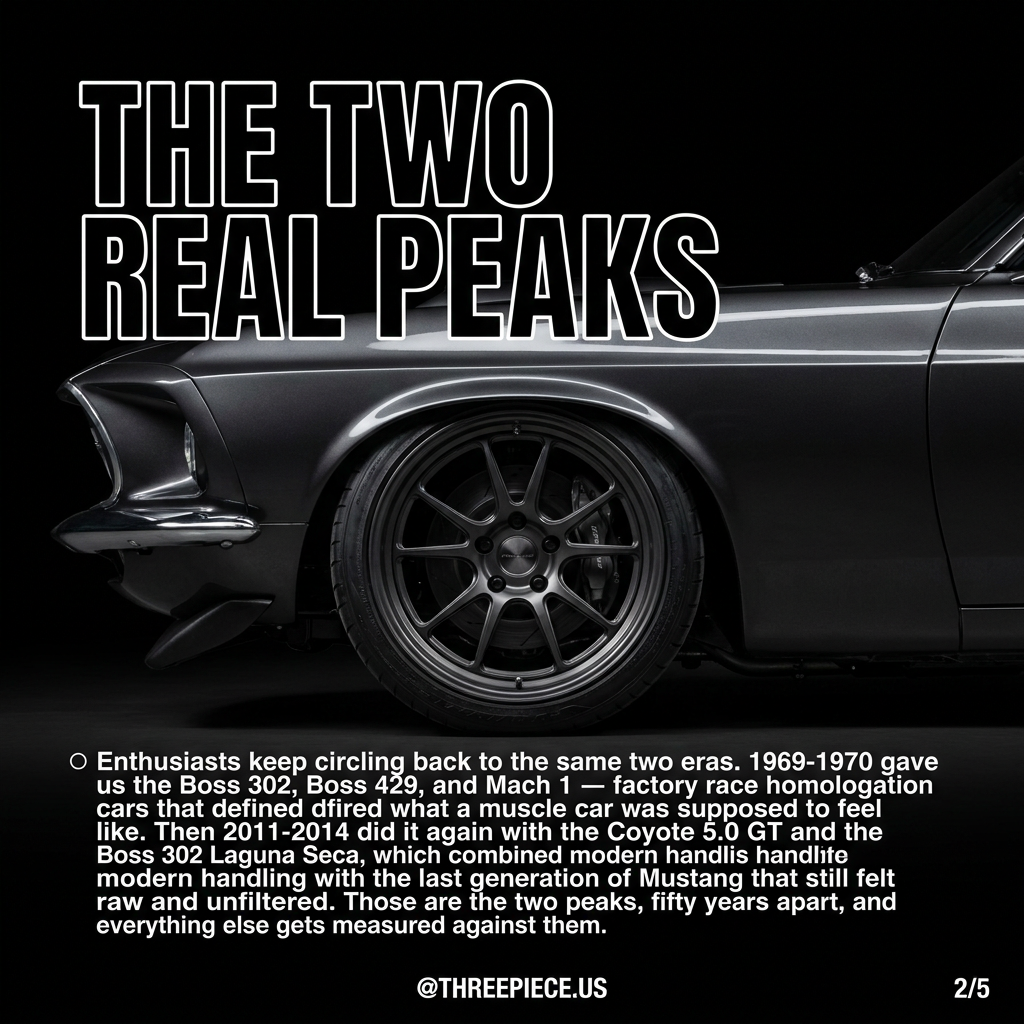
Enthusiasts keep circling back to the same two eras, separated by fifty years but connected by the same philosophy: build a factory car that feels like a race car. The 1969–1970 window gave us the Boss 302, Boss 429, and Mach 1 — factory homologation specials that defined what a muscle car was supposed to feel like. The Boss 302 used a high-revving 302ci Windsor with Cleveland heads, producing roughly 290 hp at the crank. The Boss 429 was even more extreme, a NASCAR homologation exercise that stuffed a semi-hemispherical combustion chamber big-block into a widened Mustang engine bay. These weren't just fast cars; they were purpose-built statements that Ford was serious about racing.
Then in 2011, Ford did it again. The 5.0L Coyote V8 arrived in the S197 GT, producing 412 hp stock — a massive leap from the previous 4.6L 3-valve. Two years later, the Boss 302 Laguna Seca combined that Coyote with a track-tuned suspension, a rear seat delete, and an intake manifold borrowed from the Boss 302R race car. It was raw, unfiltered, and the last generation of Mustang that felt like Ford was building for drivers who didn't need hand-holding. Those are the two peaks. Everything else gets measured against them. If you're curious how we ranked another iconic nameplate generation-by-generation, our Miata history ranking follows the same logic — peaks matter more than averages.
The Fox Body Changed Everything
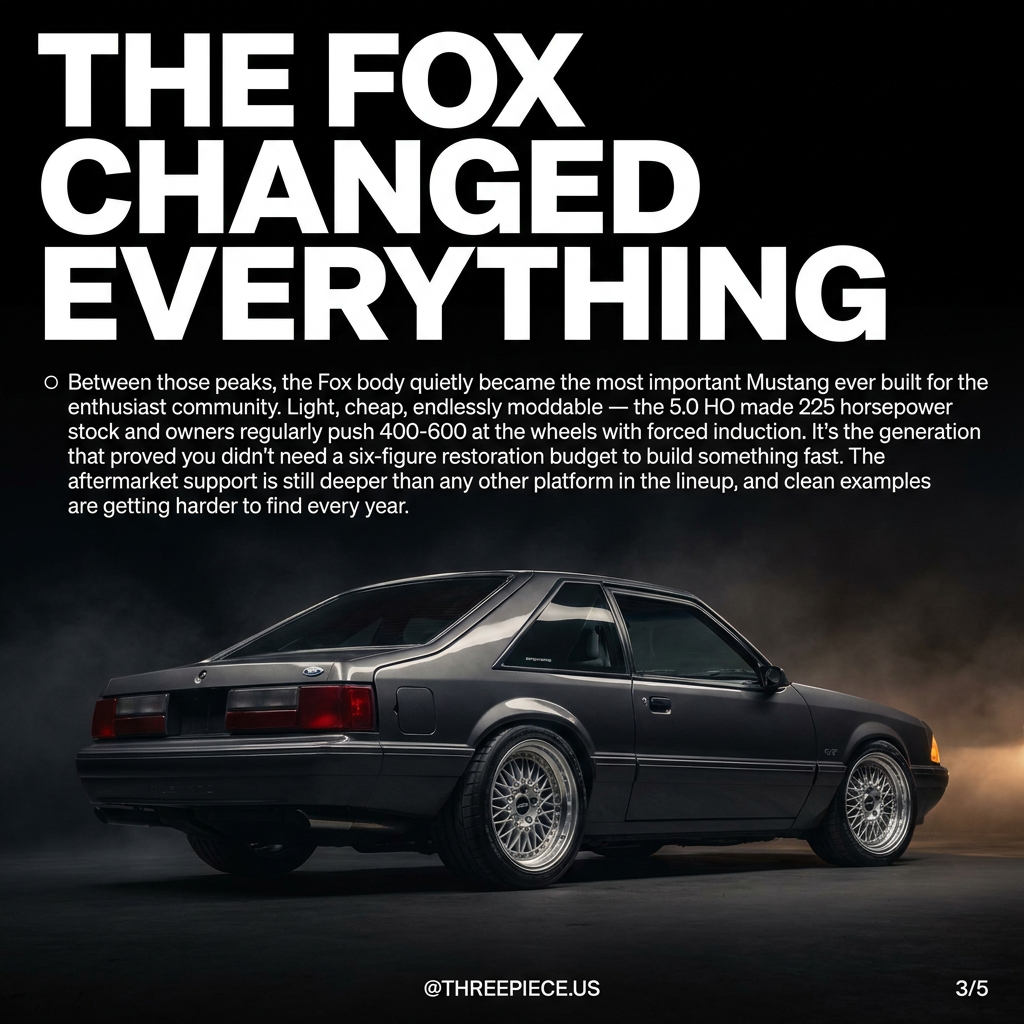
Between those two peaks, the Fox body Mustang (1979–1993) quietly became the most important platform Ford ever built for the enthusiast community. Laid on the Fox platform with a 100.5-inch wheelbase, it was lighter than anything before it and cheaper than anything after. The 5.0L HO V8 made 225 hp stock — modest by today's standards — but the real story is what owners do with it. Forced-induction Fox builds regularly push 400–600 whp on stock bottom ends, and the aftermarket support is still deeper than any other platform in the entire Mustang lineup.
The Fox body proved you didn't need a six-figure restoration budget to build something genuinely fast. A clean notchback with a turbo 5.0 and a properly sized supercharger or turbo kit will run high 10s in the quarter mile for under $15K in parts. The T-5 manual transmission is the known weak link — it starts giving up above 300 lb-ft, and most serious builders swap to a Tremec TKO or T56 before pushing power. Rear main seal leaks and cam bearing wear are common on high-mileage 302 blocks, but the parts are everywhere and the fixes are well-documented.
Clean Fox bodies are getting harder to find every year. Rust behind the wheel wells and along the undercarriage is the biggest concern on surviving examples, with restoration costs climbing to $4,000–$6,000 for bodywork alone on rough cars. If you're building one, the 5.0 and 351 Windsor are the most popular swap targets, with proper air-fuel ratio tuning being critical once you add forced induction. The Fox is the generation that'll teach you more about building cars than anything else in the Ford lineup.
Where It Gets Controversial: S550, SN-95, and the Mustang II
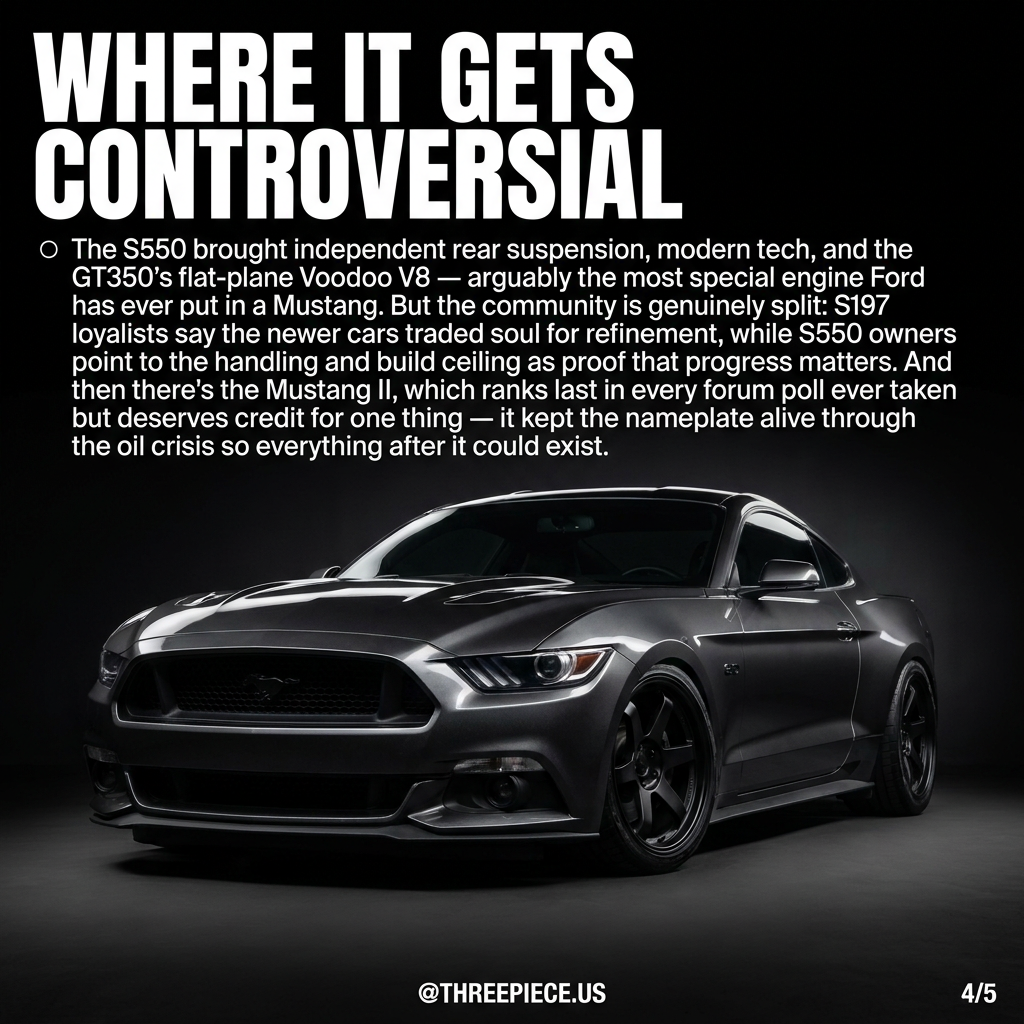
The S550 (2015–2023) brought independent rear suspension, modern chassis dynamics, and the GT350's flat-plane crank Voodoo V8 — arguably the most special engine Ford has ever put in a Mustang. The Voodoo revs to 8,250 RPM and makes 526 hp naturally aspirated, which is genuinely remarkable for a production Ford. But the community is split. S197 loyalists argue the newer cars traded soul for refinement. S550 owners counter with handling data and a build ceiling that's objectively higher. Both sides have a point, and neither is going to concede.
The SN-95/New Edge (1994–2004) sits in a weird middle ground. The switch from the pushrod 5.0 to the 4.6L Modular V8 felt like a step backward to many owners at the time — the 2-valve 4.6 was softer and less characterful than the 302 it replaced. The New Edge styling refresh in 1999 helped, and the Terminator Cobra with its supercharged 4.6L 4-valve making 390 hp became an instant legend. But the base GT models from this era are still the value sweet spot nobody talks about — you can find clean New Edge GTs for under $10K, and the 4.6 responds well to heads, cams, and intake work. The 3.8L V6 models are best avoided entirely: coolant neck failures and head gasket issues around 150,000–200,000 miles make them more trouble than they're worth.
And then there's the Mustang II (1974–1978). It ranks last in every forum poll ever taken, and the numbers back it up — a smaller, heavier-feeling car based on Pinto platform elements, with a V8 option that was hamstrung by inadequate braking and suspension. But it deserves credit for one thing: it kept the nameplate alive through the oil crisis so everything after it could exist. Some builders have turned Mustang IIs into legitimate performers by swapping Fox-body 5.0 V8s and upgrading the suspension, but parts availability is poor and the community support is thin. It's a niche play for contrarians.
The Mustang to Buy Right Now
If you want the heritage play, a clean first-gen fastback is untouchable — but you're paying $40,000–$80,000+ for anything presentable, and big-block cars are well into six figures. The Aeromotive 69-70 Ford Mustang 200 Stealth Gen 2 Fuel Tank at $816 from ThreePiece.us is the kind of part that makes a first-gen build viable for modern fuel systems — it solves the dual saddle tank issues that plague these cars and supports EFI conversions cleanly.
For the best balance of performance, mod support, and value right now, the late S197 Coyote GT (2011–2014) is the sweet spot. You're getting 412–420 hp from the factory, a well-documented tuning platform, and prices that still sit in the $18,000–$28,000 range for clean examples. The known weak points are manageable: fuel pump failures under boost load around 30,000–60,000 miles (upgrade to a Fore Innovations or Aeromotive unit early) and the notoriously clunky MT82 manual transmission, which most owners address with aftermarket short-throw shifters or a full Tremec swap. For suspension, the BMR Suspension 05-14 Ford Mustang Lower A-Arms at $679 are a direct bolt-on that transforms the front end geometry — a must if you're tracking the car or running aggressive wheel fitments.
If you're running an SN-95 with the 3.8L V6, the Airaid 99-01 Ford Mustang 3.8L PowerAid TB Spacer at $176 is one of the few bolt-ons that actually makes a measurable difference on that engine — it won't transform the car, but it addresses the restrictive factory throttle body that chokes airflow. For S197 owners looking at intake work, the Airaid 11-14 Ford Mustang GT Intake Tube at $217 is a clean, straightforward upgrade. Our complete Mustang GT wheel fitment guide covers every bolt pattern, offset, and tire size you need to know before buying wheels for any of these platforms.
Mustang Wheel Fitment Across Generations
Wheel fitment on Mustangs varies significantly across generations, and getting it wrong means rubbing, poor handling, or a stance that looks like an afterthought. Here's the quick breakdown of what works:
Fox Body (1979–1993): 4x10⁸ bolt pattern (often called 4x4.25). This is the oddball pattern that limits your options. 15x7 to 17x8 is the typical range, with +15 to +24 offset. Browse 17-inch wheels in 4x10⁸ to see what's available. Many builders convert to 5-lug (5x114.3) using SN-95 spindles and axles, which opens up the entire modern Mustang wheel catalog.
SN-95/New Edge (1994–2004): 5x114.3 bolt pattern. 17x8 to 18x9 is the sweet spot, with +24 to +35 offset depending on whether you're running spacers. Pair with 255/40R18 tires for a balanced setup on the GT.
S197 (2005–2014): 5x114.3, same as SN-95. Factory GT wheels are 18x8 or 19x8.5. The ideal aftermarket setup is 19x9.5 front / 19x10.5 rear with +22 to +30 offset. Check 19-inch wheels in 5x114.3 for options. The S197 interior also benefits from the 3D MAXpider 2005-2009 Ford Mustang Kagu Floor Mats at $141 — a small detail that keeps a build car's interior from looking trashed.
S550 (2015–2023): 5x114.3 continues. Factory Performance Pack cars came with 19x9 front / 19x9.5 rear. Aftermarket builds typically run 19x10 / 19x11 or 20x10 / 20x11 staggered. If you're considering a forged wheel setup for your S550, the weight savings matter more on a 3,700-lb car than on almost anything else in this segment.
Regardless of generation, if you're running a 3-piece wheel, proper assembly hardware and silicone sealant at $11 are non-negotiable for keeping the barrel-to-face seal tight. And if you're building a show car, quality valve stems like the 90-degree valve stem at $3.80 make a visual difference behind deep-lip wheels.

Pick Your Era and Build
The Mustang isn't one car — it's seven different cars that happen to share a name. The first-gen fastbacks are appreciating assets. The Fox body is the best project car education you can get for under $10K. The late S197 Coyote GT is the smartest performance buy in the lineup right now. And the S550 GT350 with the Voodoo V8 will be the one everyone regrets not buying when they were still attainable.
Whatever generation you land on, you're buying into sixty years of the most documented, most supported, most argued-about platform in American car culture. Browse our vehicle gallery for Mustang build inspiration, check our Mustang GT fitment guide for exact sizing specs, and explore our full wheel catalog when you're ready to finish the build. Pick your era and go.