
Posted by THREEPIECE.US on May 29th 2026
Best V8 Car Under $15K: 3 Picks That Actually Last
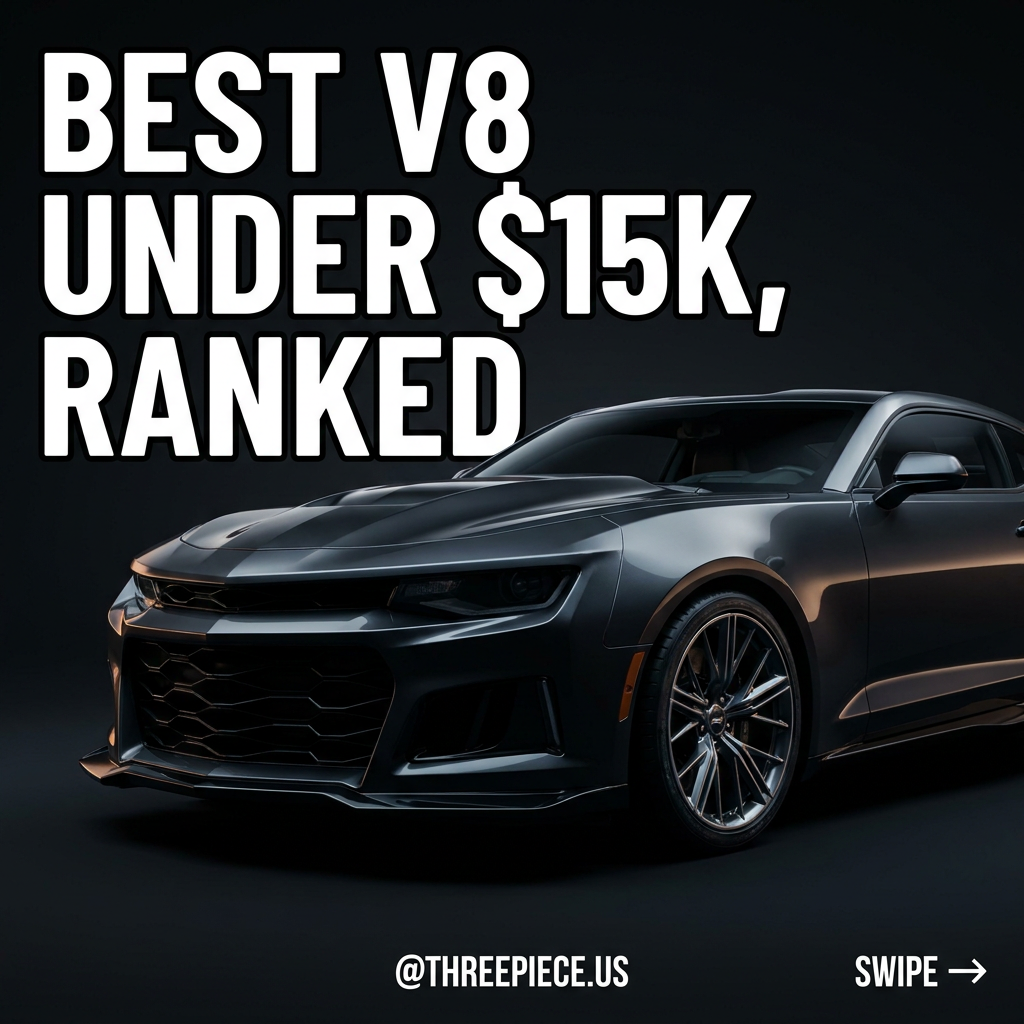
The best V8 car under $15K isn't what most people think. Forget the clapped-out Challengers and high-mileage Camaros flooding Facebook Marketplace — the real value in the V8 world right now sits in three very specific platforms that enthusiasts keep coming back to. A Coyote Mustang GT, a C5 Corvette, and a Pontiac GTO with the LS2 are all sitting in this price range with real performance, real aftermarket depth, and real long-term ownership upside. Here's exactly why — and what to watch out for on each one.
Quick links
- The Top Pick: 2012-2014 Coyote Mustang GT
- The Performance Pick: C5 Corvette
- The Sleeper: 2005-2006 Pontiac GTO
- Which One Should You Actually Buy?
- Wheels and Fitment for All Three
The Top Pick: 2012-2014 Coyote Mustang GT
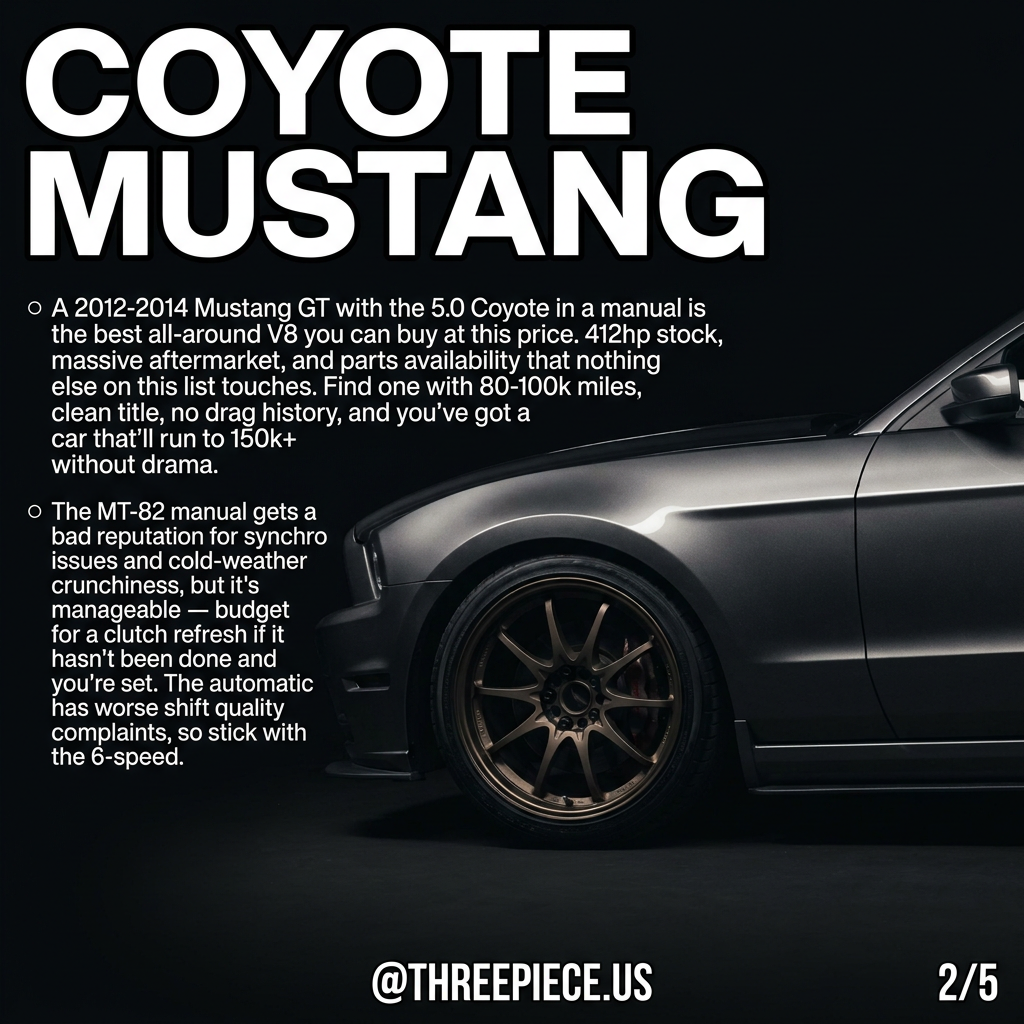
A 2012-2014 Mustang GT with the 5.0L Coyote V8 in a 6-speed manual is the single best all-around V8 you can buy for under $15,000 right now. 412 horsepower stock, a massive aftermarket ecosystem, and Ford parts availability that nothing else on this list can touch. Find one with 80-100k miles, a clean title, and no drag history, and you've got a car that'll run to 150k+ without drama.
The MT-82 manual gets a bad reputation for synchro issues — specifically 5th gear synchro failure and cold-weather crunchiness in 1st and 2nd — but it's manageable. Budget for a clutch refresh if it hasn't been done and you're set. The 6R80 automatic has worse shift quality complaints: rough cold shifts, jerks, and delays that Ford addressed through service bulletins but never fully resolved. Stick with the 6-speed.
For a deeper look at how every generation stacks up, read our complete Mustang history and ranking. And if you're already thinking about wheels, our Mustang GT wheel fitment guide covers everything from bolt pattern to fender clearance. Suspension upgrades make a huge difference on the S197 platform — a set of BMR Suspension lower A-arms for 05-14 Mustangs at $679 tightens up the front end geometry significantly over the factory stamped-steel pieces.
The Performance Pick: C5 Corvette
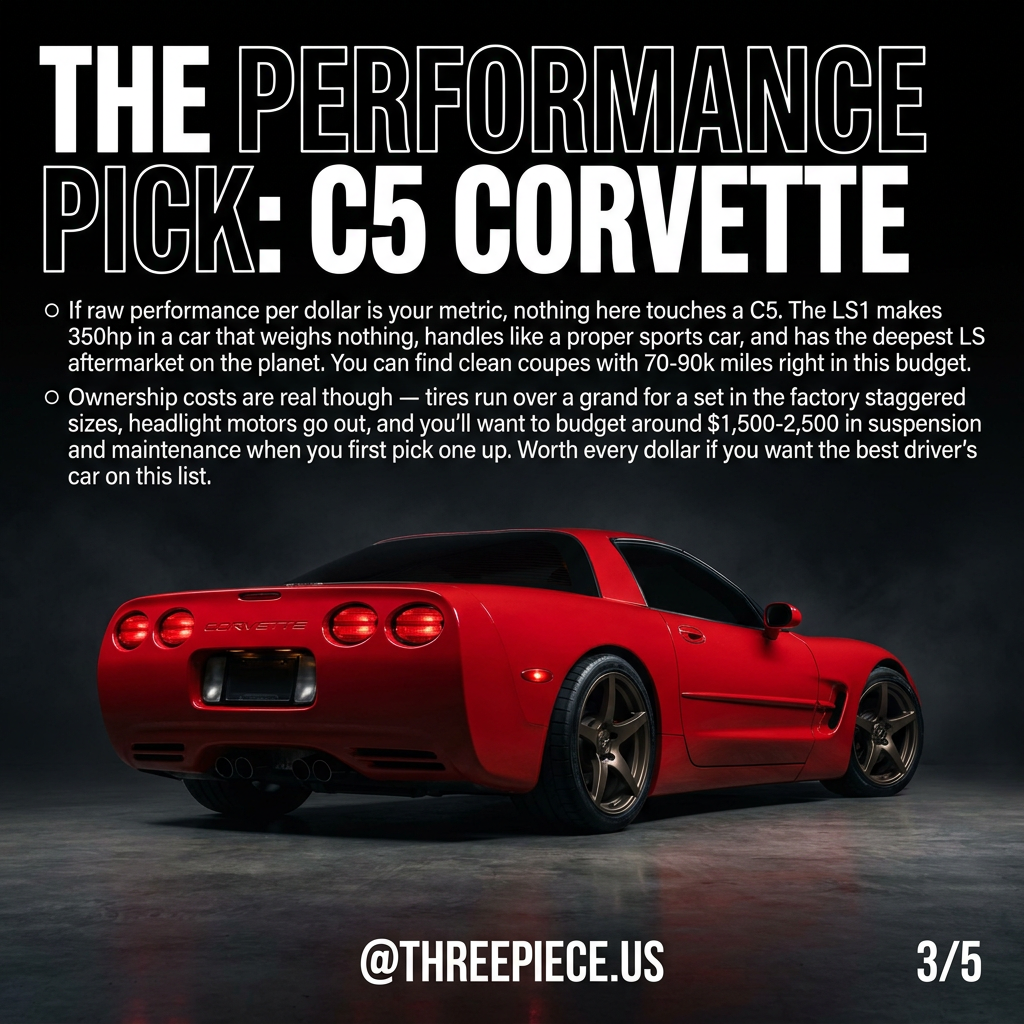
If raw performance per dollar is your metric, nothing here touches a C5 Corvette. The LS1 makes 350 horsepower in a car that weighs around 3,200 lbs, handles like a proper sports car thanks to the rear transaxle layout, and has the deepest LS aftermarket on the planet. Clean coupes with 70-90k miles are sitting right in this budget — and they've already started creeping back up in value.
Ownership costs are real, though. Tires run over $1,000 for a set in the factory staggered sizes — the C5 runs 245/45R17 front and 275/40R18 rear from the factory. Headlight motors go out (it's a when, not if situation), and you should budget around $1,500-$2,500 in suspension and deferred maintenance when you first pick one up. The rear leaf spring is a known weak point for anyone planning to track the car.
Browse 18" wheels in 5x120.65 for the rear or 17" wheels in 5x120.65 for the front to see what's available for the C5's unique bolt pattern. If you're considering forged options for this platform, read our breakdown of what forged wheels actually are and whether they're worth the money. The weight savings on a car this light makes a measurable difference.
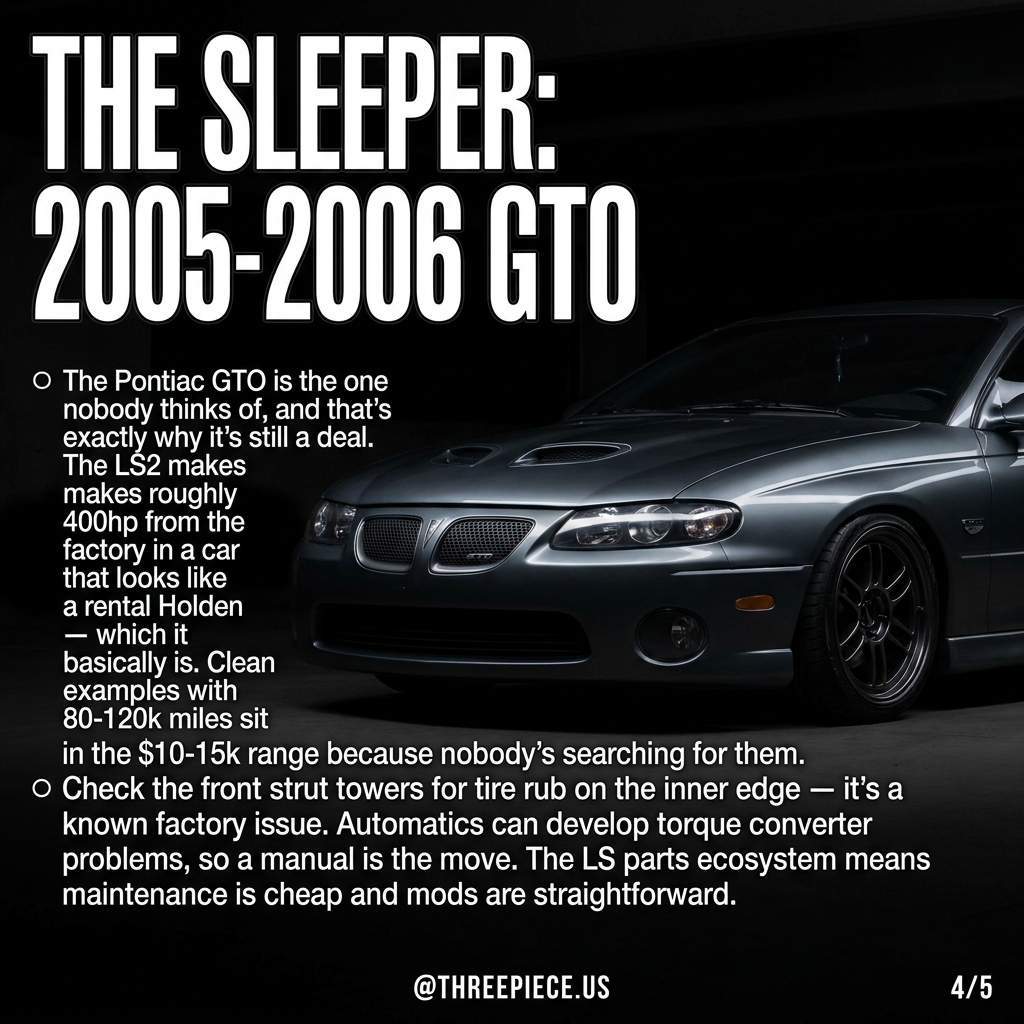
The Sleeper: 2005-2006 Pontiac GTO
The Pontiac GTO is the one nobody thinks of, and that's exactly why it's still a deal. The LS2 makes roughly 400 horsepower from the factory in a car that looks like a rental Holden Monaro — which it basically is. Clean examples with 80-120k miles sit in the $10-15K range because nobody's actively searching for them. That won't last. Production numbers were low, and the supply is thinning every year.
Check the front strut towers for tire rub on the inner edge — it's a known factory issue that gets worse with any wheel or tire changes. Automatics can develop torque converter problems, so a manual is the move. The LS parts ecosystem means maintenance is cheap and mods are straightforward — the same cam, headers, and intake that work on a Corvette or Camaro bolt right in.
For the GTO specifically, a Corsa 05-06 GTO 6.0L Sport Cat-Back + X-Pipe exhaust at $2,320 is one of the best bolt-on upgrades you can do — the LS2 wakes up dramatically with proper exhaust flow. If you're running the manual (and you should be), a Spec Stage 1 clutch kit for the 05-06 GTO at $403 handles the stock power and moderate bolt-ons without issue. Cooling matters on these cars — the Mishimoto silicone radiator hose kit for the 05-06 GTO at $170 replaces the factory rubber that deteriorates with age, and the Mishimoto 04 GTO silicone hose kit at $199 covers the earlier model year.
The GTO shares its DNA with the Pontiac G8 — for a comparison of the G8 against the Charger R/T, check out our Pontiac G8 GT vs Dodge Charger RT breakdown. If you want to see how other V8 sedans stack up in a slightly higher budget, our best V8 car under $20K guide picks up right where this list ends.
Which One Should You Actually Buy?
This comes down to what you need the car to do.
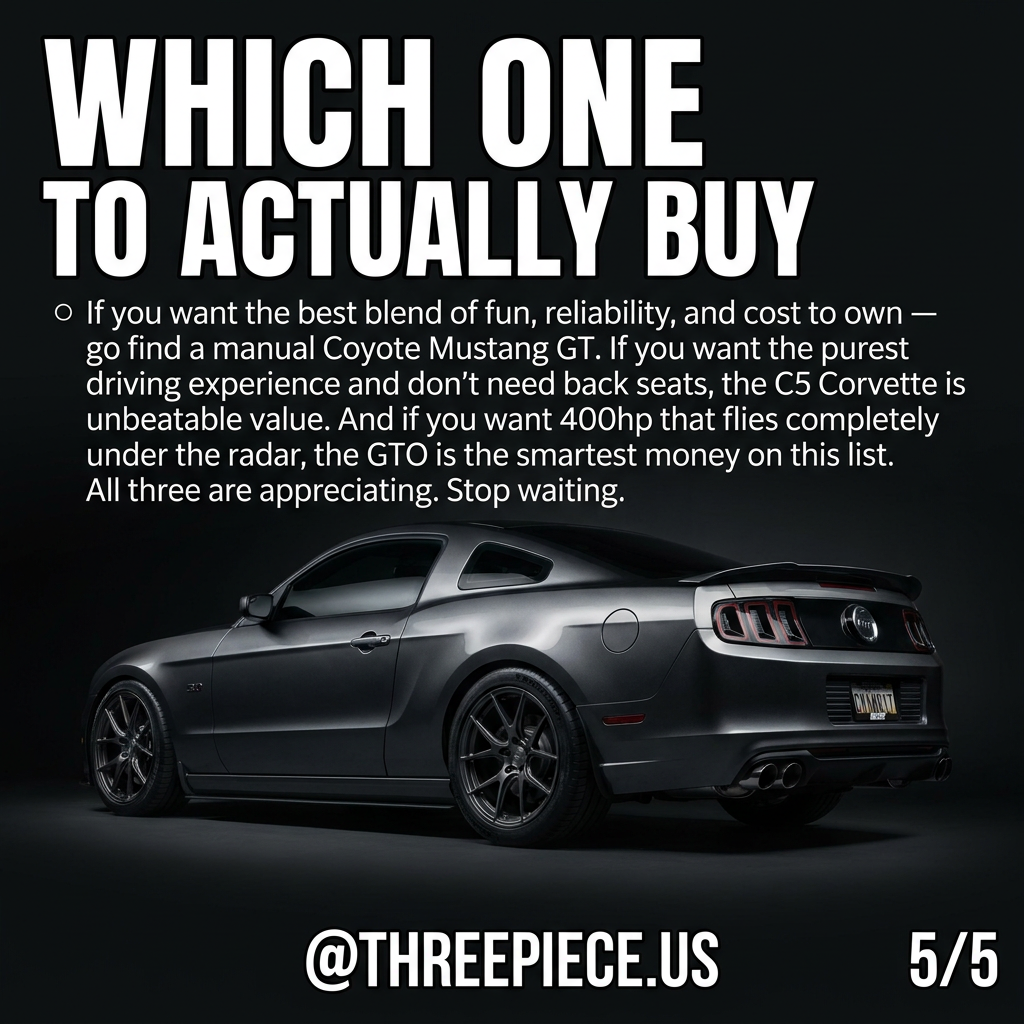
Best all-around daily driver with V8 power: the 2012-2014 Coyote Mustang GT in a manual. It's the most livable, has the cheapest parts, and the aftermarket is bottomless. If you want to add a supercharger kit later, the Coyote platform takes boost incredibly well — read our supercharger kits cost and gains breakdown for realistic numbers.
Best pure driving experience: the C5 Corvette. Nothing else here has the chassis balance, the weight distribution, or the mid-corner composure. You sacrifice back seats and daily practicality, but if driving engagement is the priority, the C5 is unbeatable at this price.
Smartest money on the list: the 2005-2006 Pontiac GTO. 400 horsepower that flies completely under the radar, in a car that most people can't even identify. The supply is shrinking, clean manuals are getting harder to find, and the LS2 platform means you're never stuck looking for parts. Upgrade the headlights with Spyder LED projector headlights for the 04-06 GTO at $487 and the car looks ten years newer overnight.
All three are appreciating. The window to buy any of these under $15K is closing. Stop waiting.
Wheels and Fitment for All Three
Once you've picked your car, wheels are the single biggest visual and performance upgrade you can make. Here's the quick rundown on fitment for each platform:
S197 Mustang GT (2012-2014): 5x114.3 bolt pattern. The sweet spot is 18x9.5 +35 front and 18x10.5 +40 rear for a staggered setup. Browse 18" wheels in 5x114.3 to see what fits. If you're going staggered, read our guide on why your lowered car needs rear camber arms — the S197 eats rear tires if you don't correct the geometry.
C5 Corvette: 5x120.65 bolt pattern (the oddball GM pattern). Factory staggered with 17x8.5 front / 18x9.5 rear. Aftermarket options are more limited than the other two, which makes 3-piece wheels an excellent solution — you can spec exact widths and offsets. Check out our vehicle gallery for build inspiration.
Pontiac GTO (05-06): 5x120 bolt pattern. Factory size is 18x8 all around, but most owners go 18x9 +30 or 18x9.5 +25 for a more aggressive look. Browse 18" wheels in 5x120 for options. If you're running 3-piece wheels on any of these platforms, assembly hardware matters — don't reuse corroded bolts. And make sure your wheels are properly centered with the right hubcentric rings for your specific bolt pattern. Our guide on hub-centric vs lug-centric wheels explains exactly why this matters.
Ready to build? Browse the full wheel catalog or check out wheel parts and accessories to finish whatever you're putting together. These three cars are some of the best values in the V8 world right now — put the right wheels under one and you'll have a car that looks and drives like something worth twice the price.