
Alfa Romeo 4C Buying Guide: 3 Reasons It's Worth It
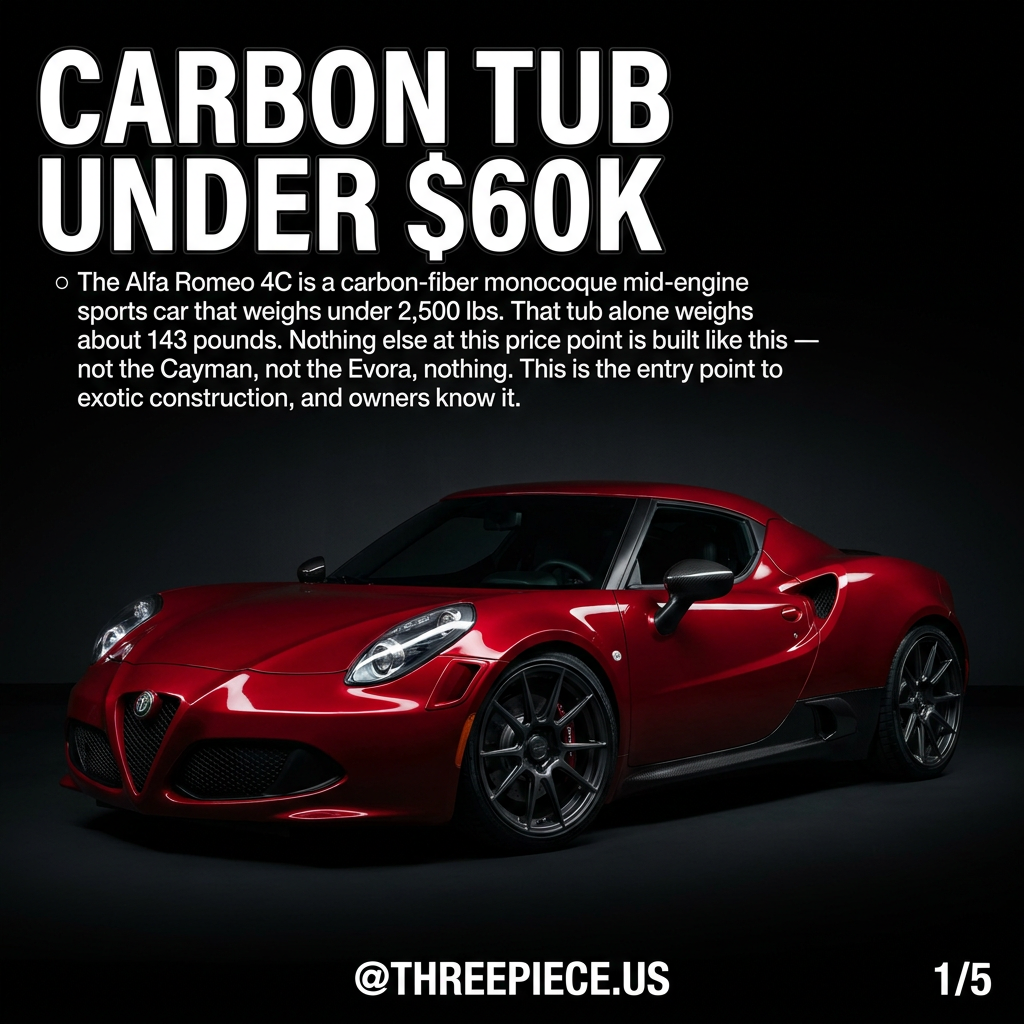
The Alfa Romeo 4C is the most overlooked mid-engine sports car of the last decade. A carbon-fiber monocoque chassis — the same construction philosophy used in the LaFerrari and Pagani Huayra — wrapped in a sub-2,500 lb package that you can pick up for under $60K. Nothing else at this price point is built like this. Not the Porsche Cayman, not the Lotus Evora, nothing. And yet, most enthusiasts are still sleeping on it. Here are three reasons the 4C deserves a serious spot on your shortlist.
Quick links
- Carbon tub under $60K — nothing else competes
- It drives like nothing else on the road
- More attention than Ferraris, real future classic potential
- Cheaper to run than you think
- Alfa Romeo 4C wheel fitment and upgrades
- Stop thinking, go drive one
Carbon Tub Under $60K — Nothing Else Competes
The 4C's carbon-fiber tub weighs approximately 143 lbs. The entire car, in coupe form, tips the scales at roughly 2,465 lbs dry. That's lighter than a base Mazda MX-5 with a full tank of gas. If you've ever wondered what it feels like to drive a car where the structure itself is the performance advantage, this is your entry point — and the only one under six figures that uses genuine carbon monocoque construction rather than a steel or aluminum tub with carbon panels bolted on top.
This isn't a marketing gimmick. The tub is the reason the 4C feels like a different category of machine. It's rigid enough that Alfa didn't bother adding a front subframe — the suspension mounts directly to the monocoque. That rigidity translates into steering precision and chassis feedback that owners on Cayman forums openly admit they can't match. The 4C is closer in construction philosophy to a Lotus Elise than anything from Stuttgart, and owners who've driven both tend to put the Alfa ahead on raw feel.
For context, the Porsche 987 Cayman — often considered the 4C's direct competitor — uses a steel monocoque and weighs ~2,900 lbs. That's over 400 lbs heavier. If you're coming from a 987 Cayman or E46 M3, the 4C will feel like someone removed a passenger from the car.
It Drives Like Nothing Else on the Road
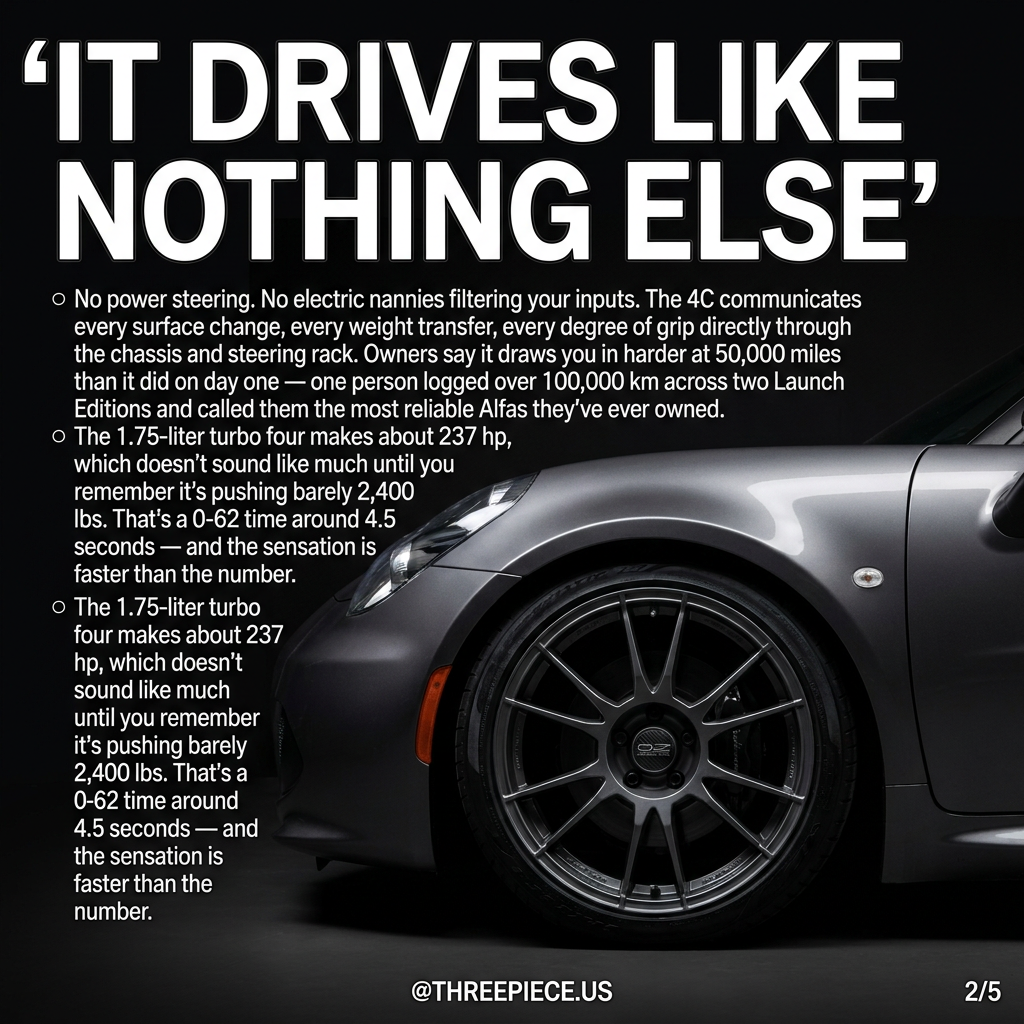
No power steering. No electric nannies filtering your inputs. The 4C communicates every surface change, every weight transfer, every degree of grip directly through the chassis and unassisted steering rack. At low speed, the steering is heavy — genuinely heavy. But the moment you're moving, it becomes sublimely undiluted. Owners describe the sensation as the car taking a confident set and staying bolted to the pavement through third-gear sweepers. One long-term owner on 4C Forums logged over 100,000 km across two Launch Editions and called them the most reliable Alfas he'd ever owned — and said the car drew him in harder at 50,000 miles than it did on day one.
The 1.75-liter turbocharged inline-four makes approximately 237 hp and 258 lb-ft of torque between 2,200-3,750 rpm. Those numbers don't sound dramatic until you remember they're pushing barely 2,400 lbs. That's a power-to-weight ratio of roughly 10.1 lbs per horsepower — competitive with a C7 Corvette Stingray. The result is a 0-62 mph time around 4.5 seconds and a top speed near 160 mph. The sensation, owners consistently report, is faster than the number suggests.
If you're interested in how Alfa Romeo's performance engineering translates to the sedan side, our Giulia Quadrifoglio build guide covers the platform that inherited much of the 4C's DNA. And if you're weighing the 4C against other affordable sports cars, our breakdown of the $30K sports car that punches above its price offers useful perspective on what the market actually looks like right now.
More Attention Than Ferraris — Real Future Classic Potential
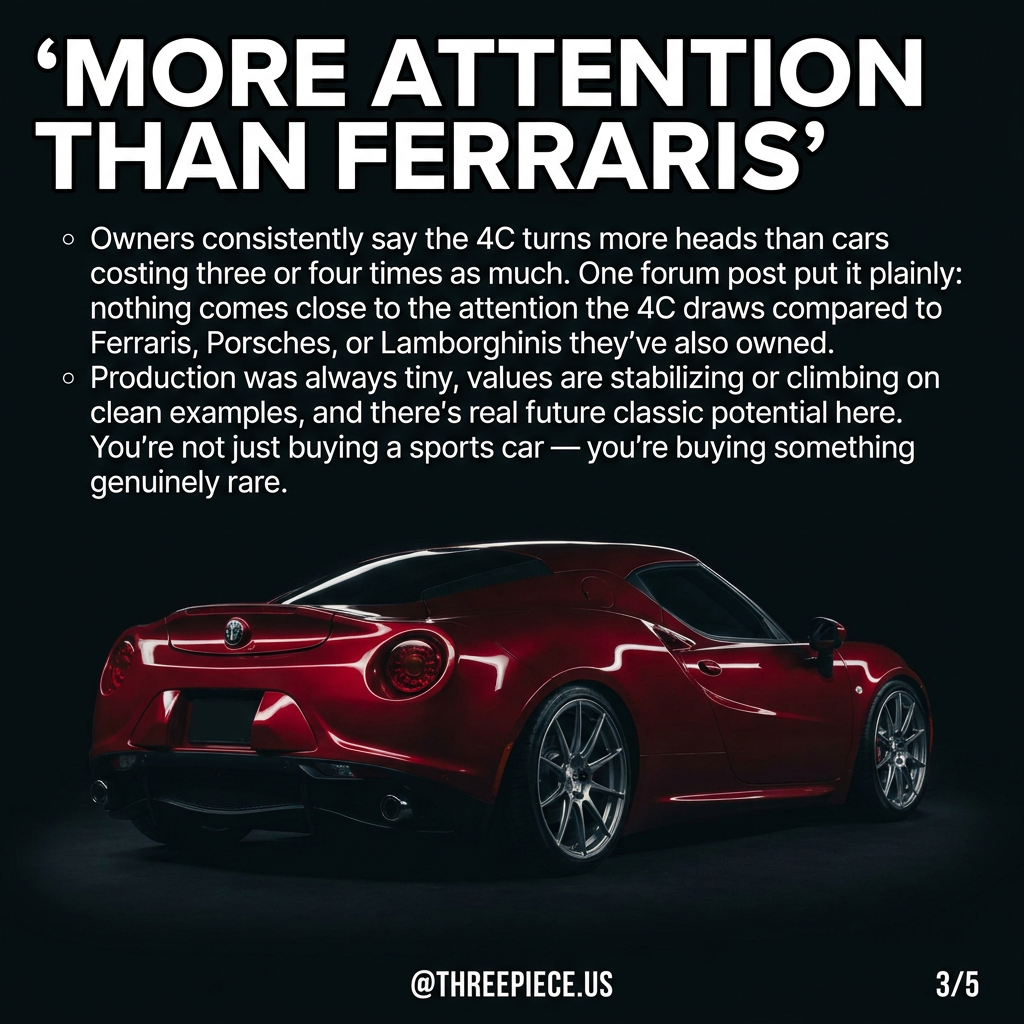
Owners consistently say the 4C turns more heads than cars costing three or four times as much. One AlfaOwner forum post put it plainly: nothing comes close to the attention the 4C draws compared to Ferraris, Porsches, or Lamborghinis they've also owned. The styling is dramatic — mid-engine proportions, aggressive front splitter, the engine visible under the rear glass in coupe form — and it reads as exotic in a way that a Cayman or even a base 911 simply doesn't.
Production numbers back up the exclusivity. Alfa never sold the 4C in large volumes. In the UK, roughly 200 units per year was a typical import figure. In the US, total production across both coupe and Spider variants from 2015 to 2020 was extremely limited. Production ended entirely in 2020, and no manual transmission or adaptive damping option was ever offered — what you see is what Alfa built, and they're not making more.
Clean examples have seen values stabilize and, in some cases, climb. Launch Editions and low-mileage Spiders are already trading at premiums. This is a car with genuine future classic potential — not because of speculation, but because the construction method, the driving character, and the production numbers all point in one direction. If you want to understand how lightweight mid-engine cars appreciate over time, the original NSX's trajectory is instructive. The 4C shares more DNA with that philosophy than most people realize.
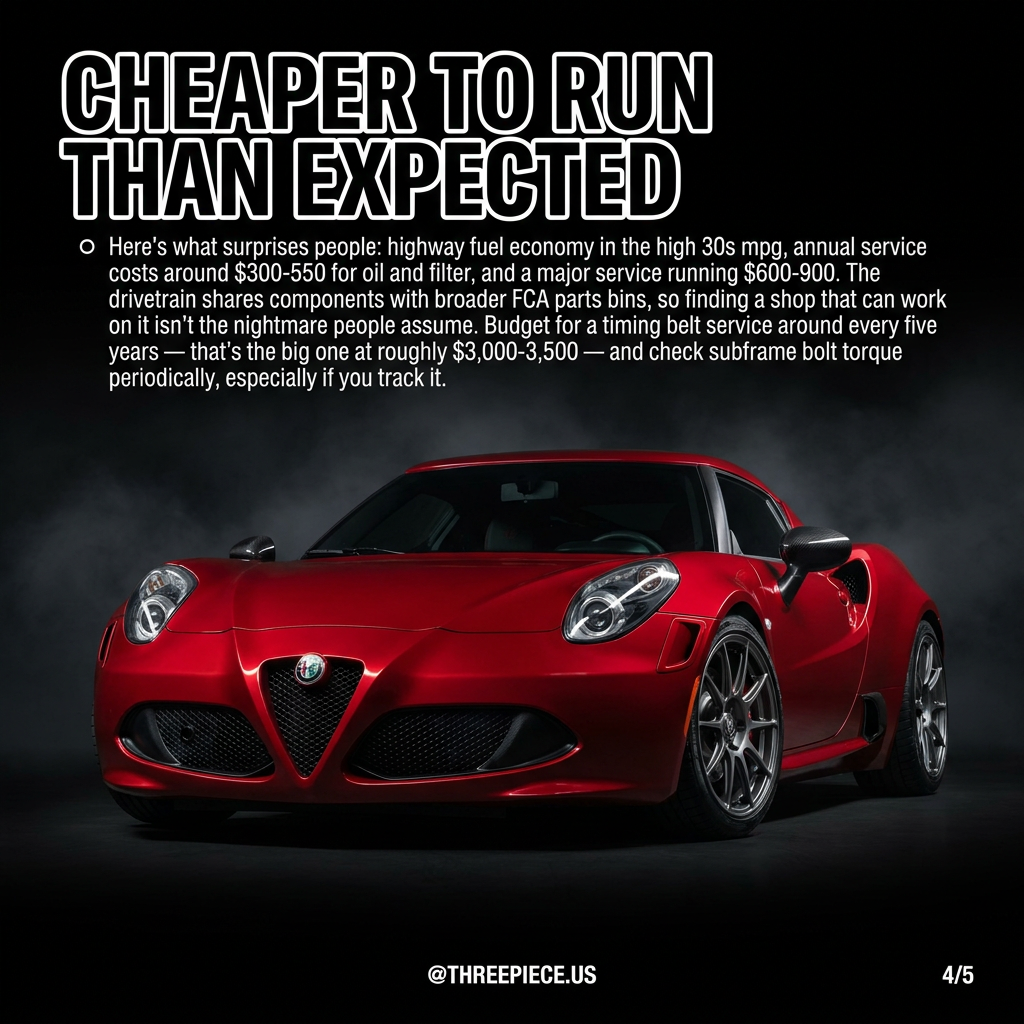
Cheaper to Run Than You Think
Here's what surprises people: highway fuel economy in the high 30s mpg. The EPA rates the 4C at roughly 24 mpg city / 38 mpg highway, combining to about 28 mpg overall. For a car that feels this exotic, those numbers are remarkable — and they're a direct consequence of the light weight and small displacement.
Annual service costs run around $300-$550 for oil and filter changes. A major service — the kind you'd schedule once a year or every 12,000 miles — typically runs $600-$900. The drivetrain shares components with broader FCA parts bins, so finding a shop that can work on it isn't the nightmare people assume. The big-ticket item is the timing belt service around every five years, which runs roughly $3,000-$3,500. Budget for it, plan for it, and it won't catch you off guard.
One maintenance note from experienced owners: check subframe bolt torque periodically, especially if you track the car. This is a known item on the platform and easy to address proactively. Beyond that, the primary consumables are tires and brakes — standard wear items on any performance car. If you're curious about how air-fuel ratios affect turbocharged engines like the 4C's 1750 TBi, that guide breaks down the fundamentals.
Alfa Romeo 4C Wheel Fitment and Upgrades
The 4C runs a staggered setup from the factory: 17x7 front and 18x7 rear on a 4x98 bolt pattern with a 58.1mm center bore. That 4x98 pattern is the biggest hurdle for aftermarket wheel selection — it's shared with vintage Fiats and a handful of other Italian cars, but it's rare in the broader performance wheel market. If you're running a 3-piece wheel, this is actually an advantage: custom bolt patterns are standard on forged multi-piece builds, so you're not limited by what's sitting on a shelf. Read our guide on what forged wheels actually are to understand why they make particular sense on a car this light.
Most owners running aftermarket wheels stick close to factory sizing — 17x7.5 to 17x8 front, 18x8 to 18x8.5 rear — to keep the car's razor-sharp turn-in intact. The 4C is sensitive to unsprung weight changes, so forged wheels are the move here. Every pound you save on the corners amplifies what the carbon tub already does. Browse 17-inch wheels in 4x98 for the front and 18-inch wheels in 4x98 for the rear to see what's available.
For tires, the factory spec is 205/40R17 front and 235/35R18 rear. Those are relatively narrow by modern standards, and that's intentional — the car was designed around minimal rolling resistance and quick directional changes, not maximum grip at all costs. If you're shopping for rubber, search 205/40R17 tires and 235/35R18 tires for options that fit.
If you're building a 3-piece set for the 4C, custom step lips starting at $399 and custom reverse barrels at $399 let you spec exactly the width and offset you need for this unusual bolt pattern. Finish the assembly with M7x32 chrome assembly bolts at $10 each and 90-degree valve stems at $3.80 for tight-clearance fitment behind the 4C's compact fenders. For inspiration on how other enthusiasts are pairing exotic platforms with multi-piece wheels, check the ThreePiece vehicle gallery.
If you're considering a staggered setup on any platform, our guide on hub-centric vs. lug-centric wheels is essential reading — especially on a car with a 58.1mm center bore where proper centering is critical to avoid vibration at speed.

Stop Thinking, Go Drive One
If you want refinement, comfort, and a quiet cruise, buy a Cayman. If you want a car that makes every single drive feel like an event — raw, loud, visceral, and absolutely unforgettable — the Alfa Romeo 4C is the one. Values aren't going down on clean examples. The ownership community is tight and deeply knowledgeable. And nothing else on the road feels like this.
The window to buy a clean 4C at reasonable money is closing. Production ended in 2020, the enthusiast base is growing, and the cars that get neglected now won't be the ones that appreciate. Find a well-maintained example, budget for the timing belt, and go drive it. You'll know within the first corner whether this is your car. And when you're ready to put the right wheels under it, browse our full wheel catalog or reach out directly — we build wheels for platforms exactly like this.