
Giulia Quadrifoglio Build Guide: 550WHP on Bolt-Ons
The Alfa Romeo Giulia Quadrifoglio is quietly becoming the most compelling performance sedan build in the enthusiast space. A Ferrari-derived 2.9L twin-turbo V6, rear-wheel drive, a Getrag transaxle, and a chassis that genuinely embarrasses cars at twice the price — yet it trades for a fraction of what an M3 or C63 commands on the used market. Owners are hitting 550whp on bolt-ons alone, no internal engine work, no turbo swap. This is the complete build guide for turning a stock QV into something genuinely special.
Quick links
- 550WHP From a Factory Sedan
- Start With the Right Model Year
- The Bolt-On Power Roadmap
- Wheel and Tire Fitment That Actually Works
- Common Failure Modes and What Breaks
- Total Build Cost and Final Takeaway
550WHP From a Factory Sedan
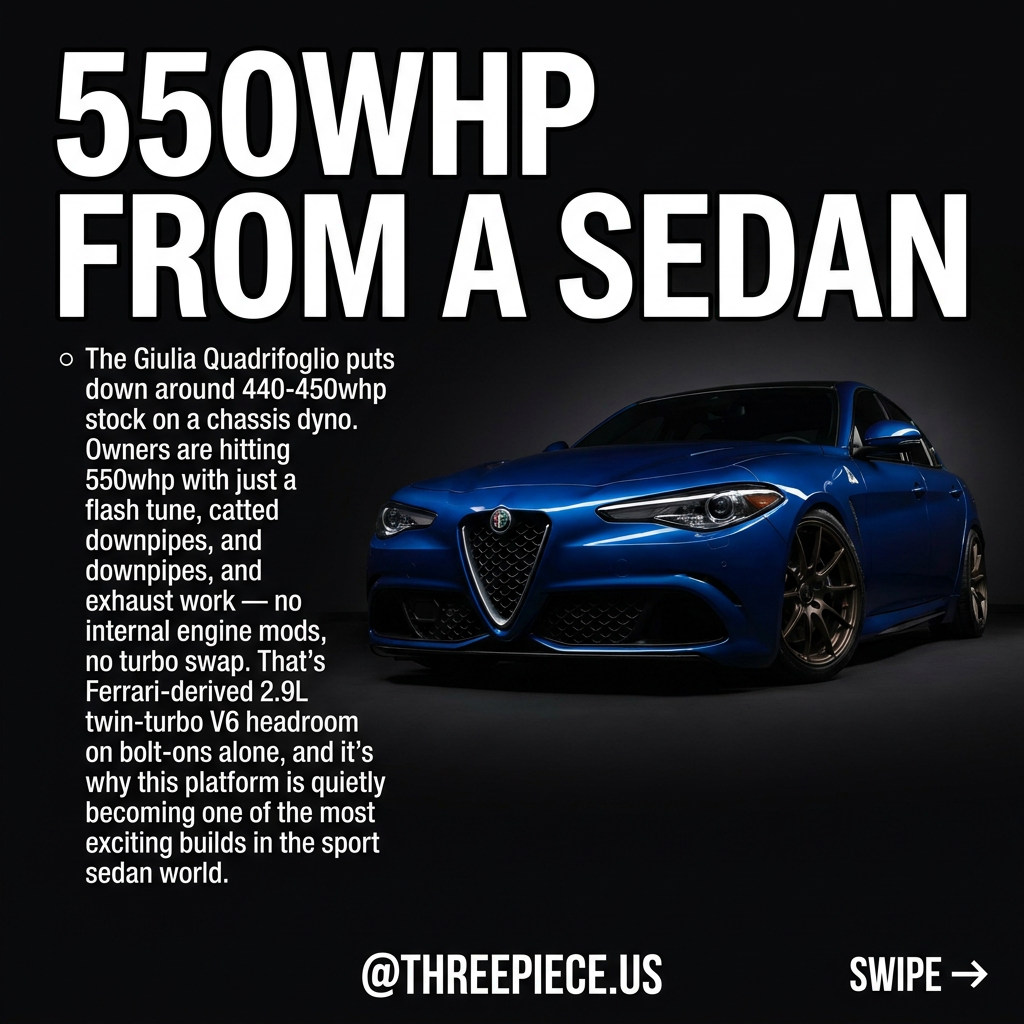
The Giulia Quadrifoglio's 2.9L twin-turbo V6 is rated at 505 PS (approximately 502-510 hp) at the crank from the factory. On a chassis dyno, that translates to roughly 440-450whp stock — already a serious number for a four-door. But the real story is what happens when you start opening up the exhaust and recalibrating the ECU. Owners on GiuliaForums and Reddit have documented hitting ~550whp with nothing more than a flash tune, catted downpipes, and exhaust work. No internal engine modifications. No turbo swap. No fueling upgrades. That's roughly 100whp of headroom sitting in the factory calibration and exhaust restriction.
For context, that's the kind of gain you'd expect from a full bolt-on B58 or a heavily modified Coyote. The difference is that the Alfa's 2.9L was co-developed with Ferrari's F154 engine family, and it has the metallurgy and turbo sizing to support these numbers without pushing the hardware into dangerous territory. If you're wondering whether an ECU tune is actually worth it, the QV is one of the strongest cases in the entire performance sedan segment.
Start With the Right Model Year
Not all QVs are created equal, and model year selection is the single most important decision in this build. Look for a 2020 or later. Here's why:
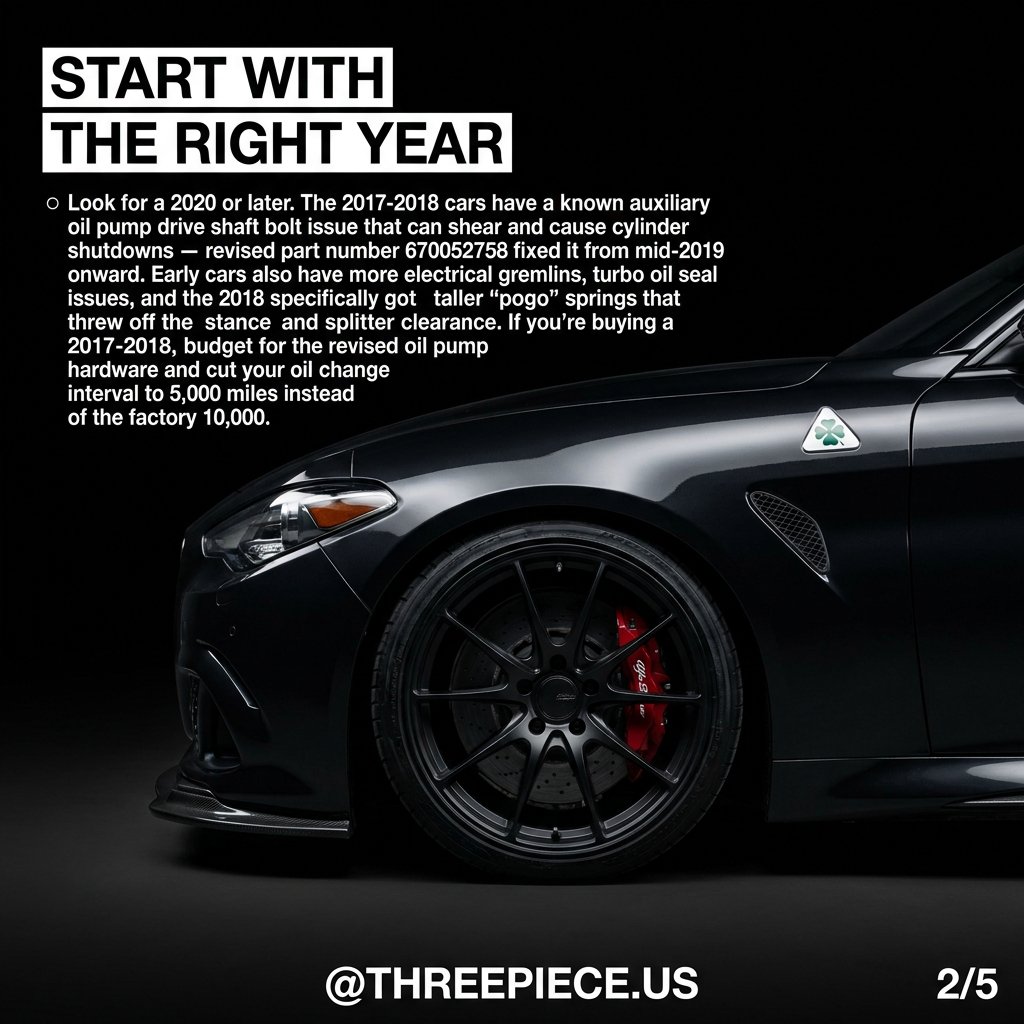
The 2017-2018 Giulia Quadrifoglio has a known auxiliary oil pump drive shaft bolt issue — the bolt can shear and cause cylinder shutdowns. Alfa revised this with part number 670052758 from mid-2019 production onward. Early cars also suffer from significantly more electrical gremlins: battery charging failures, faulty wiring harnesses, reverse lights staying on, and alternator issues. Turbo oil seal leaks and EVAP system problems are also more prevalent on these early builds.
The 2018 specifically got taller "pogo" springs from the factory that threw off the stance and splitter clearance compared to the 2017 or 2019+ baseline. If you're planning to lower the car, this matters — you'll see a more dramatic 20-40mm drop from 2018 springs compared to other years, which changes your spacer and alignment math. If you're buying a 2017-2018 because the price is right, budget for the revised oil pump hardware and cut your oil change interval to 5,000 miles instead of the factory-recommended 10,000.
The 2020+ cars resolved most of these issues and represent the cleanest starting point. They're worth the premium. Understanding the relationship between spring rate and ride quality will also help you make smarter suspension decisions once you start lowering.
The Bolt-On Power Roadmap
The QV community has essentially settled on a specific mod order, and deviating from it costs you money without proportional gains. Here's the sequence that gets you from 440-450whp to ~550whp:
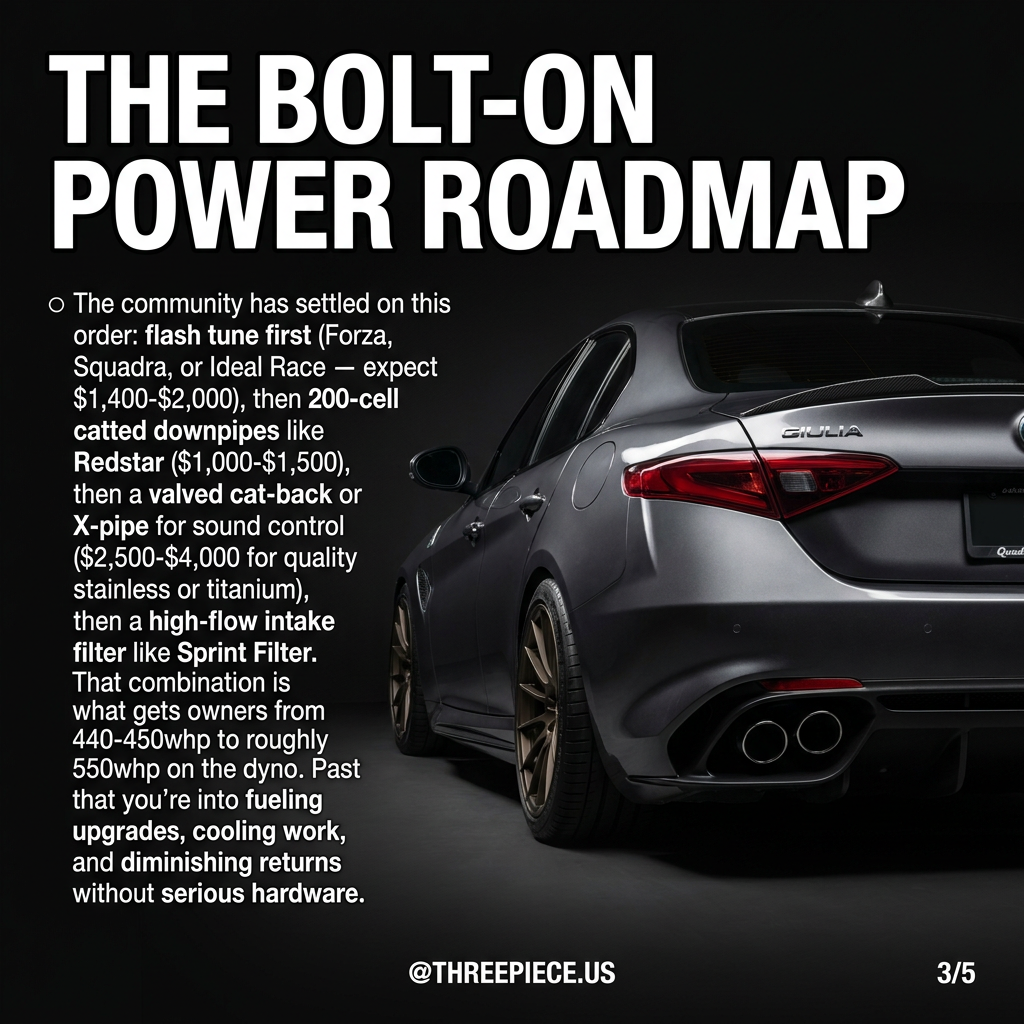
Step 1: Flash tune ($1,400-$2,000). Forza Tuning, Squadra, or Ideal Race are the established names. The tune recalibrates boost targets, ignition timing, and fueling across the rev range. This alone is worth 40-60whp on most cars. Alternatively, MADNESS Autoworks offers their MAXPower PRO plug-in module for around $800-$900, claiming 16-20% gains in HP and torque. The advantage of the MADNESS module is that it doesn't overwrite the factory ECU or increment the flash counter — important for warranty and resale considerations.
Step 2: 200-cell catted downpipes ($1,000-$1,500). Redstar, Fabspeed, and MADNESS all make options. Fabspeed's high-flow catted downpipes paired with their Centerline X-Pipe are a popular combination in the "Top 5 QV Mods" threads on GiuliaForums. The factory downpipes are extremely restrictive, and opening them up is where the tune really wakes up.
Step 3: Valved cat-back or X-pipe ($2,500-$4,000). Capristo and Alfissimo are the go-to brands. The Alfissimo "Fiammeghi" Double-H pipe replaces the mid-section for less restriction and better sound. A valved system lets you control exhaust note — quiet for daily driving, open for spirited runs. Quality stainless or titanium systems sit at the top of this price range.
Step 4: High-flow intake filter. Sprint Filter or BMC replacement elements. This is the cheapest mod on the list but rounds out the airflow path. Combined with the tune, downpipes, and exhaust, owners report 50-100whp total gains over stock depending on dyno conditions.
Past this combination, you're into fueling upgrades, intercooler work, and diminishing returns without serious hardware. For most street builds, this is the sweet spot. If you want to understand how these mods interact with your air-fuel ratio and why it matters, that context helps you evaluate tuner quality. And if you're coming from a BMW platform, the mod order philosophy is similar to what we outlined in the W212 E63 AMG build guide — tune first, then open up the exhaust, then intake last.
Wheel and Tire Fitment That Actually Works
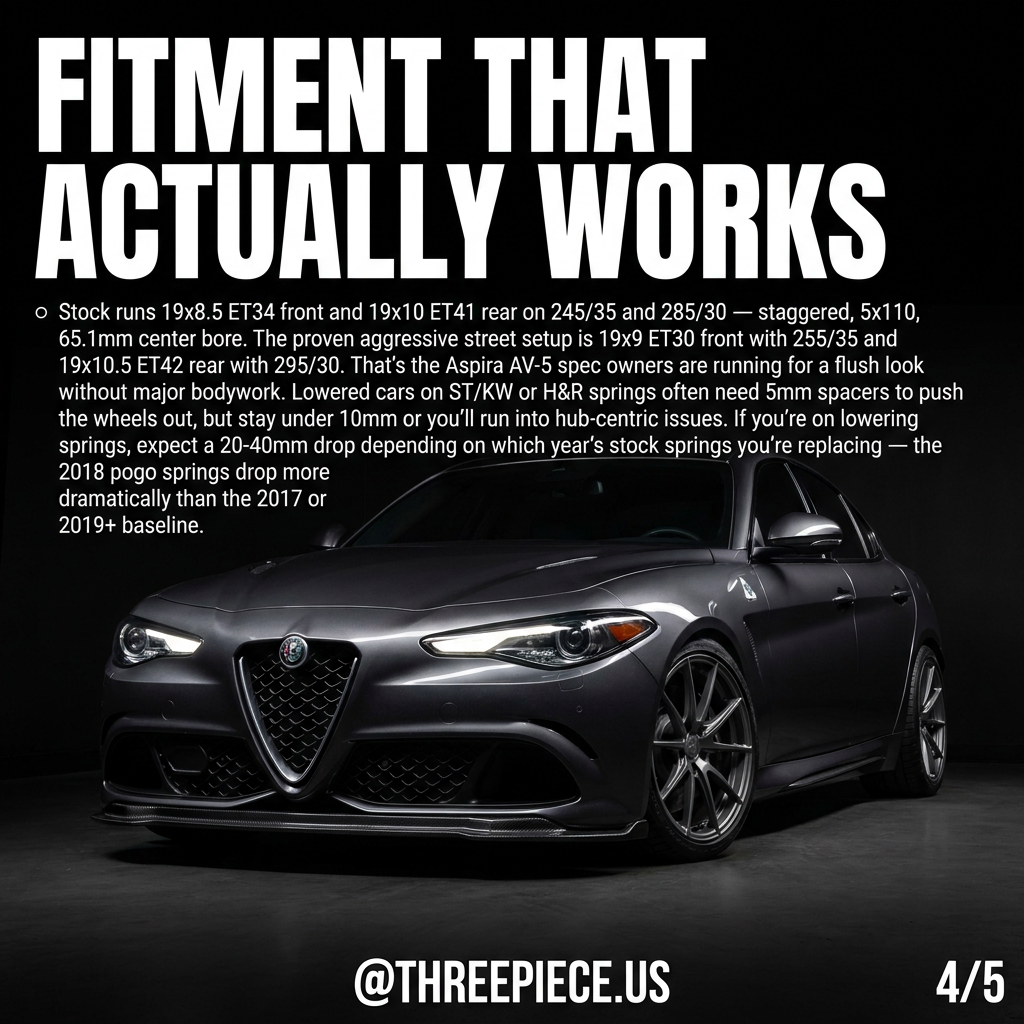
The Giulia Quadrifoglio runs a staggered setup from the factory: 19x8.5 ET34 front and 19x10 ET41 rear on 245/35R19 and 285/30R19 tires. Bolt pattern is 5x110 with a 65.1mm center bore — an unusual combination that limits your aftermarket options compared to the 5x112 or 5x114.3 world. This is where careful spec selection matters.
The proven aggressive street fitment that the community has converged on is 19x9 ET30 front with 255/35R19 and 19x10.5 ET42 rear with 295/30R19. This is the spec that owners running Aspira AV-5 wheels have documented for a flush look without needing fender work. It clears the massive Brembo 6-piston front calipers — which is the biggest constraint on this platform — and fills the rear arches properly.
If you're lowered on H&R or Eibach springs, you may need 5mm spacers to push the wheels out for a truly flush appearance. Stay under 10mm or you'll run into hub-centric fitment issues on the 65.1mm bore. Speaking of lowering, the drop you get depends heavily on which year's stock springs you're replacing — the 2018 pogo springs produce a more dramatic change than the 2017 or 2019+ baseline springs. Many owners are running H&R lowering springs for a 20-40mm drop that improves stance without destroying ride quality. For a deeper dive on how staggered setups affect handling and tire wear, read our guide on what forged wheels actually are — because on a car making 550whp, wheel construction matters enormously.
Browse 19-inch wheels in 5x110 to see what's available for the QV's bolt pattern. For tires, look at 255/35R19 fronts and 295/30R19 rears to complete the setup. If you're running a 3-piece wheel and need replacement lips or barrels, Work step lips start at $399 and custom reverse lips are also available at $399 for builds that need specific dish depths. Don't forget 90-degree valve stems at $3.80 each — essential for deep-dish 3-piece setups where straight stems won't clear.
For build inspiration on aggressive sedan fitments, check out the ThreePiece vehicle gallery. The F80 M3 and QV share similar fitment challenges with massive front brakes, and our F80 M3 wheel fitment guide covers a lot of the same offset and caliper clearance logic that applies here.
Common Failure Modes and What Breaks
The QV is an Alfa Romeo, and that means you need to know what fails before it fails. Here are the documented issues from owner threads on Reddit, GiuliaForums, and AlfaOwner UK:
Valve cover leaks: The 2017 QV is particularly prone to leaky valve covers. This can require engine-out work depending on the shop, with quotes running $1,500-$1,800 for parts and labor. Budget for this if you're buying early production.
Intake resonator cracks: The plastic resonator tube from the air filter to the turbo inlet commonly cracks due to repeated heat cycles. Symptoms include Check Engine Light codes P0171/P0174 (lean on both banks), hissing sounds, and rough idle. The OEM replacement part is only $75-$150, but diagnosing it takes time if you don't know to look for it.
Turbo wastegate linkage wear: Multiple owners have reported premature wear on the wastegate linkage. This shows up as boost control issues and inconsistent power delivery. Not catastrophic, but annoying and expensive if you don't catch it early.
Radiator and injector failures: Several post-warranty owners have needed replacement radiators and injectors. Parts availability can be spotty — back-orders are common. Oil cooler gasket leaks are also documented.
Electrical gremlins (2017-2019): Battery charging issues, faulty wiring, and random warning lights are more common on early cars. Most are resolved with software updates or component replacement, but they're a headache. This is another reason to target 2020+ production.
One mod that directly addresses engine longevity on turbocharged platforms is a catch can. If you're unfamiliar with the benefits, our breakdown of why you should run a catch can explains the oil vapor issue that affects every direct-injection turbo engine — the QV included. Gale Motorsport makes a QV-specific unit that multiple build threads reference.
Total Build Cost and Final Takeaway
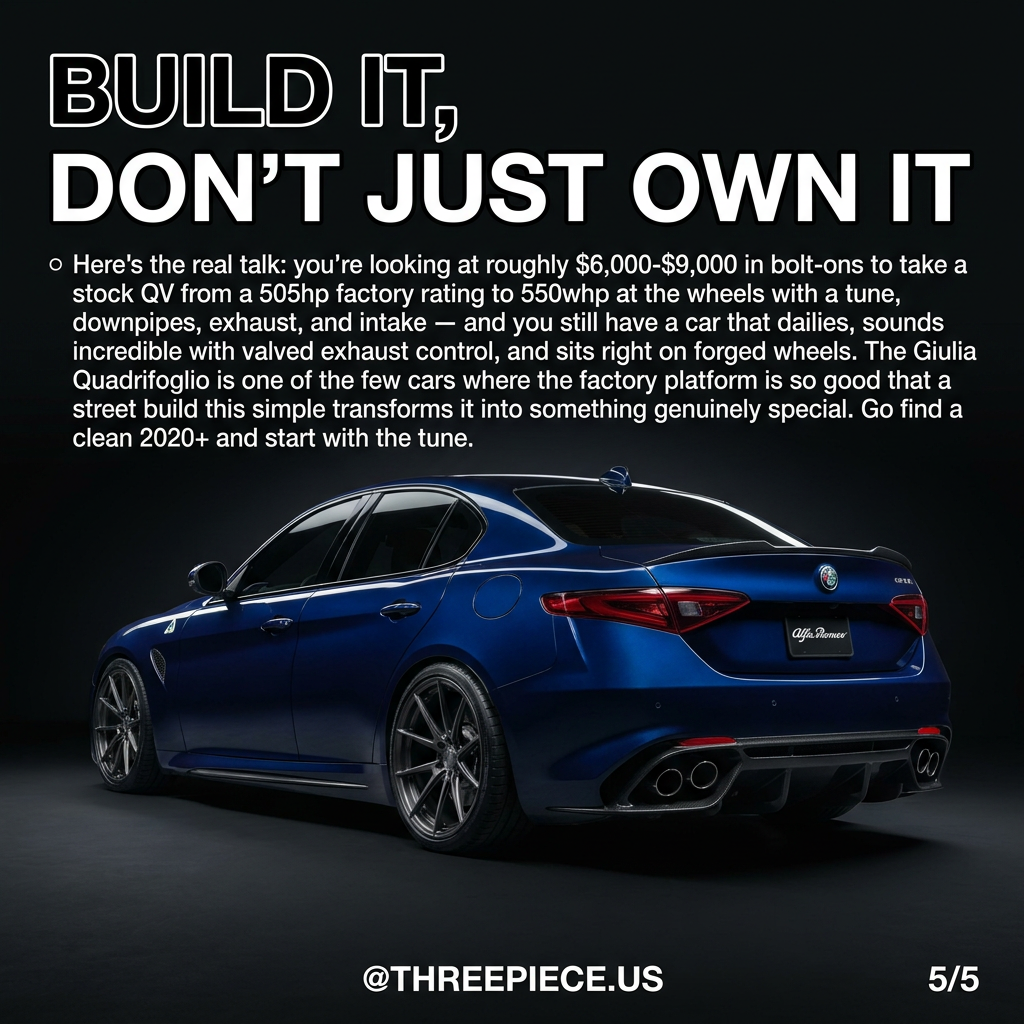
Here's the realistic math. To take a stock Giulia Quadrifoglio from its factory 505hp rating to ~550whp at the wheels, you're looking at roughly $6,000-$9,000 in bolt-on modifications:
- Flash tune or ECU module: $800-$2,000
- 200-cell catted downpipes: $1,000-$1,500
- Valved cat-back or X-pipe: $2,500-$4,000
- High-flow intake filter: $100-$200
- Catch can: $200-$400
Add lowering springs (H&R or Eibach, $300-$500), a proper wheel and tire package, and you still have a car that dailies comfortably, sounds incredible with valved exhaust control, and sits right on forged wheels. The total investment for a complete street build — power, suspension, and wheels — lands somewhere between $12,000-$18,000 depending on wheel choice and tire spec.
The Giulia Quadrifoglio is one of the few platforms where the factory engineering is so good that a relatively simple build transforms it into something that genuinely competes with cars costing two or three times as much. It's not an M3. It's not a C63. It's better than both for the money, and the enthusiast community is finally catching on. If you're comparing it to other performance sedan builds, the Acura TLX Type S occupies a similar "underrated sedan" space but doesn't have anywhere near the power ceiling.
Go find a clean 2020+ QV, start with the tune, and build it right. Browse Work Wheels or the Work Emotion series for wheel options that match the aggression this car deserves. If you're running 3-piece wheels on this platform, wheel hardware and accessories — from assembly bolts to center caps — are all available to keep your setup dialed.