

Racing Harness Guide: 4 vs 5 vs 6-Point Explained
A racing harness isn't a tighter seatbelt — it's a fundamentally different restraint philosophy. Where your OEM 3-point belt allows your upper body to shift, slide, and fight the car through corners, a multi-point harness pins your shoulders, hips, and pelvis into the seat so your hands can actually drive. If you're building a track car or prepping for HPDE days, understanding the differences between 4-point, 5-point, and 6-point harnesses — and more importantly, how to mount them — is the line between a safer car and a more dangerous one.

Quick links
- What is a racing harness?
- Why stock belts fall short on track
- 4-point vs 5-point vs 6-point harness
- Mounting geometry: where most builds go wrong
- FIA vs SFI certification explained
- Who actually needs a racing harness
- Completing the build: wheels, suspension, and safety
What Is a Racing Harness?
A racing harness is a multi-point restraint system — 4, 5, or 6 separate straps anchored directly to your chassis or roll cage — designed to hold the driver completely stationary through heavy braking, high-g corners, and impacts. Each strap serves a specific biomechanical function: shoulder straps prevent your torso from pitching forward, lap belts lock your pelvis to the seat, and anti-submarine straps stop you from sliding beneath the lap belt in a frontal impact.
The webbing is typically polyester or polyamide, flame-resistant, and rated for tensile loads that far exceed anything an OEM belt is designed to handle. Shoulder strap widths have largely moved from 3-inch to 2-inch to integrate with HANS (Head and Neck Support) devices — the narrower webbing routes cleanly through HANS shoulder slots. Release mechanisms are either cam-lock (twist knob, fast and intuitive) or latch-link (hook and tang, visible and reliable). If you're building a track car and haven't thought about how your harness interacts with your head restraint, you're already behind. For more on how suspension and chassis setup feed into track prep, check out our breakdown of how to pick the right coilover spring rate.
Why Stock Belts Fall Short on Track
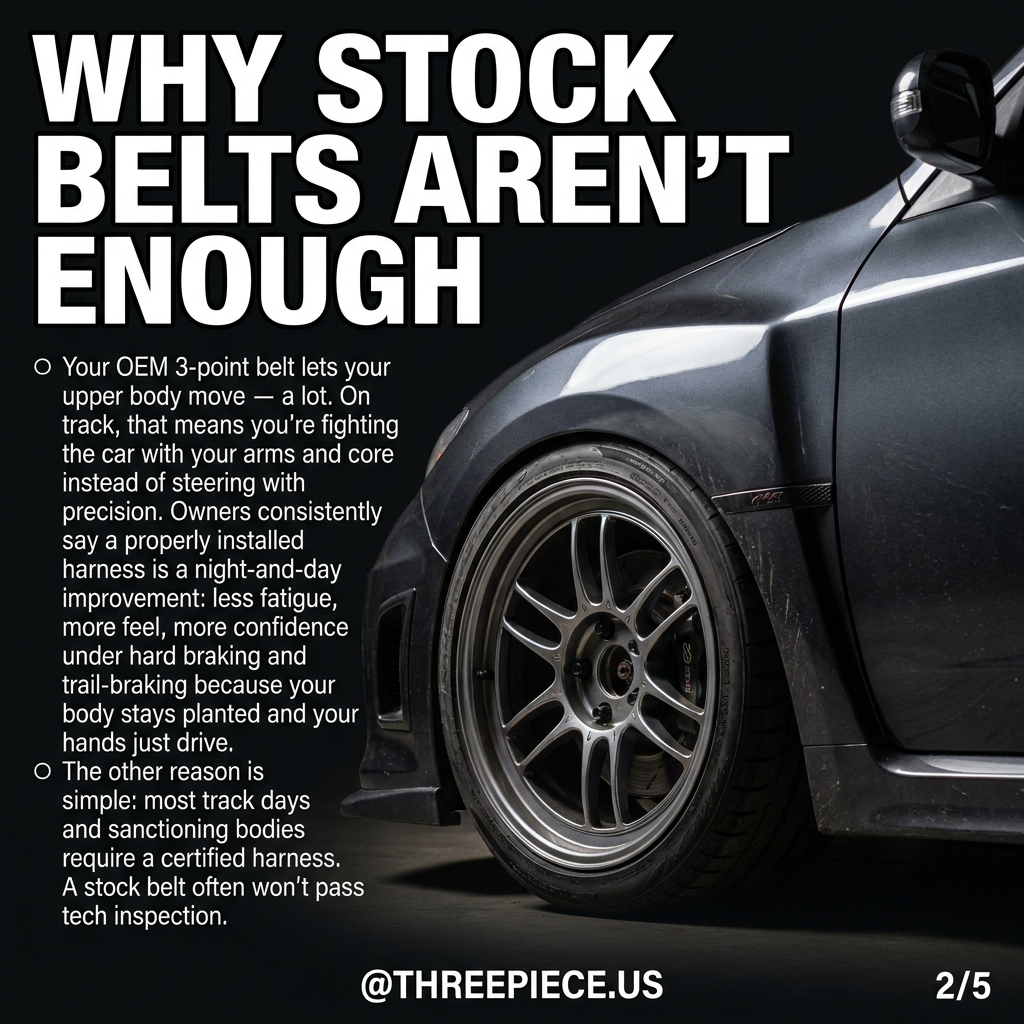
Your OEM 3-point belt was engineered around a specific crash scenario: a 35 mph frontal impact with airbag deployment, crumple zone absorption, and seatbelt pretensioners all working in concert. That system is brilliant for street driving. It is not designed for sustained lateral g-forces, repeated hard braking from triple-digit speeds, or the kind of rotational forces you encounter in a spin or rollover at pace.
On track, a stock belt lets your upper body move — a lot. Owners consistently report that this movement means you're fighting the car with your arms and core instead of steering with precision. The result is faster fatigue, less pedal feel, and worse trail-braking consistency. A properly installed harness is, by every account on major forums, a night-and-day improvement in driver confidence and lap-time consistency. You're not gripping the wheel to stay in the seat anymore — you're just driving.
The other practical reality: most track days and sanctioning bodies require a certified harness. A stock belt often won't pass tech inspection for anything beyond a basic HPDE event. If you're running timed sessions or wheel-to-wheel, it's not optional — it's mandatory. The same way you'd upgrade your suspension before pushing hard on track, the harness is a prerequisite, not an afterthought.
4-Point vs 5-Point vs 6-Point Harness
This is where most people make their first mistake — buying based on price or aesthetics instead of understanding what each configuration actually does under load.
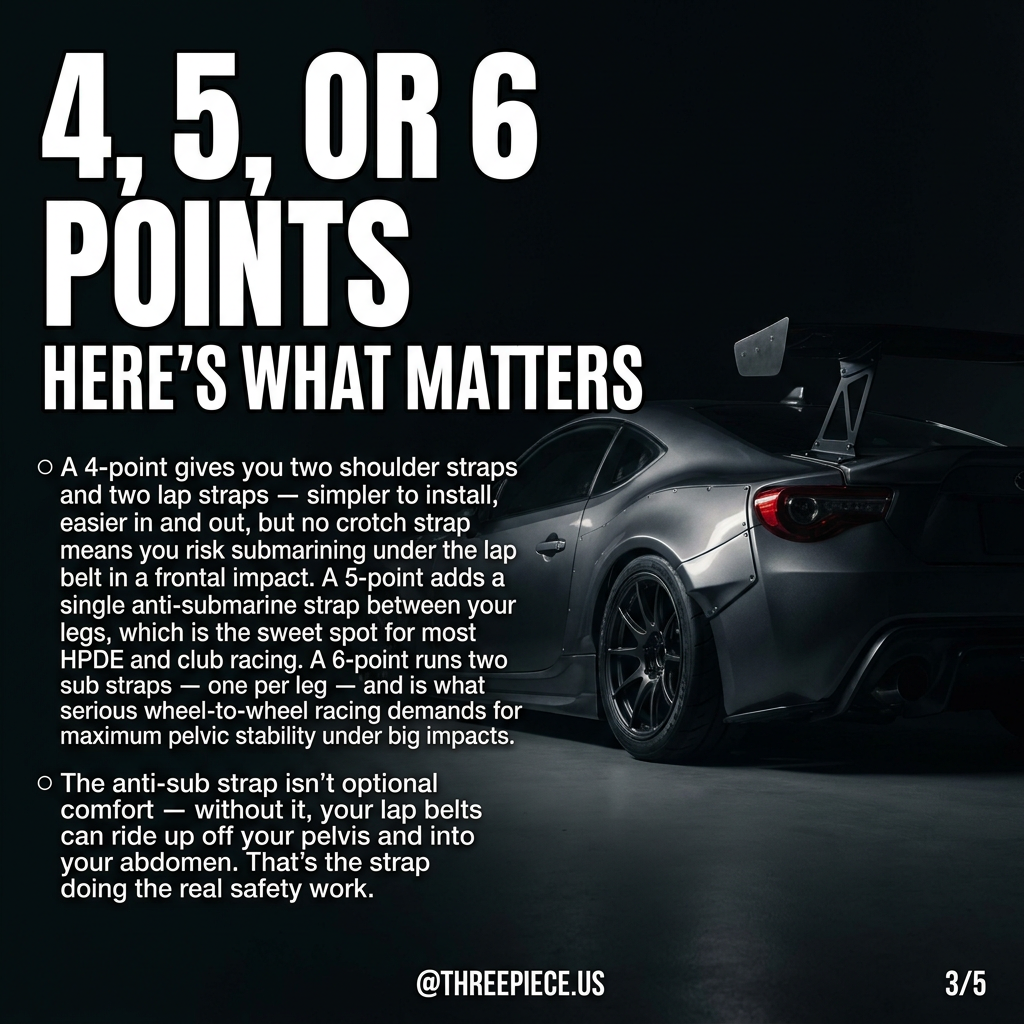
4-point harness: Two shoulder straps and two lap straps. Simpler to install, easier to get in and out of, and the most affordable option. The problem is there's no crotch strap, which means in a frontal impact your body can submarine — slide forward under the lap belt so the belt rides up off your pelvis and into your abdomen. That's a serious injury mechanism. A 4-point is acceptable for some casual track use, but most experienced builders skip it entirely.
5-point harness: Adds a single anti-submarine strap between your legs to the 4-point layout. This is the sweet spot for most HPDE and club racing — it provides solid pelvic retention, passes tech at virtually every sanctioning body, and balances safety with comfort and ease of use. If you're doing one or two track days a month and running timed sessions, a 5-point with FIA or SFI certification is the move.
6-point harness: Two sub straps — one per leg — plus two laps and two shoulders. This is what serious wheel-to-wheel racing demands. The dual anti-submarine straps provide maximum pelvic stability under big impacts and high-g loading. If you're running door-to-door in a caged car with a full containment seat, this is the standard. The trade-off is more complexity during entry/exit and a tighter fit that's less forgiving for longer stints.
There are also 7-point and negative-G strap configurations — primarily seen in aeronautic applications or certain sanctioning bodies — that add straps to hold the cam-lock buckle in place under negative g-forces (when forces try to lift you out of the seat). These are niche and rarely relevant for standard car racing. If you're curious about how build-order decisions stack up in track-focused platforms, our 350Z track build guide walks through the full mod order including safety equipment.
Mounting Geometry: Where Most Builds Go Wrong
Here's the uncomfortable truth that every forum repeats: a poorly mounted harness is genuinely less safe than a stock seatbelt. The harness itself is only as good as its mounting geometry, and most DIY installations get this wrong.

Shoulder straps need to anchor at or just below shoulder height — straight back to a harness bar or roll cage, at an angle between 0° and −20° below horizontal. If the straps route steeply downward to the floor behind the seat, the belt compresses your spine in an impact instead of holding you back against the seat. This is the single most common installation error and it turns your safety equipment into a liability.
Lap belts must sit low on your hips — across the iliac crests of your pelvis, not across your abdomen. They should be anchored to reinforced chassis points with Grade 8 hardware and backing plates, angled roughly −45° to −80° from horizontal. Bolting lap belts to thin sheet metal or stock seat brackets is a recipe for mount failure under load.
Anti-submarine straps need correct forward or rearward routing angles depending on the manufacturer's specification. Incorrect geometry here defeats the entire purpose of the strap — if it can't resist your pelvis sliding forward, you're back to the submarining problem that the strap exists to prevent.
The takeaway from every experienced builder: if you can't mount it to a proper harness bar, roll bar, or roll cage with correct geometry, don't mount it at all. Keep your stock belt until the car is properly set up. This is the same principle behind getting your coilover setup right the first time — cutting corners on safety-critical components always costs more in the end.
FIA vs SFI Certification Explained
Certifications matter because they're what tech inspectors check and what sanctioning bodies require. The two main standards are:
FIA (Fédération Internationale de l'Automobile): The international standard. FIA-certified harnesses are tested and homologated for specific load ratings, webbing strength, buckle integrity, and flame resistance. FIA certification is required for most international racing series and many domestic sanctioning bodies. FIA harnesses carry a hologram label with a manufacture date and an expiration — typically 5 years from the date of manufacture for competition use.
SFI (Safety Foundation, Inc.): The primary US-based standard. SFI Spec 16.1 covers harnesses with lap, shoulder, and anti-submarine belts. SFI-certified harnesses are required by many American sanctioning bodies (SCCA, NASA, etc.) and also carry expiration dates — typically 2 years from the date of manufacture for SFI 16.1, though this varies by spec.
Harness webbing degrades over time from UV exposure, heat cycling, and general wear. Stitching weakens. This isn't theoretical — it's why tech inspections universally require harness replacement after the defined service life or after any significant impact event. Running an expired harness is the same as running no harness in the eyes of most tech inspectors. Budget for replacement when you budget for the harness itself.
Harnesses also don't play nicely with OEM airbags. Because a harness holds you low and tight, the timing and deployment geometry of factory airbags changes — your head and neck are in a different position than the airbag system was designed for. This is why you see racing harnesses used in concert with racing seats, HANS devices, and helmets — the entire safety system works together. Mixing and matching components from different safety philosophies (harness + stock airbags + no helmet) creates unpredictable outcomes.
Who Actually Needs a Racing Harness

If you're doing track days, autocross, or any form of competition: A 5-point harness with FIA or SFI certification, mounted to a proper harness bar or roll cage, is non-negotiable. It keeps you planted, passes tech, and makes you a measurably better driver on track because your body isn't fighting the car. Pair it with a proper fixed-back racing seat and a helmet — the harness is one piece of a system, not a standalone upgrade.
If you're running wheel-to-wheel: Go 6-point. The dual anti-submarine straps provide the pelvic stability you need when another car is inches away and impacts aren't hypothetical. Your sanctioning body almost certainly requires it, and the marginal inconvenience of two sub straps is irrelevant when you're racing door-to-door.
If this is a street-only car with no roll cage and no helmet: Keep your stock belt. It's designed to work with your airbags and crumple zones in ways a harness isn't. A harness on a street car without the supporting safety infrastructure (cage, seat, HANS, helmet) is a style piece that can make outcomes worse in a real-world collision. The harness is a track tool — use it where it belongs.
Some states also prohibit removing or modifying OEM belts and airbags, and vehicles with competition seats and harnesses may fail registration, inspection, or insurance review. The forum debate between welding in a harness bar versus bolt-in tabs is real, and the answer depends on your local regulations and whether the car ever needs to pass street-legal inspection. If you're building a dedicated track car on a platform like the FR-S/BRZ or 350Z, the harness is part of the build plan from day one.
Completing the Build: Wheels, Suspension, and Safety
A racing harness is one component in a track-ready build. The car still needs wheels that can handle sustained heat, a suspension setup dialed for the kind of driving you're doing, and tires that match the grip level you're asking for. If you're prepping a car for HPDE or time attack, the harness goes in alongside properly valved coilovers, lightweight wheels in the right fitment, and a tire compound that can take repeated heat cycles.
For wheel fitment on popular track platforms, we've built detailed guides for the GR86, GT-R R35, C6 Corvette, and GTI — proper sizing matters as much on track as proper harness geometry. Browse our full wheel catalog for options across bolt patterns and widths, or check the vehicle gallery to see how other builds have come together.
If you're running a 3-piece wheel setup on a track car, make sure your assembly hardware is torqued and inspected regularly — the M7x32 Chrome Assembly Bolt at $10 and the M8x32 Chrome Assembly Bolt at $10 are the kind of small details that keep your wheels together at speed. Don't forget proper 90-degree valve stems at $3.80 for easy tire pressure checks between sessions, and hubcentric rings to eliminate vibration on track. A harness keeps you in the seat — the rest of the build keeps the car underneath you.