
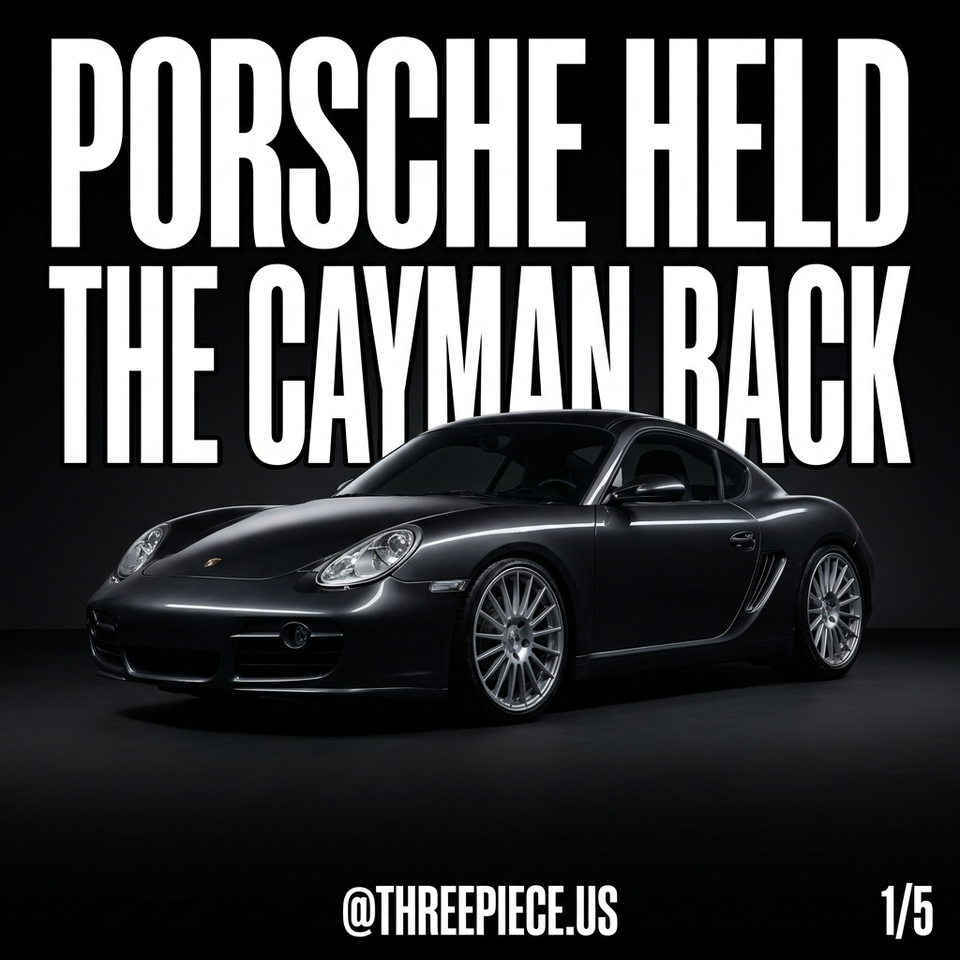
Porsche spent fifteen years building a car it wasn't allowed to let win. Ranked generation by generation, the Porsche Cayman history is the story of a mid-engine coupe that was lighter, better balanced, and more honest than the 911, and detuned on purpose so the rear-engine cars kept selling. If you're shopping a used Cayman right now, the generation split matters more than the trim, the mileage, or the paint-to-sample spec. The short version: buy the 981. The rest of this article explains why, and what to bolt to it once it's in your garage. If you've already read our 911 generations ranking, consider this the sibling Porsche never wanted you to compare.
Quick links
- 987 Cayman (2006-2012): the IMS split
- 981 Cayman (2013-2016): why it's the peak
- 718 Cayman: the flat-four and the 4.0 comeback
- Every Cayman generation ranked, and which to buy
- Cayman wheel fitment: 5x130 and staggered
- The verdict
987 Cayman (2006-2012): "Boxster with a roof" and the IMS split
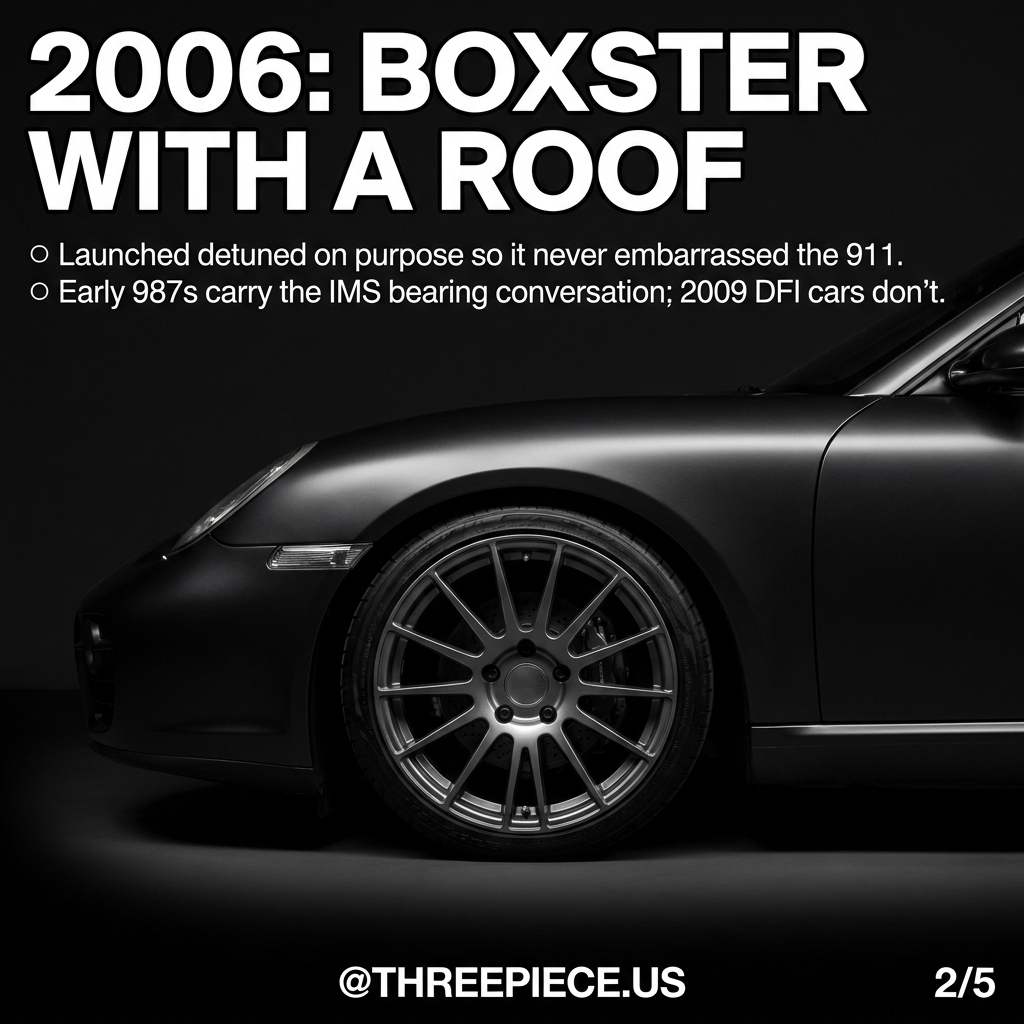
The joke was half true. The 987 Cayman shared its bones with the Boxster, but the fixed roof made it a noticeably stiffer shell with a real rear hatch and trunk. Porsche launched the Cayman S first with a 3.4L flat-six making 295hp, conveniently short of the contemporary Carrera. The base 2.7L at 245hp followed and is the slow-ish one. If you're shopping 987.1, the 3.4 S is the car.
The line that actually matters on the used lot is 2009. The 987.1 cars run the M97 engine and carry the intermediate shaft bearing conversation, the same IMS anxiety we unpacked in our Porsche 996 buyer's guide. The 2009 refresh (987.2) moved to the 9A1 direct-injection engines, which have no IMS bearing at all, plus PDK as an option. Base output rose to 265hp from a 2.9L, and the S went to 320hp. The lightweight Cayman R at 330hp closed out the generation and is the 987 collectors circle.
Translation: a 987.2 is the cheapest way into a Cayman without budgeting for a bearing retrofit. Cross-shopping one against a 911? Our 996 Turbo buyer's guide covers the other side of that coin, and if you go that route, the Fortune Auto 500 Series Coilovers for the 996 Carrera 4S & Turbo ($1,799) are the 996-specific option. For a 987 on its original 18s, browse 18-inch wheels in 5x130.
981 Cayman (2013-2016): why it's the peak
This is the one. The 981 got a longer wheelbase, a wider track, and electric power steering that Porsche, against all forum predictions, actually got right. Most importantly, it's the last standard Cayman with a naturally aspirated flat-six, and you can still get it with three pedals.
The lineup: base 2.7L at 275hp, S 3.4L at 325hp, and the GTS at 340hp, the sweet spot for people who actually drive these. Then the 2016 GT4 showed up with the 3.8L and 385hp, manual only, and became the car every Cayman since has been chasing. It's the collector car now, and it's priced like it.
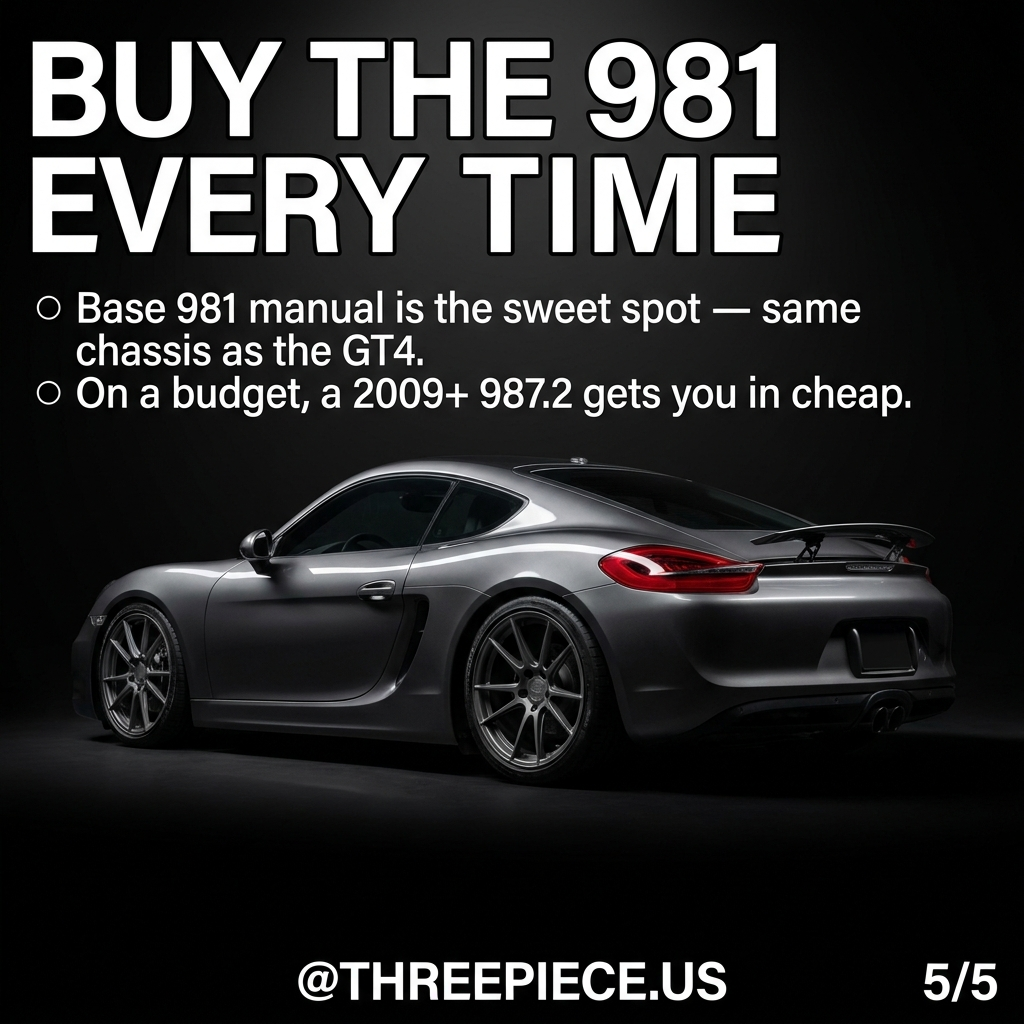
Here's the insider move: the base 981 manual sits on the same 981 shell the GT4 was built from. You won't get the GT4's engine or its front suspension hardware, but you get the proportions, the wheelbase, and the chassis balance for a fraction of the price. Spend the difference on suspension and a proper set of wheels and you've built most of the feeling. It's the same logic behind our manual RWD coupe picks, just with a flat-six behind your head.

718 Cayman: the flat-four and the 4.0 comeback
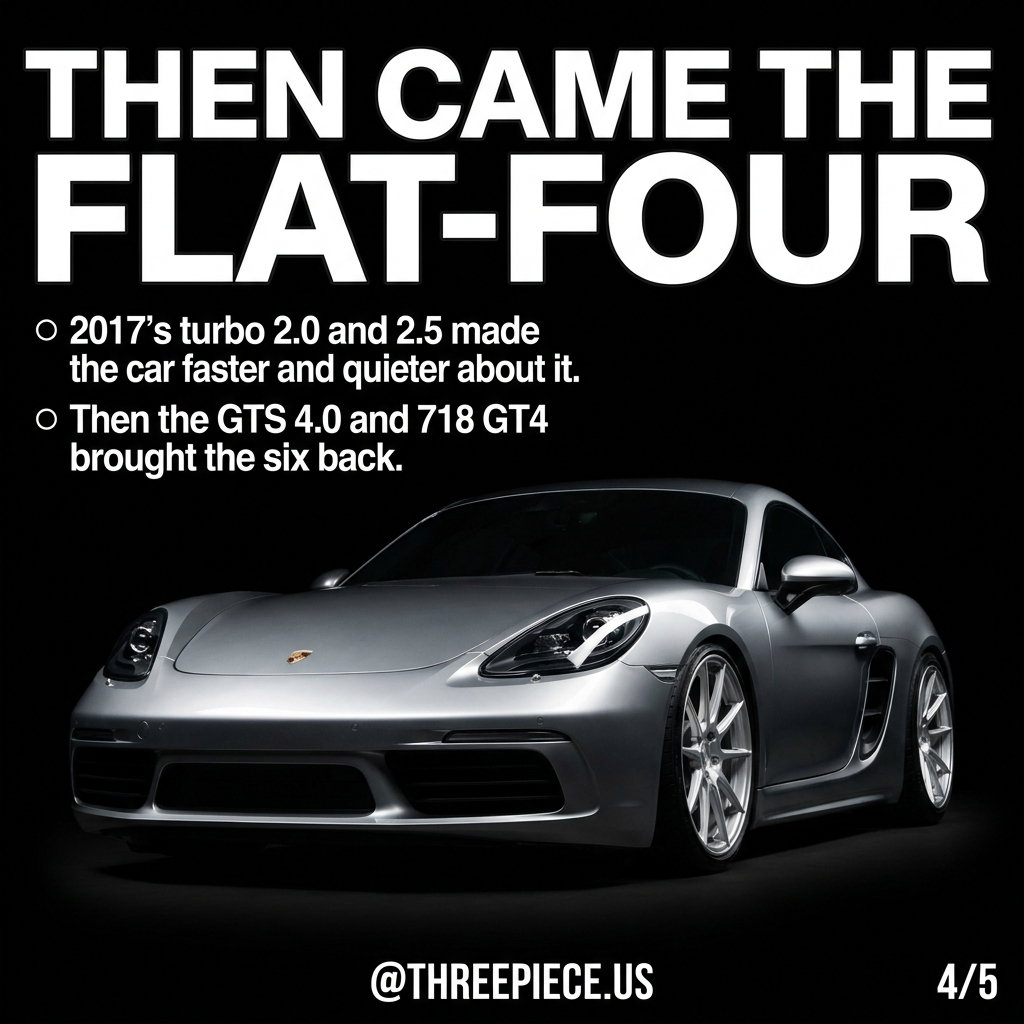
In 2017 the 718 replaced the flat-six with turbocharged flat-fours: a 2.0L at 300hp and a 2.5L at 350hp in the S, later 365hp in the 2.5 GTS. On paper it's faster. Out of a corner, the torque is real. And it sounds like a Subaru shopping cart. That's the whole argument, and the internet has been having it ever since.
Then Porsche quietly admitted it went too far. The 718 GTS 4.0 brought back a naturally aspirated six at 394hp, and the 718 GT4 made 414hp from the same 4.0. They're brilliant cars. They're also priced so far above a clean 981 GTS that the value math falls apart unless you specifically want the newest one in the parking lot.
If you're comparing modern alternatives, our G87 M2 fitment guide and Audi TT RS wheel fitment guide cover the other cars 718 shoppers end up test-driving.
Every Cayman generation ranked, and which to buy
Our ranking, built on what owners actually keep and what the market actually rewards:
- 1. 981 (2013-2016): NA flat-six, manual, no IMS, the GT4's chassis. The peak.
- 2. 718 GTS 4.0 / GT4 4.0: the best-driving modern Caymans, held back only by price.
- 3. 987.2 (2009-2012): the budget entry. DFI, no IMS, the cheapest real Cayman.
- 4. 987.1 (2006-2008): great chassis, but buy the 3.4 S and know its IMS history.
- 5. 718 flat-four: fast, capable, and nobody's heart rate has ever gone up because of it.
The move: buy a 981 S or GTS, enjoy the IMS-free peace of mind you already have, and put the savings into wheels and tires. On a budget, a 2009+ 987.2 gets you in cheap. Either way, check the vehicle gallery before you commit to a look. Seeing real fitment on real cars saves more money than any spreadsheet. Today's budget pick, by the way, is a perfectly respectable starting point: something like the Work Emotion CR Kiwami, listed from $270, is how a lot of endgame sets start. There is no endgame, of course. That's the joke.
Cayman wheel fitment: 5x130, 71.6mm, and staggered
Every Cayman generation runs 5x130 with a 71.6mm hub bore, and every one is staggered from the factory. That's the good news, because "I'll just throw a square setup on it" is a Saturday morning phrase that ends Sunday night with a spacer order and two trips to the hardware store for a socket you already own.
Factory references worth screenshotting: the 987 Cayman S on 18s ran 235/40ZR18 front and 265/40ZR18 rear. The 981 S on 19s runs 235/40ZR19 front and 265/40ZR19 rear, so start with 235/40R19 tires and 19-inch 5x130 wheels. The 981 GT4 went to 20s with 245/35ZR20 front and 295/30ZR20 rear; browse 20-inch 5x130 wheels and 245/35R20 tires if you want that posture. Our tire size chart helps if you're changing diameter and need to keep overall height in check.
Two protective notes. First, if your aftermarket wheel has a larger bore than 71.6mm, run hubcentric rings. Second, Porsche uses lug bolts, and OEM bolts are ball-seat while many aftermarket wheels are conical-seat. Match the seat to the wheel, every time.
For the wheels themselves, the Work Wheels lineup is where a lot of Cayman owners land. The Work Emotion T7R (from $432) is the clean track-day look, the Work Brombacher Mesh (from $684) leans hard into Euro heritage, and the Work Emotion CR 3P (from $895.50) is the jewelry option, a set you can lip-swap and rebuild for years. Confirm 5x130 availability for your exact size before ordering. If you go multi-piece, keep the assembly bolts and refinishing pages bookmarked for when the lips need love.
The verdict: buy the 981, spend the rest on wheels
The Cayman was always the better-balanced Porsche, and the 981 is the moment Porsche let it get closest to the truth: naturally aspirated, manual, no IMS, and built on the shell that became the GT4. Buy the 981, fix the stance, and let the savings go into a set of wheels worth staring at in the garage. For deeper wheel rabbit holes, the Work Meister series is where the multi-piece Porsche crowd ends up eventually.
Now settle it: if you had 981 GTS money in hand, would you take the GTS, or stretch for a 718 GTS 4.0 and live with the payment?