
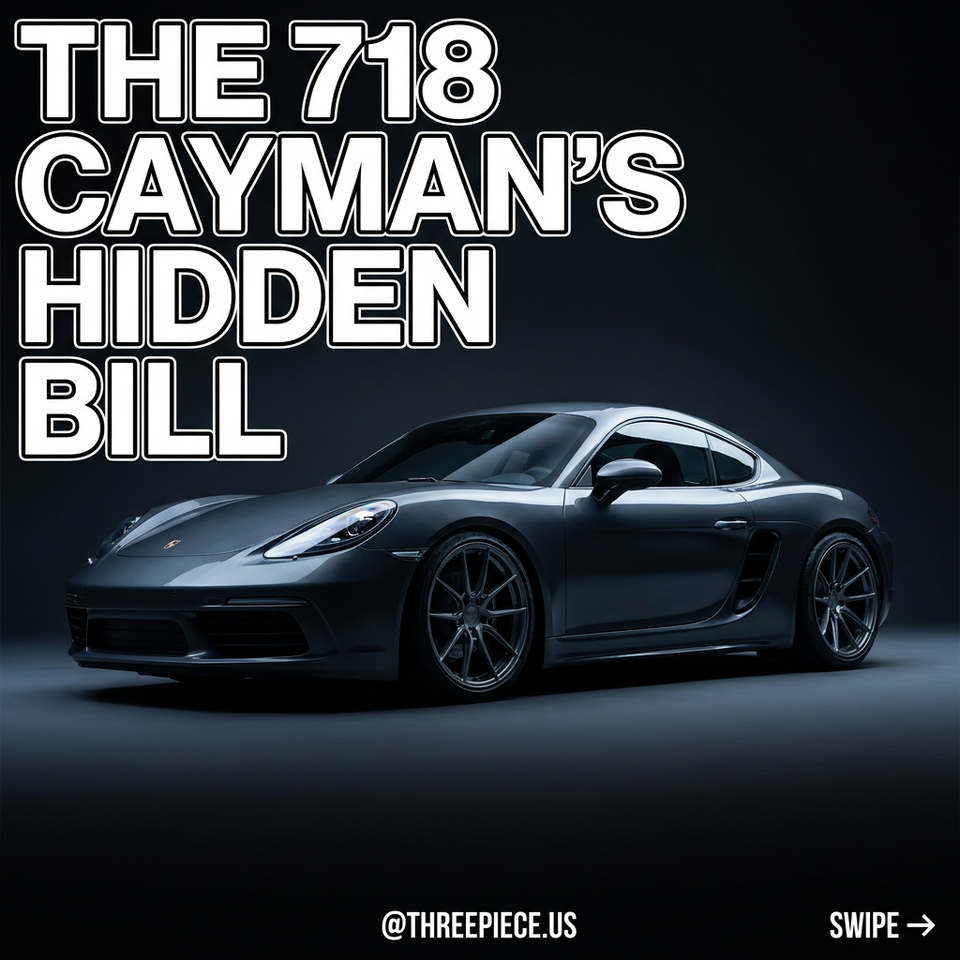
The Porsche 718 Cayman might be the best-driving car under six figures. It is also one of the most expensive cars under six figures to keep on the road once the warranty clock runs out. Every 718 Cayman buyer's guide tells you about the steering and the mid-engine balance. Almost none of them tell you what an AOS diaphragm, a seized wastegate actuator, or a tired PDK mechatronic unit costs when the car is out of warranty and the previous owner deferred everything.
Quick links
- The turbo flat-four tax
- Cooling is what wrecks the S models
- PDK will humble your wallet
- The 981 flat-six argument
- Who should still buy one
- Wheels and fitment on a 718
- The verdict
The turbo flat-four tax
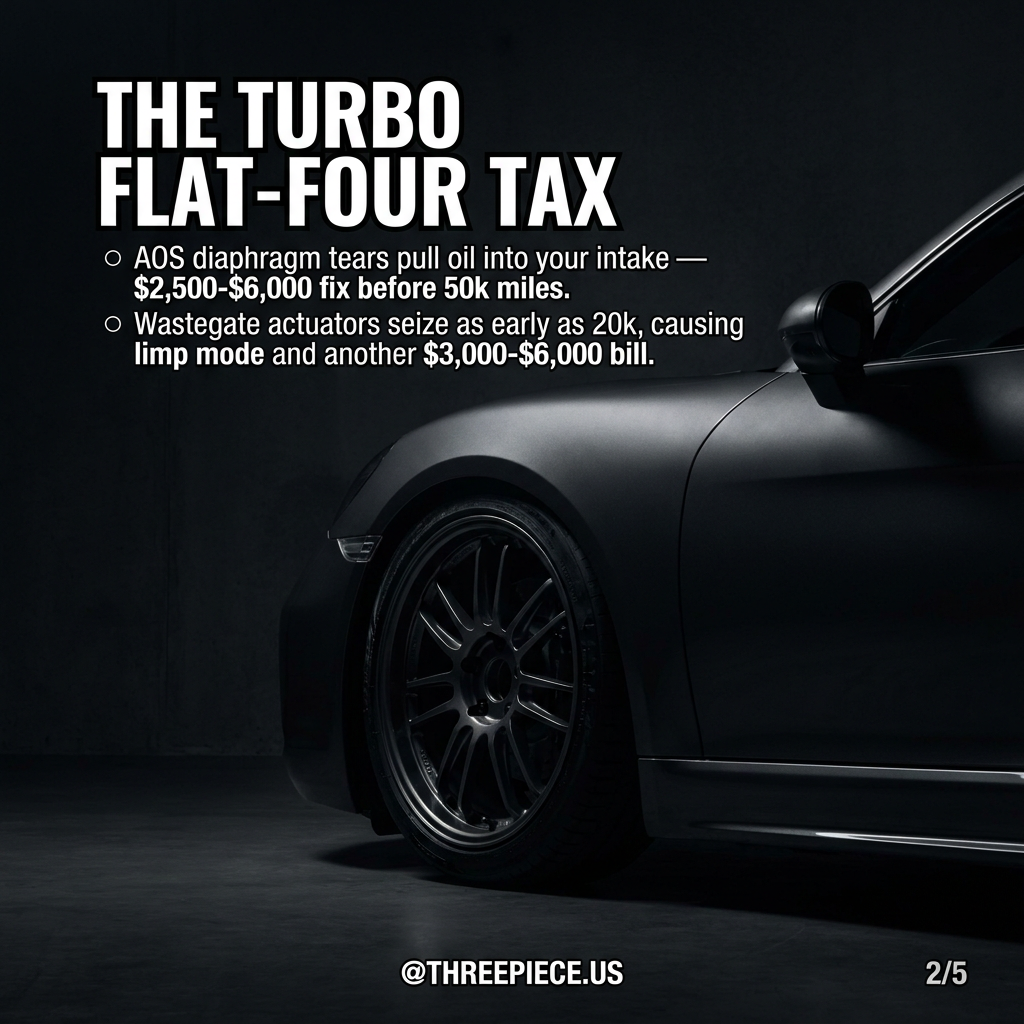
Porsche replaced a naturally aspirated flat-six with a turbocharged flat-four and handed buyers a whole new maintenance category. The one that hurts most is the air-oil separator. The internal diaphragm tears, crankcase vacuum spikes, and oil gets pulled into the intake tract. Symptoms owners report on the forums are consistent: blue-white smoke on cold start, a whistle or hiss at idle, and fuel trim codes that make no sense until someone actually pulls the intake. Depending on how much oil went where it shouldn't, that repair lands between $2,500 and $6,000, and it shows up well before 50k miles on plenty of 2.0L cars.
Then there's boost control. Wastegate actuator seizure and rattle is documented on both the 2.0L and 2.5L engines as early as 20,000 miles, and because labor often includes turbo removal, dealer quotes run $3,000-$6,000. Add direct-injection carbon buildup at 50-70k miles — walnut blasting territory, same story as every DI platform, including the ones we covered in our E90 335i N55 buyer's guide. If a 718 feels laggy and idles rough on a test drive, you're not driving a turbo car, you're driving a dirty one.
Cooling is what wrecks the S models
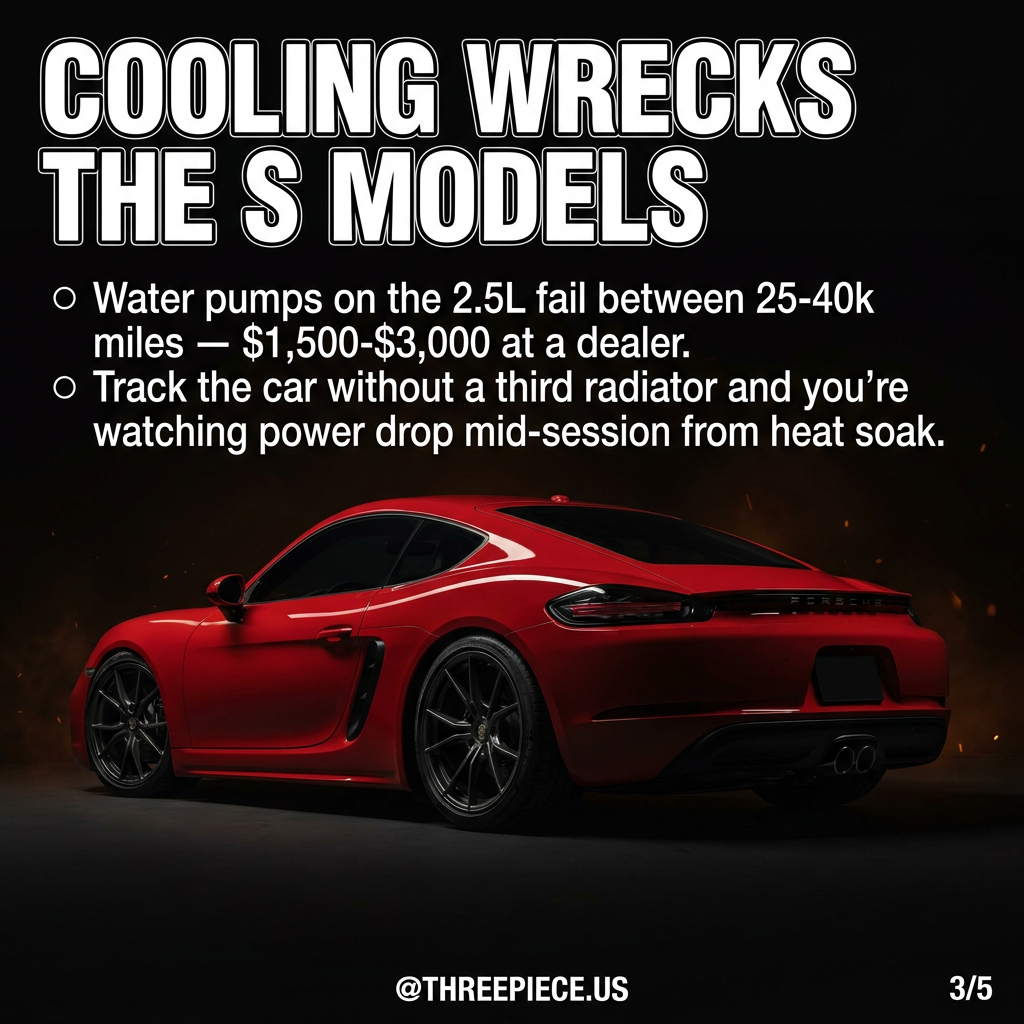
The 2.5L S cars have a well-documented water pump pattern: bearing or seal failure between 25,000 and 40,000 miles, with dealer repairs at $1,500-$3,000 including coolant and labor. One Reddit owner's CPO 2018 needed $3,700 of work at low mileage — deformed timing chain tensioner seals plus a coolant pump — and only walked away clean because the warranty was still alive.
Track use exposes the other half of the problem. The factory radiator and intercooler package is adequate for aggressive road driving and marginal on a hot session day. Heat soak arrives mid-run and power just quietly leaves. The common owner fix is the third radiator in the center opening plus better ducting, which is exactly the same logic we walked through in our piece on whether an oil cooler is worth it on track: on a boosted car, cooling is not a mod, it's a prerequisite. If you're going to do lapping days, budget cooling before you budget power, and read track vs street tires before you spend a dollar on a tune.
PDK will humble your wallet
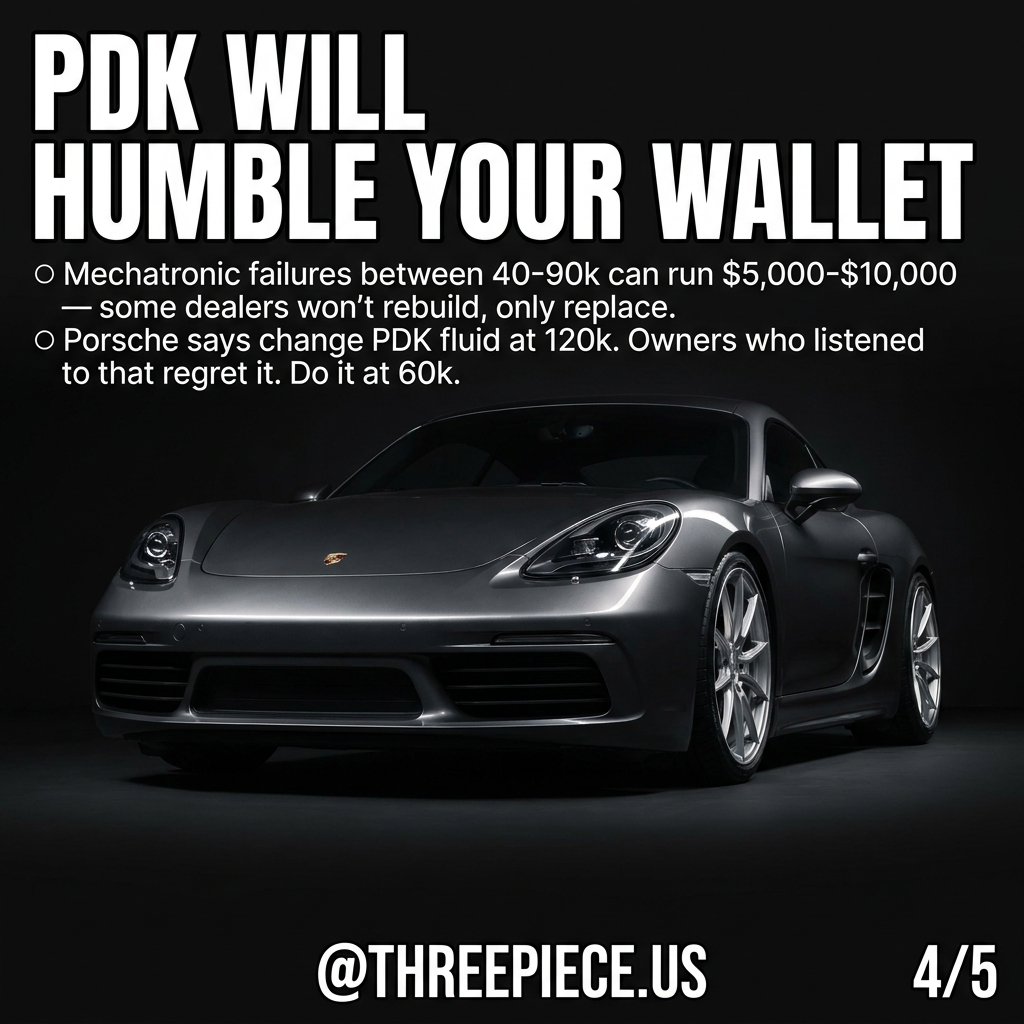
PDK is a fantastic gearbox and a genuinely durable one — right up until the mechatronic unit acts up. Reported failure window is 40,000 to 90,000 miles, and the bill runs from $2,500 for a repair to $10,000 when a dealer will only replace the unit rather than rebuild it. The single best thing you can do is ignore Porsche's 120,000-mile PDK fluid interval. Owners who took that number literally are the ones posting the failure threads. Do it at 60,000 miles and sleep better.
Manual buyers aren't exempt. The 6MT has a known 1-to-2 grind above roughly 4,000 rpm, usually traced to clutch hydraulics or a tired slave cylinder, occasionally to actual synchro wear. Cheap to diagnose, expensive to ignore. Same goes for the wear items nobody mentions in the listing: rear axle boots at 50-70k miles ($300-$800 DIY, $1,200+ at a shop), PSE valve actuator rattle around 30-40k at $600-$1,500, and headliner sag that costs $1,500-$2,500 to fix properly on a car with a six-figure sticker when new.
The 981 flat-six argument
Here's the take that gets people heated: for a lot of buyers, the outgoing 981 Cayman S with the naturally aspirated 3.4L flat-six is still the smarter used purchase. No AOS diaphragm drama, no wastegate actuator, no charge-air heat management project, and a noise that doesn't need a synthesized soundtrack to be worth revving. The 718 chassis is measurably better and the flat-four makes more torque lower down. That doesn't erase the fact that the 981 asks less of you every year you own it.
If you want the pattern-recognition version of this argument, our 996 Turbo buyer's guide covers the same dynamic: the cheap Porsche is never the cheap Porsche. It's the one with the most deferred maintenance and the most owners hoping the next guy eats it. Water-cooled Porsche shopping is deferred-maintenance archaeology, and the 718 is now old enough to qualify.
Who should still buy one
Buy it if the car is under warranty or CPO, has documented service history including intake cleaning, AOS, and coolant pump work, and you can genuinely set aside $3,000-$4,000 a year for ownership. Under those conditions the 718 is one of the best mid-engine chassis on the planet at any price, and nothing in this article changes that.
Walk away if it's a 2017-2018 car, out of warranty, with a thin folder and a suspiciously good price. At that point you're not buying a sports car, you're buying someone else's maintenance backlog with a Porsche crest on it. Pre-purchase inspection is non-negotiable: pull the intake side, check for oil, watch a cold start, scan for boost-control codes, and ask for the PDK fluid record. If the seller gets weird about any of those, you already have your answer.

Wheels and fitment on a 718
Assuming you've done the homework and bought a good one, the 718 is a car that rewards restraint in the wheel department. Factory S sizing is 19x8 ET57 front and 19x9.5 ET45 rear on 235/40R19 and 265/40R19, with GTS and GT4 cars stepping up to 20s and a much wider rear. That 5x130 bolt pattern and the high-offset front are what keep most generic aftermarket sets off this car. Our full Porsche 718 Cayman wheel fitment guide has the specifics, and if you want the theory behind why a wide rear needs a different offset strategy than the front, read how we handle staggered sizing on the RS6.
Start with 19-inch wheels in 5x130 and match tires to your actual use — 235/40R19 up front, 265/40R19 out back, and if you're doing real lapping days our breakdown of 200TW vs summer performance tires will save you a set. Style-wise, the mesh look is native to this chassis — Work's Brombacher Mesh at $684 exists specifically because of German mesh heritage, and the Work Emotion CR 3P at $895.50 is the three-piece answer for anyone who wants a custom lip and barrel spec instead of an off-the-shelf face. Browse the full Work Wheels lineup or the vehicle gallery if you want to see fitment executed properly before committing.
If you're running a three-piece set, keep the small stuff in the box with the wheels: M7x32 socket cap assembly bolts at $10, silicone sealant at $10.99 for resealing barrels, and 90-degree valve stems at $3.80 because deep-lip wheels and straight stems are a bad relationship. Everything else lives in wheel parts, and if a set needs rescuing, refinishing is cheaper than replacing.
On suspension, the 718's factory PASM setup is genuinely good and most owners are better off leaving it alone until the shocks are tired. If you're shopping the older water-cooled cars instead, we stock Fortune Auto 500 Series coilovers for the 996 Carrera 4S and Turbo at $1,799, the 510 Series at $2,399 for the remote-reservoir version, and Function and Form Type 3 kits for the 993 Turbo at $1,590. See the full suspension catalog for what fits your chassis.
The verdict
The 718 Cayman isn't a bad car. It's a car that punishes anyone who budgets for the purchase price and forgets everything after. The owners who love theirs planned for the AOS, the water pump, and the PDK fluid. The owners listing theirs at 40,000 miles didn't. Buy the one with the folder, not the one with the discount — then spend the money you saved on wheels and tires instead of a mechatronic unit.
So settle it: is the 718 a genuine mid-engine bargain for buyers who do their homework, or was the naturally aspirated 981 Cayman S the one to buy all along? And if you own a 718 — what broke first, and what did it cost you?
Try wheels on your Porsche 718 Cayman: see the Porsche 718 Cayman bolt pattern, wheel sizes by year and wheel builds in our free wheel visualizer.