

E90 335i N54 Oil Cooler: Is It Worth It on Track?
The BMW E90 335i N54 is one of the most capable twin-turbo sixes ever bolted into a sedan — and it will cook its own oil before you finish your second stint. Stock oil temps hit 275–285°F within three hard laps on a warm day, which is limp-mode territory on a motor that deserves better. If you're tracking your 335i with any kind of tune, the question isn't whether you need better oil cooling — it's whether you're solving the right thermal problem first.

Quick links
- What stock oil temps actually look like on track
- Real before-and-after data from owners
- The thermal problem nobody fixes first
- The oil thermostat trap
- What a proper setup costs
- When to pull the trigger (and when to skip it)
- Finishing the track build: wheels and tires
What stock oil temps actually look like on track
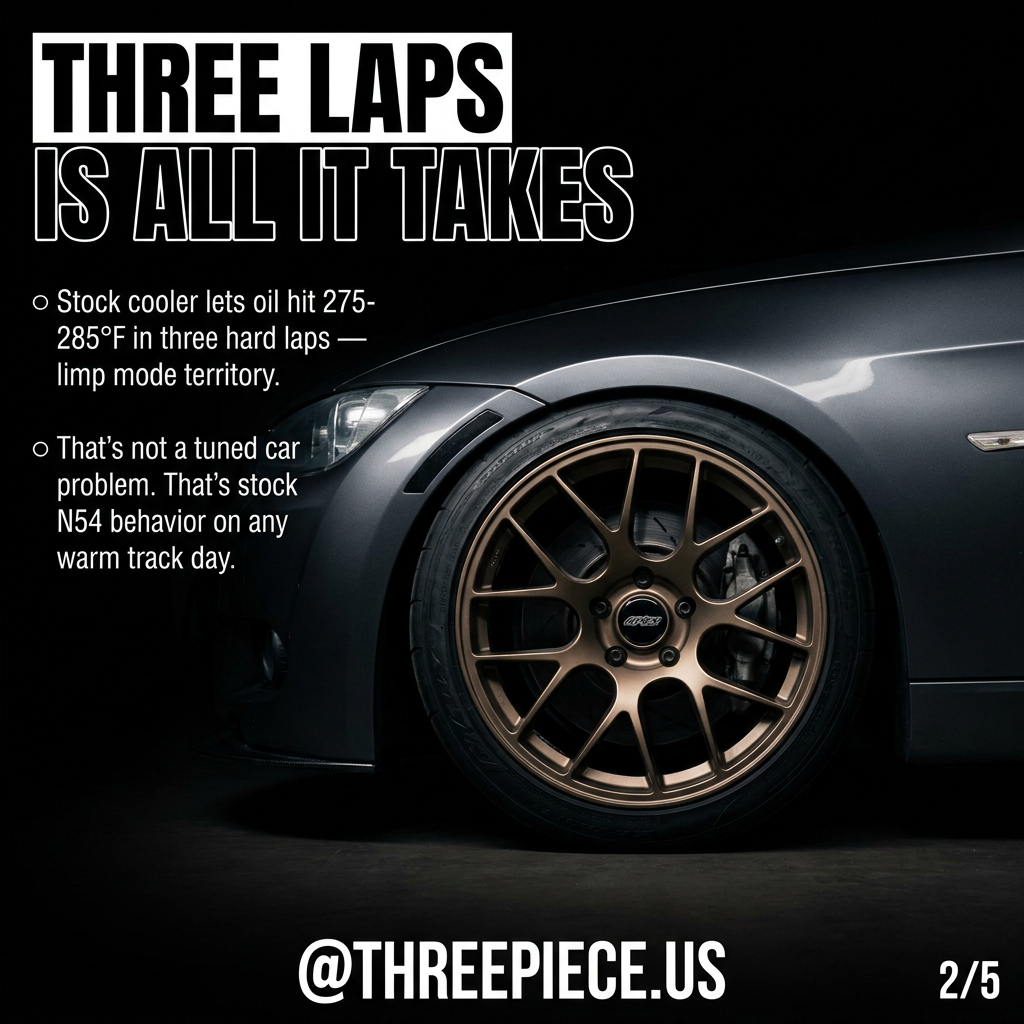
On the street, the N54 is fine. Logged data from owners consistently shows 220–250°F during spirited driving — well within the safe window. The problem starts the moment you string together sustained wide-open-throttle laps. That stock oil cooler core is roughly 8.75 × 4.75 × 1 inch — about 41 cubic inches of cooling capacity. It was sized for Autobahn pulls with cooldown periods, not 20-minute HPDE sessions in July.
By lap three on a warm track day, owners consistently log 275–285°F. The N54's limp mode triggers around 300°F, and if you're running a JB4 or MHD tune with full bolt-ons, you'll get there faster because you're making more heat. This isn't a tuned-car-only problem — stock N54s do this too. The tune just accelerates the timeline. If you've read our full N54 problems breakdown, you know thermal management is one of the platform's defining weaknesses.
Real before-and-after data from owners
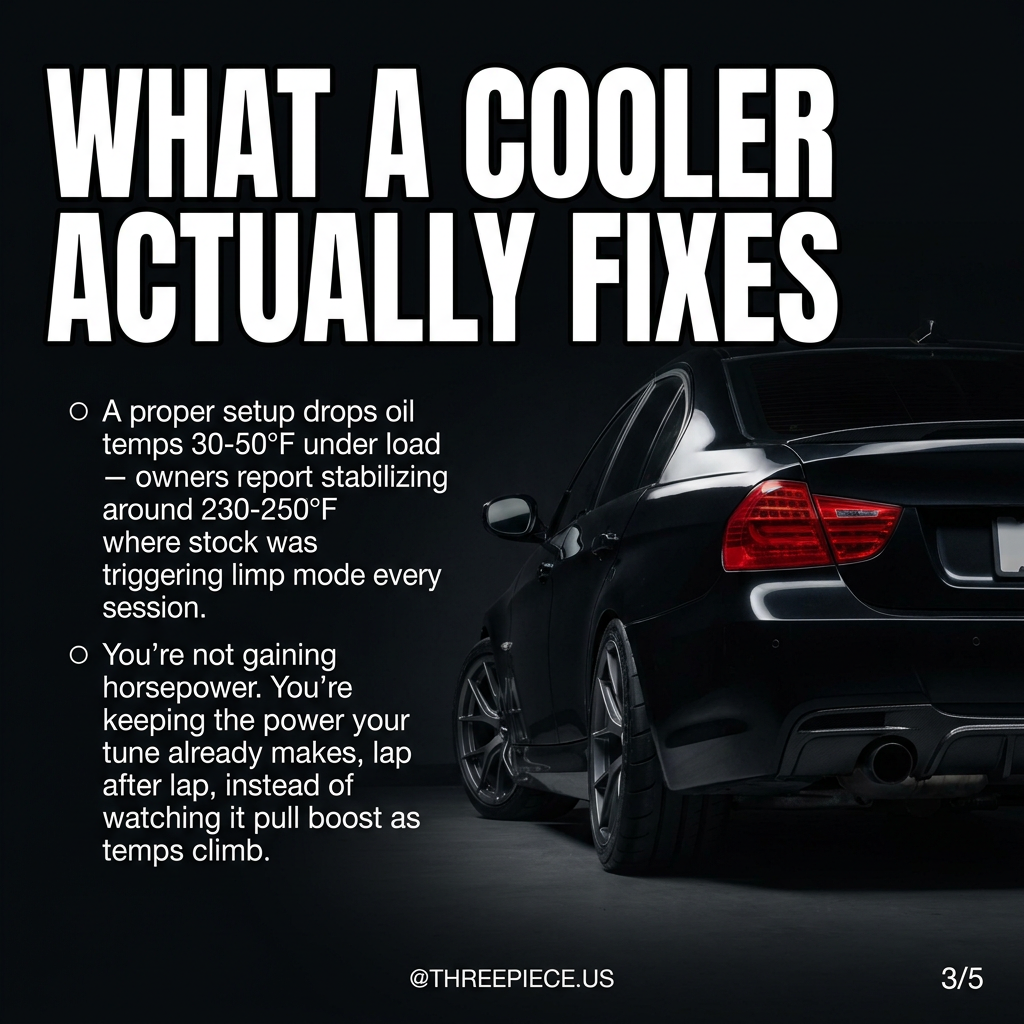
The forum data here is surprisingly consistent. Owners who install a quality aftermarket oil cooler — dual-core setups from Evolution Racewerks, large Setrab cores, or even the 335is OEM cooler swap — report oil temps dropping 30–50°F under sustained load. That's the difference between finishing a session at full power and watching your boost pull itself back every third lap.
Specific examples from logged data:
- Dual-core competition kit: Oil temps never exceeded 259°F even at high ambient temps and sustained sixth-gear wide-open throttle. Stock setup would have triggered limp mode.
- 19-row Setrab external cooler + OEM oil filter housing: Temps stayed meaningfully lower than the previous 280°F peaks after 20 minutes of track time.
- 335is OEM cooler retrofit in Florida summer: Owner reported oil stabilizing at 210–230°F — in Florida — with full bolt-ons. Previously hit limp mode after two laps every session.
That 210–230°F range is where you want to live. Your oil is actually doing its job, your turbos aren't being slowly cooked, and you're not losing power mid-session. For context on how much heat management matters in a turbo build, our Mazdaspeed3 400WHP build guide covers similar thermal lessons on another direct-injection turbo platform.
The thermal problem nobody fixes first
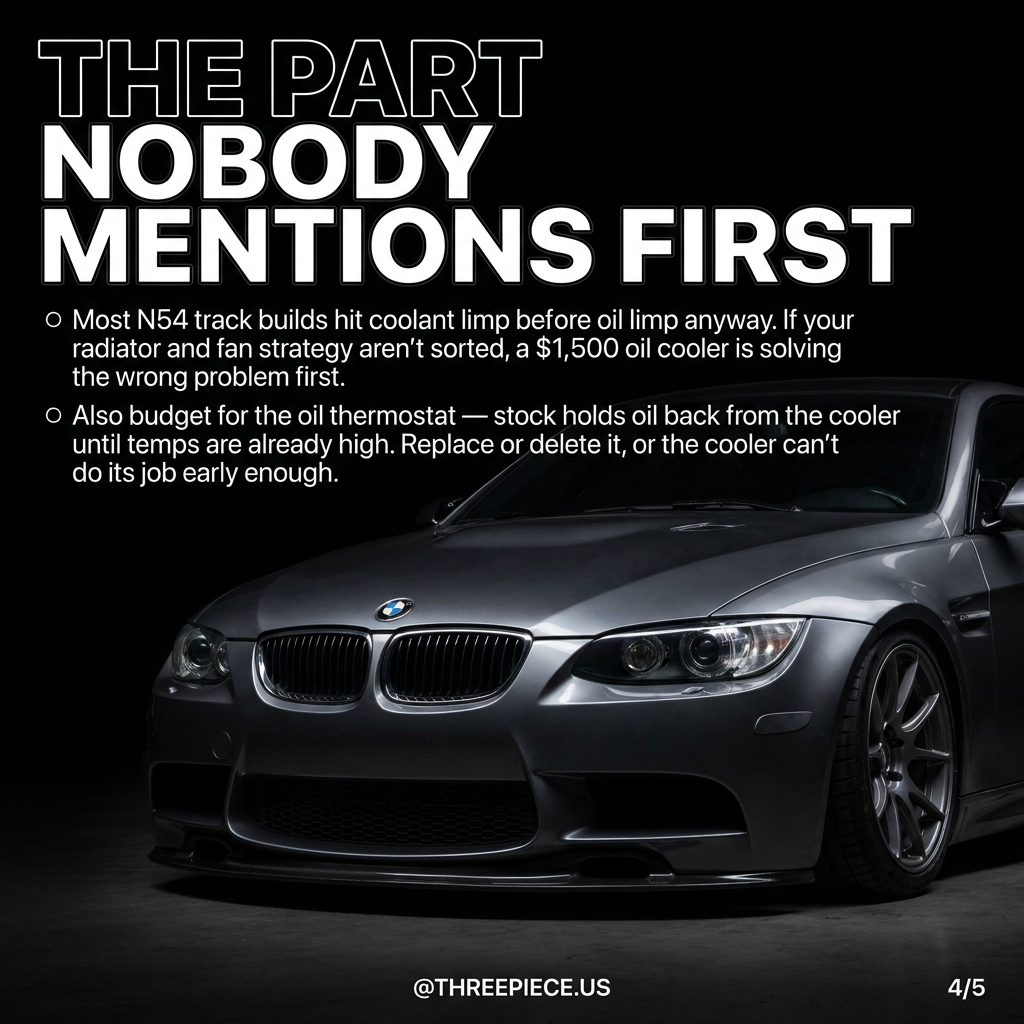
Here's the part most N54 track builds get wrong: most E90 335is hit coolant limp before oil limp anyway. If your radiator capacity, fan strategy, and engine bay airflow aren't sorted, a $1,300–$1,500 oil cooler kit is solving the wrong problem first. You'll spend the money, install it, and still get pulled off track — just by a different temperature sensor.
The smart build order is radiator upgrade and fan control first, oil cooler second. Some owners also add engine bay venting or ducting to get more air moving through the front end. The N54's cooling stack is already crowded with the charge air cooler, A/C condenser, and radiator fighting for the same air. Adding an oil cooler core to that stack without addressing airflow just moves heat around.
The GR86 track build approach we covered is a good reminder that thermal management is a system problem, not a single-part fix — and that applies whether you're cooling a naturally aspirated boxer or a twin-turbo inline-six.
The oil thermostat trap
Even after you install a proper oil cooler, the stock oil thermostat can undermine the entire upgrade. The N54's factory thermostat stays closed until oil temps reach roughly 230–250°F, which means your shiny new cooler isn't even seeing oil flow until temps are already elevated. By the time it opens, you're playing catch-up.
Most successful track setups either replace the thermostat with a lower-opening unit or delete it entirely. The trade-off: if you delete it and drive in cold climates, oil temps can stay too low in winter, which hurts moisture boil-off and viscosity. A lower-opening thermostat is the better compromise for a car that sees both street and track duty.
Budget for this when you budget for the cooler. It's a $50–$150 part that determines whether your $1,500 cooler actually works when it matters.
What a proper setup costs
Here's the real budget picture for an N54 oil cooling upgrade done right:
- Aftermarket dual-core oil cooler kit (Evolution Racewerks competition-level, dual 11×8×2" cores): $1,300–$1,500
- Oil thermostat replacement or delete: $50–$150
- Oil filter housing gasket (replace while you're in there — the OFHG is a known N54 failure point): $400–$800 at a shop, much less DIY
- Premium Dinan-level complete systems (for cars without factory cooler, including OFH, hoses, brackets, ducts): $4,000–$5,000
- Oil temperature monitoring (JB4, MHD, or standalone gauge): $50–$400 depending on what you're already running
DIY install takes several hours if you're comfortable routing lines. Shop labor adds up. More lines also mean more potential leak points — which is why replacing the OFHG at the same time is non-negotiable. That gasket goes brittle, starts leaking oil and coolant, and can soak your serpentine belt. Our N54 common problems guide covers the OFHG in detail.
When to pull the trigger (and when to skip it)
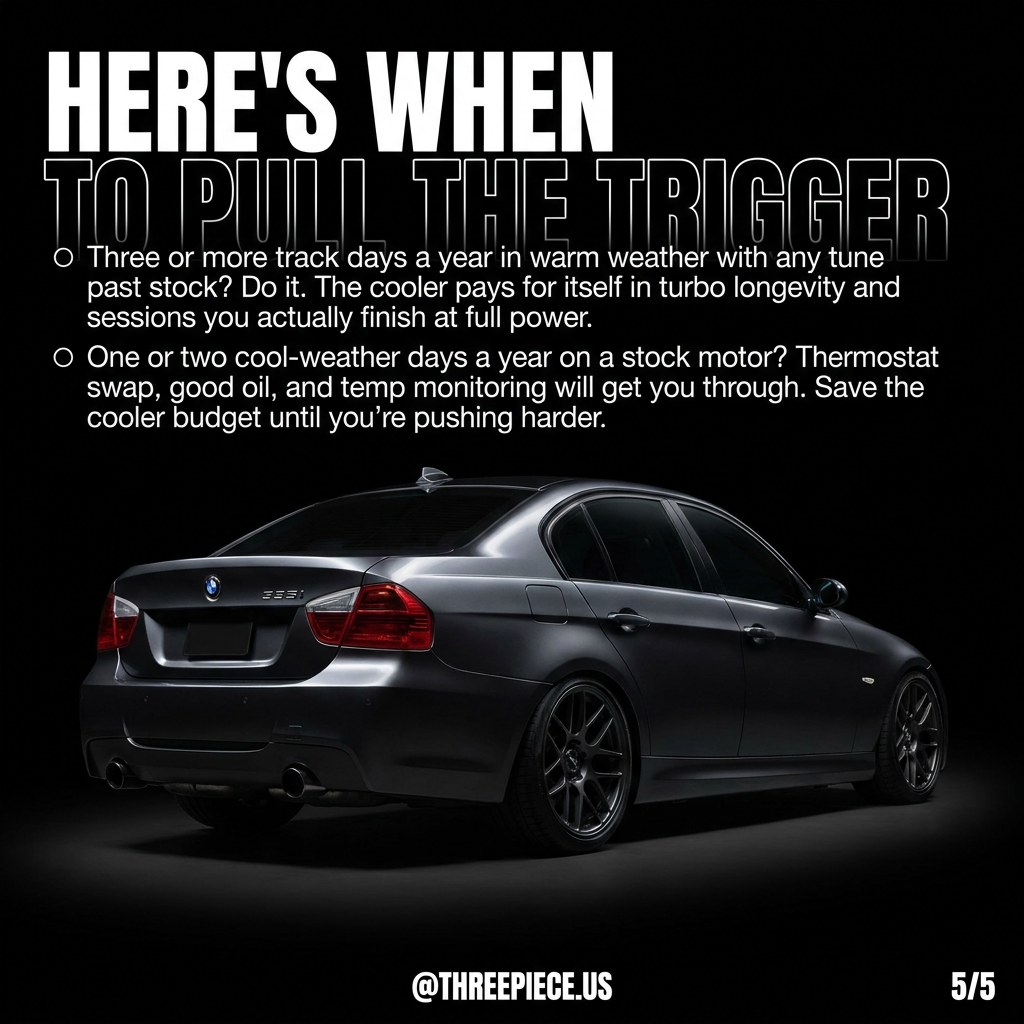
Do it if: You're doing three or more track days a year in warm weather with any tune past stock. The cooler pays for itself in turbo longevity, rod bearing health, and sessions you actually finish at full power instead of nursing a heat-soaked motor back to the paddock. The N54's rod bearings are already a known weak point — sustained high oil temps accelerate that failure mode significantly.
Skip it if: You do one or two cool-weather days a year on a stock motor. A thermostat swap, quality oil (0W-40 or 5W-40 with good HTHS ratings), and proper temp monitoring through JB4 or MHD will get you through. Save the cooler budget until you're pushing harder or adding power.
The middle ground that most forum veterans recommend: start with a thermostat swap and temp monitoring. Log your actual oil temps for a full session. If you're consistently seeing 260°F+, the cooler is justified. If you're staying under 250°F with the thermostat fix alone, you bought yourself time. For more on choosing the right performance tire compound for track days — because grip generates heat — that guide breaks down the 200TW vs summer tire decision.
Finishing the track build: wheels and tires
Once your thermal management is sorted, the next performance unlock on a track E90 is unsprung weight. The stock 18-inch wheels on a 335i are heavy, and dropping rotational mass improves braking, turn-in, and acceleration — all things you feel immediately on track.
The E90 335i runs 5x120 with a 72.56mm hub bore. For track duty, 18x8.5 +35 square is the proven sweet spot — enough width for a 255/35R18 tire without rubbing issues on stock fenders. Browse 18x8.5 wheels in 5x120 to see what's available. If you want a staggered setup, 18x9 +22 front / 18x10 +25 rear with 245/40R18 and 275/35R18 tires is the aggressive but functional track fitment — check out 18-inch 5x120 options and read our E46 M3 square vs staggered guide for the philosophy behind each approach on a BMW chassis.
For a dedicated track wheel that can take curb strikes and still look right in the paddock, the Work Emotion CR Kiwami starting at $270 is a flow-formed option that punches well above its price point. If you're building something that looks as serious as it drives, the Work Emotion CR 3P at $895.50 lets you spec the exact width and offset your build needs — that's the endgame set for an E90 that actually sees track time. Pair either with proper 255/35R18 tires and you're set.
Don't forget the details that separate a built car from a parts-bin car. 90-degree valve stems at $3.80 each make tire pressure checks between sessions painless — a small thing until you're fumbling with a gauge in a hot pit lane. And if you're running Work wheels, finish them with proper Work center caps. Check out our vehicle gallery for E90 builds running these setups.
The N54 is worth the effort. It's a motor that rewards the owners who actually manage its thermal weaknesses instead of ignoring them until something grenades. Sort the cooling, sort the wheels, and you've got a track sedan that embarrasses cars costing twice as much.
What's your N54 oil temp stabilizing at on track — and did you fix coolant or oil temps first?