

C8 Corvette Build Guide: Mod Order That Works (2020-2026)
The C8 Corvette is the best performance-per-dollar platform GM has ever produced — but most owners leave the majority of its potential untouched with random bolt-ons that don't add up to anything. The LT2 responds to a complete plan, not a parts list. Intake to exhaust to tune, done in order, done together. That's when this mid-engine platform actually wakes up and starts putting down 500+ whp at the rear wheels. Here's the build path that real C8 owners on CorvetteForum have validated with dyno sheets, trap speeds, and thousands of track miles.

Quick links
- Why the Z51 Is Your Non-Negotiable Starting Point
- The Power Path That Actually Works on the LT2
- Tuning the GM E99 ECU: What You Need to Know
- C8 Corvette Wheel Fitment That Clears Brembos
- Suspension: Drop It Right, Not Just Low
- Known C8 Weak Points to Budget For
- The Complete C8 Build Sequence
Why the Z51 Is Your Non-Negotiable Starting Point
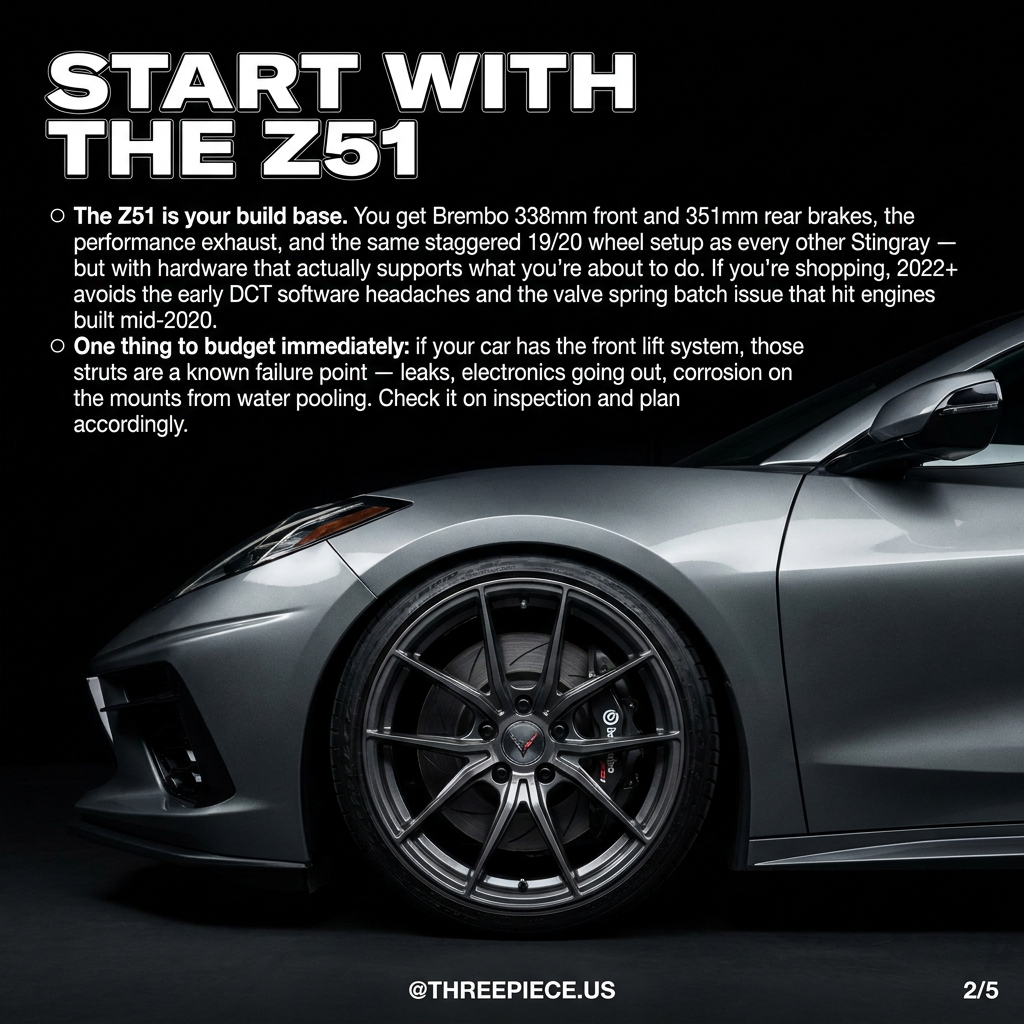
Every serious C8 build starts with the Z51 package. You get Brembo 338mm front and 351mm rear brakes, the performance exhaust, an electronic limited-slip differential, a higher-capacity cooling system, and the same staggered 19/20 wheel setup as every other Stingray — but with hardware that actually supports what you're about to bolt on. The Z51 also comes with a shorter final drive ratio (5.17:1 vs 4.89:1), which sharpens acceleration noticeably.
If you're shopping, target 2022 model year and later. The early 2020-2021 cars had DCT software calibration issues and a valve spring batch problem that hit engines built mid-2020. Both were addressed through TSBs and production changes, but avoiding them entirely is the smarter play. The C8 is already a mid-engine car with a world-class chassis — the Z51 just ensures the brakes, cooling, and drivetrain can keep up with the power you're about to add. If you're comparing this platform against other mid-engine options, our Porsche 987 Cayman comparison puts the value proposition in perspective.
The Power Path That Actually Works on the LT2
Here's what most C8 owners get wrong: they bolt on a cold air intake and an exhaust and expect the car to transform. It doesn't. Without a full breathing chain and a tune, you're chasing maybe 15-25 whp on a car that already makes 490 crank horsepower. The LT2 responds to a complete plan — intake to exhaust to tune, done in sequence.
The order matters. Start with a cold air intake — the Halltech Hornet is what the community runs and what appears in virtually every validated build thread on CorvetteForum. Then move to long-tube headers with high-flow cats — American Racing 1-7/8" headers with Jet Hot ceramic coating are a proven choice, as are Fabspeed units with HJS 200-cell sport cats. Next, a ported throttle body in the 91-95mm range — Soler's LT5/ZR1 throttle body paired with their throttle controller is the go-to combination for drive-by-wire calibration. If you want to understand how headers and high-flow cats contribute to the power chain, our breakdown of whether downpipes are worth it covers the same exhaust-flow principles.
One CorvetteForum owner (Wintee4478) documented a 2022 Z51 with Halltech CAI, American Racing headers, a ported intake manifold, and a Soler ported throttle body making 487 whp / 401 wtq on the dyno. Another (ArizonaZ06) ran a Halltech Hornet, 95mm Gwatney manifold, Soler LT5/ZR1 throttle body, and Fabspeed sport cats to hit 453 whp / 437 wtq on 93 octane. A third owner went from 11.30 at 118 mph to 10.93 at 122.5 mph with the full bolt-on chain plus an AWE exhaust. These aren't theoretical numbers — they're repeated, documented results.
The intake manifold swap is worth calling out specifically. The factory tri-intake setup leaves airflow on the table. A Gwatney 95mm manifold or the Lingenfelter pTR LT2 carbon fiber intake manifold opens up the top end significantly when paired with the rest of the breathing chain. This is where the LT2 starts feeling like a different engine. For context on how air-fuel ratio shifts with these mods, that guide breaks it down in detail.

Tuning the GM E99 ECU: What You Need to Know
The tune is where it all comes together — and where the C8 gets complicated. The GM E99 ECU is locked down tighter than any previous Corvette platform. Without a proper tune, the stock ECU caps your gains regardless of what hardware you bolt on. Multiple forum owners have confirmed that bolt-ons without tuning are "not simply additive" — you might see 15-25 whp total from a full set of mods if the ECU is still running factory calibration.
With full breathing mods and a proper tune, owners are reporting 500-520 whp at the rear wheels, especially on E85. Piggyback controllers like the Soler throttle controller handle throttle response and drive-by-wire calibration, but the real gains come from a full ECU reflash by a shop that knows the platform. This isn't a car where you download a tune from the internet — work with a specialist. If you're weighing forced induction down the road, our supercharger kits guide covers the cost-to-gain math for blower setups on V8 platforms.
C8 Corvette Wheel Fitment That Clears Brembos
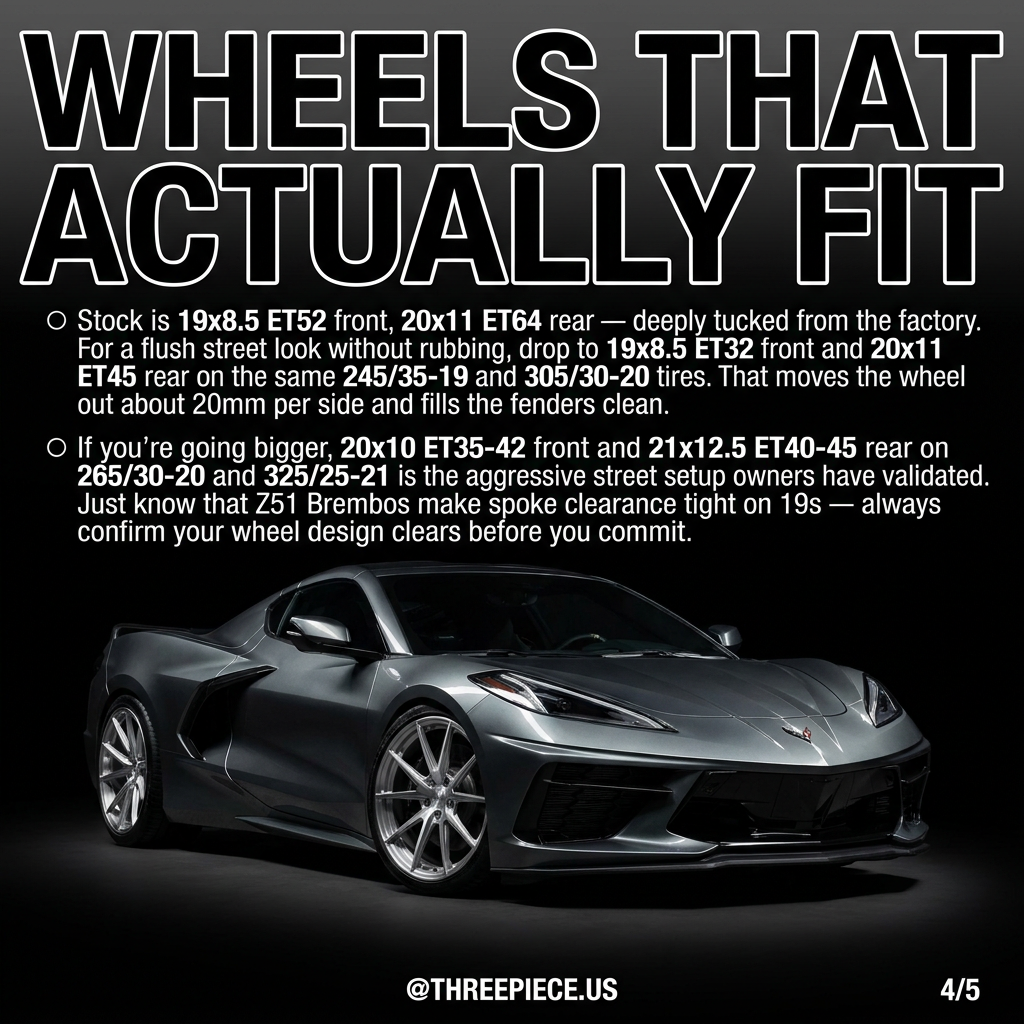
Stock C8 fitment is 19x8.5 ET52 front and 20x11 ET64 rear — deeply tucked from the factory. GM played it safe with offset, which means there's room to push the wheels outward for a flush look without touching fenders. For a clean street setup without rubbing, drop to 19x8.5 ET32 front and 20x11 ET45 rear on the same 245/35R19 and 305/30R20 tires. That moves the wheel face out roughly 20mm per side and fills the fenders properly.
If you're going aggressive, the validated street setup is 20x10 ET35-42 front and 21x12.5 ET40-45 rear on 265/30R20 and 325/25R21 tires. This is the setup owners have run without cutting or rolling fenders on lowered cars. Browse 19-inch wheels in 5x120 for the front axle or 20-inch wheels in 5x120 for the rear. For the aggressive setup, check 20x10 options up front and 21-inch rears in 5x120.
One critical note: Z51 Brembos make spoke clearance tight on 19-inch wheels. Always confirm your wheel design clears the caliper before you commit. Multi-piece wheels give you an advantage here because you can spec the disc type and offset precisely. If you're running a 3-piece setup, understanding hub-centric vs lug-centric centering matters — the C8 is hub-centric from the factory with a 70.3mm hub bore, and you want to maintain that. Pair your wheels with hubcentric rings if your aftermarket setup doesn't match the OE bore.
For tire sizing on the flush setup, shop 245/35R19 tires for the front and 305/30R20 tires for the rear. For build inspiration across platforms, the ThreePiece vehicle gallery shows what proper fitment looks like on a range of performance cars.
Suspension: Drop It Right, Not Just Low
The C8's factory suspension is genuinely good — especially the Z51's Magnetic Ride Control (MRC) dampers. The goal isn't to replace everything. It's to close the 15-20mm wheel gap that GM left from the factory while maintaining ride quality and MRC functionality.
Lowering springs are the most common path. Paragon and Eibach both make C8-specific spring sets that work with MRC. A 15mm drop fills the gap without destroying ride quality or scraping on every driveway. If you want adjustability, coilover conversions exist but you lose MRC — which is a significant trade-off on a car this sophisticated. For a deeper dive on how lowering changes your alignment geometry, our guide on rear camber arms explains why correction hardware matters on lowered platforms.
Sway bars are the other high-value suspension mod. Eibach front and rear sway bars sharpen turn-in and reduce body roll without changing ride height or compromising MRC. Multiple CorvetteForum build threads — including the 2023 Z51 HTC build by Maniac Magee — list Eibach sway bars as one of the first handling mods installed. Check our suspension category for spring and coilover options across platforms.
Known C8 Weak Points to Budget For
The C8 is reliable for a mid-engine performance car, but there are documented weak points you should budget for before spending on power mods.
Front lift system failures: If your car has the optional front lift, those struts are a known failure point. Leaks, electronics going out, and corrosion on the mounts from water pooling are all documented. Check it on any pre-purchase inspection and plan for replacement or delete.
DCT transmission concerns: Several owners on CorvetteForum and Reddit have reported transmission failures or needing replacements, especially on 2021 units. The dual-clutch unit is robust when maintained, but early software calibration was rough. Again — 2022+ avoids the worst of this.
Brake pad heat management: Track-focused owners consistently report brake heat as the first limiting factor. The Z51 Brembos are good hardware, but the factory pads aren't track-rated. Upgrading to Hawk Performance Ceramic C8 brake pads at $190 is one of the smartest early investments — they handle heat better than stock while staying street-friendly. For dedicated track use, Carbotech 1521 pads or Pagid RSL29s are what the serious track builds run. If you want to understand why pad compound matters, our article on semi-metallic brake pad problems breaks down the trade-offs. Track builders should also consider Girodisc 2-piece rotors at all four corners — they shed unsprung weight and manage heat far better than the factory single-piece units.
An oil catch can is another smart preventive mod. The LT2 uses direct injection, which means intake valves don't get fuel-washed. A UPR catch can keeps oil vapor out of the intake tract and reduces carbon buildup over time — multiple build threads list it as a day-one install.

The Complete C8 Build Sequence
Here's the build in order, the way validated C8 owners have done it:
- Brake pads — Hawk Performance Ceramic C8 pads at $190 if you're doing any spirited driving
- Oil catch can — UPR or equivalent, day-one install
- Cold air intake — Halltech Hornet is the community standard
- Long-tube headers + high-flow cats — American Racing or Fabspeed
- Ported throttle body — 91-95mm range, Soler or Gwatney
- Intake manifold — Gwatney 95mm or Lingenfelter pTR carbon fiber
- Tune — full ECU calibration by a C8 specialist shop
- Sway bars — Eibach front and rear
- Lowering springs — 15mm drop, MRC-compatible
- Wheels and tires — flush fitment, Brembo-clearing design
You end up with a mid-engine Corvette making north of 500 whp at the wheels that still daily drives, still looks right, and didn't require cracking the block open. The C8 platform is genuinely good out of the box — the build just finishes what GM started.
If you're building a 3-piece wheel setup for your C8, browse new wheels or explore American-style replacement wheel halves starting at $399 to spec the exact width, offset, and lip depth your build needs. For finishing touches, grab a set of 90-degree valve stems at $3.80 each — essential for deep-dish rears where straight stems won't clear the brake caliper. And if you're running multi-piece wheels, silicone sealant at $10.99 keeps your barrel-to-lip seal airtight through heat cycles and track abuse.
The C8 rewards builders who think in systems, not parts. Plan the whole chain, execute in order, and this platform delivers more than anything else at its price point.