
Posted by THREEPIECE.US on May 1st 2026
BMW 335i N54 Problems: Why You Should NOT Buy One
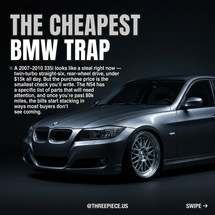
The 2007-2010 BMW 335i E90 with the N54 engine looks like the best performance deal under $15k — 300 horsepower, twin-turbo inline-six, rear-wheel drive, and a chassis that still embarrasses newer cars. But the purchase price is the smallest check you'll ever write on this platform. The N54 has a documented list of failure points that stack up fast once you're past 80,000 miles, and most of these cars are well beyond that now. Here's every reason you should think twice before buying one — and the one scenario where it actually makes sense.

Quick links
- The Fuel System Will Wreck Your Budget
- Everything Leaks, Everything Rattles
- Turbocharger & Wastegate Issues
- Cooling, Ignition & Carbon Buildup
- Real Cost of N54 Ownership Past 80K Miles
- When Buying an N54 335i Actually Makes Sense
- The Smarter Alternative: N55 335i
- Wheel Fitment for the E90 335i
The Fuel System Will Wreck Your Budget
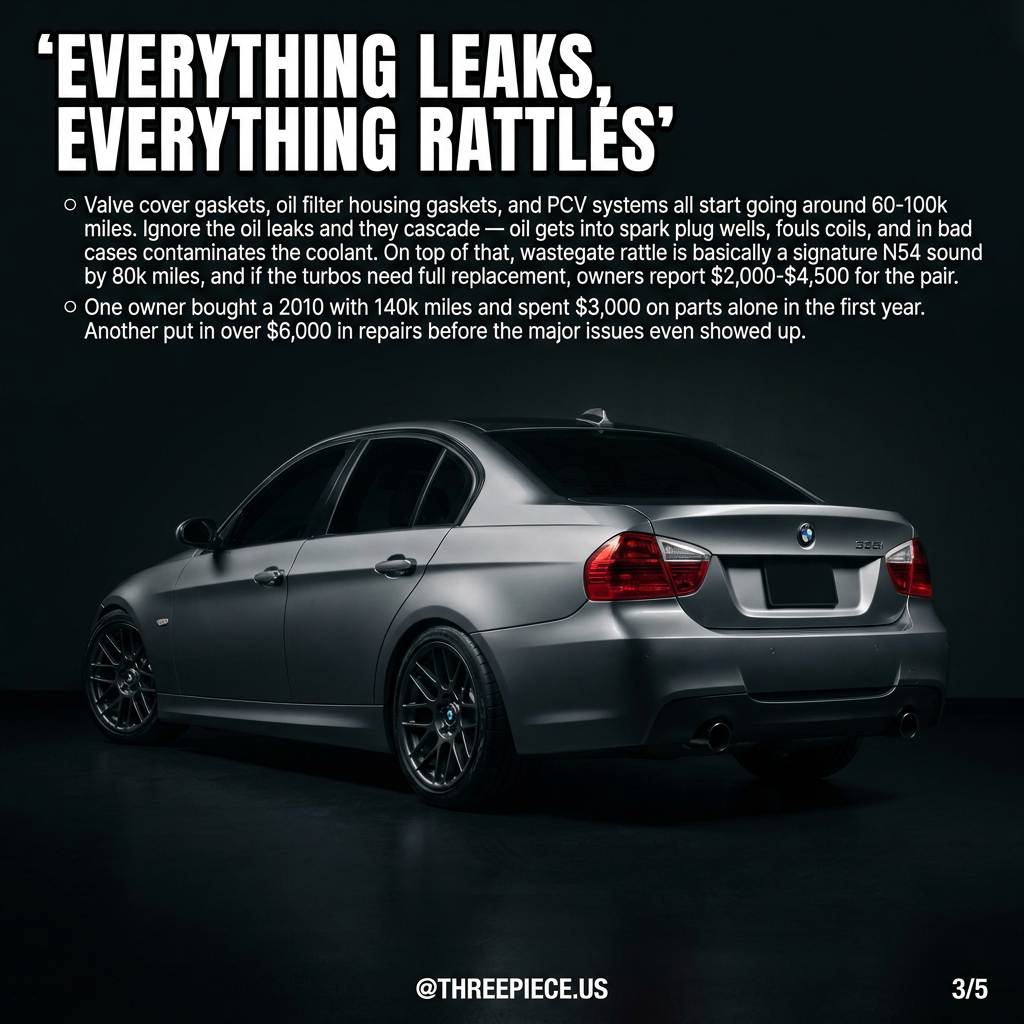
The high-pressure fuel pump (HPFP) is the single most infamous failure point on the N54. Symptoms include long cranking, limp mode, misfires, and sometimes a complete no-start. BMW acknowledged the problem was so widespread that they extended the warranty to 10 years and 120,000 miles — and nearly every 2007-2010 335i on the market today has aged past both thresholds. Early HPFP units (pre-revision ending in -881) had poor o-ring seals between split design halves. Later revisions (-881 and -943) improved things, but they're far from bulletproof. Replacement runs $1,000-$1,500 with parts and labor.
Then there are the piezo fuel injectors. Early revisions (Index 1 through 9) fail constantly — misfires, rough idle, poor emissions. Owners frequently replace entire banks at once, and a full set of six runs around $3,000. Later revisions (Index 10 and above) are more reliable, but many used cars still have the original injector sets. That's a potential $4,500 just to keep the fuel system functional, before you've touched anything else on the car. If you're comparing turbocharged platforms in this price range, the Ford Focus ST Mk3 and Mazdaspeed 3 BL both offer forced induction without this specific fuel system nightmare.

Everything Leaks, Everything Rattles
The N54's gasket situation is genuinely bad. Valve cover gaskets and oil filter housing gaskets (OFHG) both start failing between 60,000 and 100,000 miles. On some N54s, valve cover gasket failure leads to oil consumption as high as 1 liter per 1,000 km. Ignore the leaks and they cascade — oil seeps into spark plug wells, fouls ignition coils, and in worst-case scenarios the OFHG failure lets oil contaminate the coolant system. That turns a $300 gasket job into an engine-out repair.
The PCV (crankcase ventilation) system is another weak link. Blockages cause elevated crankcase pressures, oil consumption, smoke, and misfires. OEM PCV parts fail frequently enough that the community recommends upgraded units from RB or Burger Tuning for around $40. It's a cheap fix, but it's one more item on a list that never seems to end. For context on how other platforms handle aging gaskets and seals, the W204 C63 AMG buying guide covers the M156's own headbolt issues — different engine, similar "hidden cost" ownership pattern.
Turbocharger & Wastegate Issues
Wastegate rattle is practically a signature N54 sound by 80k miles. You'll hear it on cold start and when lifting off the throttle. It's not just cosmetic — over time it degrades boost stability and can lead to boost creep. The turbos themselves also fail: bearings wear, seals leak, and you start seeing smoky exhaust and inconsistent boost. On modded cars running aggressive tunes, turbo life shortens significantly. A full turbo replacement runs $2,000-$4,500 for the pair depending on whether you go OEM or aftermarket. If you're interested in what a properly modded N54 looks like, our E90 335i N54 build guide covers the correct mod order — including when and why to address the turbos. Understanding stage 1 vs stage 2 tune results is also critical before you decide how hard to push the stock hardware.
Cooling, Ignition & Carbon Buildup
The electric water pump and thermostat are semi-expected failures after 100,000 miles. When they go, overheating risk is immediate. Experienced owners preemptively replace both to avoid getting stranded. Budget $500-$800 for the pair.
Ignition coils and spark plugs need attention far sooner than BMW's advertised "lifetime" intervals. Realistic service life is 50,000-60,000 miles, and coil failures accelerate when oil leaks contaminate the plug wells from the gasket issues above. VANOS solenoids — BMW's variable cam timing — get clogged with sludge if oil changes are delayed. Symptoms include rough idle, reduced low-end torque, and error codes 2A82/2A87.
Because the N54 is direct injection only, carbon buildup on the intake valves is inevitable. Throttle response degrades, idle quality suffers, and by 60,000-80,000 miles most cars need walnut blasting to clean the valves. It's a $400-$600 service at a specialist shop. If you want to understand how intake modifications interact with direct injection platforms, our breakdown of whether a cold air intake is worth it covers the nuances.
Real Cost of N54 Ownership Past 80K Miles
Forum threads and build logs paint a consistent picture: once you're past 80,000-100,000 miles on an N54, you should expect several thousand dollars of maintenance in the next few years just to keep the car reliable. One owner bought a 2010 with 140k miles and spent $3,000 on parts alone in the first year. Another documented over $6,000 in repairs before the major issues even surfaced. Here's a rough breakdown of what the common repairs cost:
- HPFP replacement: $1,000-$1,500
- Full injector set (Index 10+): ~$3,000
- Valve cover gasket + OFHG: $500-$1,000
- Turbo replacement (pair): $2,000-$4,500
- Water pump + thermostat: $500-$800
- Walnut blasting (carbon cleanup): $400-$600
- Coils + plugs: $200-$400
Add it up and you're looking at $7,600-$11,800 in potential repairs on a car you paid $10,000-$15,000 for. That math doesn't work for a daily driver. It's a fundamentally different equation than something like the Honda Civic Si FA5 or the Lexus IS 350 XE20, where the drivetrains are genuinely robust at high mileage. The article on the $8k BMW that's better than an M3 is also worth reading if you're drawn to the BMW chassis feel but want lower ownership risk.
When Buying an N54 335i Actually Makes Sense
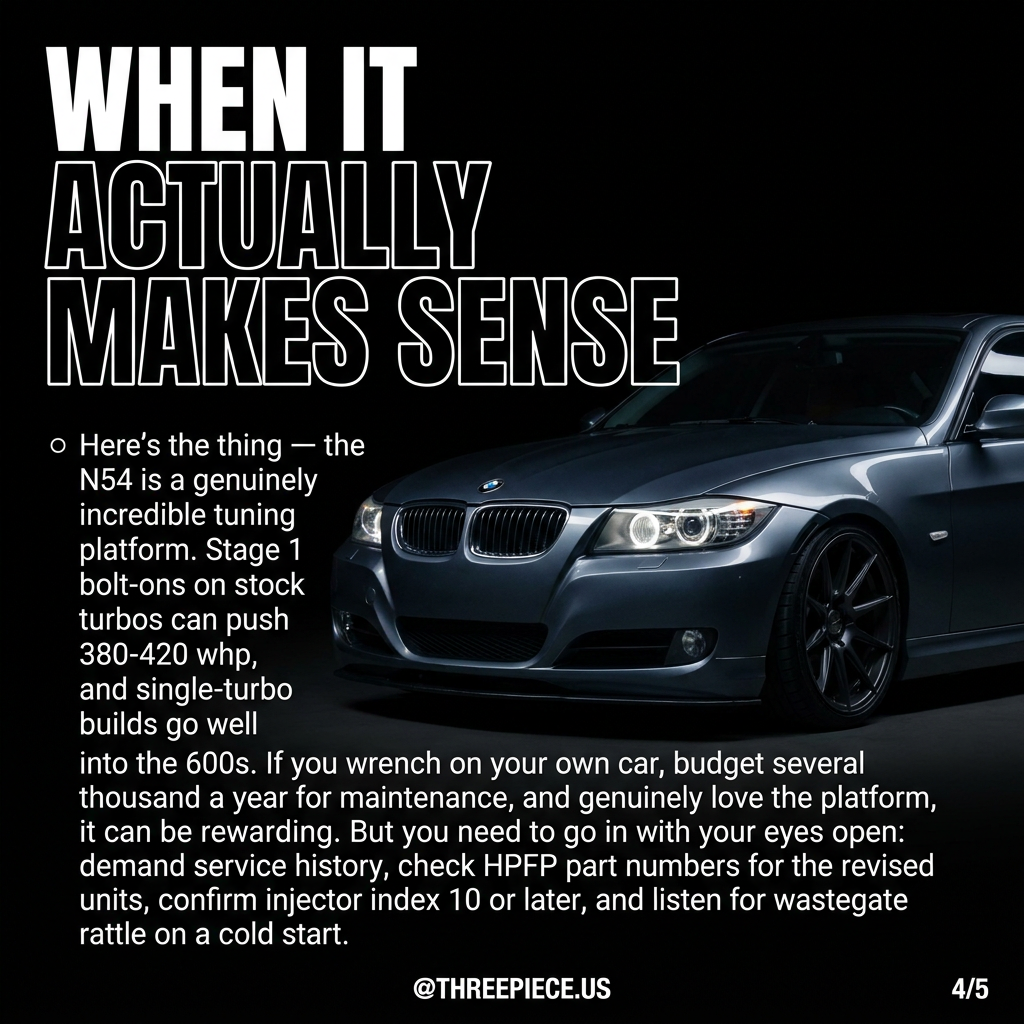
Here's the thing — the N54 is a genuinely incredible tuning platform. Stage 1 bolt-ons on stock turbos can push 380-420 whp, and single-turbo builds go well into the 600s. The closed-deck iron block, forged crank, and twin-scroll turbo setup give it headroom that most modern engines can't touch at this price point. If you wrench on your own car, budget several thousand a year for maintenance, and genuinely love the platform, it can be deeply rewarding.
But you need to go in with a checklist, not just enthusiasm:
- Demand proof the HPFP was revised — part number ending in -881 or -943.
- Confirm injector index 10 or later.
- Verify oil change history — every 7,500 miles or less.
- Check for evidence of replaced water pump, thermostat, OFHG, and valve cover gaskets.
- Listen for wastegate rattle on a cold start.
- Ask about walnut blasting or check intake valve condition.
2007 models are the riskiest — earliest production, lowest build refinement, fewest factory revisions. Later 2009-2010 cars tend to have more updated parts from the factory, but always verify by VIN or service records. Never assume. If you do commit, our N54 6MT build guide lays out the correct mod order so you're not wasting money on the wrong upgrades. And if you're debating between the E46 and E92 M3 chassis instead, our E46 M3 vs E92 M3 comparison covers that decision in depth.
The Smarter Alternative: N55 335i
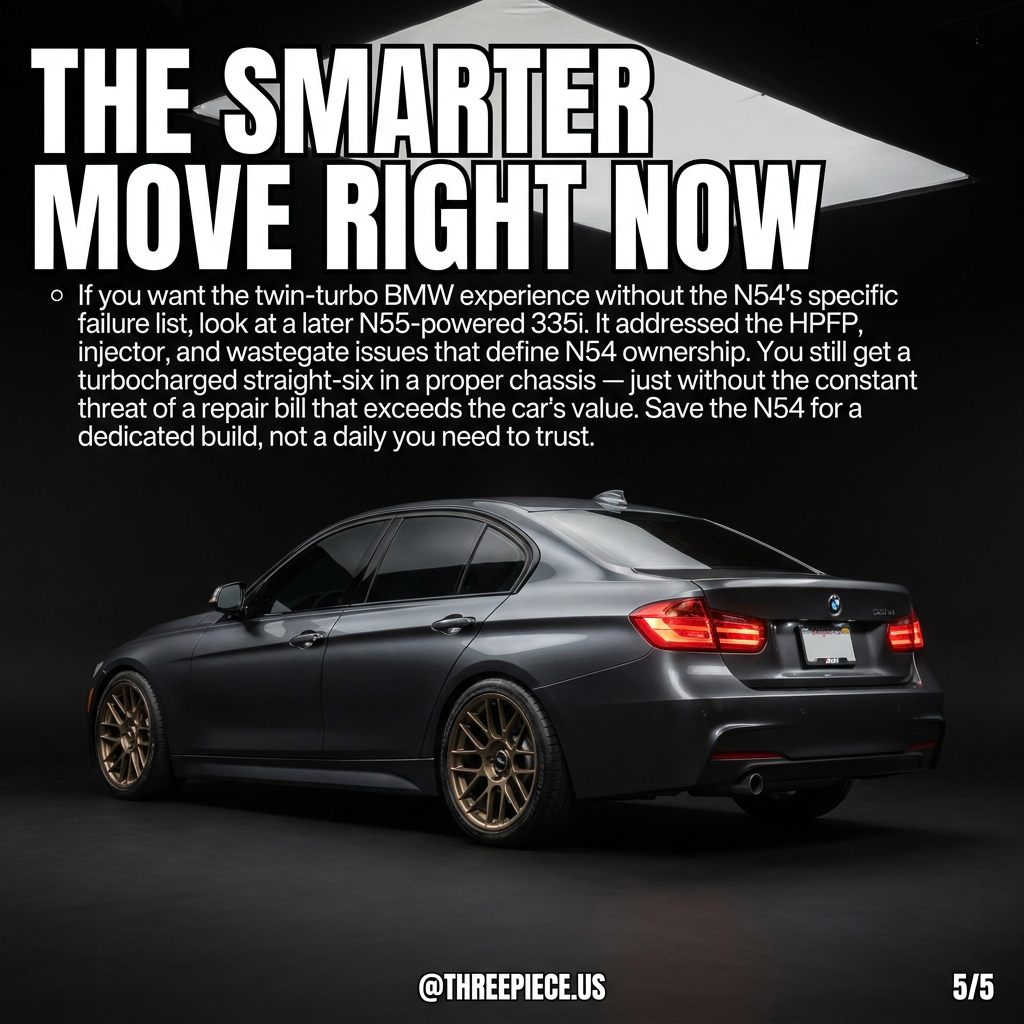
If you want the turbocharged BMW straight-six experience without the N54's specific failure list, the N55-powered 335i is the smarter buy. BMW addressed the HPFP design, moved to more reliable solenoid injectors, and resolved the wastegate rattle issue. You still get a turbocharged inline-six in a proper rear-drive chassis — just without the constant threat of a repair bill that exceeds the car's value. Our N55 335i buying guide breaks down exactly what to look for, and the F30 335i N55 build guide covers the mod path if you want to extract more power from the newer engine. Save the N54 for a dedicated build car, not a daily you need to trust.
Wheel Fitment for the E90 335i
If you do end up with an E90 335i — N54 or N55 — getting the wheel fitment right makes or breaks the look. The E90 runs a 5x120 bolt pattern with a 72.6mm center bore. The sweet spot for most builds is 18x8.5 +35 to +38 front and 18x9.5 +35 to +38 rear for a staggered setup. If you're running a square setup, 18x8.5 +35 all around works cleanly without aggressive camber. Browse 18-inch wheels in 5x120 to see what's available.
For tires, a staggered setup pairs well with 225/40R18 fronts and 255/35R18 rears. If you're running a square setup, 245/40R18 is the go-to size. Make sure you're running hubcentric rings if your wheels aren't factory bore — the E90 is sensitive to vibration at highway speed without them. For staggered fitment fundamentals, read our guide on wheel fitment mistakes — the principles apply across platforms.
The Work Emotion series and Work Meister line both look exceptional on E90s, especially in 18-inch fitments. If you're going 3-piece, the Work VS series in a deep-lip rear configuration is one of the best looks on this chassis. Finish the build with proper 90-degree valve stems at $3.80 each — they're essential for clearing big brake kits on the E90. Check the ThreePiece vehicle gallery for real-world examples of E90 builds with proper wheel setups.
Bottom Line: Know What You're Getting Into
The BMW 335i N54 is one of the most capable tuning platforms ever sold under $15k. But it's also one of the most expensive cars to keep running once the warranty is long gone. The HPFP, injectors, turbos, gaskets, and cooling system all have documented failure timelines, and most used examples on the market today are sitting right in the danger zone. If you're not prepared to spend $5,000-$10,000 in the first two years of ownership on maintenance and repairs, this is not your car. If you are, and you buy smart with verified service history and revised parts, the N54 rewards you with a driving experience that very few cars in this price range can match. Choose wisely — and when you're ready to finish the build with proper wheels, browse the full wheel catalog at ThreePiece.us.