

Audi 8V RS3: 3 Reasons This Five-Cylinder Is Worth It
The Audi 8V RS3 is one of the most compelling performance sedans on the used market right now — a 2.5-liter turbo inline-five with quattro AWD, genuine 400+ whp tuning headroom, and a sound that nothing else in the segment can replicate. Depreciation has done its thing on early examples, but clean facelift DAZA cars are starting to firm up in value. Here's why real owners keep saying this is the compact performance car they don't regret buying.
Quick links
- Nothing else sounds like this
- Tuning headroom is absurd
- Daily it year-round, no excuses
- Budget these, then relax
- RS3 wheel fitment and sizing
- Go find a clean one
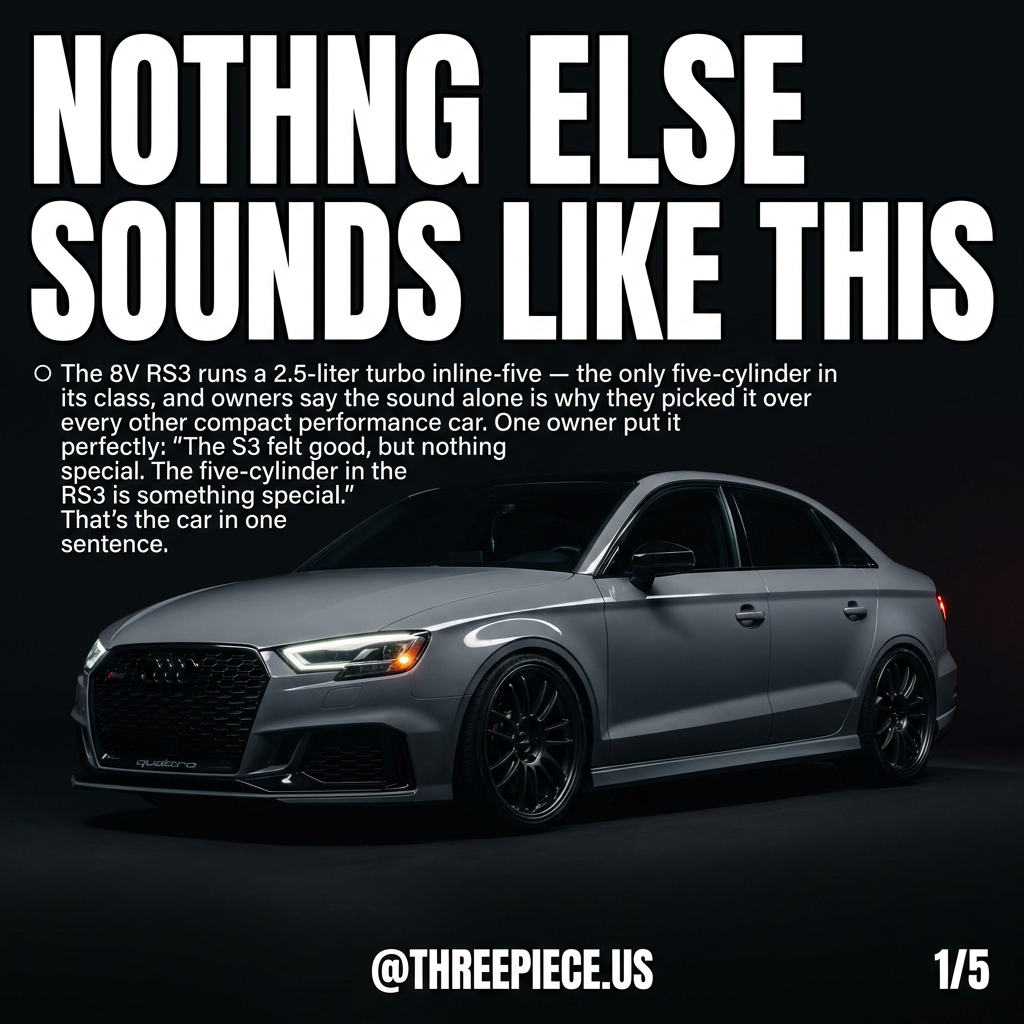
Nothing Else Sounds Like This
The 8V RS3 runs the EA855 2.5-liter turbo inline-five — the only five-cylinder in its class, and one of the only five-cylinders in production during its entire run. Owners consistently say the sound is the single biggest reason they chose the RS3 over a Golf R, S3, or CLA45 AMG. One owner summed it up perfectly: "The S3 felt good, but nothing special. The five-cylinder in the RS3 is something special." That warble under boost — the uneven firing order creating a sound that's equal parts Group B rally car and modern turbo sedan — is genuinely addictive. It's not marketing. It's the reason people cross-shop these against cars that cost twice as much.
The facelift DAZA engine (2017.5+) is the one to target. It swaps the earlier pre-facelift cast-iron block for an aluminum unit, dropping roughly 26 kg (57 lbs) off the nose while adding both direct and port injection. The port injection matters more than most buyers realize — it significantly reduces carbon buildup on the intake valves, which was a consistent maintenance item on the earlier cars. Stock output on the DAZA sits at 394 hp and 354 lb-ft of torque, available between approximately 1,700–5,850 rpm. That's a wide, usable powerband that makes the car feel effortless in daily driving.
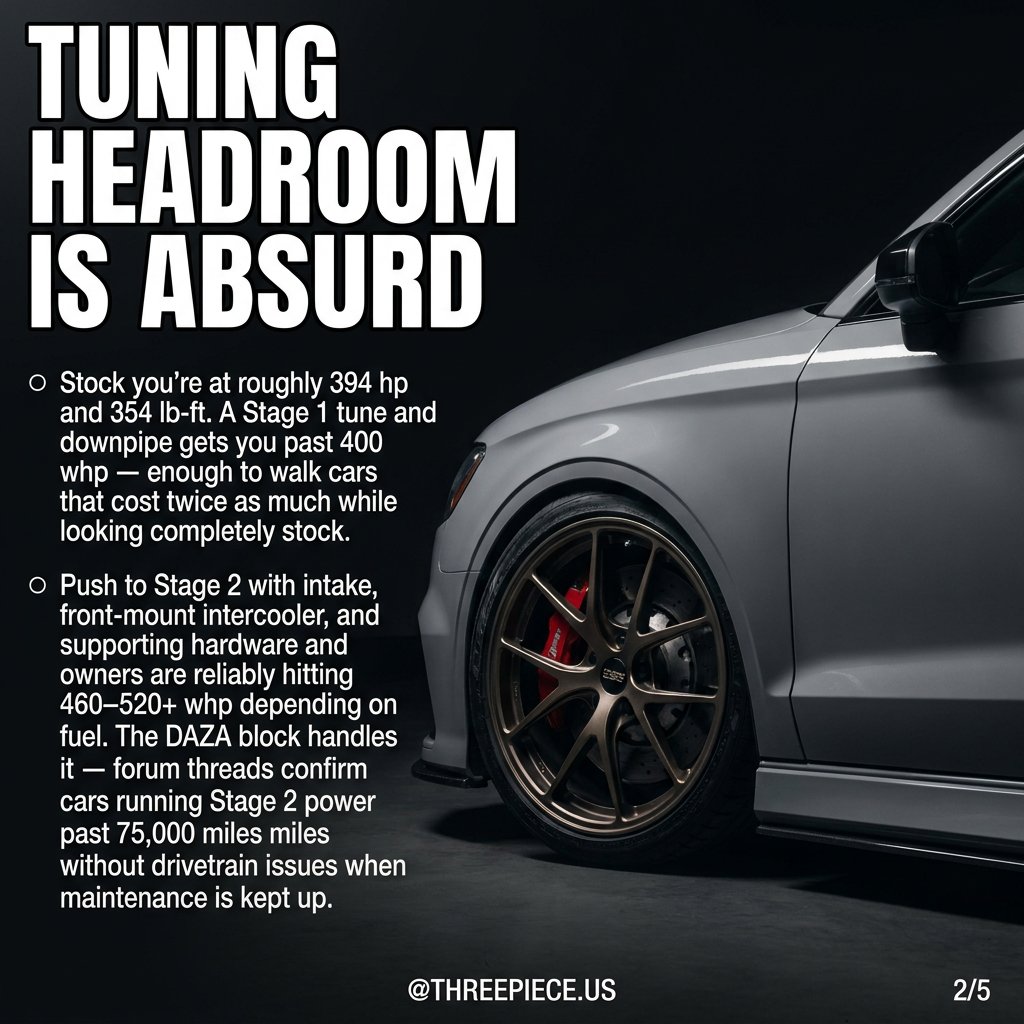
Tuning Headroom Is Absurd
This is where the RS3 separates itself from almost everything in the compact performance segment. The DAZA block handles power like a platform that was over-engineered from the factory — because it was. Audi used this engine family across the RS3 and TT RS, and the aftermarket has had years to figure out exactly where the limits are.
A Stage 1 ECU tune plus a downpipe gets you past 400 whp on pump gas. That's enough to walk cars that cost twice as much while looking completely stock from the outside. If you're curious about what an ECU tune actually delivers in real dyno numbers, the RS3 is one of the best examples of a platform where the tune-to-dollar ratio is exceptional.
Push to Stage 2 — intake, front-mount intercooler, downpipe, and supporting hardware — and owners are reliably hitting 460–520+ whp depending on fuel. Integrated Engineering dyno sheets show approximately 460 whp on 93 octane and 552 hp on E85. Forum threads confirm cars running Stage 2 power past 75,000 miles without drivetrain issues when maintenance is kept up. The tuning ecosystem is deep: Unitronic, APR, Integrated Engineering, and others offer tunes, bolt-ons, and accessories specifically for the EA855 platform. A 3.5-inch shielded downpipe is one of the most effective single bolt-ons you can do — it unlocks turbo efficiency, improves spool, and transforms the exhaust note.
If you're weighing forced induction options more broadly, our breakdown of supercharger kits vs. turbo upgrades gives useful context, though the RS3's factory turbo setup makes bolt-on gains far simpler than most platforms. And if you're considering a cold air intake, know that on the RS3 a quality intake is actually part of the Stage 2 recipe — not a standalone mod.
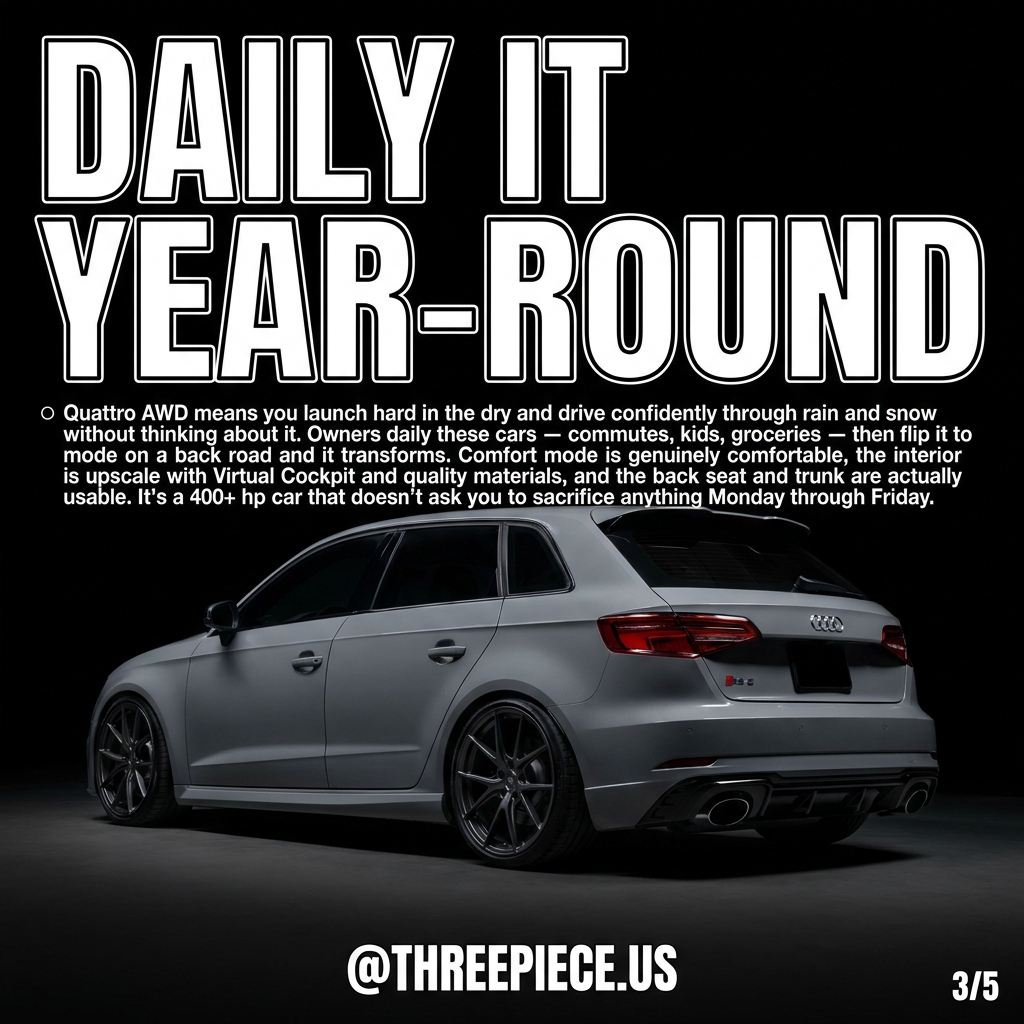
Daily It Year-Round, No Excuses
The RS3's quattro AWD system means you launch hard in the dry and drive confidently through rain and snow without thinking about it. Facelift models later received the Torque Splitter — multi-plate clutches for each rear wheel — which boosts corner-exit traction and allows controlled oversteer when you want it. It's a meaningful upgrade over the earlier Haldex-based system for anyone who actually pushes the car on back roads.
But the real story here is that owners daily these cars — commutes, kids, groceries — then flip it to Dynamic mode on a weekend and it transforms. Comfort mode is genuinely comfortable. The interior is upscale with Audi's Virtual Cockpit, quality materials, and a back seat and trunk that are actually usable. It's a 400+ hp car that doesn't ask you to sacrifice anything Monday through Friday. That's what separates it from an Evo X or a Focus RS — those are incredible performance cars, but they don't disappear into normal life the way the RS3 does.
The chassis hardware backs up the daily-driver claim: a four-link rear axle, progressive steering, widened track width front and rear, and 370mm front steel brake discs (carbon-ceramic optional). The ride height is lower than the A3/S3, and the front end was uprated on facelift cars. It's sharp on turn-in without being punishing over broken pavement. If you're coming from something like a B8 S4, the RS3 feels tighter and more immediate while being nearly as comfortable.

Budget These, Then Relax
The DAZA engine is solid through 125,000+ miles with proper maintenance, but you need to know the service items going in. This isn't a buy-it-and-forget-it car — it's a buy-it-and-maintain-it car, and the difference matters.
Walnut blasting the intake valves every 40,000–60,000 miles is necessary on all direct-injection versions. Budget approximately $800 per service. The facelift DAZA's port injection reduces buildup significantly, but doesn't eliminate it entirely.
Mechatronic unit and DSG issues are the big-ticket item. Fault codes like P17BF and P17C1 tend to appear around 60,000–80,000 miles, especially under spirited driving. Repairing or replacing the mechatronic unit runs $3,000–$5,000. This is the single most expensive potential repair on the platform, and it's worth inspecting thoroughly on any used purchase.
Beyond that, watch for water pump housing cracks, rear main seal leaks, and oil pan leaks — all frequently mentioned on Audizine even on stock cars. Keep up with DSG and Haldex fluid changes on schedule. If you're running E85 blends, make sure the injector hardware is upgraded — owners report lean conditions and injector failure when tuning for ethanol without the supporting mods.
If you do the homework upfront, the RS3 rewards you for years. The maintenance costs are real but predictable — and they're a fraction of what you'd spend keeping something like a N54 335i on the road with comparable power levels.
RS3 Wheel Fitment and Sizing
Getting the wheel fitment right on an 8V RS3 is critical — and it's where a lot of owners waste money. The RS3 runs a 5x112 bolt pattern with a 57.1mm center bore. Stock wheels are 19x8 ET49, which looks fine but leaves room for a more aggressive setup.
Most owners running aftermarket wheels land on 19x8.5 +42 to +45 as the sweet spot for a flush look without fender modification. If you're going wider, 19x9 +35 to +40 works with minor rolling on the rears. Browse 19-inch wheels in 5x112 to see what's currently available. For a deep dive on the most common RS3 wheel mistakes — including why some popular choices don't clear the front brakes — read our full breakdown on RS3 wheel fitment and the $8,000 mistake most owners make.
If you're considering forged wheels for the RS3, the weight savings compound with the DAZA's lighter aluminum block — you're reducing unsprung mass on a car that was already engineered to be lighter than its predecessor. The Work Emotion series and Work VS series both offer fitments that work on this platform, and the quality difference over cast alternatives is immediately noticeable. If you're building a set of 3-piece wheels, make sure you're using proper assembly hardware — the M7x32 chrome assembly bolts at $10 each are a popular choice, and if you want something more distinctive, the M7x32 24K gold bolt/nut sets at $15 are a clean detail on a dark-finished wheel.
For tire sizing, 245/35R19 is the go-to on a square setup, or 255/30R19 if you're running 9-inch-wide rears. Search 245/35R19 tires or 255/30R19 tires to see current inventory. Finish the build with proper 90-degree valve stems at $3.80 each — they make a real difference on deep-dish lips where straight stems don't clear.
Check out the ThreePiece vehicle gallery for RS3 and Audi builds with proper fitment for visual reference.
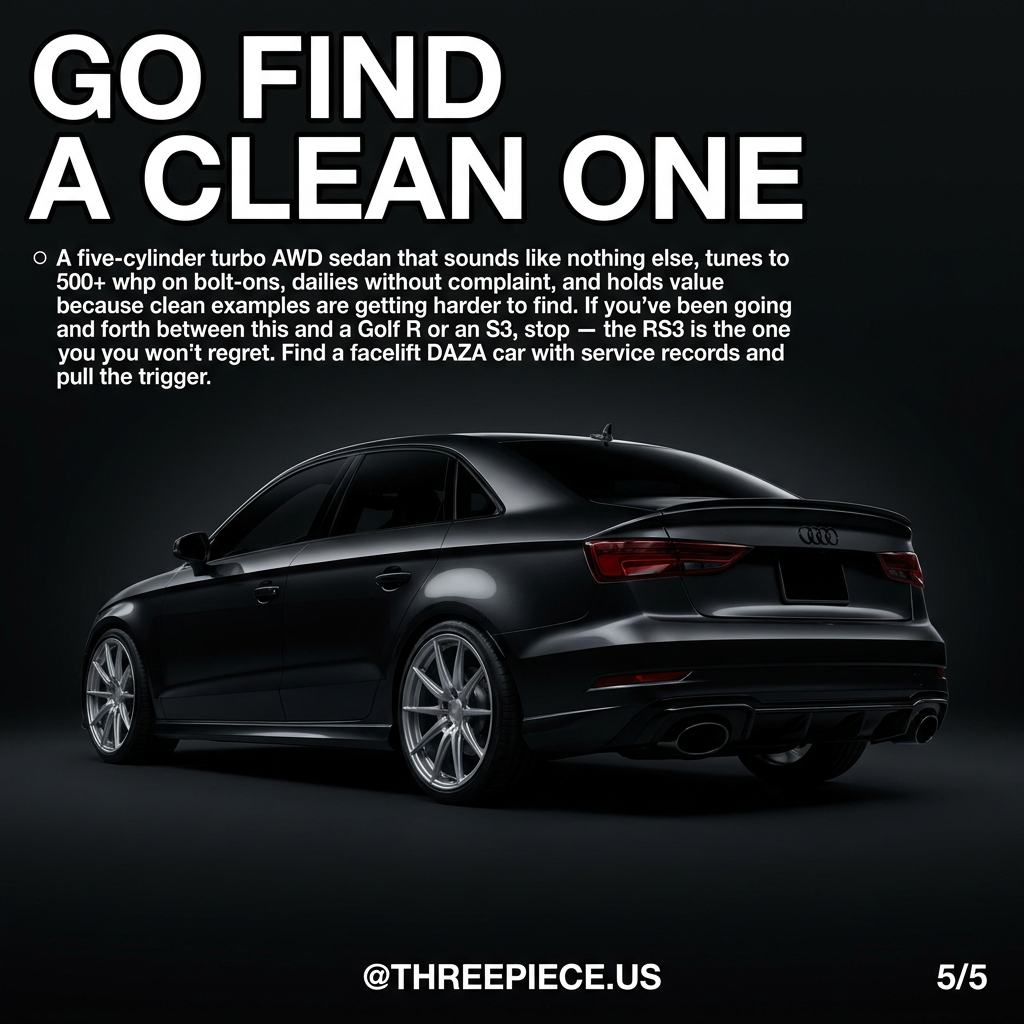
Go Find a Clean One
A five-cylinder turbo AWD sedan that sounds like nothing else on the road, tunes to 500+ whp on bolt-ons, dailies without complaint, and holds value because clean examples are getting harder to find. If you've been going back and forth between this and a Golf R or an S3, stop — the RS3 is the one you won't regret.
Find a facelift DAZA car with service records and pull the trigger. Target cars with documented DSG and Haldex service history, ask about walnut blasting records, and inspect the water pump housing before you hand over money. If the maintenance has been done, you're buying into one of the best performance-per-dollar platforms in the compact segment.
For rivals worth comparing, read our takes on the AMG A45 and the Focus RS build guide — both are strong cars, but neither matches the RS3's combination of refinement, tuning headroom, and that five-cylinder sound. Browse our full wheel catalog when you're ready to finish the build the right way.