

6th Gen Camaro SS Problems: 3 Reasons NOT to Buy
The 6th gen Camaro SS looks like the deal of the decade right now — GM's Alpha platform is legitimately one of the best-handling muscle car chassis ever built, the LT1 6.2L V8 makes 455 horsepower, and used prices have dropped into the low $30Ks. But there are three specific ownership traps hiding inside these cars that can cost you thousands before you hit 50,000 miles. Two of them are mechanical, one is electrical, and all three are well-documented across owner forums, TSBs, and long-term build threads. Here's what nobody mentions at the dealer.

Quick links
- The 8-Speed Auto Transmission Shudder
- The LT1's Lifter and Oil Pump Problem
- Electrical Gremlins That Stack Fast
- What to Buy Instead (Or How to Buy Right)
- 6th Gen Camaro SS Wheel Fitment Basics
- Final Verdict
The 8-Speed Auto Transmission Shudder
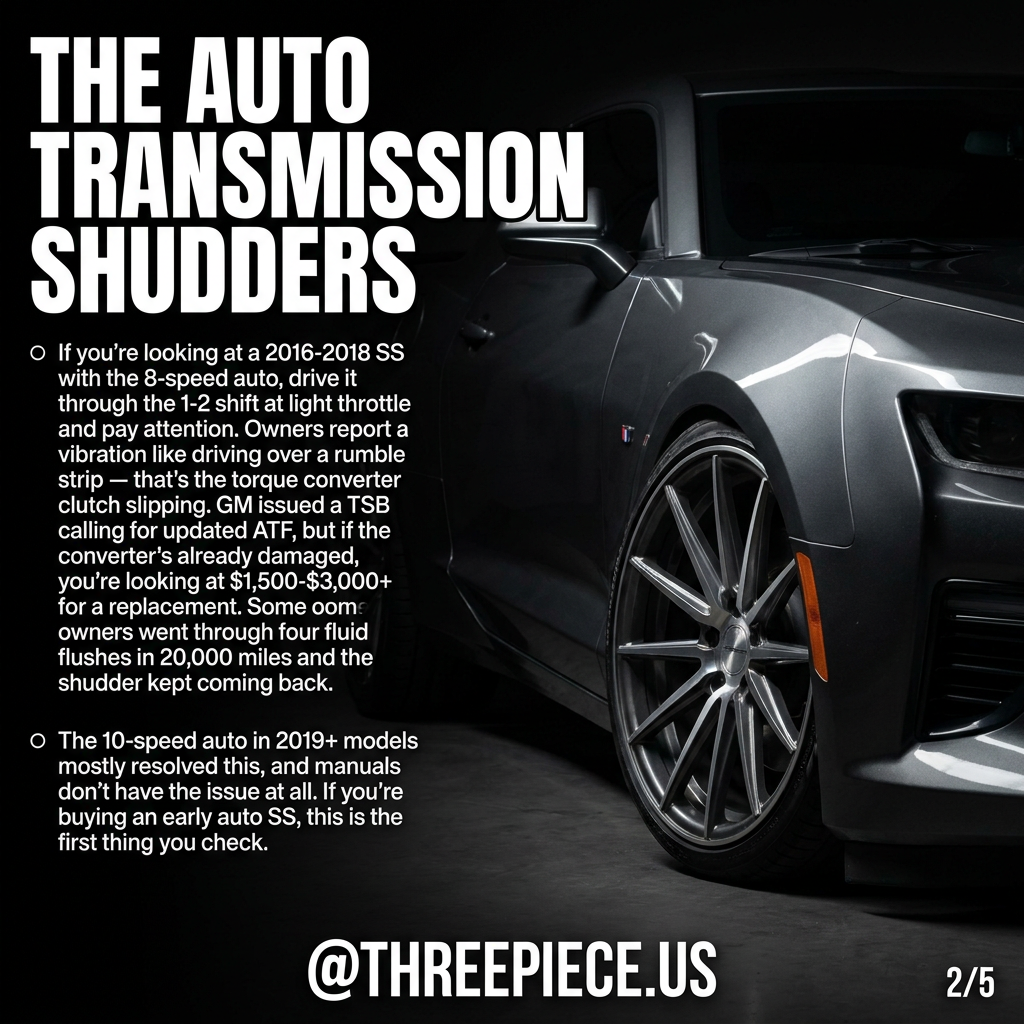
If you're shopping a 2016–2018 Camaro SS with the 8-speed automatic (RPO M5U / 8L90), this is the first thing you check on a test drive. Drive it through the 1–2 shift at light throttle and pay attention. Owners across Camaro6 forums and Reddit consistently describe a vibration like driving over a rumble strip — that's the torque converter clutch slipping against the flywheel under partial lock-up.
GM acknowledged this with a Technical Service Bulletin calling for updated ATF, but the fix was a band-aid. Some owners went through four fluid flushes in 20,000 miles and the shudder kept returning. Once the torque converter clutch material is contaminated or worn, flushing the fluid only delays the inevitable. You're looking at a torque converter replacement that runs $1,500–$3,000+ in parts and labor, and some dealers initially refused to honor warranty claims without documented evidence of the shudder — meaning owners had to record the behavior themselves.
The 10-speed automatic introduced in 2019+ mostly resolved this, and the 6-speed manual doesn't have the issue at all. If you're dead set on an early automatic SS, get a pre-purchase inspection that specifically addresses transmission fluid condition and shift behavior. For context on how other muscle car platforms handle automatic transmissions, our breakdown of Dodge Charger Hellcat problems covers the ZF 8HP — a different gearbox with its own quirks.
The LT1's Lifter and Oil Pump Problem
The 6.2L LT1 is a strong engine on paper, but it carries a design decision that has wrecked more than a few of these cars: Active Fuel Management (AFM). This system shuts down four cylinders under light load to save fuel, and the hydraulic lifters that enable cylinder deactivation are the weak link. When they fail — and they do, often between 30,000 and 80,000 miles — they typically take the camshaft and pushrods with them.
Here's what makes this expensive: you can't just swap the lifters. In most cases, the cam lobes are already damaged by the time you hear the tick, so the cam has to come out too. Owners on Camaro6 and Reddit consistently report $4,000–$7,000 for a full cam, lifter, and pushrod replacement. That's a repair bill that can exceed the value gap between a Camaro SS and its competitors.
But the lifters aren't even the scariest part. The LT1 uses a variable displacement vane-style oil pump instead of the traditional gear-style pump from earlier LS engines. It's lighter and more efficient, but it's also more sensitive to oil pressure drops. Hard driving, track days, or even aggressive street use without meticulous oil maintenance can lead to oil pump failure and subsequent bearing damage. That's a bottom-end rebuild north of $7,000–$10,000, and owners report zero warning before catastrophic failure — no check engine light, no gradual noise, just sudden loss of oil pressure. If you're considering any car with forced induction or high-RPM use, understanding how air-fuel ratios affect engine longevity is essential reading. And if you're weighing a supercharger kit for the LT1, know that you're adding stress to an oil system that's already marginal under hard use.

Electrical Gremlins That Stack Fast
This is the one that truly frustrates long-term 6th gen Camaro SS owners, because it's not a single dramatic failure — it's a pattern of small, expensive electrical issues that compound over time.
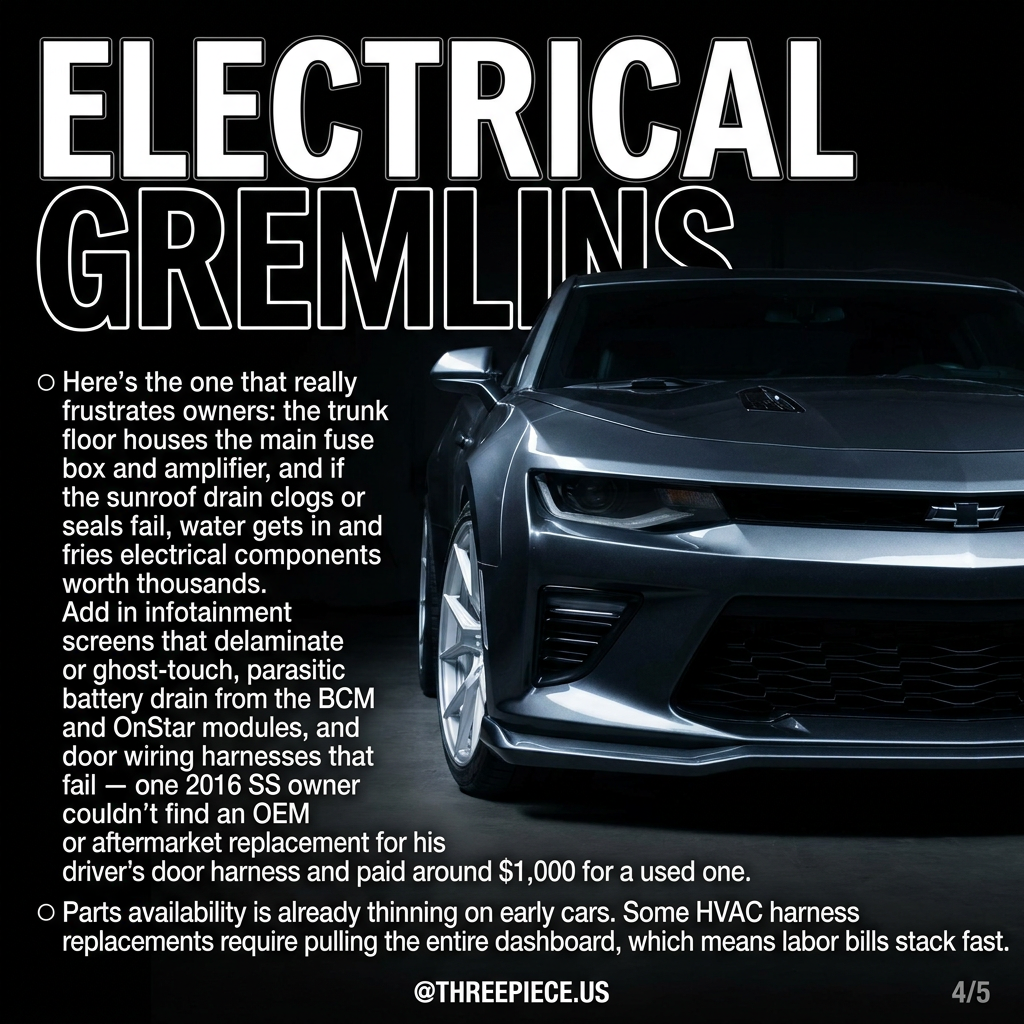
The worst design decision: GM placed the main fuse box and audio amplifier in the trunk floor. If the sunroof drain clogs or the rear seal fails, water pools directly on top of critical electrical components. Owners have reported thousands of dollars in damage from a single water intrusion event — fried amplifiers, corroded fuse boxes, and cascading electrical faults that take weeks to diagnose.
Beyond the trunk floor issue, the infotainment screens on early cars are known to delaminate and develop ghost-touch behavior, where the screen registers phantom inputs or freezes entirely. The Body Control Module (BCM) and OnStar modules can cause parasitic battery drain, leaving you with a flat battery after a few days of sitting. And door wiring harnesses fail — one 2016 SS owner couldn't find an OEM or aftermarket replacement for his driver's door harness and ended up paying around $1,000 for a used unit.
Parts availability is already thinning on early 6th gen cars. Some HVAC harness replacements require pulling the entire dashboard, which means labor bills stack into the thousands for what should be a straightforward wiring repair. This is a pattern we've seen across other platforms too — our look at Genesis GV70 problems covers similar electrical frustrations from a different manufacturer, and W212 E63 AMG issues show how German cars handle (or don't handle) aging electronics.
What to Buy Instead (Or How to Buy Right)
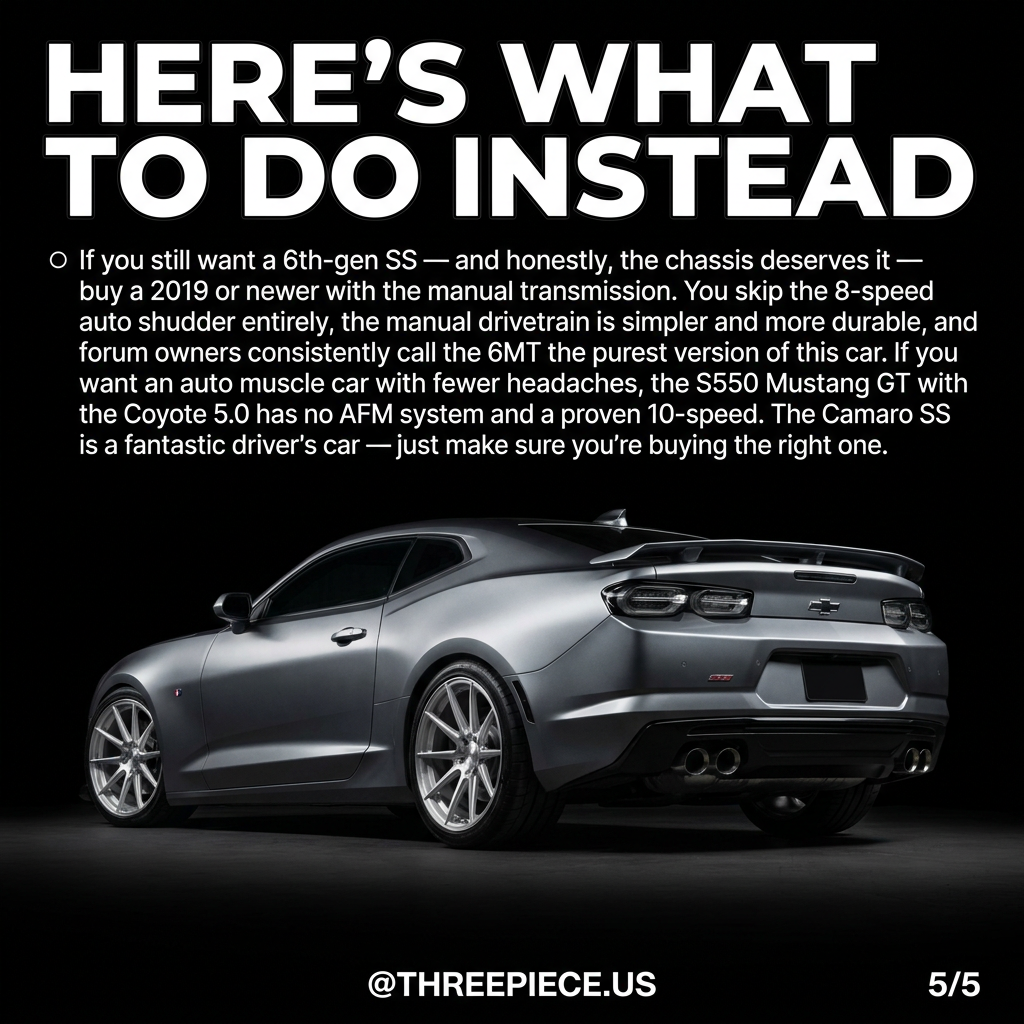
If you still want a 6th gen SS — and honestly, the chassis deserves it — here's the move: buy a 2019 or newer with the 6-speed manual transmission. You skip the 8-speed auto shudder entirely, the manual drivetrain is simpler and more durable, and forum owners consistently call the 6MT the purest version of this car. The 2019+ also benefits from the improved 10-speed auto if you must have a slushbox, plus incremental improvements to the electrical system.
If you want an automatic V8 muscle car with fewer mechanical headaches, the S550 Mustang GT with the Coyote 5.0 has no AFM system and runs a proven 10-speed. Our Ford Mustang history and ranking guide covers every generation, and the Mustang GT wheel fitment guide will help you spec it properly. For a different kind of V8 sedan experience, the Pontiac G8 GT vs Dodge Charger RT comparison is worth reading.
If you're buying any 6th gen SS, here's your pre-purchase checklist:
- Drive the automatic through 1→2 shifts at light throttle — listen for shudder or slip
- Check transmission fluid service history and condition
- Listen for lifter tick at cold start and warm idle — research whether that specific model year had valve spring issues
- Inspect the trunk floor for moisture stains or corrosion on electrical components
- Test all windows, door functions, and climate controls
- Confirm whether key parts like wiring harnesses are still available new for that year
6th Gen Camaro SS Wheel Fitment Basics
If you've done your homework and found a clean 6th gen SS, the next step is making it look right. The Alpha platform runs a 5x120 bolt pattern with a 66.9mm hub bore. Stock SS wheels are 20x8.5 front / 20x9.5 rear with +30/+35 offsets, but the enthusiast community has found that 19x9.5 +22 front / 19x10.5 +22 rear is the aggressive street fitment sweet spot — enough concavity to look serious without requiring excessive fender work.
Browse 20-inch wheels in 5x120 if you want to stay with the stock diameter, or 19-inch wheels in 5x120 for a slight drop in unsprung weight and better tire sidewall. Pair them with 275/35R19 tires up front and 305/30R19 tires out back for a properly staggered setup. Understanding the difference between forged and cast wheels matters here — the 6th gen SS is heavy enough that reducing unsprung mass with forged wheels makes a noticeable difference in turn-in response.
If you're running a 3-piece wheel setup, make sure you're using proper hubcentric rings for the 66.9mm hub bore — this platform is sensitive to wheel vibration, and hub-centric vs lug-centric fitment is not optional on a car this heavy. For the finishing touch, a set of 90-degree valve stems at $3.80 each makes tire pressure checks on deep-dish setups dramatically easier.
Final Verdict: A Great Chassis With Expensive Caveats
The 6th gen Camaro SS is a genuinely fantastic driver's car — the Alpha platform's dynamics embarrass cars costing twice as much. But the 8-speed auto torque converter shudder, the LT1's AFM lifter failures, and the trunk-mounted electrical components are not anomalies. They're patterns, documented across thousands of owner reports, and they can turn a $32,000 car into a $40,000+ ownership experience in a hurry.
Buy the right year, buy the manual, and inspect thoroughly — or look at the competition. If you end up with a clean one, the suspension and wheel upgrades are where this car truly comes alive. The aFe Control Lowering Springs for the 2016+ Camaro 6.2L V8 at $389 are a solid starting point for closing the wheel gap without sacrificing ride quality. And if you want to let the LT1 breathe, the AWE Tuning Touring Edition Cat-Back Exhaust for the 2016–2019 Camaro SS at $2,254 is the go-to for a refined V8 note without drone. Check out the ThreePiece vehicle gallery for build inspiration, and explore our full selection of wheels and wheel parts to finish the build right.