

The Civic Si vs S2000 debate usually ends before it starts, because everyone already knows which one is on the poster. Fair. The S2000 earned every dollar of its legend. But while the S2K crowd bids clean AP2s into the stratosphere, the 8th gen Civic Si sits in classifieds with a K20Z3 that revs to 8,000 rpm, a close-ratio 6-speed, and a factory helical limited-slip diff. Nobody is fighting over it. That is the cheat code: Honda's high-rev religion at an entry price that leaves room for tires, seat time, and the wheels you actually want.

Quick links
- Why S2000 prices went vertical
- The 8th gen Civic Si: K20Z3 for about $6,500
- Civic Si bolt-ons: four parts, then it's done
- What the S2000 still owns
- 8th gen Civic Si buyer's checklist
- Civic Si wheel fitment: where the savings go
- The verdict
Why S2000 prices went vertical
S2000 owners have a line that sums up the whole platform: "AP2 is the better car. AP1 is the better S2000." The AP1's F20C screams to 9,000 rpm with roughly 240 hp, the kind of top end that makes owners who switch to anything else say it's "always in the back of my mind." The AP2's 2.2L F22C1 trades some of that ceiling (redline drops to the low-8,000s) for about 162 lb-ft arriving roughly 1,000 rpm earlier, softer manners, and fewer of the AP1's known gremlins: cracked intake valve spring retainers after a money-shift, and tired second-gear synchros on early cars.
The result? Clean CR AP2s now ask $45,000-60,000, and even tired AP1s carry an age tax in top-end refreshes. That's the same collector gravity we covered in our Miata generations ranking and the Evo IX buyer's guide: once a car becomes "the one," the entry fee stops being about the driving.

The 8th gen Civic Si: K20Z3 for about $6,500
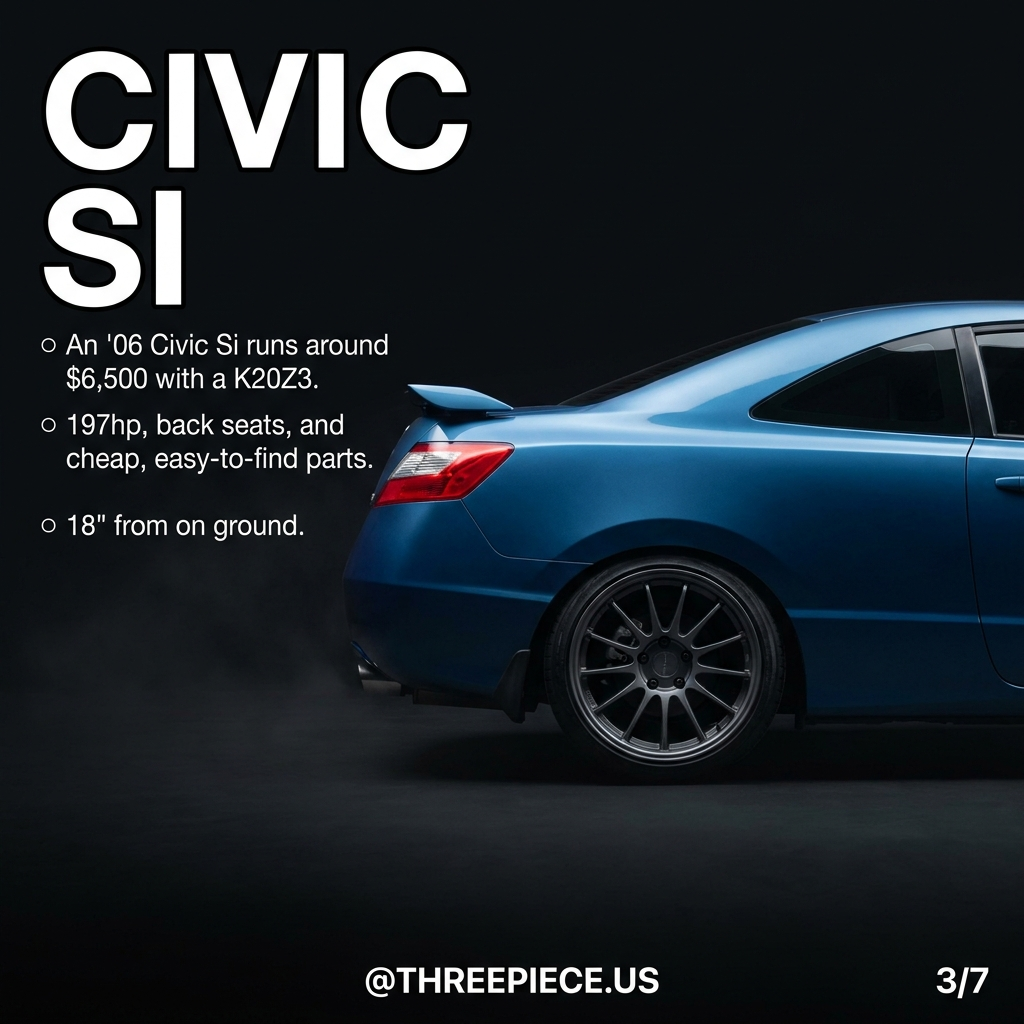
An '06 Civic Si runs around $6,500. For that you get a 197 hp K20Z3 that makes its peak near the top of the tach, a short-throw 6-speed, the helical LSD that keeps the inside front from lighting up on corner exit, plus back seats and a parts supply so deep you will never wait on anything. Coupe (FG2) or sedan (FA5), same heart.
This is the same value logic as our FC1 Civic Si build guide, except the 8th gen gets there without a turbo. It's naturally aspirated, it revs, and it still feels like the Honda that built the reputation. If you want to see where K-series Hondas end up once owners start personalizing them, scroll the ThreePiece vehicle gallery.
Civic Si bolt-ons: four parts, then it's done
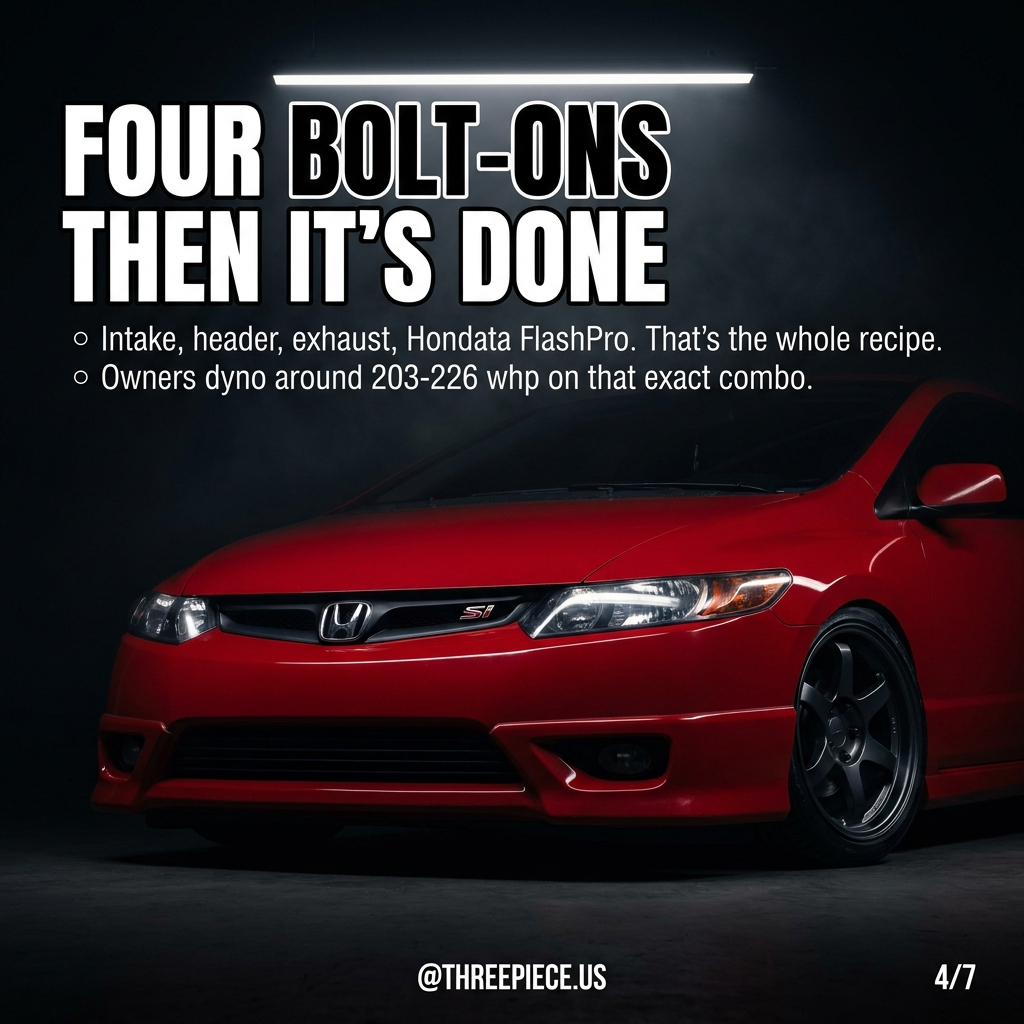
The whole recipe fits on a napkin: intake, header, exhaust, Hondata FlashPro. Owners running that exact combo dyno around 203-226 whp. On paper, that's stock-S2000 territory, measured at the wheels. The tune is what makes the header and intake earn their keep. Skip it and you've mostly bought noise.
The 10th gen crowd learned the same lesson the hard way, as our 10th gen Civic intake roundup shows. And if you eventually go further than bolt-ons, the fueling rabbit hole in our 2012-2015 Civic Si injector guide is where the 9th gen K24 crowd lives. Plan your suspension alongside power, not after it. Browse the suspension catalog before you buy the third exhaust.
What the S2000 still owns
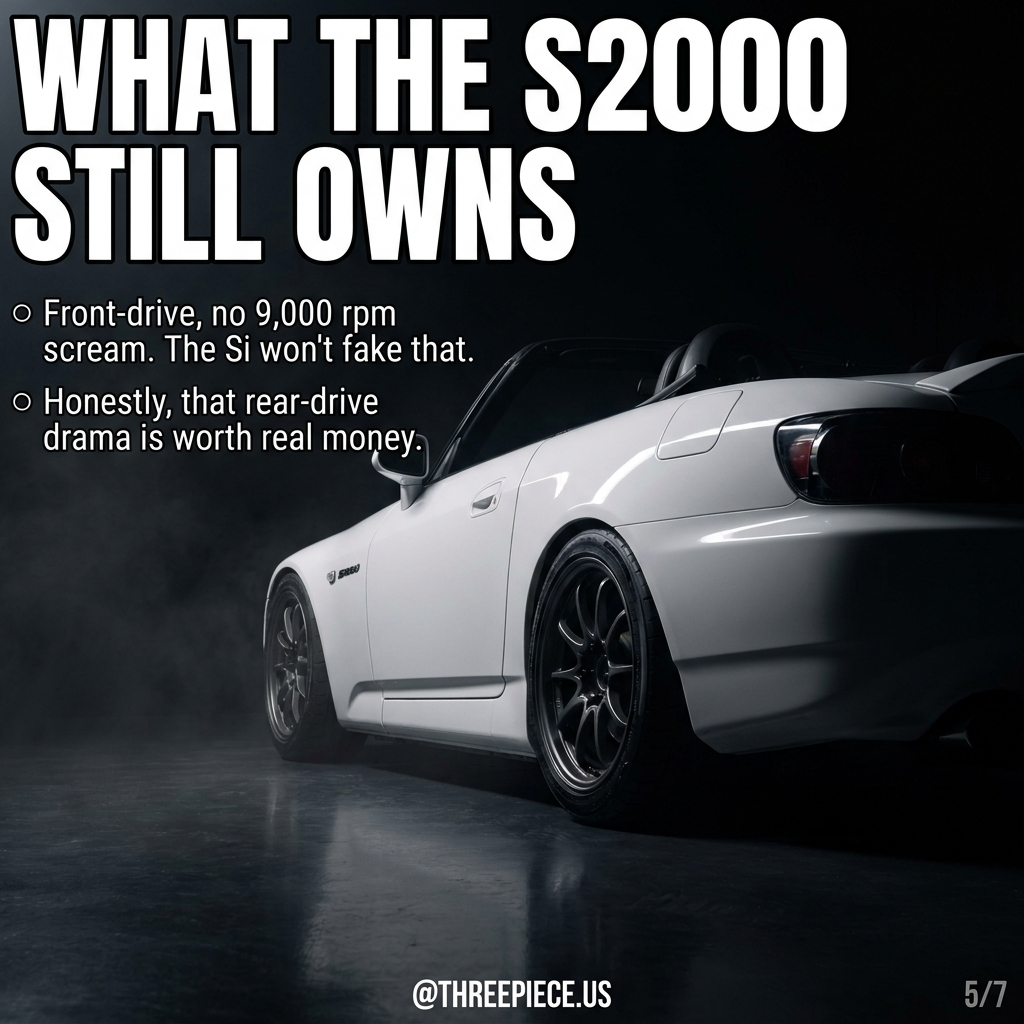
Here's the honest part. The Si is front-drive, and it will not fake a 9,000-rpm F20C scream. No tune changes where the driven wheels are. If what you're chasing is throttle-steer on corner exit, the AP1 howl, and a roadster on a back road at sunset, that rear-drive drama is worth real money. Save for the S2000. No shame in it.
The Si wins a different fight: one car, daily-driven, modded, and paid for. That's the same "better car vs better icon" split we argued in 964 vs 993. Whichever way you lean, rubber matters more than either badge. Our Falken tire verdict is a good place to start pricing your first real set.
8th gen Civic Si buyer's checklist
Two things to check before you hand over cash:
- Third gear grind ('06-'08): Run it hard through third on the test drive and listen. Honda addressed it with TSB 08-020, so ask for records showing the work was done.
- Clear coat: Budget for paint on the roof, hood, and trunk. Peeling clear on horizontal panels is the platform's calling card.
Same philosophy as our GD STI buyer's guide: know the platform's weak spot before you fall in love. Swapping wheels later? Read the TPMS sensor guide first. A fresh 90 Degree Valve Stem at $3.80 is cheap insurance on any aftermarket set.

Civic Si wheel fitment: where the savings go
Factory reference for the 8th gen Si: 17x7 +45, 215/45R17, on a 5x114.3 bolt pattern with a 64.1mm hub bore. Start your search in 17-inch wheels in 5x114.3, size up through 18-inch 5x114.3 options if you're chasing posture over sidewall, and price 215/45R17 tires as your stock-size baseline. Running wheels with a larger center bore? Grab hubcentric rings and the right lug nuts so the new set actually stays true.
Climb the ladder at your own pace. The Work Emotion CR Kiwami lists from $270 and is the classic time-attack Honda look. The Work Emotion T5R from $396 and the Work Emotion T7R from $432 give you more spoke drama. When the S2000 money you didn't spend starts burning a hole, the Work Emotion CR 3P from $895.50 is the endgame set. (There is no endgame.) See the full Work Emotion lineup. And if you scored a used set that's seen some curbs, our wheel refinishing service brings it back.

The verdict: bank the difference, build the Si
If the 9,000-rpm scream is the whole point, save for the S2000 and don't look back. If you want one car that dailies, revs, takes a tune, and leaves you enough money for tires, track days, and a proper set of Work Wheels, the 8th gen Civic Si is the smartest way into Honda's high-rev religion. So pick your side: $6,500 Si plus wheels, tires, and seat time, or the down payment on a clean AP2?
Try wheels on your Honda S2000: see the Honda S2000 bolt pattern, wheel sizes by year and wheel builds in our free wheel visualizer.