
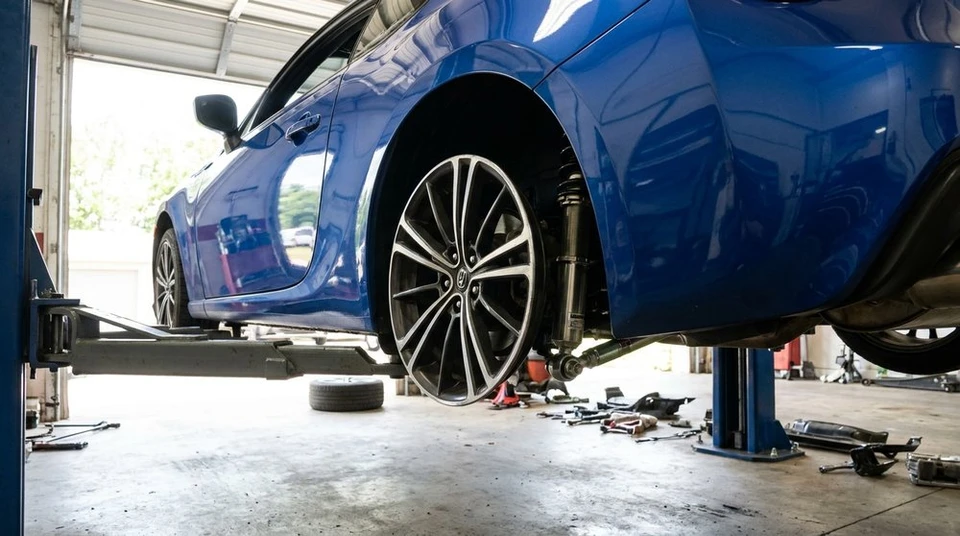
If you drop your car 1.5 inches or more, plan on a camber kit. A mild drop adds only about -0.5° of camber, which a normal alignment can handle. A 2-inch drop can push you to -3° or worse, and factory adjustment typically maxes out around 1.5°. Skip the kit and the inner edge of your tires pays for it, often 2-3x faster than the rest of the tread.
What does a camber kit actually do?
Camber is how far the top of the tire leans in or out when you look at the car head-on. Negative camber means the top tips in toward the fender.
A camber kit gives your alignment tech more adjustment than the factory parts allow. That covers camber plates, adjustable arms, eccentric bushings and cam bolts, or a ready-made kit that bundles the right pieces for your car.
The point is simple: get camber back where you want it after the suspension changes, instead of living with whatever the drop gave you.
Why does lowering add negative camber?
Your control arms pivot on fixed points. When the chassis drops, the arm angle changes, and camber changes with it.
On most front-wheel-drive and all-wheel-drive cars, lowering makes the front wheels go negative. Some rear suspension designs go negative too, which is why a lot of lowered cars need hardware at both ends.
There's another way to look at it. Once the car sits lower, the factory control arms are often effectively too long for the new ride height. That's exactly the problem a threaded adjustable arm solves.
How much drop before you need a camber kit?
Here's how it usually plays out:
| Situation | Typical camber | What it means for you |
|---|---|---|
| Mild drop | About -0.5° added | A standard alignment can usually correct it |
| Drop of 1.5" or more | Varies by car | Factory adjustment may or may not be enough; budget for a kit |
| 2" drop | -3° or more | No alignment rack can fix it without camber-adjustable hardware |
| Factory adjustment range | Typically maxes out at 1.5° | Need more than that and you need a kit |
| Track car (on purpose) | Often -2° to -3° | Set for cornering grip, not tire life |
Coilover cars catch people out here. Even with a modest drop like 1.2 inches up front and 0.6 inches in the rear, owners have been told to add a camber kit. Don't assume a small number on the tape measure means you're safe.
What does too much negative camber do?
A little negative camber is normal. Properly set-up cars run at least some, so the idea that every car runs zero is a myth. The trouble starts when the drop piles on more than you asked for.
- Inner-edge tire wear. At -3°, the car rides mostly on the inside edge. A tire that should last 40,000 miles can be down to the cords on that edge at 15,000.
- Tramlining. The car wants to follow ruts and grooves in the road instead of tracking straight.
- Worse straight-line braking. Less tread flat on the pavement means less grip when you stand on the pedal.
- Faster wear on parts. Extreme angles put more stress on wheel bearings, ball joints and tie rod ends.
- Pulling. If one side lands at -2.5° and the other at -3.5°, the car will pull. That's why good shops check every corner on its own.
Camber plates vs camber arms vs bushings
Which hardware you need depends on how your suspension is built. Here's the quick breakdown:
| Type | How it works | Where you'll see it |
|---|---|---|
| Camber plates | Replace the factory upper strut mount so the top of the strut can move in or out | Strut-style front suspensions |
| Camber arms | Replace the factory control arm, usually threaded so you can correct the length | Rear multi-arm setups and many front ends |
| Eccentric bushings and cam bolts | Offset hardware that shifts the pivot point to add adjustment | Cars that already use cam bolts or bushings at the pivots |
| Ready-made kits | A bundle of the right pieces for one platform | Most popular cars |
Camber plates
If your car runs front struts, plates are the classic fix. They swap in where the factory upper mount lives and let you slide the top of the strut to dial camber. Browse front upper camber kits or the pillowball front upper camber kits if you want a firmer-feeling mount.
Camber arms
Camber arms replace the stock arm with an adjustable one, usually threaded. Lower the car, spin the arm to the right length, and camber comes back. For the rear of most lowered cars, this is the go-to. Our rear camber arms guide goes deeper, and you can shop rear upper camber kits or rear upper camber kits with pillowball bushings.
Control arm kits aren't just for slammed cars. Eibach's front kit for the Tacoma shows the same idea working on trucks, where height changes in either direction throw camber off.
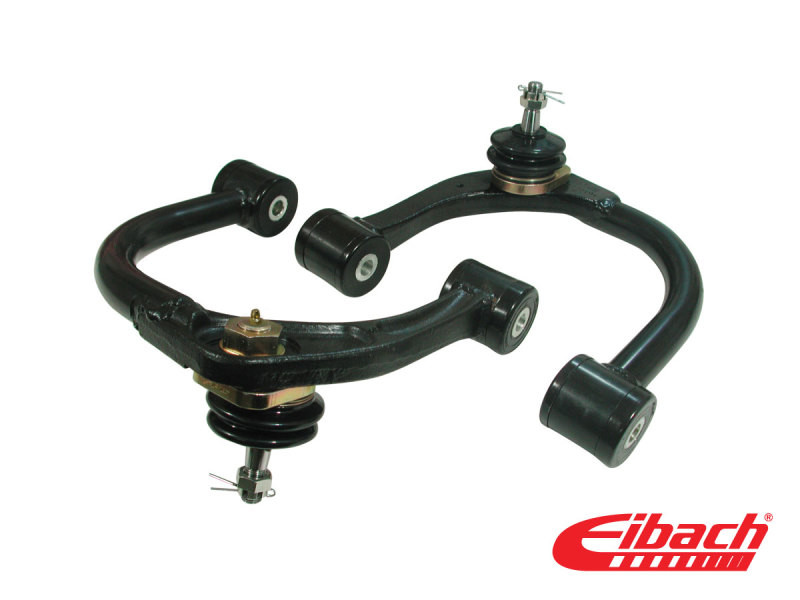
Eibach Pro-Alignment Front Camber Kit for 2016+ Toyota Tacoma - 5.25470K
- Fits: 2016-2023 Toyota Tacoma (TRD Sport); 2021 Toyota Tacoma (Trail); 2023 Toyota Tacoma (Trail Special Edition); 2005-2013 Toyota Tacoma (X-Runner)
- Part number: 5.25470K
$870.00 · View details
The Eibach Pro-Alignment front camber kit (5.25470K) is a control arm kit with a hybrid tubular and forged steel design and an OE-style ball joint. It's sold in pairs. It gives +/-2 degrees of additional camber over factory and improves droop travel, drivability and tire wear on lifted suspensions. It fits the 2016-2023 Tacoma TRD Sport, 2021 Trail, 2023 Trail Special Edition and 2005-2013 X-Runner. If you're raising a Tacoma instead of dropping it, our Tacoma leveling kit picks are the place to start.
Cam bolts and eccentric bushings
The cheapest route, when your car already uses cam bolts at the pivots. You swap the factory bolts for ones with more offset and get extra range without new arms.
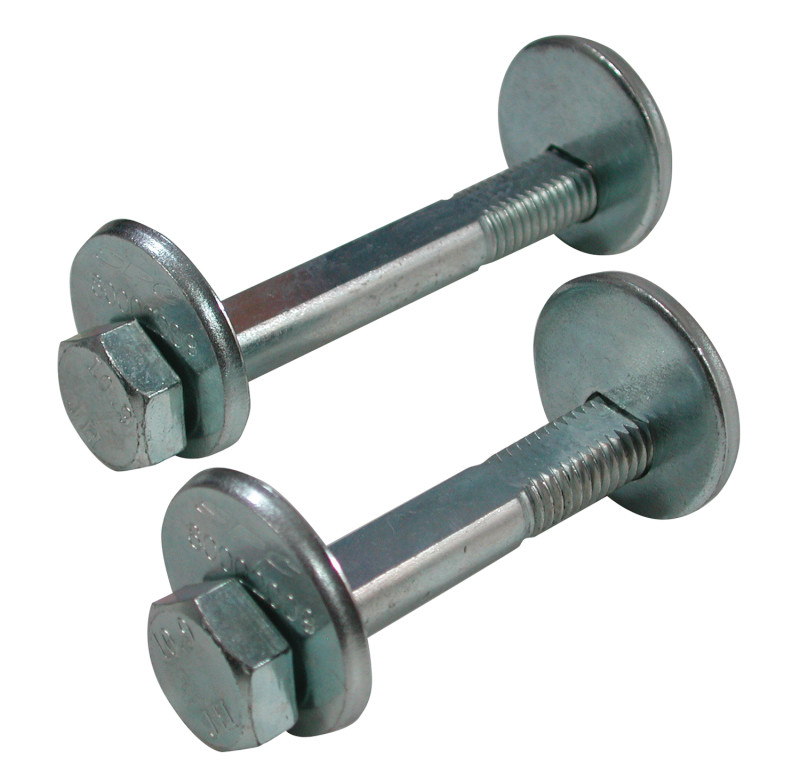
SPC Performance Camaro Rear Camber/Toe Adjustment Kit - 87430
- Fits: 2008-2009 Pontiac G8 (GT); 2009 Pontiac G8 (GXP)
- Part number: 87430
$57.54 · View details
The SPC Performance 87430 rear camber/toe kit is a textbook example. It replaces the OE cam bolts and gives +/-1.0° of camber change and +/-2.0° of toe change, with no slotting or grinding. It's built as a Camaro kit, and it fits the 2008-2009 Pontiac G8 GT and 2009 G8 GXP.
Offset bushings do the same job at bushing pivots. On the Mazda 3 MPS, SuperPro's SPF2326K double-offset alignment kit gains about 1° of camber in its preferred position and adds positive caster on both sides. It's designed as a non-tyre-wearing geometry change.
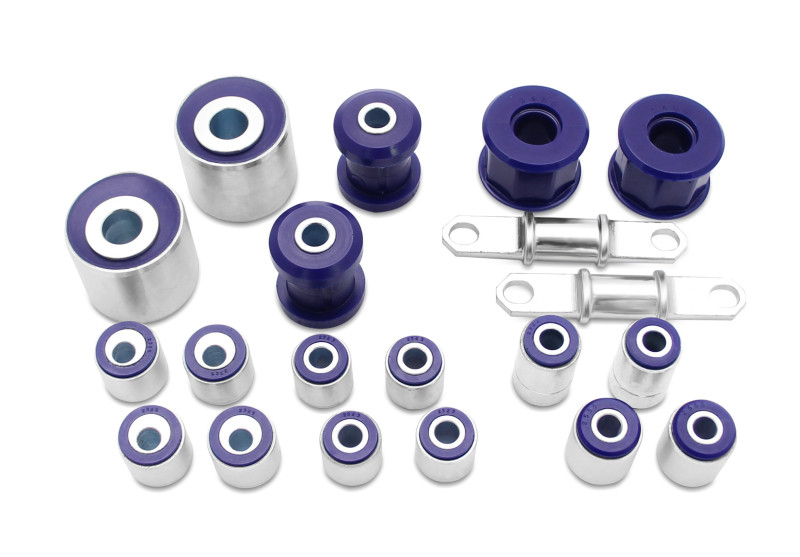
SuperPro 2004 Mazda 3 i Front / Rear Vehicle Master Bushing Kit - Caster/ Camber Adj - KIT170K
- Fits: 2004 Mazda 3 (S, i)
- Part number: KIT170K
$665.99 · View details
This SuperPro master bushing kit covers the front and rear of the 2004 Mazda 3 S and i. Full front-and-rear SuperPro kits are serious work; on the Mazda 3 MPS, the full kit is rated a difficult install with a fitting time of 1,020 minutes. That's 17 hours, so this is a shop job for most people. Confirm with SuperPro which offset bushes come in the kit for your exact car before you book the alignment.
| Product | Type | Adjustment | Fits | Price |
|---|---|---|---|---|
| SPC Performance 87430 | Rear cam bolt kit | +/-1.0° camber, +/-2.0° toe | 2008-2009 Pontiac G8 GT; 2009 G8 GXP | $57.54 |
| Eibach 5.25470K | Front control arm kit | +/-2° over factory | 2016-2023 Tacoma TRD Sport; 2021 Trail; 2023 Trail SE; 2005-2013 X-Runner | $870.00 |
| SuperPro KIT170K | Front and rear bushing kit | - | 2004 Mazda 3 S, i | $665.99 |
The mistakes we see people make
- Chasing max negative camber for "grip." Moderate negative camber helps in corners. Too much hurts straight-line grip and grip everywhere except high-speed cornering. Your daily doesn't live at the apex.
- Forgetting toe. Keep toe as close to stock as you can. Bad toe eats tires faster.
- Letting the shop use the wrong spec. Some trims have different specs depending on wheel size. Make sure the tech is using the numbers for your exact trim and wheels, and always ask for the printout.
- Skipping the alignment. Any time you touch suspension, get it aligned. Coilovers, arms, bushings, all of it.
- Fixing one end only. If your rear goes negative when lowered, a front kit alone won't save your rear tires.
What it means when you're buying
Start with where the camber is off. Front-drive and AWD cars usually need the front sorted first; check your rear numbers before assuming you're done. Shop front camber kits and rear camber kits separately so you get the right part for each end.
Then match the hardware to the suspension. Struts up front point to plates. Multi-arm rears point to camber arms. Factory cam bolts point to an offset bolt kit. Brands like Truhart front camber kits are one option to look at.
Building a stance car? Extra negative camber is part of the look. It lets the tire lean in and clear the fender, so you can go lower. Just know you're trading tire life for tuck, and budget for it.
Finally, put the alignment in the budget from day one. A camber kit without a proper alignment is just expensive parts sitting at the wrong angle.
What we'd do
- Under about an inch of drop, get an alignment first. If the factory range gets you to spec, save your money.
- At 1.5 inches or more, we'd buy the camber kit with the coilovers or springs and do one alignment for both.
- For a daily, we'd keep camber moderate and toe close to stock. Tires last, the car tracks straight.
- For a track car, the -2° to -3° range is where most of them live, and that's where we'd start.
- Whatever you run, walk out of the shop with the printout in hand.
FAQ
Do I need a camber kit for a lowered car?
If you've dropped it 1.5 inches or more, probably yes. A mild drop adds about -0.5° that a regular alignment can fix, but a 2-inch drop can push you to -3° or past it, beyond what factory adjustment can correct. Get it aligned first and see where you land; if the shop can't reach spec, you need the kit.
What do camber arms do?
Camber arms replace your factory control arms with adjustable ones, usually threaded. Lowering a car often leaves the stock arms effectively too long for the new ride height, which tips the tires inward. A threaded arm lets the alignment tech set the right length and bring camber back where you want it, front or rear depending on the car.
Do camber arms or camber plates work better?
Neither is better across the board; it depends on your suspension. Camber plates are the fix for strut-style front ends, since they replace the upper strut mount and let the strut top move in or out. Camber arms are the answer for control arm setups, especially lowered rears. Plenty of cars end up running plates up front and arms out back.
Will a camber kit stop my tires from wearing on the inside?
It can, as long as you actually use it to dial camber back. At -3° a car rides mostly on the inner edge, which can wear 2-3x faster than the rest of the tread. A kit plus a proper alignment, with toe set close to stock, gets the tread back on the road and spreads the wear out again.
Do you need an alignment after installing a camber kit?
Always. The kit only adds adjustment range; the alignment is where the numbers get set. Have the shop check each corner individually, use the spec for your exact trim and wheel size, and hand you the printout. Uneven left and right camber will make the car pull even with brand-new parts.
Ready to sort your alignment? Browse our full range of camber kits or narrow it down in camber adjustment kits.