

VW CC VR6 4Motion Buying Guide: AWD Sleeper in 2026
The VW CC VR6 4Motion is the most overlooked AWD six-cylinder four-door coupe on the used market in 2026. While everyone chased the 2.0T because it was cheaper and everywhere, Volkswagen quietly offered a 280 hp naturally aspirated 3.6L VR6 with Haldex all-wheel drive in a car that looks like it costs twice its asking price. These were low-volume even when new, and clean examples are genuinely scarce now. If you've been looking for a sleeper grand tourer that nobody at the car meet expects, this is the one — but you need to know exactly what you're getting into before you buy.

Quick links
- Why the VR6 Exists in a Different League Than the 2.0T
- Why Clean Examples Are Getting Harder to Find
- Known Failure Points: What Actually Breaks
- Your Pre-Purchase Checklist
- CC VR6 Wheel Fitment and Upgrades
- Go Find One Before They're Gone
Why the VR6 Exists in a Different League Than the 2.0T
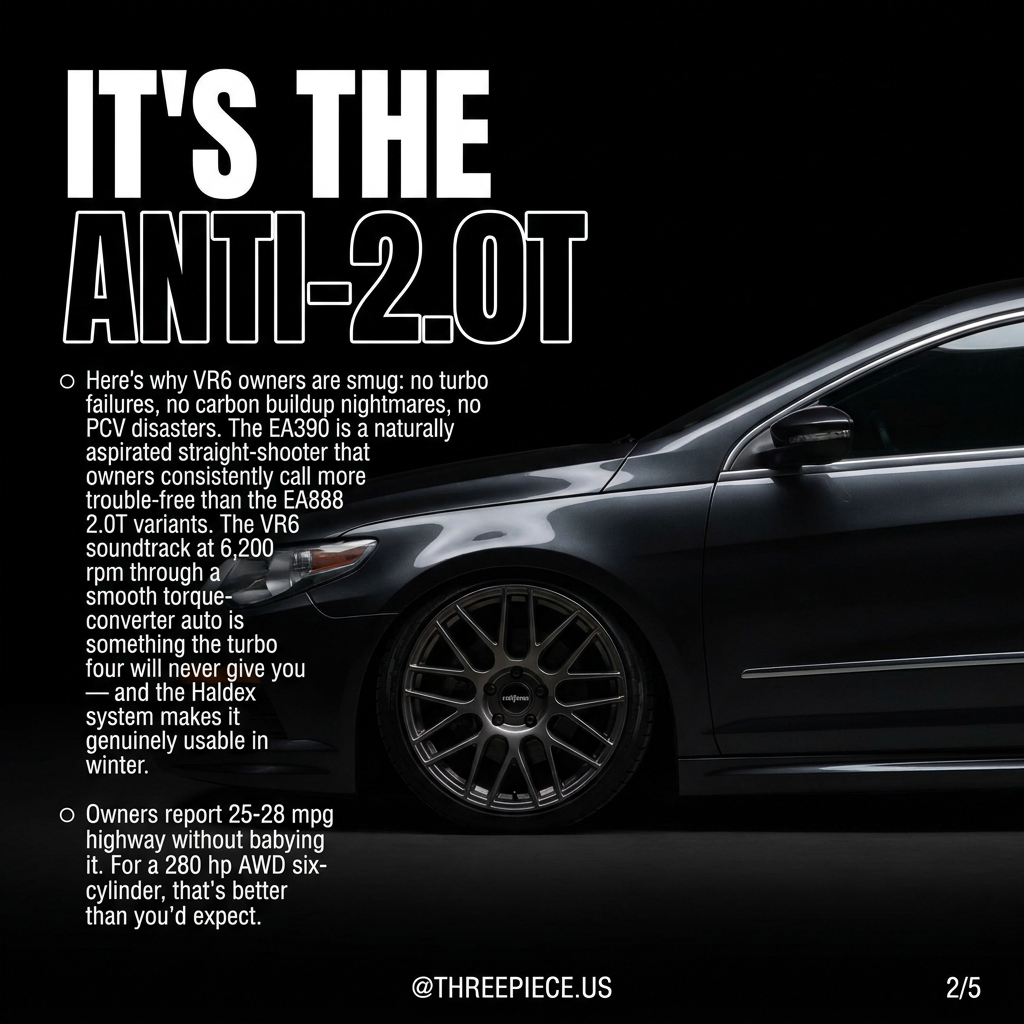
Here's why VR6 owners are smug: no turbo failures, no catastrophic carbon buildup nightmares, no PCV disasters that snowball into engine damage. The EA390 3.6L VR6 is a naturally aspirated straight-shooter that forum owners consistently call more trouble-free than the EA888 2.0T variants. VW paired it exclusively with a 6-speed Aisin torque-converter automatic — no DSG — which means no mechatronic unit failures, no clutch pack wear, none of the dual-clutch anxiety that plagues the rest of the VW lineup.
The VR6 soundtrack at 6,200 rpm through that smooth torque-converter is something the turbo four will never replicate. Owners report 25–28 mpg highway without babying it, which is genuinely impressive for a 280 hp AWD six-cylinder. The Haldex-based 4Motion system is front-biased but engages the rear axle under slippage, making the CC a legitimate four-season car. Compare that to something like the Audi S4 — you're getting a similar concept at a fraction of the price, and arguably with fewer headaches from the powertrain. If you've been eyeing other underrated AWD sedans, the CC VR6 deserves a spot on your shortlist.
Why Clean Examples Are Getting Harder to Find
The CC VR6 4Motion was a low-volume trim even when new. Most dealers only received a handful, and the people who bought them tend to keep them. This isn't like hunting for a GTI or even a Golf R — these were niche cars purchased by buyers who specifically wanted the VR6 and AWD combination and were willing to pay the premium over the 2.0T. Forum members describe finding one with low mileage as "extremely hard" in 2026.
The ownership patterns tell the real story. One long-term owner put 158,000 miles on a 2013 Executive trim and called it "mechanically solid," only planning walnut blasting for intake carbon buildup at that point. Another owner documented two timing chain services — one at roughly 135,000 miles, the second around 265,000 km — proving these engines can push well past 200k miles if maintained properly. These cars reward people who take care of them, which is why the ones that surface tend to come from loyal first or second owners. That's a pattern you see with other overlooked enthusiast cars like the Toyota Aristo — low production, loyal owners, and a window that's closing fast.

Known Failure Points: What Actually Breaks
The VR6 is more reliable than the 2.0T, but it's not bulletproof. Here are the documented big-ticket items you need to budget for, with real mileage data from owners and shops.
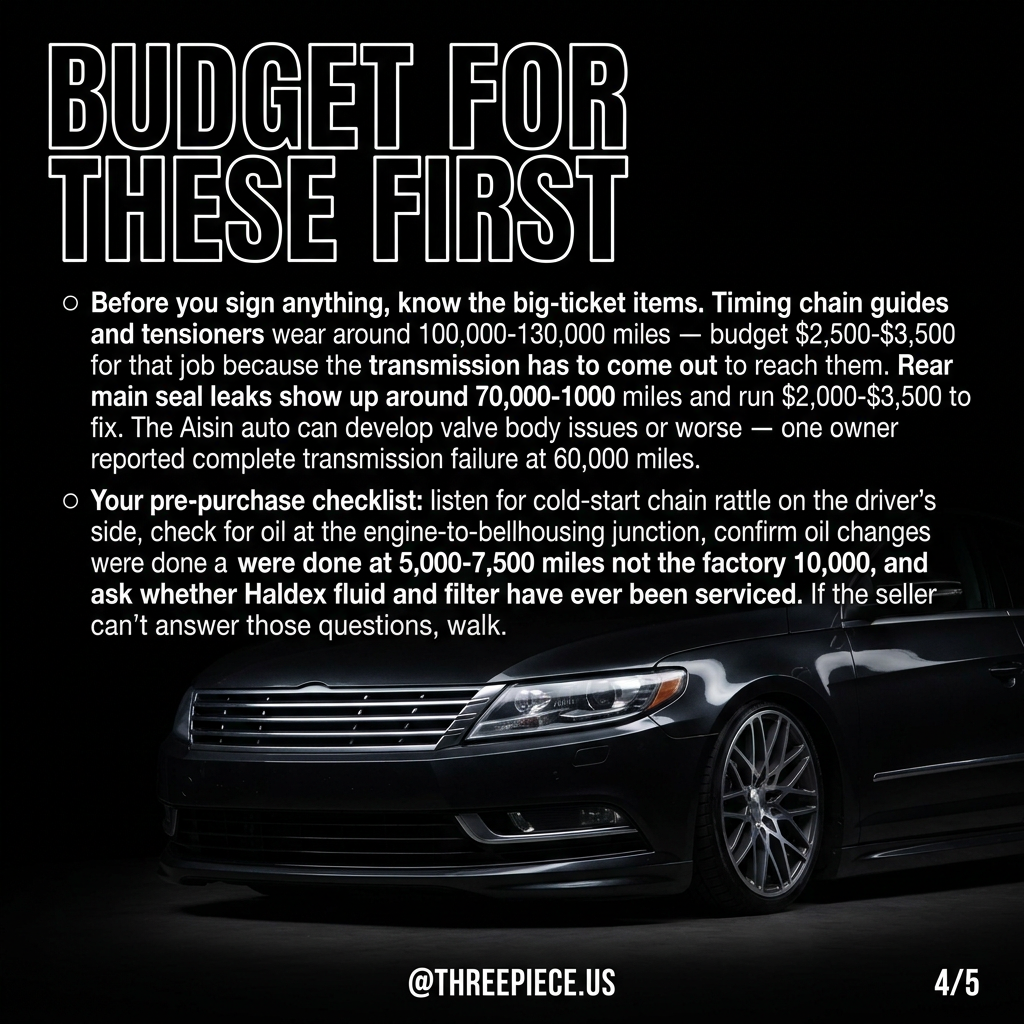
Timing Chains and Guides (~100,000–130,000 miles): This is the big one. The upper chains stretch, plastic guides and tensioners degrade, and if the chain jumps or slips you're looking at valves contacting pistons — catastrophic engine damage. Symptoms start with a rattle at cold start from the driver's side. If caught early, chain guides and tensioners run $1,500–$2,500 including labor. If you miss it and damage occurs, expect $5,000–$8,000+ for a full tear-down. VW revised the tensioner design from mid-2012 production onward, so later cars carry lower risk — but some 2012 models still have the older style depending on build date.
Rear Main Seal Leaks (~70,000–100,000 miles): The RMS leaks outward due to PCV and internal pressure problems. On the VR6, the transmission has to come out to access the seal. Look for oil at the engine-to-bellhousing junction. Budget $2,000–$3,500 depending on your shop. Some owners upgrade to IABED billet seals for better longevity. If you're already doing a timing chain service, combine the jobs to save on labor since the trans is already dropped.
Aisin Automatic Transmission: The 6-speed auto is generally solid, but it's not immune. One owner reported complete transmission failure at just 60,000 miles — slipping, refusal to shift into higher gears, limp mode. Replacement or rebuild runs $3,000–$5,000+. Test shifting aggressively during your test drive and pay attention to any delayed or jerky transitions. This is similar to the kind of transmission lottery you see discussed in our W212 E63 AMG breakdown — the drivetrain is mostly great, but when it goes, it goes expensively.
Valve Cover Gaskets, PCV, and Coil Packs (~60,000–90,000 miles): Valve cover gaskets leak, the PCV system fails, and coil packs go bad — especially if heat-soaked. These leaks can aggravate the RMS and chain cover issues if ignored. Valve cover gasket job runs $500–$900; coil packs are $150–$250 installed per cylinder. An oil catch can is a worthwhile preventive mod on this engine to reduce PCV-related pressure buildup.
Electrical and Trim Annoyances: Rear window trim cracking, trunk wiring harness rotting, sunshade mechanisms failing, infotainment freezing. VW revised the rear-window trim piece in later production, and updated PCV housings and gaskets in newer VR6s. None of these are showstoppers, but they add up if you're buying a neglected example.
Your Pre-Purchase Checklist
If you can confirm these items before signing anything, you'll save yourself thousands and avoid the worst surprises.
1. Oil change records: Does the history show changes at 5,000–7,500 miles, or just the factory-recommended 10,000? The factory interval is widely considered too long by shops and long-term owners. Dirty oil accelerates wear on chains, tensioners, and cam lobes. If the seller only followed the factory schedule, assume the chain and guides are on borrowed time past 80k miles.
2. Cold-start chain rattle: Start the car cold and listen from the driver's side, upper area of the engine. Any rattle that fades as the engine warms is a timing chain red flag. This is the single most important test you can do on a VR6.
3. Oil at the bellhousing junction: Get under the car and inspect where the engine meets the transmission. Any oil seepage here means the rear main seal is going or gone. Budget accordingly.
4. Transmission behavior: Drive it hard. Accelerate aggressively through all six gears. Any slipping, delayed shifts, or jerky transitions means valve body issues or worse. Don't accept "it just needs a fluid change" as an answer.
5. Haldex service history: Ask whether the Haldex fluid and filter have ever been serviced. This is rarely maintained on used CCs, and the AWD system adds complexity that most owners ignore. If it hasn't been done, it's not a dealbreaker — but it's a negotiation point and an immediate maintenance item.
6. Target under 100,000 miles: This puts you ahead of the timing chain and RMS windows. If you're buying above 100k, confirm those services have already been completed or price them into your offer.
CC VR6 Wheel Fitment and Upgrades
The VW CC runs a 5x112 bolt pattern with a 57.1mm center bore — the standard VW/Audi hub. Factory wheel sizes range from 17" to 18" depending on trim. For aftermarket, the sweet spot on the CC is 18x8.5 +45 or 19x8.5 +45. The fastback roofline and wide fenders mean this car looks dramatically better with properly fitted wheels — it's one of those platforms where the right wheel setup transforms the entire presence of the car.
Browse 18" wheels in 5x112 or step up to 19" options in 5x112 to see what's currently available. If you're running aftermarket wheels on a 5x112 car, you'll want hubcentric rings to maintain proper centering — the 57.1mm bore is smaller than most aftermarket wheel bores, so this is non-negotiable for vibration-free driving. Understanding the difference matters; our guide on hub-centric vs. lug-centric wheels breaks it down.
For tire sizing, 225/40R18 is the factory-equivalent fitment, but you can go wider to 245/40R18 on an 8.5" wide wheel for better grip and a meatier sidewall profile. Pair them with 245/40R18 tires for a proven setup. On 19s, 235/35R19 or 245/35R19 works well — check 245/35R19 tires for options.
The CC's lines suit both Japanese multi-piece wheels and European mesh designs equally well. The Work Emotion series in 18" is a popular choice on VW builds, and the Work Meister line gives you that classic multi-piece look that complements the CC's fastback silhouette. If you're going three-piece, you'll need quality assembly hardware — M7x32 chrome assembly bolts at $10 each are the standard for most Work and aftermarket multi-piece wheels. For a premium touch, the M7x32 24K gold bolt and nut set at $15 adds a detail that pops against dark wheel finishes. Check our vehicle gallery for build inspiration across similar European platforms.
If you're considering forged wheels for this build, read our breakdown of what forged wheels actually are and whether they're worth it. On a car this rare, the right wheel setup is what separates a clean CC from one that turns heads at every meet.

Go Find One Before They're Gone
The VW CC VR6 4Motion is a smooth, rare, AWD six-cylinder four-door coupe that flies completely under the radar — and prices haven't caught up to what this car actually is. If you're willing to wrench or trust a good independent VW shop, this is one of the best-kept secrets on the used market right now.
Target under 100,000 miles. Confirm timing chain service history. Budget $2,000–$3,500 in year-one maintenance to get ahead of the known items — rear main seal, Haldex service, valve cover gaskets. Do that and you've got a car that nothing else at this price point can match: a VR6 soundtrack, all-wheel drive confidence, a fastback silhouette that aged better than most modern designs, and the satisfaction of owning something most people don't even know existed.
If you've already found yours, start with the wheels. Browse new wheels in 5x112, grab proper lug nuts and 90-degree valve stems at $3.80 each for multi-piece setups, and finish the build the way it deserves. The CC VR6 4Motion is a car that rewards owners who pay attention — don't let this window close without looking.