
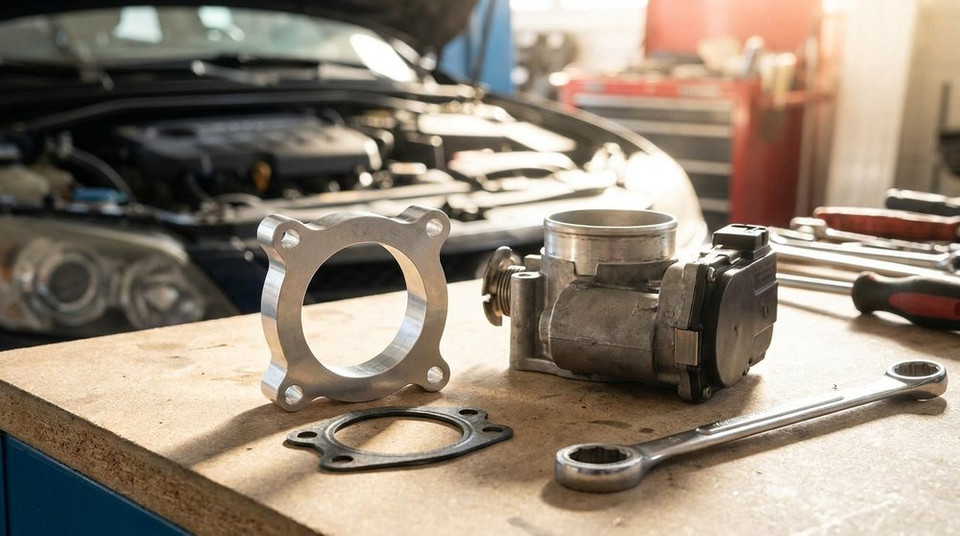
A throttle body spacer doesn't add real power to a modern fuel-injected engine. Back-to-back dyno pulls land anywhere from zero to single-digit gains, usually 0-6 hp, and that's inside the normal swing between one dyno run and the next. Some engines even lose a few horsepower. Buy one to replace a factory spacer or because you like the part. Don't buy one for horsepower.
What is a throttle body spacer?
It's a machined ring, usually aluminum, that bolts between the throttle body and the intake manifold. Many have a spiral "helix" or serrations cut into the bore. Others are a plain ring.
A few cars come with a spacer from the factory. The Audi RS3 and TT RS 2.5 TFSI are good examples. On those, an aftermarket spacer replaces a stock part instead of adding a new one.
You'll find them under throttle body spacers in our engine components section, sorted by vehicle.
How is it supposed to make power?
There are two sales pitches:
- More plenum volume. The spacer moves the throttle body out a bit and adds air space before the manifold.
- Swirl. A helix or serrated bore stirs up the air right before it enters the engine. The idea is better mixing and better throttle response.
Here's the problem. A 1/4-inch-tall, 2.5-inch round spacer adds a tiny sliver of volume compared to the whole intake. That's not enough to change how the engine breathes.
The swirl idea made more sense on older setups. Spacers did their best work on engines that mix fuel and air at the throttle: 2- and 4-barrel carburetors and throttle-body injection. Guys running single- and dual-plane carbureted intakes with short runners are the ones who actually felt a difference. On modern factory intakes, plenum spacers just don't do much.
Smaller engines can even lose some low-end torque with a spacer in place.
Do throttle body spacers work on the dyno?
This is where the hype meets the rollers. Here's how spacers have done in back-to-back pulls on fuel-injected engines, with the one maker claim at the bottom for comparison.
| Vehicle / engine | Spacer | Before | After | Change |
|---|---|---|---|---|
| Ford 4.6L 3-valve, GM LS, Mopar HEMI V8 | Several | - | - | No gain on any; HEMI lost 4 hp at the tires |
| 2nd-gen Toyota Tundra (at the wheels) | Volant Vortice | 281 hp / 292 lb-ft | 287 hp / 301 lb-ft | +6 hp / +9 lb-ft, inside the run spread |
| Jeep | aFe Silver Bullet | 231.0 hp / 210.0 lb-ft | 236.8 hp / 210.7 lb-ft | +5.8 hp / +0.7 lb-ft |
| Ford Focus ST (same tune) | - | 239.9 hp / 300 lb-ft | 245 hp / 311 lb-ft | +5.1 hp / +11 lb-ft |
| Pontiac GTO (retuned, same dyno) | - | - | - | +1 lb-ft peak, no real hp |
| Dodge Charger | - | - | - | +3 hp / +10 lb-ft |
| BMW 325i (E46) | aFe 46-31008 | - | - | Up to +10 hp / +14 lb-ft (maker claim) |
Look at the pattern. The best independent numbers top out around 6 hp. The worst is a loss. The only double-digit horsepower figure comes from the company selling the part.
Why a 5 hp "gain" doesn't mean much
Dynos don't read the same number twice. Heat, air temperature and how warm the engine is all move the result from pull to pull. A few horsepower either way is normal, even with nothing changed.
The Tundra test shows this perfectly. The +6 hp looked great until you look closer. The engine was cooler during the second set of runs. The spread between runs was about 3 hp and 3 lb-ft before the spacer, and 5 hp and 6 lb-ft after. That means the "after" peak could have been anywhere from 282 to 292 hp. The tester's own read: at best a couple horsepower and a pound-foot of torque, at worst nothing. He didn't recommend it.
The Focus ST numbers have the same issue. That was three pulls without the spacer and two with, at 75 degrees and then about 80. That's too few runs to separate a real gain from normal variation.
Then there's the butt dyno. The GTO owner who saw just 1 lb-ft still said throttle response felt sharper. Most guys who swear by spacers talk about how the car feels, not what the sheet says.
If you've got a Tundra and want a change you'll actually notice, our guide to the best lift kits for the Toyota Tundra is a better place to spend the money.
Mistakes we see people make
- Buying it for horsepower. Expect a couple of horsepower at best on a modern engine. If the box promises ten, read the table above again.
- Stacking it with other mods and crediting the spacer. Spacers usually go on alongside an intake, a tune or exhaust. When the car picks up power, nobody can say which part did it.
- Assuming it bolts right up. On that Tundra, the Volant spacer's bolt pattern didn't quite match the factory throttle body. After 45 minutes, only 3 of the 4 bolts would thread. The holes had to be drilled one size larger and beveled to fit. Check fitment with the maker for your exact vehicle before you order.
- Ignoring the noise. Some spacers whistle or hiss. Helix-only designs are known for it.
- Putting one on a small engine. You can trade away some low-end torque for nothing.
- Reusing a tired gasket. If the throttle body is coming off anyway, grab fresh throttle body gaskets while you're in there.
When a spacer actually makes sense
There are a few honest reasons to buy one: replacing a factory spacer, finishing a build you've already planned, or you just like the part. Here are three we stock.
| Part | Fits | Material | Price |
|---|---|---|---|
| do88 CP-130 | Audi RS3 2.5 TFSI (8V/8Y) 2017-; TT RS 2.5 TFSI (8S) 2016- | 6063 aluminum, matte black anodized | $112.02 |
| aFe Silver Bullet 46-31008 | 2001-2006 BMW 325i (Base) | 6061-T6 billet aluminum | $139.00 |
| Torque Solution TS-TBS-018R (Red) | 2010-2012 Hyundai Genesis Coupe 2.0T | - | $88.48 |
Replacing a factory spacer: do88 CP-130
This one makes the most sense to us, because it doesn't pretend to be a power part. The do88 CP-130 for the RS3 and TT RS replaces the factory spacer (OE ref. 07K133424). It fits the 400 hp 2.5 TFSI with DAZA and DNWA engine codes in the RS3, and the DAZA in the TT RS. It's made from solid 6063 aluminum in matte black and comes with two 1/8-27 NPT plugs for when you don't need the ports. do88 makes no horsepower claim, and we respect that.
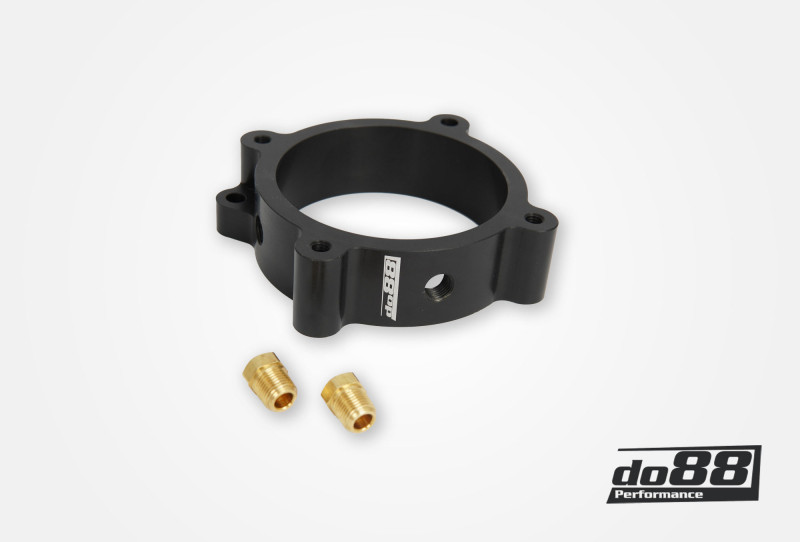
do88 Audi RS3 2.5T (8V/8Y)/TT RS 2.5T (8S) Throttle Body Spacer - Black - CP-130
- Emissions: not CARB legal (not for sale in California)
- Part number: CP-130
$112.02 · View details
E46 owners who want one anyway: aFe Silver Bullet
The aFe Silver Bullet spacer for the E46 325i is CNC-machined from 6061-T6 billet aluminum. It uses a serrated/helix entry that's meant to create turbulence while cutting the whistle you get from helix-only designs. aFe says it's good for up to 10 hp and 14 lb-ft on the E46. Our honest expectation is closer to what the same family of spacer did on a Jeep: a few horsepower and almost no torque.
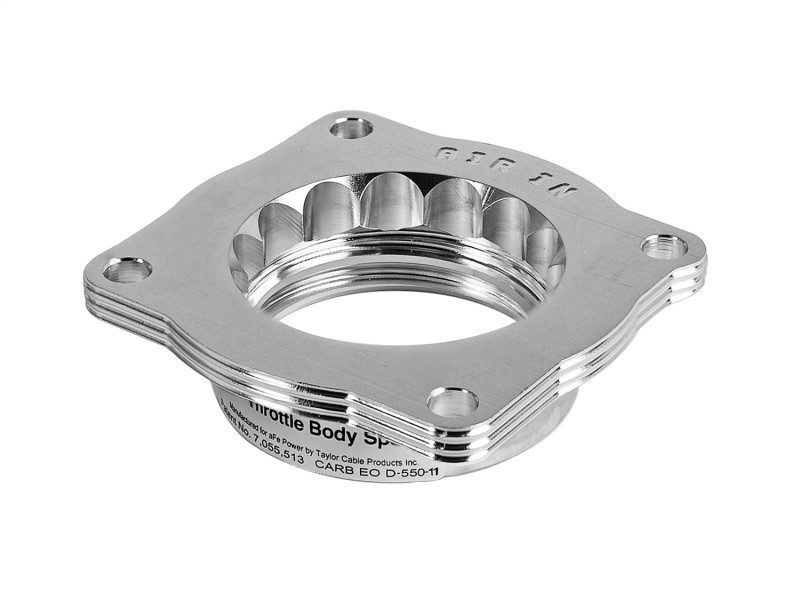
aFe Silver Bullet Throttle Body Spacers TBS BMW 325i (E46) 01-06 L6-2.5L - 46-31008
- Fits: 2001-2006 BMW 325i (Base)
- Part number: 46-31008
$139.00 · View details
Genesis Coupe 2.0T: Torque Solution
For 2010-2012 Genesis Coupe 2.0T owners, the Torque Solution red throttle body spacer is a fitment-specific piece that adds some color to the engine bay. Buy it for the build and the look, not for a dyno sheet.
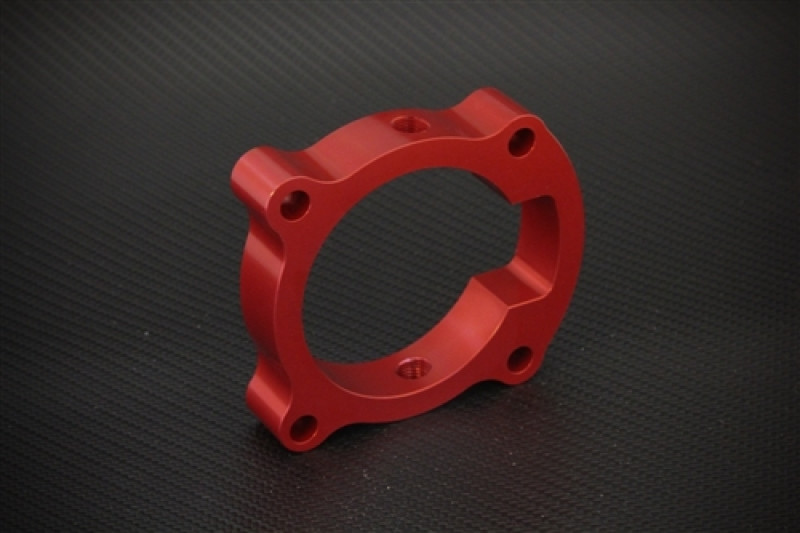
Torque Solution Throttle Body Spacer (Red): Hyundai Genesis Coupe 2.0T 10-12 - TS-TBS-018R
- Fits: 2010-2012 Hyundai Genesis Coupe (2.0T)
- Emissions: not CARB legal (not for sale in California)
- Part number: TS-TBS-018R
$88.48 · View details
What we'd do
- On a modern fuel-injected daily, we'd skip the spacer. The best case is a couple of horsepower you can't prove.
- If your RS3 or TT RS needs its factory spacer replaced, the do88 CP-130 is the one we'd bolt in.
- If you run a carbureted engine with a short-runner intake, that's where spacers earned their reputation. That's the one place we'd try one for power.
- Truck guys, put that money toward something you'll actually see and feel. A set from our leveling kits or lift kits changes the truck every time you walk up to it.
Still want one for your build? Browse the full throttle body spacer lineup or our intake-side throttle body spacers by vehicle.
FAQ
Do throttle body spacers work?
Not for power on modern fuel-injected engines. Back-to-back dyno pulls show anywhere from no gain to single digits, usually inside normal run-to-run variation. One test across a Ford 4.6L, a GM LS and a HEMI found zero gains, and the HEMI lost 4 hp. They make sense as factory spacer replacements or on carbureted short-runner intakes, not as a bolt-on power mod.
Do throttle body spacers add horsepower?
Barely, if at all. The best independent results we've seen top out around 5-6 hp, like +5.8 hp on a Jeep and +6 hp on a Tundra. That Tundra gain fell inside the spread between runs, so it may not be real. Manufacturer claims run higher. aFe rates its E46 part at up to 10 hp.
Do throttle body spacers improve throttle response?
A lot of owners say the car feels sharper, even when the dyno sheet stays flat. One GTO picked up just 1 lb-ft after a retune, yet the owner still swore response improved. That's a feel thing, not something the numbers back up. If crisp response is the goal, don't expect a spacer to transform the car.
Can a throttle body spacer hurt performance?
Yes, it can. The HEMI in that three-engine test lost 4 hp at the tires with a spacer installed, and other owners have seen small losses too. Smaller engines can also give up some low-end torque. Some spacers add a whistle or hiss, and poorly matched ones may need drilling just to bolt up.
Do throttle body spacers work on carbureted engines?
That's where they make the most sense. Spacers did their best work on 2- and 4-barrel carbureted engines and throttle-body injection, where fuel and air mix at the throttle. Guys with single- and dual-plane carbureted intakes and short runners are the ones who report real seat-of-the-pants gains. On modern factory intakes, the effect mostly disappears.