
Porsche 993 Build Guide: Mod Order That Actually Works
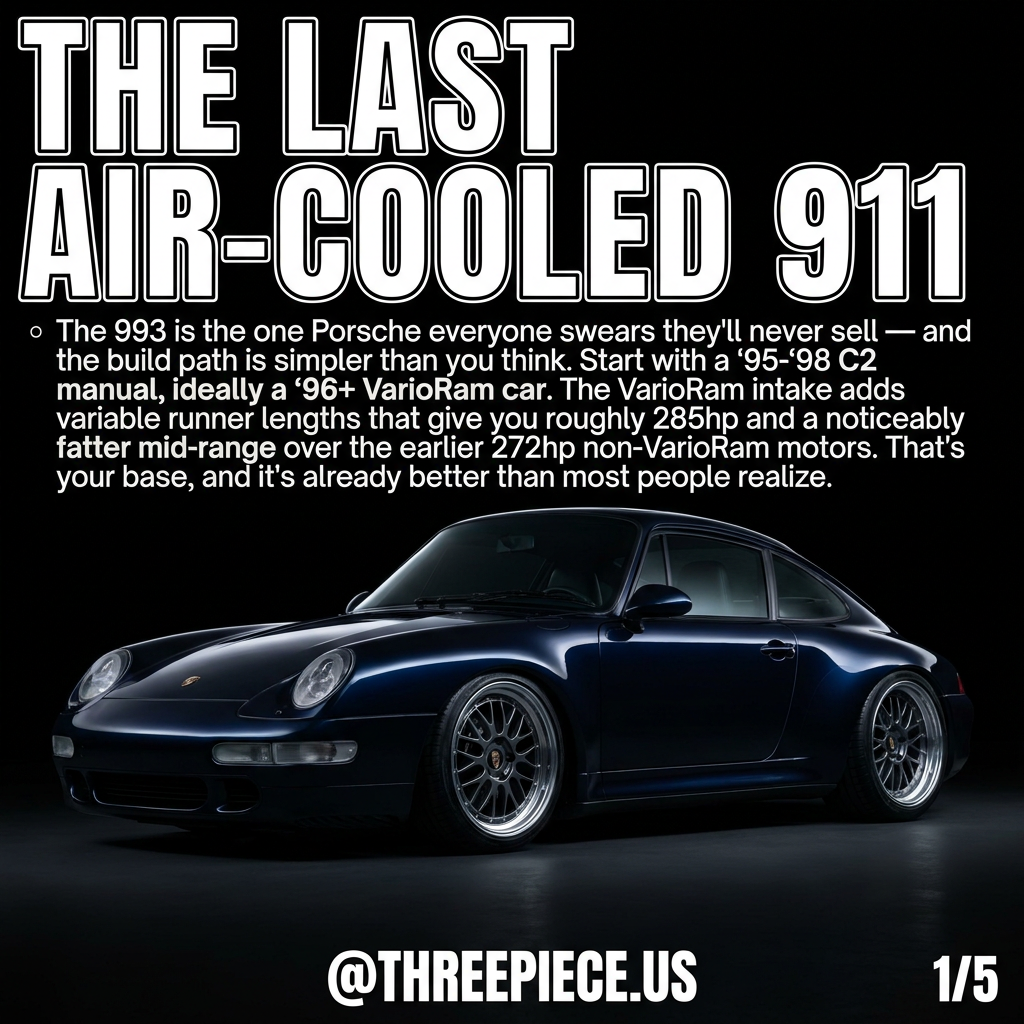
The Porsche 993 is the last air-cooled 911 ever produced, and building one correctly is more important now than ever. Values keep climbing, the parts supply keeps shrinking, and every bolt-on you choose either adds to the car's legacy or chips away at it. This guide covers the exact mod order that experienced 993 owners follow — from exhaust and ECU tuning to RS suspension components, wheel fitment, and the electrical gremlin you need to sort before anything else. If you're sitting on a 1995–1998 Carrera C2 and wondering where to start, this is your roadmap.
Quick links
- Pick the Right Donor: VarioRam Matters
- Exhaust First, Then Tune — In That Order
- RS Suspension Parts Change Everything
- 993 Wheel Fitment That Actually Works
- Fix the DME Relay Before It Strands You
- The Complete 993 Build That Makes Sense
Pick the Right Donor: VarioRam Matters
Not all 993 Carreras are equal. The 1996–1998 models came equipped with Porsche's VarioRam intake system, which uses variable-length intake runners to fatten the mid-range torque curve. The result is roughly 285 hp versus 272 hp on the earlier non-VarioRam 1995 cars. That 13-horsepower gap doesn't sound like much on paper, but the real difference is in how the car pulls between 3,000 and 5,000 rpm — it's a completely different driving experience in daily use.
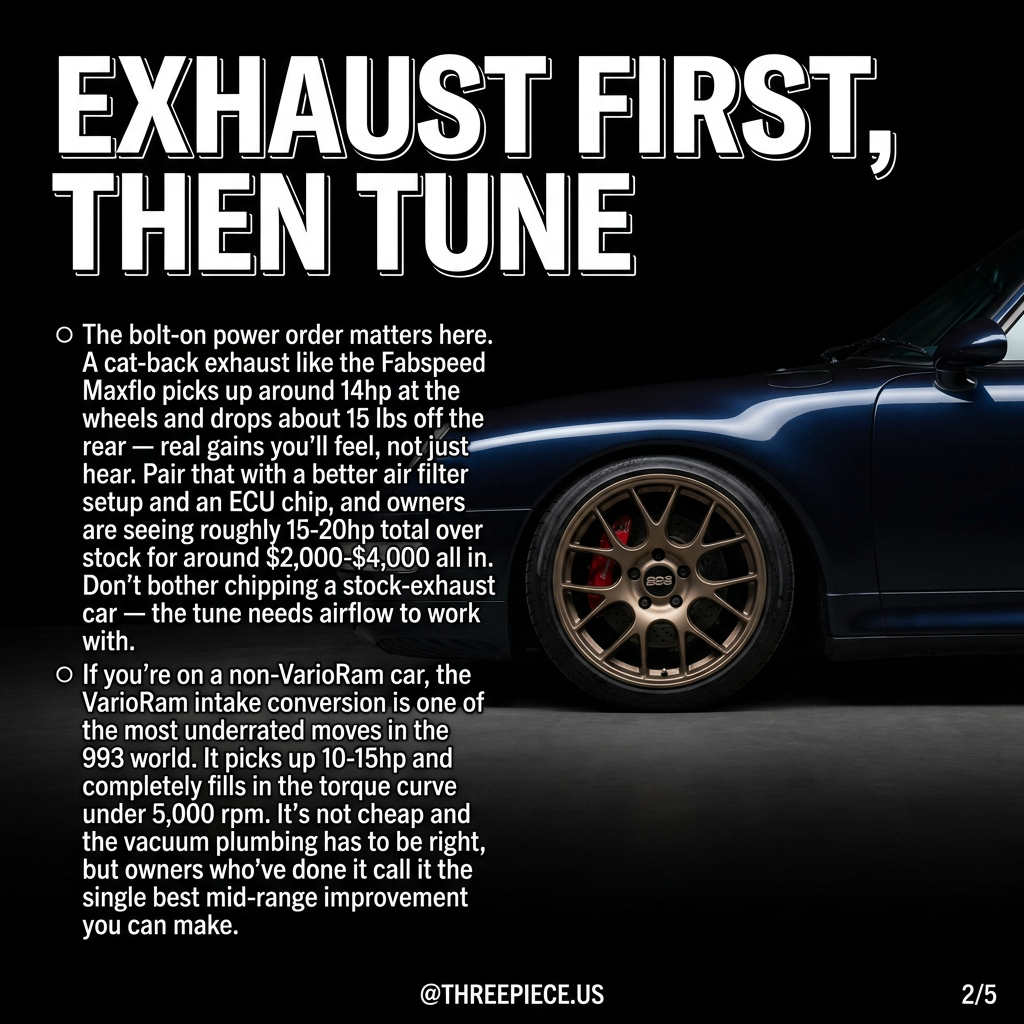
If you're shopping, target a '96+ C2 manual. The C2 (rear-wheel drive) is lighter than the C4 all-wheel-drive variant, and the manual gearbox is non-negotiable if you're building a driver's car. If you end up with a '95 non-VarioRam car, the intake conversion is one of the most underrated moves in the 993 world — it picks up 10–15 hp and completely fills in the torque curve under 5,000 rpm. It's not cheap and the vacuum plumbing has to be perfect, but owners who've done it call it the single best mid-range improvement you can make. For context on how air-fuel ratio and intake design affect naturally aspirated power delivery, the VarioRam system is a textbook example of OEM engineering that most aftermarket solutions struggle to replicate.
Exhaust First, Then Tune — In That Order
The bolt-on power order matters on the 993's M64 flat-six. A quality cat-back exhaust like the Fabspeed Maxflo picks up around 14 hp at the wheels and drops roughly 15 lbs off the rear — real gains you'll feel, not just hear. Pair that with a better air filter setup and an ECU chip, and owners are consistently seeing 15–20 hp total over stock for around $2,000–$4,000 all in.
Here's the critical point most people get wrong: don't bother chipping a stock-exhaust car. The tune needs airflow to work with. The ECU remap is calibrated around improved exhaust flow and intake breathing — without those hardware changes, the chip has nothing to optimize. This is the same principle that applies across every naturally aspirated platform, and it's why our ECU tuning guide emphasizes supporting mods before software.
For the more aggressive builds, the Project M003 thread on Rennlist documents a full decat setup with Fister D exhaust tips. That's illegal in most states for street use, but the forum data shows significant power and sound improvements. The factory 993 Cup 3.8 made 315 hp in race trim, and the extreme end — like Rothsport Racing's bespoke 4.0L build — has pushed the air-cooled flat-six to 460 hp at 7,800 rpm with billet internals, slide-valve ITBs, and custom heads. You don't need to go that far, but it shows the ceiling is much higher than most people assume.
RS Suspension Parts Change Everything
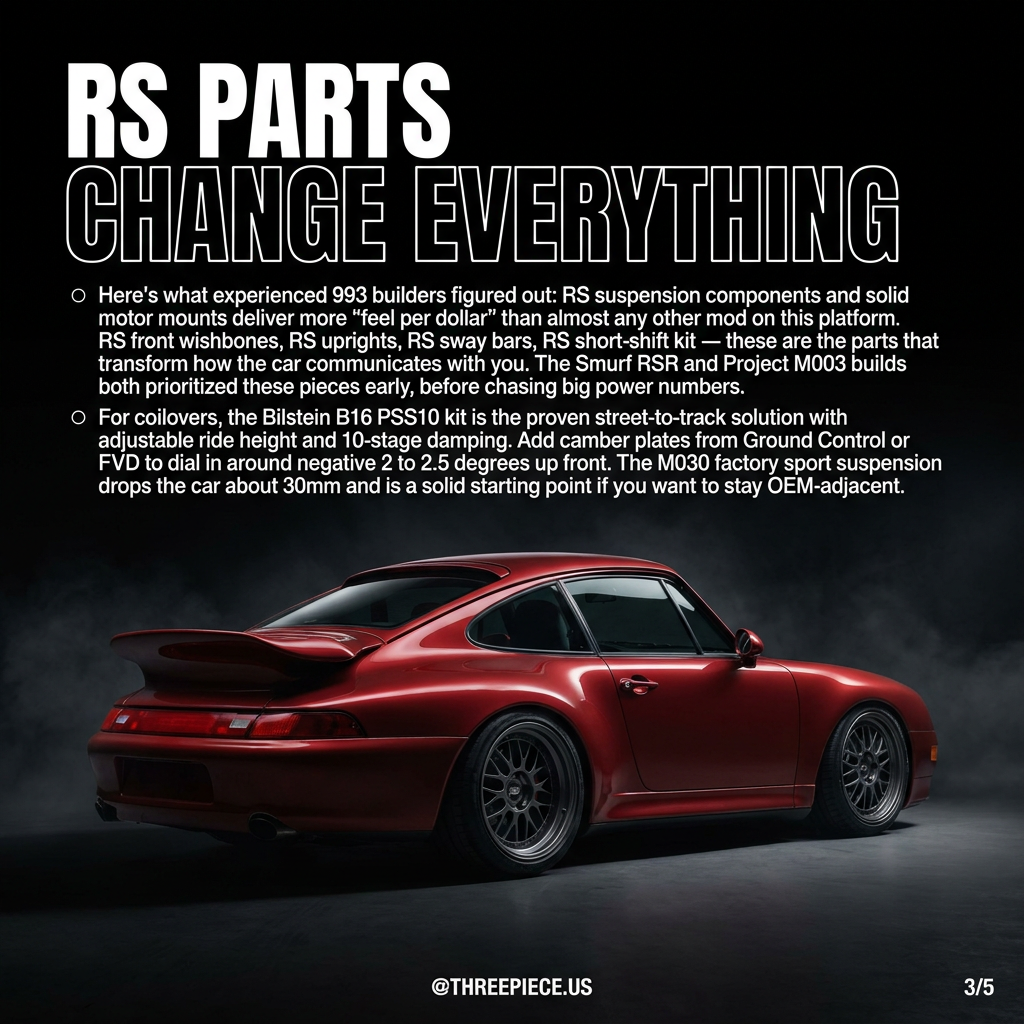
This is what separates a 993 that looks nice from one that actually communicates with you. Experienced builders on Rennlist — including the legendary Smurf RSR and Project M003 builds — figured out early that RS suspension components and solid motor mounts deliver more "feel per dollar" than almost any other modification on this platform.
The parts list reads like a factory homologation spec sheet: RS front wishbones, RS uprights, RS Evo tie rods, RS front and rear sway bars, RS engine carrier, RS short-shift kit. These aren't power mods — they're communication mods. They tighten every input, reduce compliance in the bushings, and make the car talk to you through the steering wheel and seat. Both the Smurf RSR and M003 builds prioritized these pieces before chasing big power numbers, and that philosophy is why those cars drive the way they do.
For coilovers, the Bilstein B16 PSS10 is the proven street-to-track solution with adjustable ride height and 10-stage damping. Add camber plates from Ground Control or FVD to dial in around negative 2.0 to 2.5 degrees up front. If you want to understand how spring rates interact with your damper choice, our coilover spring rate guide breaks down the math. And if you're running aggressive camber on a lowered 993, read our explanation of why rear camber arms matter — the 993's multi-link rear is sensitive to ride height changes.
The factory M030 sport suspension drops the car about 30mm and is a solid starting point if you want to stay OEM-adjacent. But once you've driven a 993 on RS geometry with proper coilovers, the M030 setup feels like a compromise. A Whiteline Universal Camber Gauge at $255 is worth owning if you're going to be dialing in alignment yourself — it pays for itself after two alignment shop visits.
993 Wheel Fitment That Actually Works
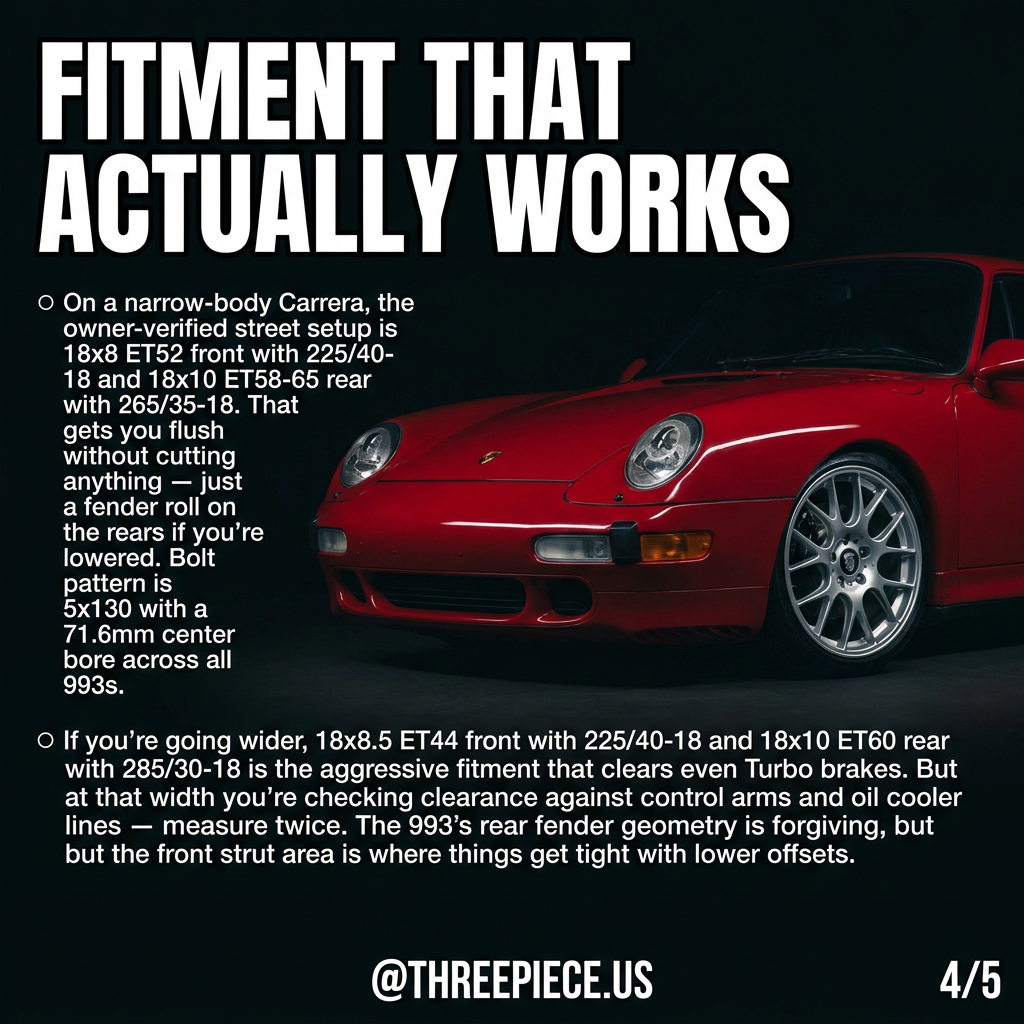
The 993 runs a 5x130 bolt pattern with a 71.6mm center bore across all variants. Getting the fitment right on a narrow-body Carrera requires precision — the rear fender geometry is forgiving, but the front strut area is where things get tight with lower offsets.
The owner-verified street setup for a narrow-body 993 is:
- Front: 18x8 ET52 with 225/40-18
- Rear: 18x10 ET58–65 with 265/35-18
That gets you flush without cutting anything — just a fender roll on the rears if you're lowered. If you're going wider, 18x8.5 ET44 front with 225/40-18 and 18x10 ET60 rear with 285/30-18 is the aggressive fitment that clears even Turbo brakes. But at that width, you're checking clearance against control arms and oil cooler lines — measure twice.
Browse 18-inch wheels in 5x130 to see what's currently available. For the staggered setup, understanding offset and width combinations is critical — our 718 Cayman wheel guide covers the same 5x130 bolt pattern and many of the same clearance considerations apply to the 993. If you're considering a 3-piece wheel build, Work Wheels offer extensive width and offset customization that makes nailing 993 fitment straightforward. The Work Meister series in particular has become a classic pairing with air-cooled Porsches — the stepped lip aesthetic complements the 993's curves without looking forced.
For tire sizing, pair the front wheels with 225/40R18 tires and the rears with 265/35R18 tires. If you're running the aggressive setup, search 285/30R18 tires for the rear. The Smurf RSR build ran Michelin Pilot Cup tires on 9-inch fronts and 11-inch rears, but that's a track-oriented setup with RSR fender flares — don't try those widths on a narrow body.
If you're building a set of 3-piece wheels for your 993, Work step lips starting at $399 and Work step barrels at $399 let you spec the exact dish depth your fitment requires. Need to understand the difference between step and reverse lip profiles? Our forged wheel guide explains how construction type affects both weight and customization options.
Fix the DME Relay Before It Strands You
This is the one maintenance item every 993 owner needs to address immediately, and most don't know about it until they're stuck in a gas station parking lot. The DME relay (also called the fuel pump relay) controls both the fuel pump prime circuit and the O₂ sensor heater circuit. The original relays — which share a part number lineage with the 944 series (944.615.227.00) — develop microscopic cracked solder joints on the relay board's coil side.
Symptoms are maddening: the engine cranks but won't fire, or you get intermittent hot-restart failures after stopping for fuel. These failures typically surface around 70,000–100,000 miles but can appear earlier. The fix is either opening the relay and resoldering the cracked joints (a $0 fix if you own a soldering iron), replacing it with the updated Porsche unit (993.615.227.00, roughly $25), or upgrading to a solid-state aftermarket relay like the Focus 9 unit ($200–$400). The solid-state option eliminates the mechanical failure point entirely and is the move if you're building a car you plan to keep.
This is the kind of invisible reliability issue that separates a well-sorted 993 from a frustrating one. Budget for it early in your build — it's cheap insurance against being stranded.
The Complete 993 Build That Makes Sense
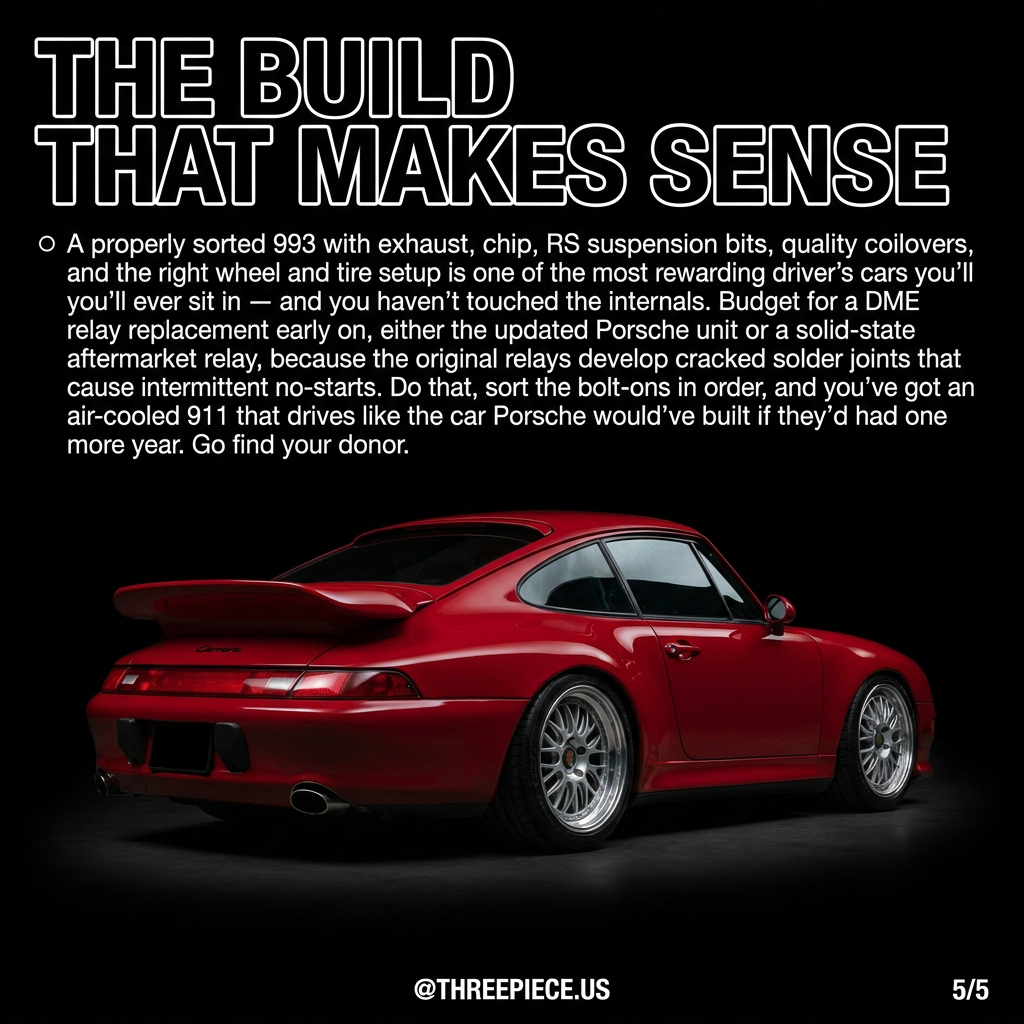
A properly sorted 993 with exhaust, chip, RS suspension bits, quality coilovers, and the right wheel and tire setup is one of the most rewarding driver's cars you'll ever sit in — and you haven't touched the internals. Here's the build order that experienced owners follow:
- DME relay replacement — solid-state preferred
- Cat-back exhaust — Fabspeed Maxflo or equivalent (~14 whp, -15 lbs)
- ECU chip — only after exhaust is installed
- RS suspension components — wishbones, uprights, sway bars, short-shift kit
- Coilovers + camber plates — Bilstein B16 PSS10 or Moton Clubsports for track use
- Wheels and tires — 18x8/18x10 staggered in 5x130
Total budget for steps 1–6 on a street build runs roughly $8,000–$15,000 depending on whether you're sourcing used RS parts or buying new. That's on top of the car itself, which currently trades between $50,000 and $90,000 for a clean C2 manual depending on mileage and history.
The beauty of this build path is that every modification is reversible and every part adds to the car's desirability. You're not hacking up a future classic — you're building one. Check the ThreePiece vehicle gallery for build inspiration, and if you're comparing the 993 against newer Porsche platforms, our Porsche Cayman history and Boxster vs. Cayman comparison provide useful context on how the modern mid-engine cars stack up against the air-cooled rear-engine experience.
If you're sourcing 3-piece wheels for your 993 build, explore our full wheel catalog or pick up finishing details like 90-degree valve stems at $3.80 each — essential for deep-dish rear wheels where straight stems won't clear the brake caliper. The 993 deserves to be built right. Go find your donor.