

Posted by THREEPIECE.US on Apr 30th 2026
Ford Focus ST Mk3 Buying Guide: Best Turbo Hatch Under $15K
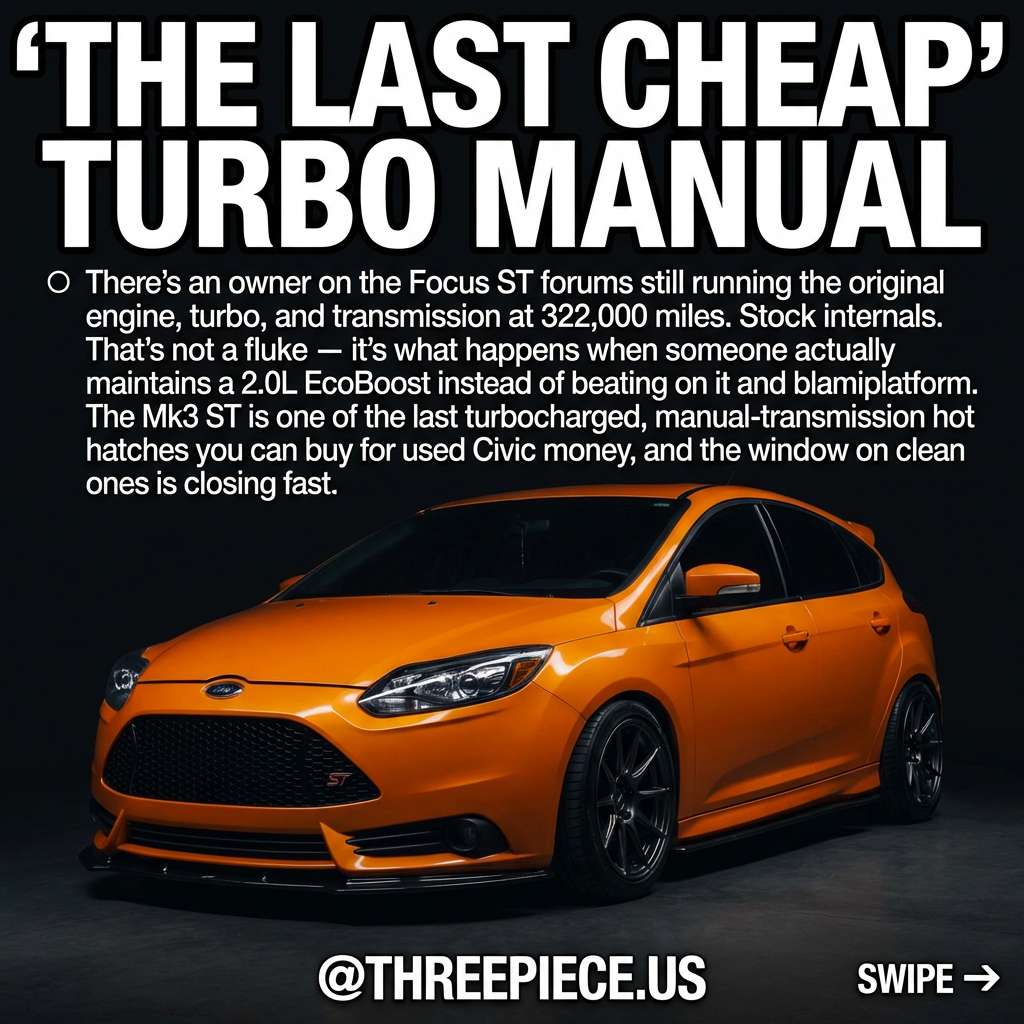
The 2013-2014 Ford Focus ST is one of the last turbocharged, manual-transmission hot hatches you can buy for used Civic money — and the window on clean examples is closing fast. While the enthusiast market fights over CTR allocations and GR Corolla markups, the Mk3 ST sits on Facebook Marketplace making 252 hp and 270 lb-ft from a 2.0L EcoBoost through a six-speed manual, backed by one of the deepest aftermarket ecosystems in the sport-compact world. There's an owner on FocusST.org still running the original engine, turbo, and transmission at 322,000 miles on stock internals. That's not a fluke — it's what happens when someone actually maintains the platform instead of abusing it.
Quick links
- Why the Mk3 ST matters in 2026
- Power, tuning, and the solved EcoBoost formula
- Aftermarket depth that rivals anything Japanese
- Known failure points: what actually breaks
- Pre-purchase checklist for 2026 buyers
- Wheel fitment and tire sizing for the Focus ST
- Final verdict: stop circling, go buy one
Why the Mk3 ST matters in 2026
The Focus ST occupies a rapidly vanishing category: affordable, turbocharged, manual, hatchback. The Mazdaspeed 3 is older and more fragile. The Golf R Mk7 costs nearly double. The FK8 Civic Type R is still commanding $35K+. The Mk3 ST slots in at $10,000-$15,000 for clean examples with service history, and that price floor is rising every quarter as supply dries up.
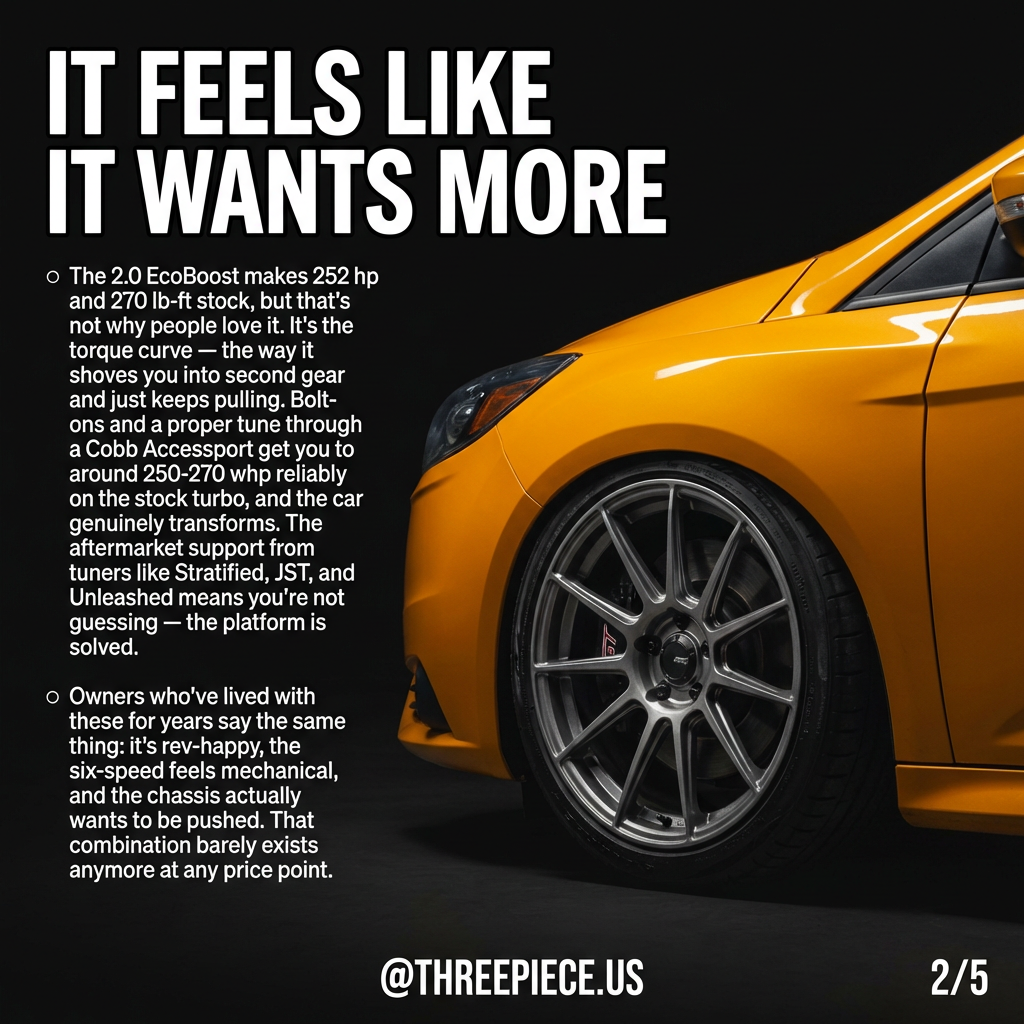
What makes this car special isn't just the spec sheet. It's the way the torque curve shoves you into second gear and keeps pulling. Owners who've lived with these for years describe the same thing: it's rev-happy, the six-speed feels mechanical and direct, and the chassis genuinely wants to be pushed. Ford's engineers tuned the Mk3 platform with real intent — the suspension geometry, the torque vectoring system, the electric power steering calibration. That combination barely exists anymore at any price point, let alone under $15K.
Power, tuning, and the solved EcoBoost formula
Stock, the 2.0L EcoBoost makes 252 hp and 270 lb-ft. Those numbers are conservative from the factory — Ford left headroom in the tune. With a Cobb Accessport V3 and a custom tune from Stratified, JST, MonsterTuned, or Unleashed, owners reliably hit 250-270 whp on the stock turbo with nothing more than bolt-ons. That's a genuine transformation in how the car pulls, and the data backing these numbers is extensive — thousands of dyno sheets across a decade of community builds.
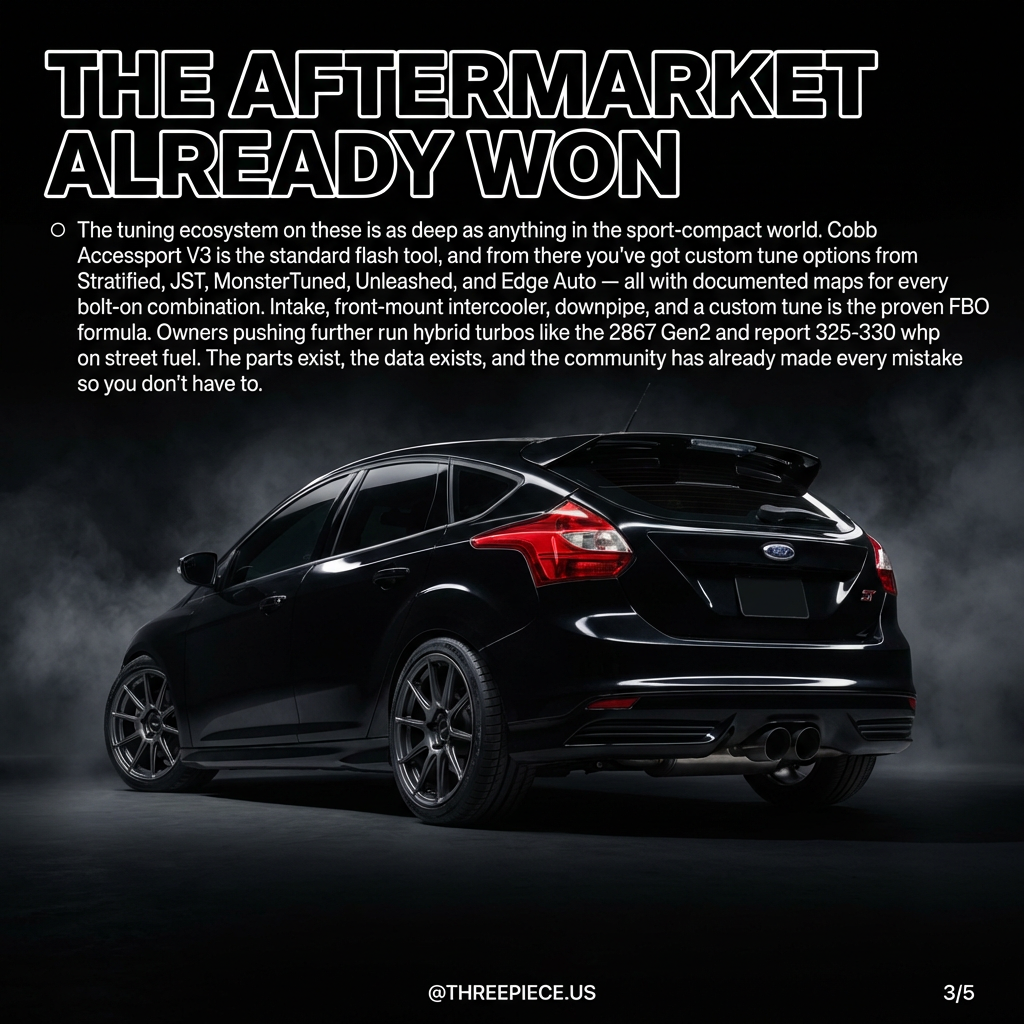
The proven full bolt-on (FBO) formula is straightforward: intake, front-mount intercooler, downpipe, and a custom tune. Owners pushing further run hybrid turbos like the 2867 Gen2 and report 325-330 whp on street fuel. The platform is genuinely solved — every combination has been mapped, every failure mode documented, every tuner calibration refined over years of real-world data. If you're curious about what stage tuning actually delivers in measurable gains, our breakdown of stage 1 vs stage 2 dyno results covers the principles that apply directly to the EcoBoost platform.
For the exhaust side, the AWE Tuning Ford Focus ST Touring Edition Cat-back Exhaust at $1,168.60 is one of the best-sounding options on the platform — non-resonated with chrome silver tips, it opens up the exhaust note without droning on the highway. That's a meaningful upgrade in both sound and flow for the FBO recipe.
Aftermarket depth that rivals anything Japanese
The tuning ecosystem on the Focus ST is as deep as anything in the sport-compact world. The Cobb Accessport V3 is the standard flash tool, and from there you branch into custom tune options from at least five reputable tuners — all with documented maps for every bolt-on combination. This isn't a platform where you're guessing or hoping a tune works. The community has already made every mistake so you don't have to.
On the intercooler side, the aFe BladeRunner 2.5in Intercooler Tubes for the Focus ST at $518.52 replace the restrictive factory charge piping and are a critical piece of the FBO puzzle — especially if you're running a front-mount intercooler and pushing past 300 whp. Upgraded intercooler piping reduces heat soak and keeps intake temps consistent, which directly affects how aggressively your tuner can push timing.
Beyond power, the suspension and chassis parts availability is equally strong. Steeda, JBR, Whiteline, and Eibach all make Focus ST-specific components. Motor mount and transmission mount upgrades are among the most recommended first modifications on the forums — they tighten up shifter feel, reduce wheel hop, and delay internal drivetrain wear. If you're weighing whether coilovers are worth it on a daily driver, the Focus ST is one of the strongest cases for "yes" — the stock suspension is competent but leaves real grip on the table.
Known failure points: what actually breaks
Every platform has weak spots, and the Focus ST's are well-documented. Knowing them before you buy is the difference between a great ownership experience and a financial disaster.
Bosch CP4 high-pressure fuel pump (2013-2014 only): This is the big one. The CP4.2 pump has a documented history of catastrophic failure — when the internal roller tappet wears, it sends metallic debris through the entire fuel system. Injectors, fuel rail, lines — all contaminated. Repair bills hit $8,000-$10,000. Proactive CP3 conversion kits run about $1,500 in parts plus $1,400-$1,600 in labor. That's your first phone call after buying a 2013-2014 car. Non-negotiable.
Cylinder head cracks: The 2.0L head can crack between exhaust ports around 90,000-110,000 miles, especially on early casting revisions where the water jacket runs very close to the hot exhaust ports. Symptoms include coolant in the exhaust, misfires at idle, and unexplained coolant loss. Cars that have been overheated, modded without proper cooling upgrades, or driven hard without cooldowns are most at risk.
Second gear synchros: Frequently cited as weak around 60,000-70,000 miles. Grinding or difficulty entering second under load is the telltale sign. Replacement with a used transmission plus clutch and flywheel runs around $1,000-$2,000 depending on parts sourcing. Speaking of clutches — budget for a replacement around 60,000-80,000 miles if it hasn't been done. The dual mass flywheel degrades with aggressive use.
For owners planning to upgrade the clutch, the ACT XT/Race Sprung 6 Pad Clutch Kit for the Focus RS/ST at $1,689.84 is a serious upgrade that handles significantly more torque than stock — essential if you're running a tune and bolt-ons. Pair it with the ACT XACT Flywheel Streetlite at $713.21 to ditch the failure-prone dual mass unit entirely.
Other known issues: Purge valve failures around 40,000-70,000 miles cause rough idle, stalling, and EVAP codes — cheap and owner-fixable. Cooling system components (water pump, thermostat housing) tend to leak before 80K. And verify the wiring harness recall was completed on any 2013-2014 car — faulty MAP sensor splices cause stalling and limp mode. Check the VIN before you sign anything.

Pre-purchase checklist for 2026 buyers
If you're shopping for a Mk3 ST right now, here's what separates a great buy from an expensive lesson:
- CP4 fuel pump status: Has it been converted to CP3? If not, budget $3,000+ for the conversion immediately. Ask for service records.
- Wiring harness recall: Verify by VIN that the MAP sensor splice recall was completed. If not, get it done — it's a free fix at the dealer.
- Coolant system: Check for coolant smell, unexplained loss, or white residue. Scope the exhaust side of the head between cylinders 2-4 if possible. Any signs of cracking mean walk away.
- Transmission: Test second gear under load — both upshift and downshift. Any grinding means synchro wear. Also test 5th and 6th for smooth engagement.
- Clutch and flywheel: If the car has 60,000+ miles and the clutch hasn't been replaced, budget for it. Feel for slippage in third gear at full throttle.
- Cooling components: Water pump, thermostat housing, and hoses. Ask when they were last replaced. These are preventative items, not "wait until they fail" items.
- Mod history: A well-documented Stage 1 car with a reputable tune is often better than a "stock" car that was actually beaten on and returned to stock before sale. Ask for the Cobb Accessport serial number — it stays married to the car's ECU even after uninstall.
This process mirrors the same diligence we recommend in our Focus RS Mk3 build guide — the RS shares the same platform DNA and many of the same maintenance concerns. If you want to understand how the EcoBoost platform responds to modifications in a structured order, that guide is essential reading even for ST owners. The Mazdaspeed 3 build guide is also worth comparing — it's the closest competitor in the turbo hatch space and shares similar LSPI concerns with its direct-injection turbo four.
Wheel fitment and tire sizing for the Focus ST
The Focus ST runs a 5x10⁸ bolt pattern with a 63.4mm hub bore. Stock wheels are 18x8 +55, which is conservative. Most owners running aftermarket wheels settle on 18x8.5 +35 to +45 as the sweet spot — enough width for a meatier tire without rubbing issues on stock fenders. Some aggressive setups run 18x9 +35 with minor fender work.
Browse Enkei NT03+M 5x10⁸ 18x9.5+40 Gunmetal to see what fits. If you're considering going wider, check out Enkei NT03+M 5x10⁸ 18x9.5+40 Gunmetal as well. The Work Emotion series is a popular choice on these cars — lightweight, strong, and available in sizes that work with the ST's offset range.
For tires, 245/40R18 is the go-to size on 18x8.5 wheels — it fills the fender well properly and provides a significant grip upgrade over the stock 235/40R18. Search 245/40R18 tires to find options that match your driving style. If you're exploring the relationship between wheel width, offset, and tire stretch, our guide on common wheel fitment mistakes covers the principles that apply across platforms.
Don't forget hubcentric rings — the 63.4mm hub bore means most aftermarket wheels will need them for a vibration-free fit. And if you're running 3-piece wheels, proper valve stems and assembly hardware matter more than most people realize. Check out our vehicle gallery for build inspiration across platforms.

Final verdict: stop circling, go buy one
A clean, well-maintained 2013-2014 Focus ST with service records is one of the best performance-per-dollar plays left in the sport-compact world. Owners at 150,000-200,000+ miles report replacing only wear items. The tuning path is proven and documented. The community is massive and still active. And nothing else at this price gives you a turbocharged six-speed hatch with this much aftermarket depth.
Find an ST3 with Recaros if you can — the bolstering and material quality are leagues above the base seats and they hold value independently. Confirm the CP4 status, verify the recall work, check the cooling system, and go drive it. You'll know in the first pull why people keep these for a decade.
The "cheap manual turbo hatch" tax hasn't fully hit the Focus ST yet, but it will. The same thing happened to the Mazdaspeed 3, the WRX hatch, and every other car in this segment. Clean examples with documentation are disappearing every month. If you've been circling one, the time to move is now — not next year when the good ones are gone.