
A45 AMG Problems: Why You Should NOT Buy a W176
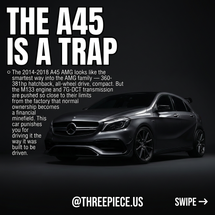
The 2014-2018 Mercedes-AMG A45 looks like the smartest entry into the AMG family on paper — 360-381 hp from a 2.0L turbocharged four-cylinder, all-wheel drive, hatchback practicality. In practice, the W176 A45 is one of the most financially punishing performance cars you can buy used. The M133 engine and 7G-DCT transmission were pushed so close to their factory limits that normal ownership becomes a rolling repair bill. Here's every documented problem, what it costs, and why experienced owners say you should think twice.
Quick links
- Turbo & Engine Failures
- 7G-DCT Transmission Problems
- Oil Leaks, Seals & Hidden Costs
- Running Costs That Stack Fast
- Who Should Actually Buy One
- Smarter Alternatives to the A45
- W176 A45 AMG Wheel Fitment
- Final Verdict
Turbo & Engine Failures: The M133's Achilles Heel
The M133 is the most powerful series-production 2.0L four-cylinder Mercedes has ever made, and that record comes with consequences. Early 2014 cars shipped without an anti-surge valve on the turbocharger, meaning excess boost pressure could only escape through the turbo impeller itself. That design flaw caused premature bearing wear, shaft play, and turbo replacements running $2,200-$6,600. Mercedes issued a recall to retrofit the fix, but many used examples slipped through without the work being done. One Belgian owner documented replacing the turbo twice by 47,000 km at roughly €6,000 each time.
Beyond the turbo, camshaft adjuster solenoids leak oil into the wiring harness between 40,000 and 60,000 miles, a repair that runs $1,800-$4,400. The chain tensioner can fail shockingly early — one French forum documented a tensioner replacement at just 19,000 km (≈12,000 miles) with a quote of €1,800 for parts and labor. If you're considering any turbocharged performance car, understanding how air-fuel ratios stress engine components helps explain why the M133's factory tune leaves almost zero margin.
PCV system failures are another documented issue. A 2016 A45 with ~104,000 km (~65,000 miles) showed oil pooling between the air filter and turbo — the oil separator under the intake manifold had given up. You can check this yourself: remove the intake piping and wiggle the turbo compressor shaft side-to-side. Any perceptible play means the seals are worn. Owners who've dealt with this firsthand often wish they'd invested in an oil catch can from day one.

7G-DCT Transmission Problems: Crunching, Slipping, Overheating
The 7-speed dual-clutch gearbox is arguably the A45's most expensive weak point. Owners consistently report a metallic crunch when selecting reverse from cold — sometimes a software update helps, but often it's mechanical: worn synchros or clutch packs, especially on tuned cars. The clutch pack replacement alone costs $3,500-$6,000, and mechatronic unit failures stack another $1,500-$3,000 on top of that.
Facelift models (2016+) introduced a different problem: transmission oil temperatures exceeding 100°C even during light driving. Forum diagnostics point to the transmission electric pump, coolant hoses, or check valves (part numbers 1765010758 and 1765012182 on the W176 chassis) as culprits. Some owners replaced the R48 temperature sensor (part 0009056102) to bring readings back to normal, but that's treating the symptom, not the cause.
One owner documented replacing the rear differential by 83,000 km. This isn't a "one thing goes wrong" car — it's everything, in sequence. If you're comparing the A45's dual-clutch to other performance transmissions, the dual-mass vs single-mass flywheel debate gives useful context on how clutch-based systems handle stress differently. The A45's DCT simply wasn't built with enough thermal headroom for the power it manages.
Oil Leaks, Seals & the Repair Bills Nobody Warns You About
Multiple A45 owners report oil leaking from crankshaft seals and driveshaft seals, often described as a "wet gearbox" appearance underneath the car. UK dealers quote £3,000-£4,000 for a full seal replacement when the car is out of warranty, and parts availability can delay the repair further. Oil pump solenoid faults (error code P06DA00) require dropping the sump and removing the subframe to access — independent garages estimate ~£980 in labor plus roughly £80 in parts for a 2016 model.
The turbo bracket itself cracks on pre-facelift cars, and replacements are often OEM-only with limited aftermarket options. Air conditioning compressor failures run over £300, blower motor resistor packs fail, and dashboard screens glitch. Even the sport seat bolsters degrade quickly under regular use, and the windshield trim plastic cracks from UV exposure. Water ingress through leaking boot plugs soaks rear carpets — a problem that leads to electrical gremlins if left unchecked.
If you're weighing whether an ECU tune is worth it on a car like this, understand that the M133 is already mapped close to its mechanical ceiling. Any additional boost pressure accelerates every failure mode listed above. The community consensus is clear: tuning an A45 without preemptively addressing the turbo, cooling, and transmission shortcomings is a recipe for a five-figure repair bill.
Running Costs That Stack Fast
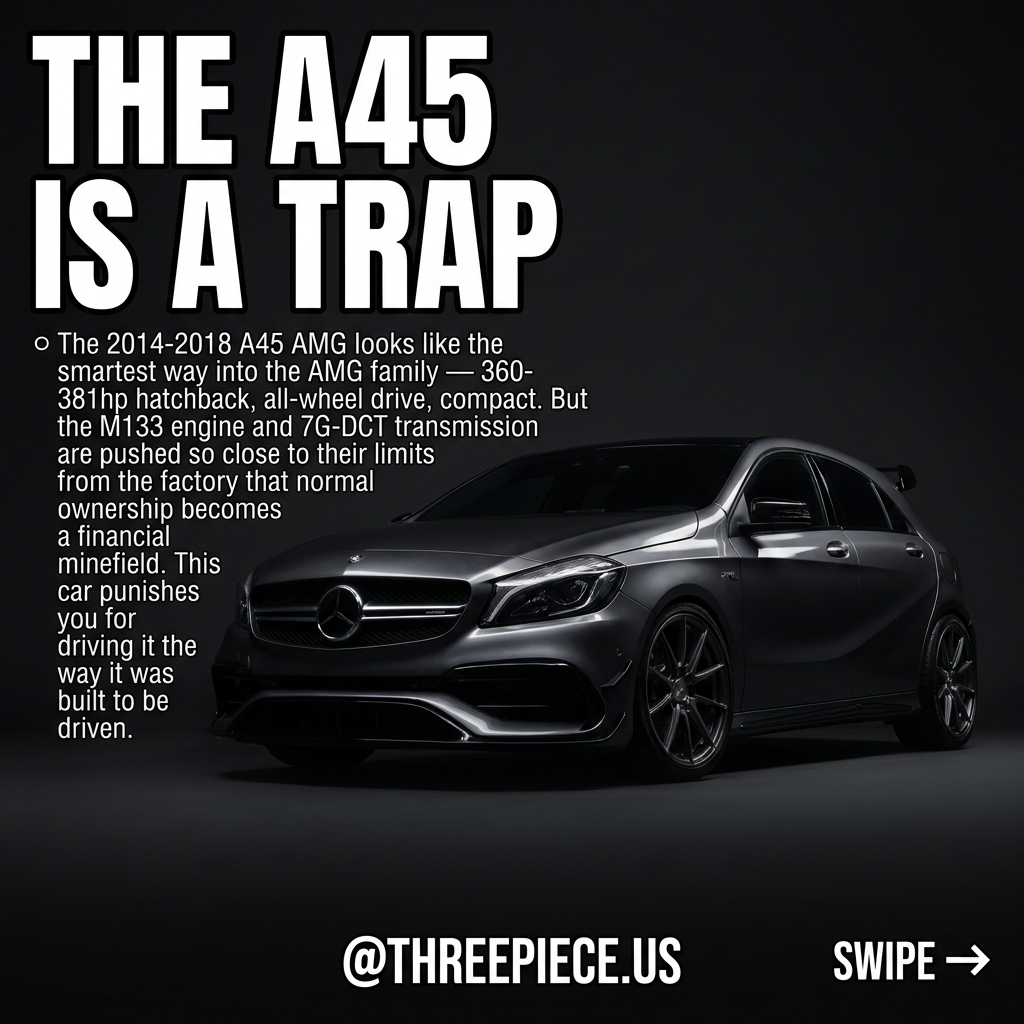
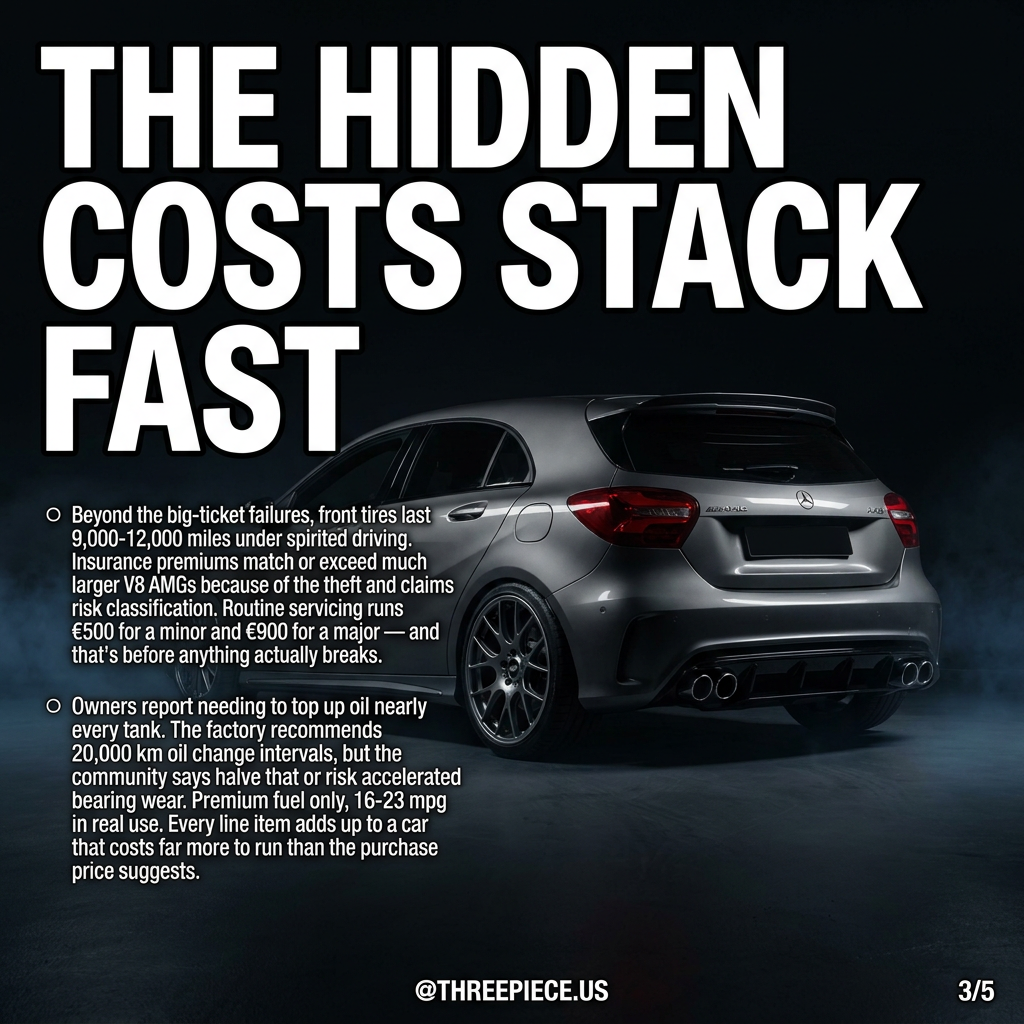
The big-ticket failures get all the attention, but the A45's daily running costs are equally brutal. Front tires last 9,000-12,000 miles under spirited driving. Insurance premiums match or exceed much larger V8 AMGs because of the A45's theft risk classification and high claims frequency. Routine servicing runs €500 for a minor service and €900 for a major — and that's before anything actually breaks.
Owners report needing to top up oil nearly every fuel tank. Mercedes recommends 20,000 km oil change intervals, but the community says halve that or risk accelerated bearing wear. Premium fuel only, 16-23 mpg in real-world use. Every line item adds up to a car that costs dramatically more to run than the purchase price suggests. When you're burning through front tires that fast, you want to at least be running proper fitment — browse 235/35R19 tires to see what's available in the A45's stock front size.
For context, the W212 E63 AMG has its own documented issues, but its running costs are actually more predictable than the A45's — and that's a V8 AMG sedan. When a hot hatch costs more to maintain than a car two classes above it, something is fundamentally wrong with the ownership equation.

Who Should Actually Buy a W176 A45 AMG
Despite everything above, the A45 can work for a specific type of buyer. If you wrench on your own cars, buy a post-February 2014 facelift model with complete service history, and budget several thousand dollars per year for maintenance, the M133 rewards you with one of the most visceral hot hatch experiences ever built. The facelift cars got improved cooling, revised turbo oil feed geometry, and shorter gear ratios. They're meaningfully more reliable than the early production cars.
We actually covered the A45's performance credentials in depth in our 400HP hatchback guide — the M133's output-per-liter figure was genuinely record-breaking. The car's mechanical capability isn't in question. The question is whether you can afford to keep it running at that level. If you're buying this as a low-cost entry into AMG ownership or expecting trouble-free daily driving, you're setting yourself up for the kind of ownership stress that multiple owners say wrecked the experience entirely.
Pre-purchase inspection is non-negotiable. Check for turbo shaft play, pull transmission temperature logs with an OBD scanner, inspect every seal and gasket underneath, and verify the anti-surge valve recall was completed on 2014 models. If the seller can't produce receipts for major service items, walk away.
Smarter Alternatives to the A45 AMG
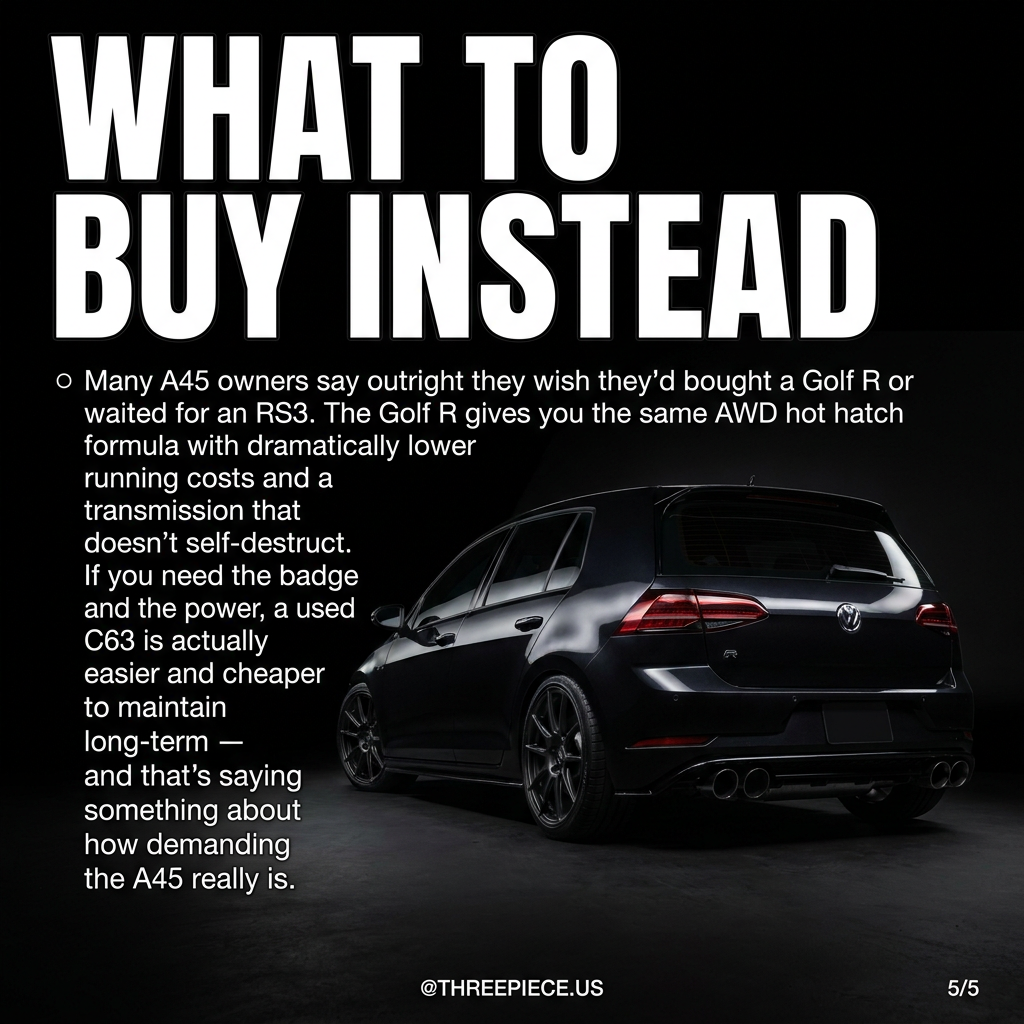
Many A45 owners say outright they wish they'd bought a Volkswagen Golf R or waited for an Audi RS3. The Golf R delivers the same AWD hot hatch formula with dramatically lower running costs and a transmission that doesn't self-destruct under normal use. If you're considering a Golf R, our GTI wheel fitment guide covers the shared MQB platform sizing that applies to the R as well. For the turbo inlet side, the aFe 15-19 VW GTI Turbocharger Inlet Pipe at $210 is a proven upgrade for MQB cars.
The Audi 8V RS3 offers more power, a more robust 2.5L five-cylinder, and a transmission that handles the output with far less drama. Our CLA45 vs RS3 comparison explored this matchup from the Mercedes side — but when you factor in the W176's reliability record specifically, the RS3 pulls ahead on total cost of ownership.
If you need the AMG badge and the power, a used W204 C63 is actually easier and cheaper to maintain long-term — and that's saying something about how demanding the A45 really is. The M156 V8 has its own quirks, but parts availability is better, independent shop knowledge is deeper, and the major failure points are well-documented with established preventive fixes. For anyone looking at the AWD hot hatch segment more broadly, the Mitsubishi Evo X remains one of the best AWD bargains if you can find a clean example.
W176 A45 AMG Wheel Fitment
If you do buy an A45 — or you already own one and want to make it look the part — the W176 runs a 5x112 bolt pattern with a 66.6mm center bore. Factory wheel sizes range from 18x7.5 ET52 to 19x8 ET48 depending on the option package. The community sweet spot for aftermarket fitment is 18x8.5 ET42-45 all around, which gives you a wider contact patch without requiring aggressive fender work.
For a square setup, browse 18x8.5 wheels in 5x112 to see what fits. If you're going 19s, 19x8.5 in 5x112 is the move. Pair 18s with 235/40R18 tires or 245/40R18 tires for a slight width increase over stock.
If you're running 3-piece wheels on the A45, you'll want proper hubcentric rings to match the 66.6mm bore, and 90-degree valve stems at $3.80 each make tire pressure checks far easier behind deep-dish lips. For anyone considering forged options, our breakdown of what forged wheels actually are explains why the weight savings matter on a car this heavy for its class. Browse the full vehicle gallery for real-world fitment examples on similar platforms.
Final Verdict: The A45 AMG Is a Trap for the Wrong Buyer
The W176 A45 AMG is an engineering achievement that Mercedes built to win headlines, not to be cheap to own. The M133 produces 190 hp per liter from the factory — that kind of specific output demands respect and a maintenance budget to match. Turbo failures, DCT clutch replacements, oil leaks, chain tensioner issues, and sky-high consumable costs mean you can easily spend the car's purchase price again in repairs within two to three years of ownership.
If you're buying one, buy a facelift, buy it with full history, and budget accordingly. If you're cross-shopping against a Golf R, an RS3, or even a C63 just because the A45's sticker price looks tempting — you need the full picture before you commit. This car punishes you for driving it the way it was built to be driven. Check out our full wheel catalog if you're building one right, and explore the suspension category for coilover options that complement a proper A45 setup.