
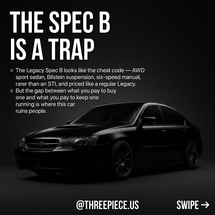
Subaru Legacy Spec B Problems: Why You Should NOT Buy One
The 2005-2009 Subaru Legacy Spec B looks like the ultimate enthusiast cheat code — AWD sport sedan, Bilstein suspension, six-speed manual, rarer than an STI, and priced like a regular Legacy. But the gap between what you pay to buy one and what you pay to keep one running is where this car wrecks people. Here's every problem documented by actual owners, what the repairs really cost, and the one scenario where buying a Spec B actually makes sense.

Quick links
- Engine Failures That Stack Up Fast
- Center Diff Binding on Manual Cars
- The Maintenance Bills Nobody Mentions
- When Buying a Spec B Actually Makes Sense
- What To Buy Instead
- Spec B Wheel Fitment & Upgrades
- Final Verdict
Engine Failures That Stack Up Fast
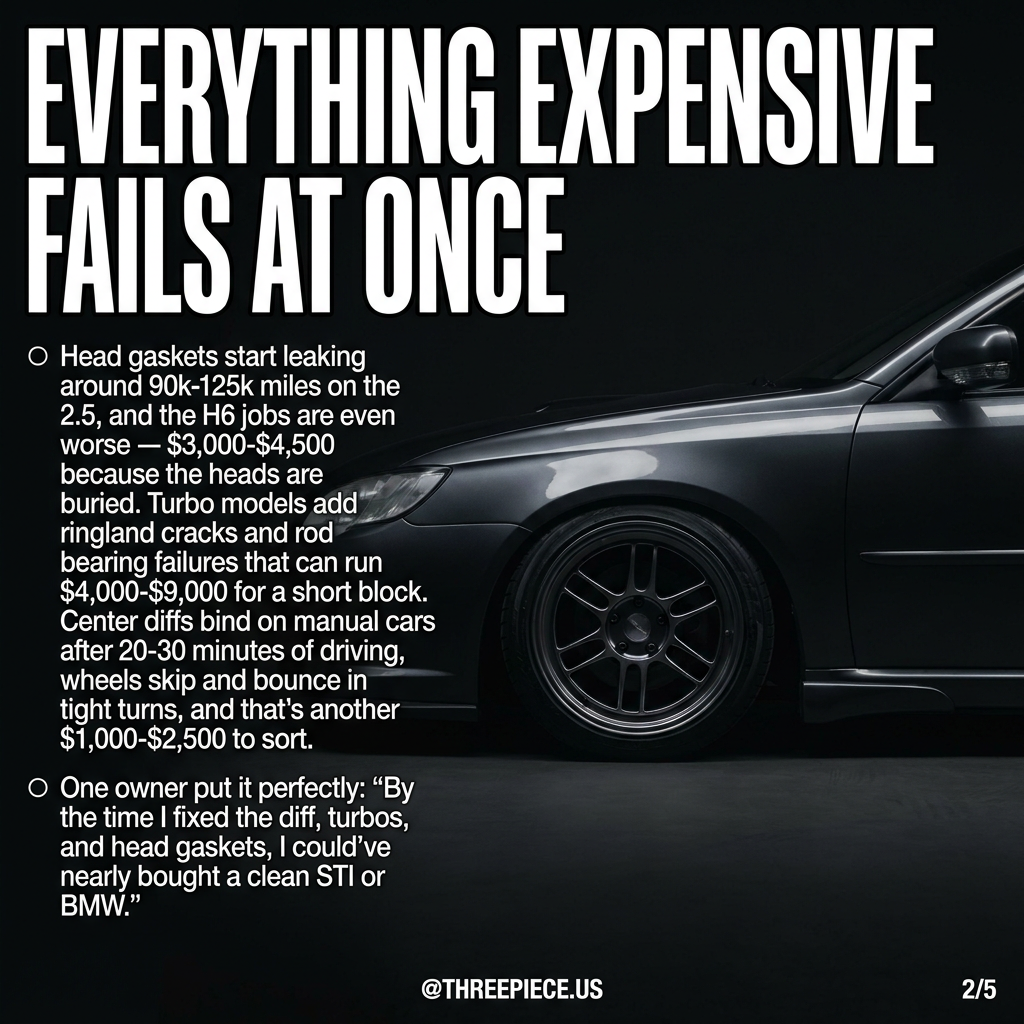
The EJ25 2.5-liter boxer in the turbo Spec B is one of the most failure-prone engines Subaru ever put in a performance car. Head gaskets start leaking around 90,000-125,000 miles, and the symptoms are textbook: coolant loss, overheating under load, oil-coolant mixing, bubbly overflow tanks. The repair runs $2,000-$3,000+ if the heads aren't warped — and on a 15-20 year old car that's been heat-cycled thousands of times, they often are.
The H6 3.0R Spec B gets a partial pass here. The EZ30 flat-six doesn't fail as often as the EJ25, but when it does, the repair is significantly worse. Heads are buried under timing covers, and the job runs $3,000-$4,500 with resurfacing. One owner on the Legacy forums summed it up: "By the time I fixed the diff, turbos, and head gaskets, I could've nearly bought a clean STI or BMW." If you're comparing this kind of repair cost to other platforms, our breakdown of N54 335i problems shows a similar pattern — premium components that cost premium money to fix.
On the turbo models, add ringland cracks and rod bearing failures to the list. A short block replacement runs $4,000-$9,000. That's not a repair — that's a second car payment.
Center Diff Binding on Manual Cars
This is the one that catches Spec B buyers completely off guard. The center differential on six-speed manual cars develops binding after 20-30 minutes of driving. Symptoms: wheels skip, bounce, and grab during tight turns. It feels like the AWD system is fighting itself — because it is. The viscous coupling wears out and causes the center diff to stick, and the repair runs $1,000-$2,500 depending on whether you can source a refurbished unit.
Here's where it gets tricky: forum threads are full of owners who replaced the center diff only to find the real culprit was worn trailing arm bushings, front suspension strut arms, or seized control arms. The Spec B shares some components with the WRX/STI platform, but many suspension pieces are unique to the Spec B trim — making diagnosis harder and parts more expensive. If you're considering any AWD sport sedan from this era, our Evo X buying guide covers a platform with far fewer drivetrain headaches at similar money.
Before you buy any manual Spec B, take it on a 30+ minute test drive that includes tight parking lot turns and low-speed maneuvers. If it skips or binds, walk away — or at minimum, budget for the fix and negotiate the price down accordingly.
The Maintenance Bills Nobody Mentions
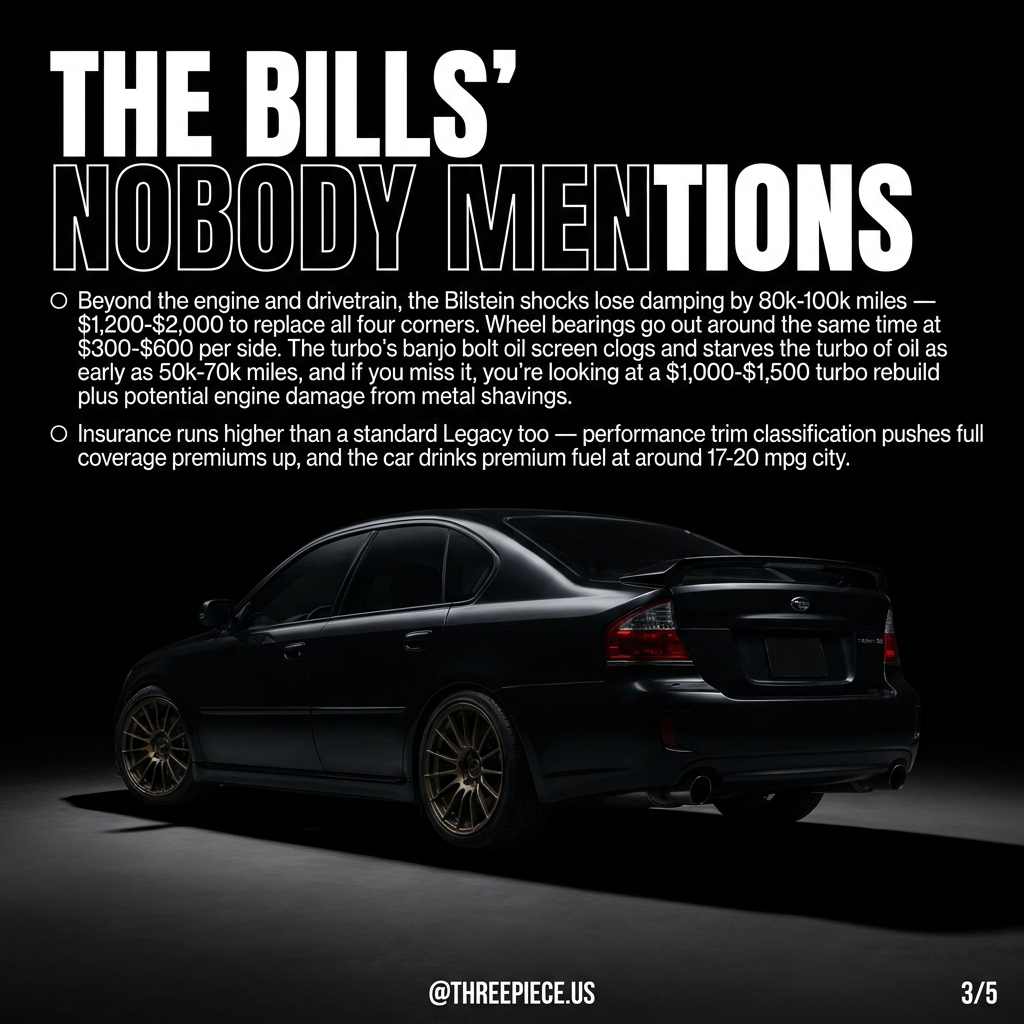
Beyond the engine and drivetrain, the Spec B has a stack of wear items that all seem to fail at the same mileage. The factory Bilstein shocks lose damping by 80,000-100,000 miles, and replacing all four corners costs $1,200-$2,000. If you're shopping for Bilstein replacements, ThreePiece.us carries suspension components across multiple platforms — though finding the exact Spec B application requires careful cross-referencing since Subaru used a unique Bilstein spec for this car. Understanding spring rates and how they affect ride quality matters here, because the Spec B's factory setup was stiffer than a standard Legacy and any replacement needs to match that intent.
Wheel bearings go out around the same time — $300-$600 per side. The turbo model's banjo bolt oil screen clogs as early as 50,000-70,000 miles, starving the turbo of oil. Miss that, and you're looking at a $1,000-$1,500 turbo rebuild plus potential engine damage from metal shavings circulating through the oil system.
The H6 models add timing chain tensioner noise and front timing cover oil leaks to the mix. A 2007 Spec B owner on Reddit put it bluntly: "Your timing cover is almost always going to leak… timing chain can stretch." Timing cover gasket replacement runs $400-$800 in labor, and if you delay, you risk chain slap and misalignment that turns a gasket job into a full timing system rebuild.
Insurance runs higher than a standard Legacy too — the performance trim classification pushes full coverage premiums up. And the car drinks premium fuel at around 17-20 mpg city. None of these are individually ruinous, but they stack. A Spec B with deferred maintenance at 100k miles can easily need $5,000-$8,000 in catch-up work before it's sorted.
When Buying a Spec B Actually Makes Sense
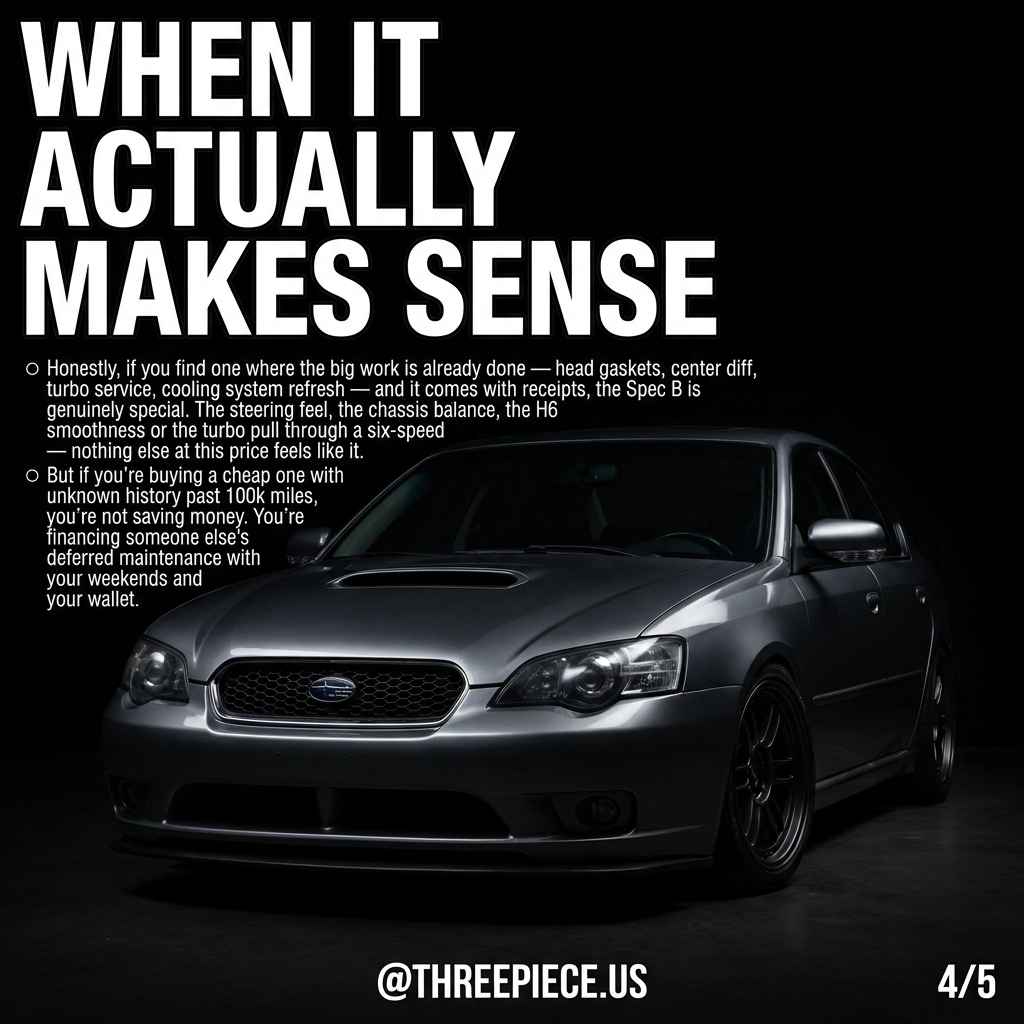
If you find one where the big work is already done — head gaskets, center diff service, turbo maintenance, cooling system refresh — and it comes with receipts, the Spec B is genuinely special. The steering feel, the chassis balance, the H6 smoothness or the turbo pull through a six-speed — nothing else at this price point delivers that combination.
The inspection checklist for a Spec B worth buying:
- Center diff behavior (manual only): Take tight turns after a 30-minute drive. Any skipping or binding is a hard no.
- Timing cover and valve cover leaks (H6): With engine warm, listen for rattle at startup. Inspect seals beneath the alternator and pumps.
- Cooling system integrity: Pressure test the system. Check radiator, thermostat, and all hoses.
- Compression and leakdown test: Non-negotiable on any EJ25 turbo past 80k miles. White smoke or coolant consumption means walk away.
- Suspension bounce test: Factory Bilsteins should still have firm rebound. If the car floats or wallows, budget for replacement shocks.
A sorted Spec B with documented maintenance history is a legitimate performance bargain. An unsorted one past 100k miles is someone else's deferred maintenance bill with your name on it.
What To Buy Instead
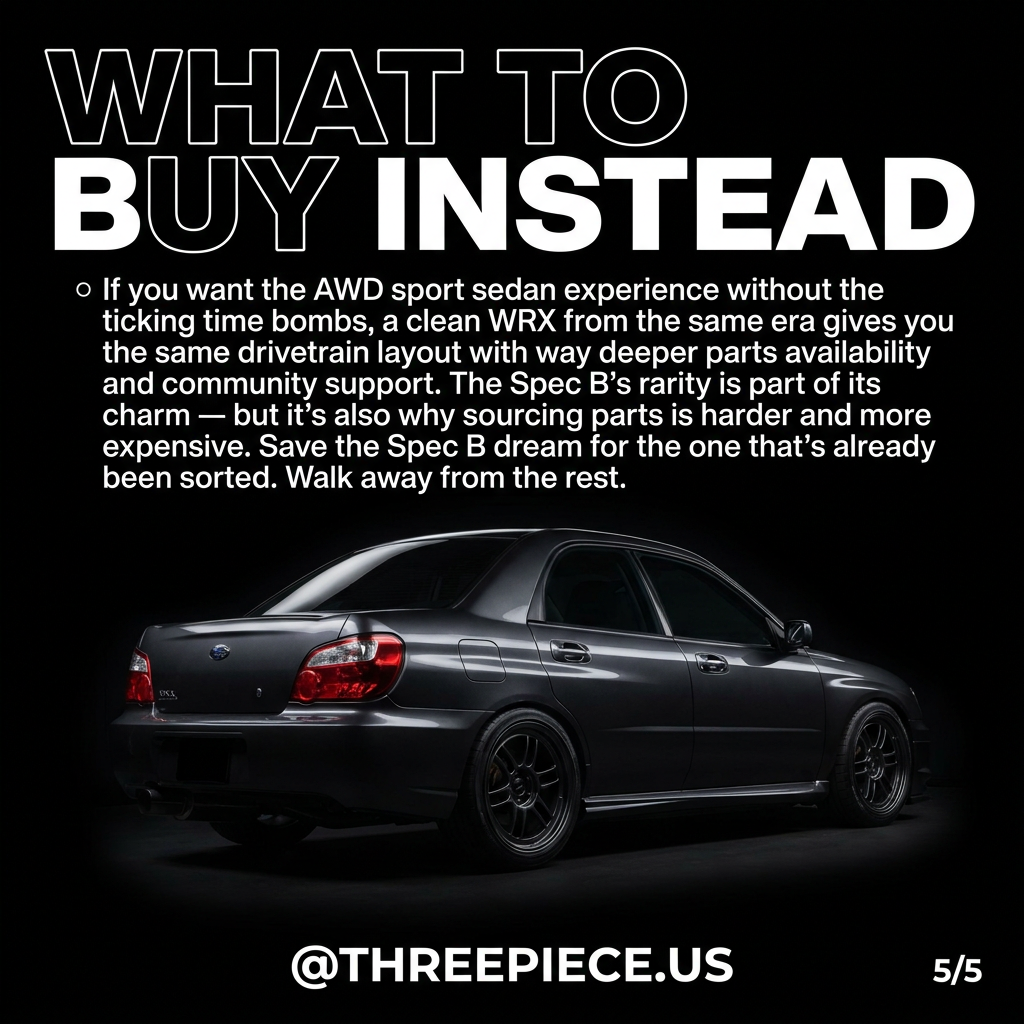
If you want the AWD sport sedan experience without the ticking time bombs, a clean WRX from the same era gives you the same drivetrain layout with significantly deeper parts availability and community support. The Spec B's rarity is part of its charm — but it's also why sourcing parts is harder and more expensive. WRX parts are everywhere, aftermarket support is massive, and the community has documented every failure mode and fix.
For similar money, consider a Lexus IS 350 if you want a sport sedan with Toyota reliability, or an Infiniti G37 Sport 6MT if you want a naturally aspirated V6 with a manual and rear-drive engagement. Both are more reliable long-term and have better parts ecosystems. If you're set on AWD, the Evo X is a more capable performance platform with better documented mod paths, and even the Audi B8 S4 with the 3.0T offers supercharged AWD performance with a more predictable maintenance curve if you follow the known service intervals.
Spec B Wheel Fitment & Upgrades
If you do end up with a sorted Spec B, the wheel game is where these cars really shine. The 4th-gen Legacy runs a 5x100 bolt pattern, which is shared with the GD/GG WRX and STI platforms. Factory Spec B wheels are 18x7.5, but most builds run 18x8.5 +45 to +50 for a proper flush fitment without fender work.
Browse 18-inch wheels in 5x100 to see what fits. The Work Emotion series is a popular choice on this platform — lightweight, aggressive, and available in the right offsets. For a more classic JDM look, the Work Equip line fits the Spec B's understated sedan aesthetic perfectly. If you're considering multi-piece wheels, read our guide on what forged wheels actually are and whether they're worth it — on a car this rare, the wheel choice matters.
For tires, pair 18x8.5 wheels with 225/40R18 or 235/40R18 rubber depending on your offset and fender clearance. Finish the build with proper 90-degree valve stems at $3.80 each — essential on deep-dish or concave wheel designs where standard stems won't clear. Check out the ThreePiece.us vehicle gallery for build inspiration across similar platforms.
Final Verdict: Save the Spec B Dream for the Right One
The Subaru Legacy Spec B is not a bad car. It's a genuinely great driver's car trapped inside a maintenance nightmare — and the rarity that makes it special is the same thing that makes it expensive to own. Head gaskets, center diff binding, timing cover leaks, worn Bilsteins, turbo oil starvation — these aren't if-problems, they're when-problems. And on a car that's now 15-20 years old, most of these "when" moments have already arrived or are about to.
If you find one that's already been through the gauntlet with receipts to prove it, buy it and enjoy one of the best-kept secrets in the Subaru lineup. But if you're looking at a cheap Spec B with unknown history past 100k miles, you're not saving money — you're financing someone else's deferred maintenance with your weekends and your wallet. Browse wheels, suspension, and wheel accessories at ThreePiece.us to build the right platform the right way.