
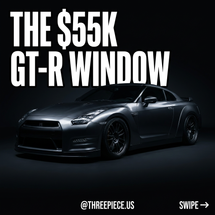
R35 GT-R Depreciation: Why $55K Examples Are Everywhere
The R35 GT-R depreciation curve has reached a tipping point. Clean CBA-spec examples — 2009 through 2011 — are sitting on lots and forums between $45,000 and $60,000, and most buyers are walking right past them. That's a 480 hp twin-turbo AWD platform for Mustang GT money. The question isn't whether the R35 is a good car. It's whether you understand why the market discounted it this hard, what actually breaks, and how to buy one without getting wrecked by deferred maintenance.
Quick links
- Why CBA R35s bottomed out
- The GR6 transmission: separating myth from money pit
- VR38DETT engine limits on stock internals
- Year-one budget: what to set aside
- R35 GT-R wheel fitment and tire sizing
- The buy window is closing
Why CBA R35s Bottomed Out
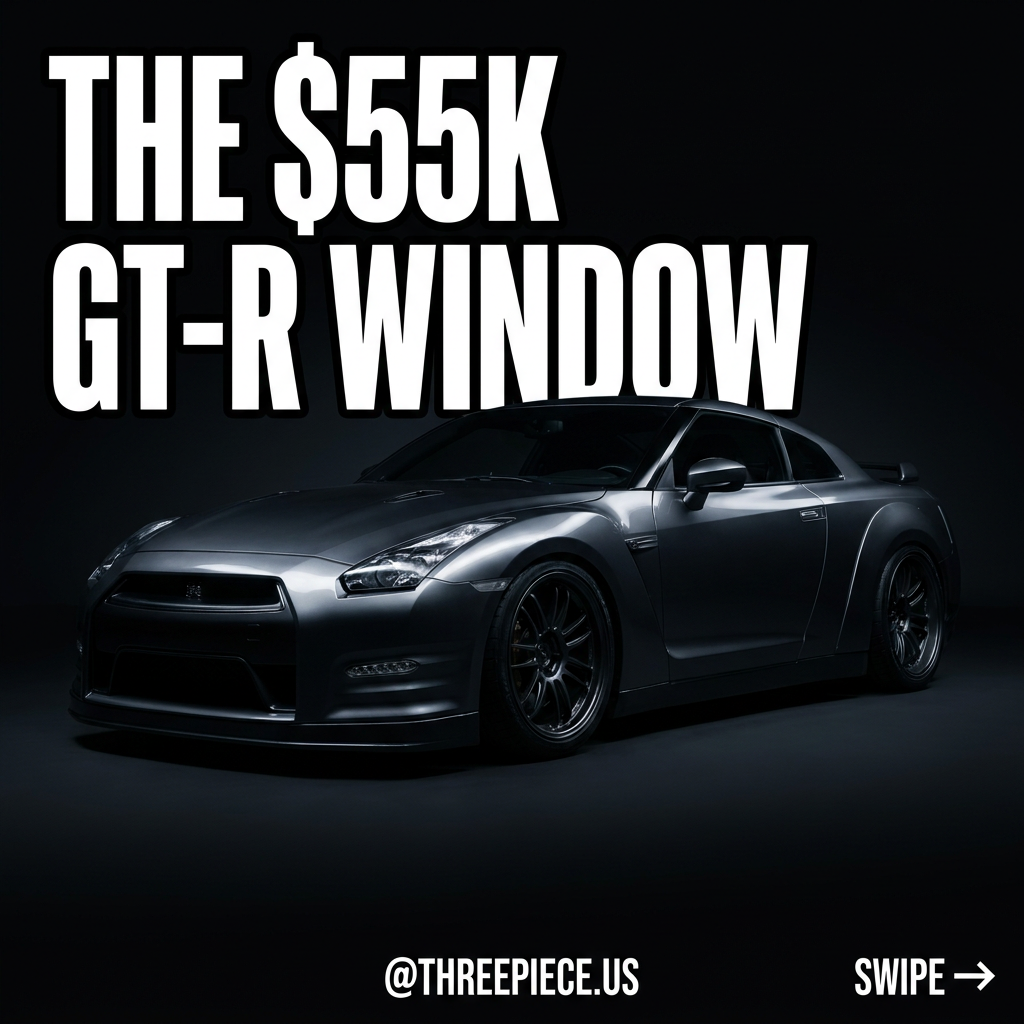
Three forces converged to push CBA GT-R prices to where they are now. First, the original owners — the guys who bought them new between 2009 and 2012 — are aging out. Priorities shifted. Second and third owners drove them hard for a few years, got spooked by service quotes, and moved them. That created a supply glut of 60,000–80,000 mile examples hitting the market simultaneously. Supply did what supply always does.
The second factor is perception. The R35's maintenance reputation precedes it. Buyers hear "$20,000–$35,000 transmission rebuild" and close the listing. That fear is baked into every asking price you see. A clean, documented CBA car at $55K isn't priced that way because something is wrong with it — it's priced that way because the next buyer assumes something will go wrong. That gap between perceived risk and actual risk is where the opportunity lives.
Third, the R35 sits in an awkward segment. It's too expensive for casual enthusiasts and too "old" for the crowd chasing the latest thing. Compare this to how the SRT 392 Challenger depreciation played out — same dynamic of perceived maintenance cost suppressing resale on a mechanically overbuilt platform.
The GR6 Transmission: Separating Myth from Money Pit
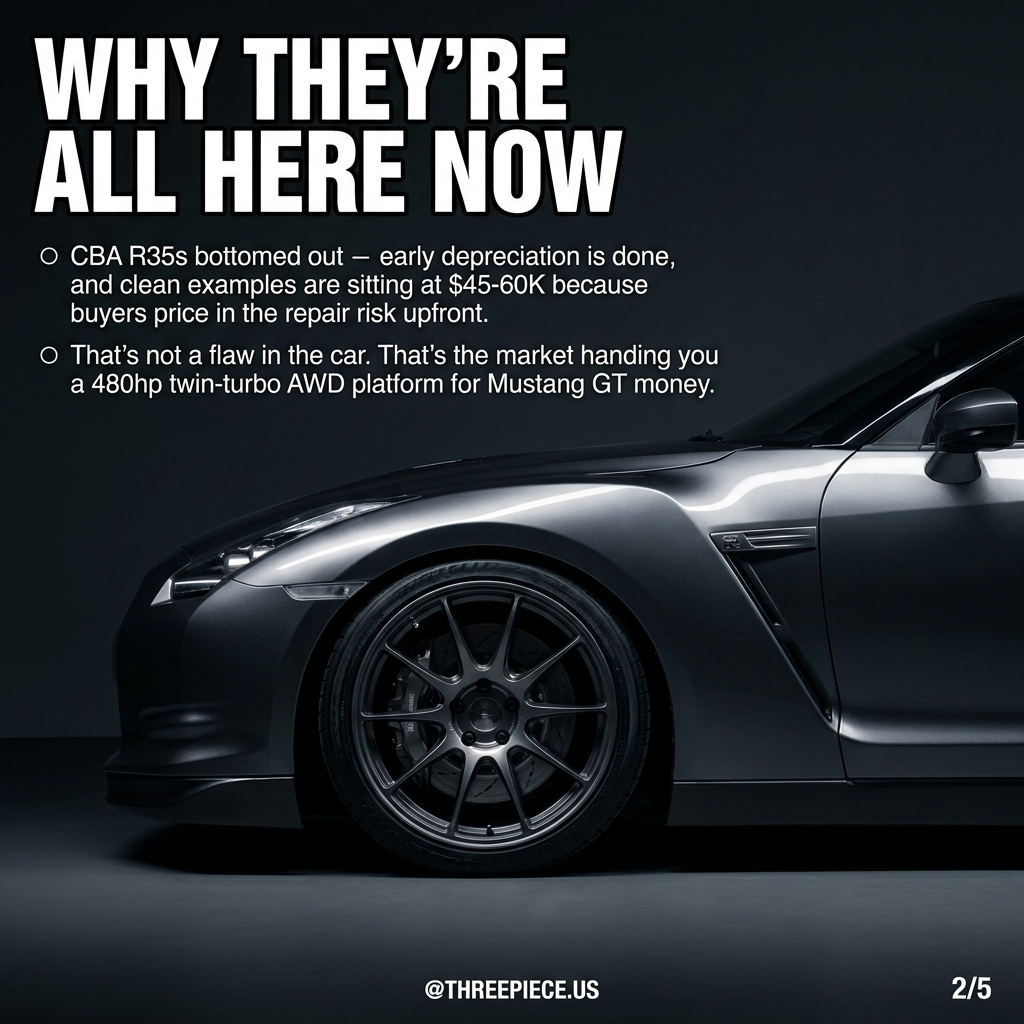
The GR6 dual-clutch transaxle is the R35's boogeyman, and it deserves some of that reputation — but not all of it. Here's what actually fails and what it costs.
Pressure sensors and solenoids are the most common GR6 issue on CBA cars. The three pressure sensors (line pressure plus both clutch packs) drift with thermal cycling over time. Symptoms include hesitation under load, uneven clutch engagement, and drivetrain warning lights. Replacing sensors and solenoids plus a TCM re-adaptation runs a few thousand dollars — not the catastrophe people imagine. The problem is when owners ignore early symptoms and let a $3,000 fix become a $25,000 rebuild.
Launch control software is the other big variable. Early 2009 cars shipped with "LC1" — essentially a full clutch dump designed as a traction recovery mode that owners used for drag launches. It destroyed clutches and stripped first-gear synchros. Nissan eventually issued LC2 and later LC3/LC5 revisions with better clutch modulation. When shopping, confirm the car has had the software update. If it hasn't, that tells you something about how it was maintained.
Shift fork and actuator wear shows up on high-mileage or aggressively shifted cars. The OEM shift fork for 1st/reverse is a known weak point — the square edges on the actuator wear down, causing misalignment and eventually code P2715. Dodson billet shift forks are the community-standard upgrade. Budget several thousand for this repair if your PPI shows early signs.
At extreme power levels (800+ whp), the cast aluminum differential housing itself can crack under torque. Ring gear separation from the pinion is the failure mode. Billet diff covers with ARP hardware address this on built cars, but if you're buying a $55K street car, this isn't your concern. Understanding how bolt-on power adders actually affect drivetrain stress helps frame where the real limits sit.
VR38DETT Engine Limits on Stock Internals
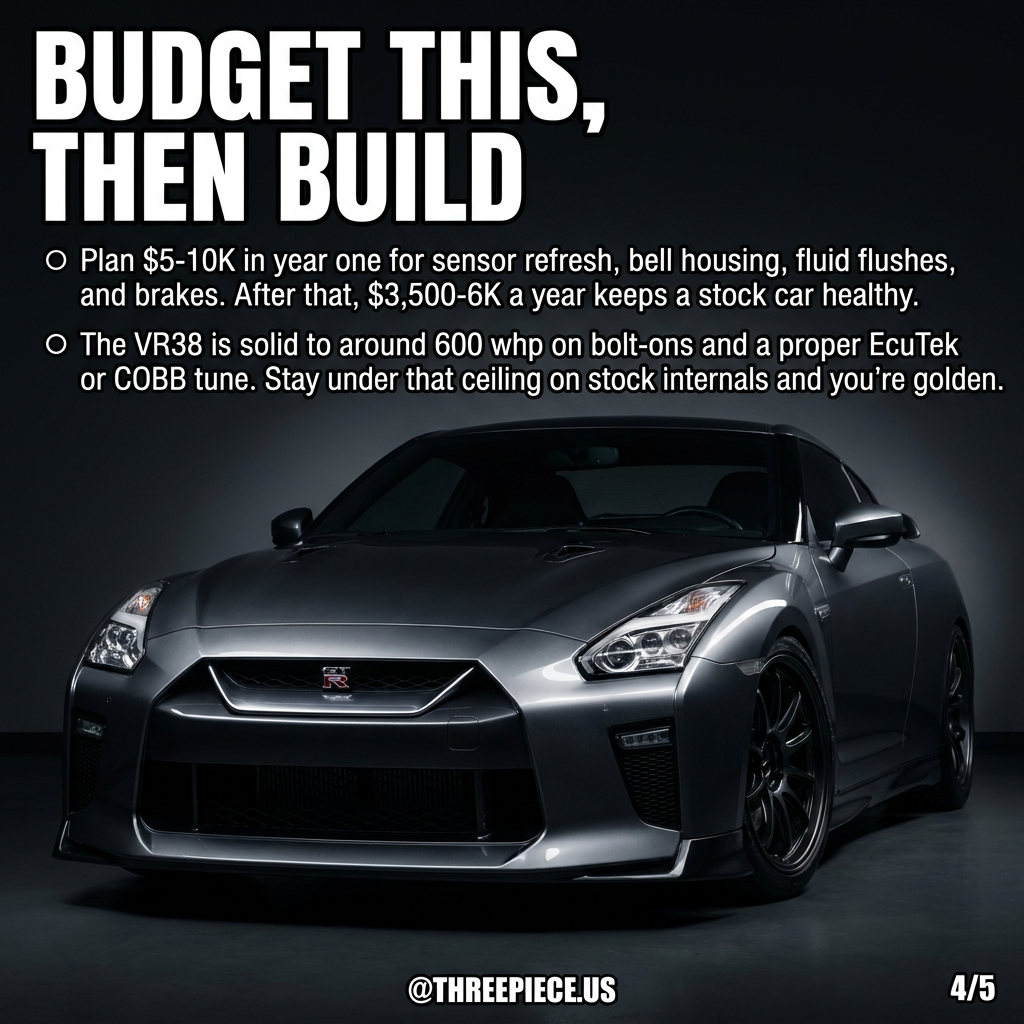
The VR38DETT is genuinely overbuilt from the factory. Nissan designed it to make 480 hp at the wheels as a baseline, and most of the internals have significant headroom above that. On a stock motor with bolt-ons — downpipes, intake, and a proper EcuTek or COBB tune — you can reliably push 550–600 whp as long as fueling, cooling, and tune calibration are dialed.
The ceiling on stock internals is around 600 whp / 600 lb-ft. Above that, the stock connecting rods start bending or crushing, particularly once boost exceeds ~30 psi with hybrid turbos. Rod bearings are the canary in the coal mine — they wear under sustained hard driving even at stock power. Preventive bearing replacement during a service interval is cheap insurance. Clevite VR38 con rod bearing sets run around $60 per bearing.
For context on how bolt-on tuning scales on turbocharged platforms, our Giulia Quadrifoglio build guide covers a similar progression — stock motor, aggressive tune, and knowing exactly where the factory parts give up. The R35 follows the same logic: respect the ceiling, and the stock bottom end is remarkably durable.
Beyond 650 whp, you're looking at forged rods and pistons, ID1700 injectors, dual fuel pumps, and GT4500-class turbos. At that point, the engine build alone can exceed $15,000–$20,000 in parts and labor. That's a separate conversation from buying a $55K street car — but it's worth knowing the upgrade path exists and is well-documented. The air-fuel ratio fundamentals become critical at these power levels, especially on ethanol blends.
Year-One Budget: What to Set Aside
If you're buying a CBA R35 at $55,000, plan to spend $5,000–$10,000 in the first year on deferred maintenance. This isn't optional. Here's where that money goes:
- Transmission fluid flush — the GR6 needs fresh fluid on a strict schedule. If the seller can't show receipts, assume it's due.
- Pressure sensor inspection / replacement — pull TCM live data during your PPI. If sensor readings are drifting, address them immediately.
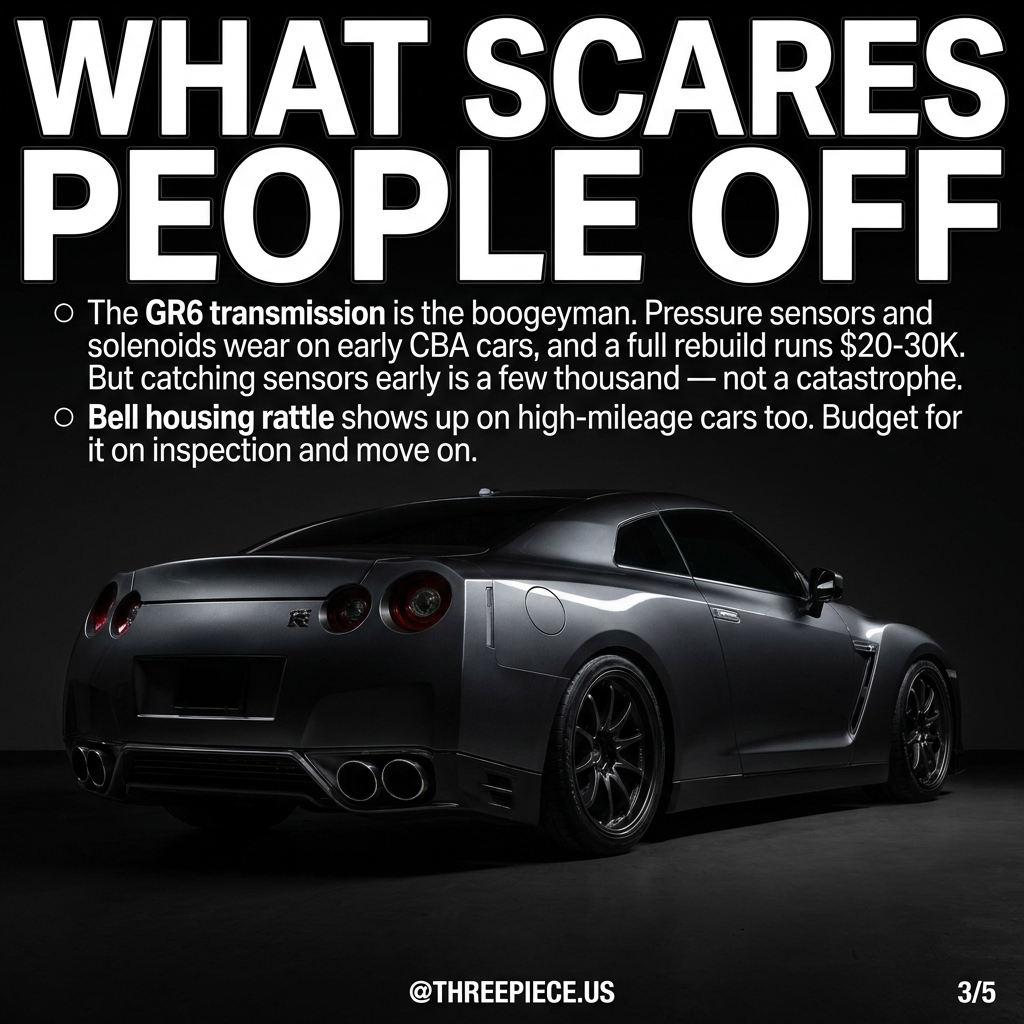
- Bell housing rattle — common on high-mileage CBA cars. Budget for it on inspection and move on. It's a known issue, not a surprise.
- Brake pads, rotors, and lines — the R35's Brembo system is expensive to service but straightforward. If you're considering pad compounds, our breakdown of semi-metallic brake pad problems applies here — the R35 benefits from a proper ceramic or carbon-metallic compound.
- Tires — if the car is sitting on rubber older than three years, replace it. Period. The R35 runs staggered from the factory: 255/40ZR20 front, 285/35ZR20 rear. Browse 255/40R20 tires and 285/35R20 tires for options.
- Cooling system inspection — check hoses, clamps, and coolant condition. The VR38 runs hot under boost, and a cooling failure at speed is catastrophic.
After year one, ongoing maintenance runs $3,500–$6,000 annually to keep a stock-power car healthy. That's real money, but it's predictable money — and it's a fraction of what comparable performance costs on a Porsche 911 Turbo or AMG GT. An oil catch can is a cheap addition that helps with long-term intake and valve cleanliness on the VR38, especially on cars that see spirited driving.
R35 GT-R Wheel Fitment and Tire Sizing
The R35 runs a 5x114.3 bolt pattern with a 66.1mm hub bore. Factory wheel sizing is 20x9.5 +45 front and 20x10.5 +25 rear — a staggered setup that gives the ATTESA E-TS AWD system room to work. If you're considering aftermarket wheels, understanding 370Z fitment is useful since it shares the same bolt pattern and many owners cross-reference sizing between the two platforms.
Most R35 builders stay at 20" to clear the factory Brembos, though some run 19" with careful caliper clearance checks. A popular aggressive fitment is 20x10 +15 front and 20x11 +10 rear — browse 20x10 wheels in 5x114.3 and 20x11 wheels in 5x114.3 to see what's available. For a deep dive on staggered setups and how offset affects handling on AWD cars, read our WRX wheel offset analysis — the principles translate directly.
If you're running 3-piece wheels on an R35, proper hubcentric rings are non-negotiable for centering on the 66.1mm hub. The Work VS series and Work Meister line are both popular choices on R35 builds — aggressive lips with enough spoke clearance for the massive front calipers. Finish the look with Black/Gold Work VS center caps at $120 or Work VS reproduction center caps at $50. Check our vehicle gallery for real-world R35 builds on 3-piece wheels.
If you're rebuilding or refinishing existing 3-piece wheels for this car, Work reverse lips and Work step barrels are both available starting at $399. Assembly hardware matters too — M7x32 chrome assembly bolts at $10 each or the M7x32 24K gold bolt/nut sets at $15 if you want the detail to match the car.
The Buy Window Is Closing
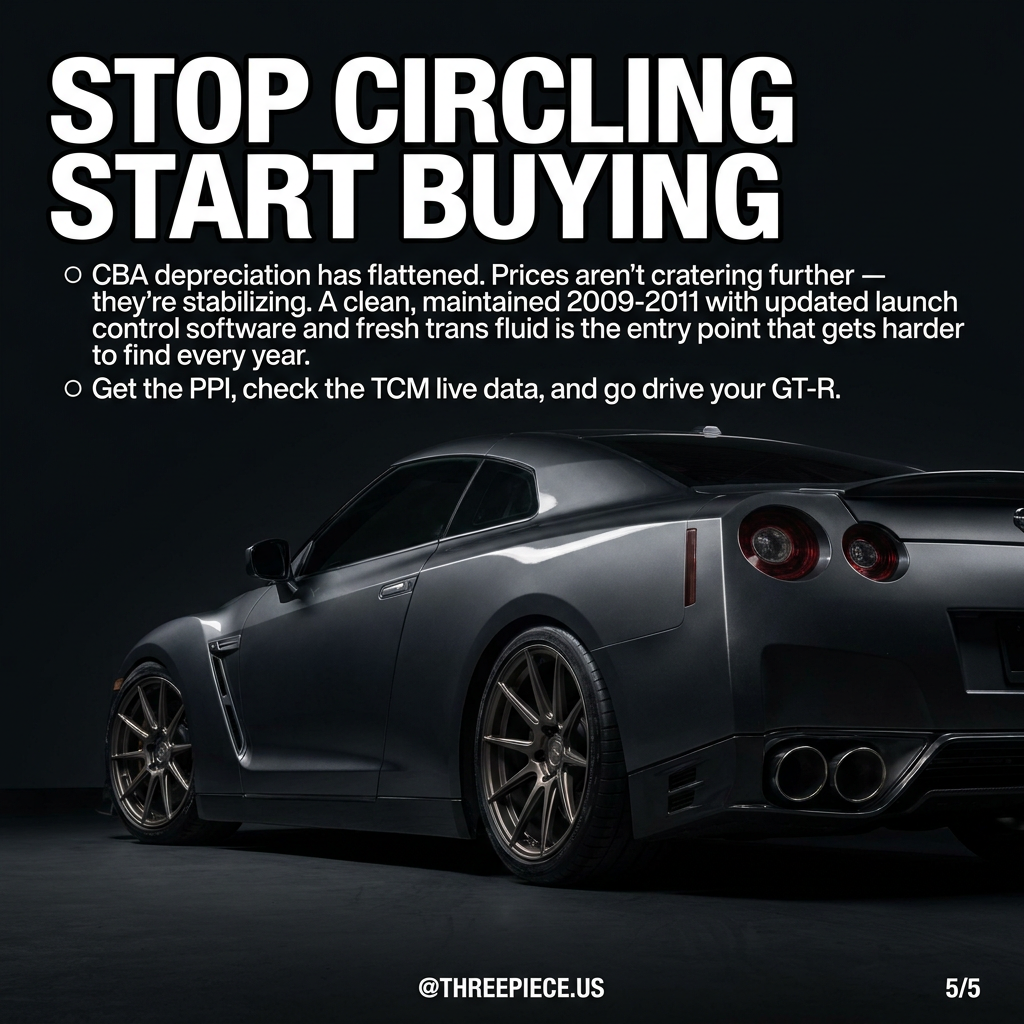
CBA R35 depreciation has flattened. Prices aren't cratering further — they're stabilizing, and the cleanest examples are being absorbed by builders who understand the value proposition. A maintained 2009–2011 with updated launch control software, documented fluid changes, and clean TCM data is the entry point. Every year, the supply of unmolested examples shrinks.
The R35 is the last of the analog-adjacent AWD performance cars. It predates the era of fully electronic throttle mapping, over-the-air software nannies, and 4,500-lb curb weights. The market always figures that out eventually — look at what happened to R32, R33, and R34 Skyline GT-R values once the import window opened. The CBA R35 is following the same trajectory, just on a longer timeline because production numbers were higher.
Get the PPI. Pull TCM live data. Check the launch control software revision. Verify fluid service history. And then go drive your GT-R. Browse wheels, Nissan-specific parts, and wheel accessories at ThreePiece.us to start building yours the right way.