
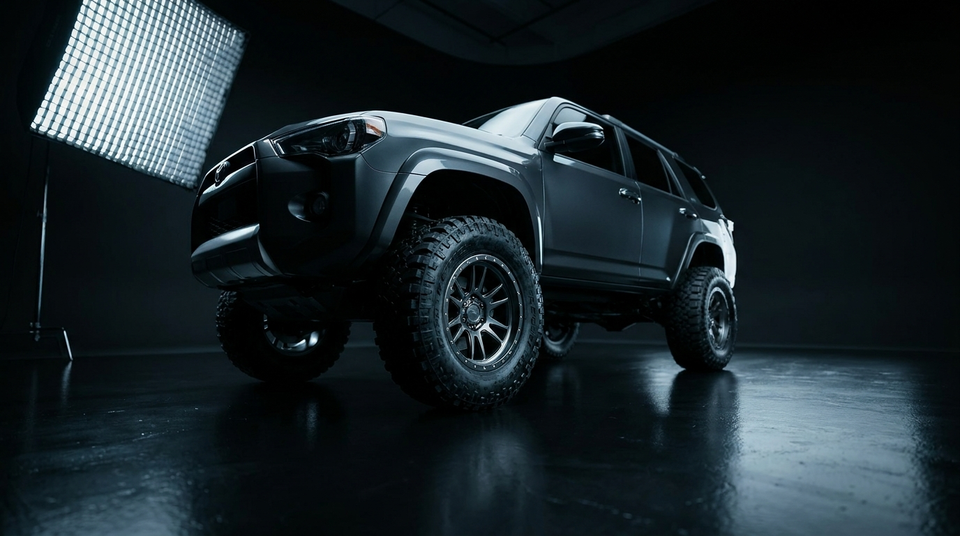
Flotation and metric are two ways of writing the same thing: your tire's size. Metric sizes like 275/40R20 list the section width in millimeters, the sidewall height as a percentage of that width (the aspect ratio), and the rim in inches. Flotation sizes like 35X12.50R20 skip the math and state the tire's height and width directly in inches. To swap between the two systems, you match them by overall diameter — not by the numbers on the sidewall.

How to read a metric tire size
A metric size reads width / aspect R rim. In 275/60R20, that's a 275 mm section width, a sidewall 60% of that width tall, an R for radial construction, and a 20-inch wheel. To find the height, use:
overall diameter (in) = rim + 2 × (section_width_mm × aspect/100) ÷ 25.4
Run 275/60R20 through it and you get an overall diameter of about 33.0 in. A few more worked examples: 265/70R17 is 31.6 in, 315/70R17 is 34.4 in, 285/75R16 is 32.8 in, and 255/80R17 is 33.1 in. Browse sizing across our full tire catalog.
How to read a flotation tire size
Flotation sizing is more literal. In 35X12.50R20, the first number is the nominal overall height in inches (~35 in), the second is the section width in inches (~12.5 in), and the last is the wheel diameter (20 in). No aspect-ratio calculation is needed — the height is right there. That's why off-roaders talk in "33s," "35s," and "37s." You'll see this format across our all-terrain and mud-terrain lineups.
Converting between them
Convert by matching overall diameter, then keeping the same rim. A flotation 33X12.50R20 stands a nominal 33 in tall — and a metric 275/60R20 works out to 33.0 in on the same 20-inch wheel, so those two are close equivalents. Likewise, a flotation 35 (35X12.50R17/18/20) is a genuine ~35 in, while a metric 315/70R17 measures 34.4 in — a near match, but a touch shorter. Because flotation numbers are nominal, always compare the calculated metric diameter side by side rather than trusting the headline number.
Quick comparison
- Flotation 33X12.50R20 (~33 in) ≈ metric 275/60R20 (33.0 in)
- Flotation 35X12.50R17 (~35 in) ≈ metric 315/70R17 (34.4 in), slightly taller
- Metric 255/80R17 (33.1 in) sits right at flotation "33" territory
When each is used
Metric sizing covers the vast majority of cars, CUVs, and daily-driven trucks — it's the standard for all-season fitments. Flotation sizing is the language of trucks and off-road builds, where all-terrain and mud-terrain tires are commonly sold in whole-inch heights. Many popular sizes exist in both systems, so you can often shop either way in our tire selection.
Frequently Asked Questions
What does 35X12.50R17 mean?
It's a flotation size for a tire about 35 inches tall and 12.5 inches wide, mounted on a 17-inch wheel. The height and width are stated directly in inches, with no aspect-ratio math required.
Is a 33 the same as a 275/60R20?
Very close. A flotation "33" (like 33X12.50R20) is a nominal 33 inches, and 275/60R20 calculates to 33.0 inches on the same rim — so they're effectively equivalent in height.
How do I convert a metric size to inches?
Use rim + 2 × (section_width_mm × aspect/100) ÷ 25.4. For example, 265/70R17 comes out to 31.6 inches tall.
Which is better, flotation or metric?
Neither is better — they're just two labeling systems. Metric dominates cars and CUVs; flotation is common on trucks and off-road tires. Choose by overall diameter and the fitment your vehicle and wheels require.