Short answer: yes, a 35-inch tire can be made to work on a Rivian R1T, but it is not a bolt-on swap the way a 33 is. The factory 20-inch wheel is an 8.5-inch-wide rim with roughly a 48 mm offset on a 5x139.7 bolt pattern with a 64.1 mm hub bore, and the truck's plus-size window opens up to wheels in the 8.5–9.0-inch width range with offsets pulled in to about 35–50 mm. Get into a 9x20 at roughly a 38–45 mm offset, use the air suspension's taller ride-height modes intelligently, and a 35x12.50R20 becomes realistic — usually with some liner massaging and almost always with a lower ride-height limit set so the truck doesn't squat down onto the tread.
That is the honest headline. What follows is the long version: what 33s, 35s and 37s each actually cost you on this platform, how offset and backspacing really work, why an electric truck changes the entire re-gearing conversation, and which sizes are worth your time.
Start with the factory numbers, because everything keys off them
For 2022–2025 R1Ts, the reference point is an 8.5x20 wheel at about a 48 mm offset, 5x139.7 bolt pattern, 64.1 mm center bore. That hub bore is small relative to the 5x139.7 half-ton world, so a lot of generic half-ton wheels will bolt on but sit acorn-centric rather than hub-centric unless you use the correct centering rings. On a 7,000-plus-pound truck with instant torque, hub-centric fitment is not a detail to hand-wave — it is what keeps the wheel concentric under load and keeps the studs in shear-free clamp rather than carrying vehicle weight.
The workable plus-size envelope for this truck runs 8.5x20, 8.5x21 and 8.5x22 at roughly 35–50 mm offset, and 9x20, 9x21 and 9x22 at roughly 38–45 mm. Two things fall out of that. First, you have real width available — a 9-inch rim is the sensible minimum for a 12.50-wide flotation tire, and it seats the tread flatter than the 8.5 does. Second, the offsets on offer are still fairly high by traditional 4x4 standards. You are not going to hang a 0 mm-offset wheel out in the weather and call it done; the R1T's front suspension geometry, the quad-motor packaging and the aero cladding all argue for staying inside that window. Verify the exact combination against your own trim and any suspension changes before you buy.
How big you can realistically go, by trim and setup
Every R1T rides on height-adjustable air suspension, which is the single biggest reason this truck tolerates larger rubber at all. Raising into the taller modes buys you body clearance over the tire, and that helps enormously at parking-lot speeds and on the trail. What it does not buy you is bump clearance: when the suspension compresses hard over a whoop or a driveway entrance, the tire ends up in the same place regardless of what mode the dash says. Fitment is decided at full compression and full steering lock, not at ride height.
Trim matters at the margins. Trucks that left the factory with the more off-road-oriented wheel and all-terrain tire package generally already have some of the liner and cladding geometry that plays nicer with a taller tire, and they start from a chunkier rolling diameter, so the jump to a 33 feels like nothing. Quad-motor trucks are heavier than dual-motor trucks, which changes the load-index math more than it changes clearance. Second-generation trucks brought revised motor and suspension hardware; the fitment logic below still applies, but confirm liner shapes and lower ride-height limits for your specific model year rather than assuming a build thread from a different generation transfers.
Broadly: a 33 is the easy win, a 35 is the enthusiast sweet spot with real prep, and a 37 is a committed build.
33-inch tires: the upgrade almost everyone should start with
A 33 is where the R1T stops feeling like a compromise and still behaves like a truck you'd commute in. In practical terms that means either a 33x12.50R20 at a true 33.0-inch diameter on the factory 20-inch wheel size, or a 285/70R17 at about 32.7 inches if you are going down to a 17-inch wheel for sidewall. The step up from stock is modest enough that clearance issues are usually limited to the front liner's leading edge at full lock with the suspension compressed, and often not even that, depending on wheel offset and how much the truck is loaded.
The trade-offs are correspondingly small. Efficiency drops — any taller, heavier, more aggressive tire costs range on an EV, and a 33-inch all-terrain will typically pull a noticeable percentage out of your highway number depending on tread pattern, pressure and speed. Ride quality generally improves off pavement because you're adding sidewall. Speedometer error is small but real and worth correcting. If your priority is a truck that looks right, airs down well, and still road-trips without you doing charging-stop math, a 33 is the mature answer.
One note on the 17-inch route: the R1T carries large brake hardware, and the documented plus-size window for this truck lives in 20–22-inch diameters. Dropping to a 17 to gain sidewall is a legitimate strategy on many trucks, but you must confirm caliper clearance with the specific wheel you intend to run before ordering tires. Do a physical test fit or get a clearance drawing from the wheel manufacturer.
35-inch tires: doable, but you have to build for it
This is the size most people are actually asking about. The two realistic paths are a 35x12.50R20 at a full 35.0 inches, or a 315/70R17 at roughly 34.4 inches — that metric size being the quiet hero, because those six-tenths of an inch of diameter and the slightly narrower section width take real pressure off the front wheel well and off your efficiency numbers.
To make a 35 live on this truck, plan on several things at once. A wheel in the 9x20 range with an offset around 38–45 mm gives the tire somewhere to go without pushing scrub radius off into the weeds. Some trimming of the front inner liner and its leading lip is common, and the plastic wheel-arch cladding is usually the first thing to make contact — that is a good thing, because plastic is cheap and body metal is not. Expect to review your ride-height strategy: many owners running tall rubber restrict the truck out of its lowest, most aerodynamic settings so it can't drop the body onto the tread at highway speed. Whether that's done through the vehicle's own height settings or with aftermarket suspension hardware, treat it as part of the build rather than an afterthought.
Do you need a lift? Not necessarily in the traditional sense — air suspension changes the conversation — but you should assume some combination of ride-height management, liner trimming and correct offset. Nobody can promise you a rub-free result sight unseen; tolerances, load, tread pattern and even individual tire mold variation all move the needle. Test fit at full lock, cycle the suspension, and go looking for witness marks after your first dirty drive. The tires themselves are well supported at this size: a Falken Rubitrek A/T in 35x12.50R20 is a good example of a modern, road-manner-focused all-terrain with the load capacity a heavy EV truck needs, while the Nexen Roadian ATX in 35x12.50R20 with a 125 load index leans harder toward payload and sidewall toughness.
37-inch tires: possible, but it's a different truck afterward
Thirty-sevens exist for this platform — a 37x12.50R20 or a 37x12.50R17 both measure a full 37.0 inches — but you are now well outside anything resembling a bolt-on. Two additional inches of diameter over a 35 means an extra inch of static clearance needed above the tire and an extra inch of swing at full lock, and the front wheel well is where that fight happens. Realistically this means substantial liner and cladding removal or replacement, careful attention to the lower control arm and steering sweep, a hard lower limit on ride height, and in most cases dedicated aftermarket suspension components.
Then there's the physics. A 37-inch light-truck tire in a load range appropriate for this truck is heavy — often 15–25 pounds more per corner than the 35 — and every pound is unsprung and rotating. On an EV that mass hits you three ways: acceleration, braking distance, and regenerative braking calibration, which is tuned around a specific rolling radius. Range loss is meaningful. Steering effort and tramlining go up. Unless you're building a genuinely dedicated trail truck and you accept the efficiency penalty as the cost of entry, the 35 gives you most of the capability for a fraction of the compromise.
Offset and backspacing, explained properly
Offset is the distance from the wheel's mounting face to its centerline, in millimeters. A high positive offset like the factory 48 puts the mounting face well outboard of centerline, tucking the tire in toward the suspension. Backspacing measures the same relationship differently: it's the distance in inches from the mounting face to the inboard rim edge, and it's the number that actually predicts inner clearance.
The conversion is straightforward. Backspacing equals half the wheel's overall width (section width plus one inch for the flanges) plus the offset converted to inches. The factory 8.5-inch wheel at 48 mm works out to roughly 6.6 inches of backspacing. Move to a 9x20 at 38 mm and you land near 6.5 inches — you've gained a half inch of tire width but kept the inner edge in nearly the same place, pushing the extra width outboard where the wheel well is more forgiving. That is exactly the trick you want when fitting a 12.50-wide tire: buy your clearance outward, not inward, because inward is where the strut, spring, control arm and steering components live.
The catch is that reducing offset increases scrub radius, which increases the leverage the tire exerts on steering, bearings and knuckles. It amplifies torque steer and impact harshness. On a truck this heavy, that's why staying inside the roughly 35–50 mm window makes engineering sense even though a lower offset would give you easier clearance. Wheel spacers can achieve a similar geometric result, but they add stack height and a second clamping interface; if you use them, use quality hub-centric units and re-torque religiously.
Gearing on an electric truck: the rule changes
On a conventional 4x4, the standard advice for 35s or 37s is to re-gear the axles — swap the ring-and-pinion to a numerically higher ratio — because a taller tire is effectively a taller final drive. It hurts acceleration, forces the transmission to hunt, loads the torque converter, and can genuinely cook a drivetrain that's towing at altitude. That principle is real and worth understanding, because it's the same physics acting on your Rivian.
The difference is that the R1T's motors drive through fixed single-speed reduction gearboxes. There is no ring-and-pinion to change and no practical re-gearing path, so you don't get to fix the ratio — you simply absorb the effect. Bigger tires reduce effective torque multiplication at the contact patch and raise the road speed at which the motors reach their limits. In daily driving you'll barely notice, because electric motors make enormous torque from zero and there's an enormous surplus to trade away. Where you will notice is efficiency, sustained-load towing on grades, and thermal headroom during long climbs. If you tow regularly at the upper end of the rating, be conservative about diameter and think hard before going past a 35.
Speedometer, odometer, stability systems and TPMS
Rolling diameter is an input to nearly every control system on the truck. A 35-inch tire replacing a roughly 32-inch factory diameter is around a 9 percent change, which means your indicated speed reads low by roughly that amount, your odometer under-counts, and range estimation drifts. That in turn affects warranty mileage tracking, service intervals and anything else keyed to distance.
Rivian has offered tire-size configuration in vehicle software for certain factory-supported wheel and tire packages, and a service center is the right place to ask what your specific truck and model year supports. Do not assume an arbitrary aftermarket size will be selectable. If it isn't, understand that ABS, stability control, traction control and regen all continue to reference the original rolling radius; the systems still function, but their calibration is now slightly off, and that's a real consideration on a heavy vehicle.
TPMS is direct-sensor on this platform. New wheels need sensors that the vehicle recognizes, correctly programmed and relearned, and the placard pressures on the door jamb no longer strictly apply once tire construction and load range change. Work out appropriate cold pressures for your new tire's load-inflation table at your actual axle weights — and weigh the truck, don't guess. Warning thresholds may need to be reconsidered with the shop.
Load range matters more here than on almost any pickup
An R1T is heavy. Curb weight sits in the neighborhood of 7,000 pounds before you add a passenger, a bed full of gear or a rooftop tent, and gross vehicle weight ratings for trucks in this class run higher still. Battery mass is also carried low and centrally, which is great for handling and merciless on sidewalls during hard cornering and off-camber trail work.
Practically, that means you want a genuine light-truck construction tire with a load index that clears your heaviest realistic axle load with margin. In the 35x12.50R20 space, a 121-rated tire like the Falken carries roughly 3,200 pounds per tire, while a load-range-F option such as the Nexen Roadian ATX in that size at a 125 index goes to around 3,600. Both are workable; the higher rating gives you more cushion if you tow, run a camper, or air down often. Understand the trade: stiffer, higher-ply tires ride firmer at street pressure and weigh more, which costs range. Don't buy more capacity than your use case needs, but never buy less.
All-terrain or mud-terrain on an electric pickup
For the overwhelming majority of R1T owners, an all-terrain is the correct tire. Aggressive mud-terrains cost range through both rolling resistance and aerodynamic churn, they roar at highway speed in a cabin with no engine noise to mask them — which is genuinely more noticeable than in a combustion truck — and their large voids reduce dry-pavement braking grip on a vehicle that already asks a lot of its contact patches. A modern all-terrain like the Roadian ATX in 315/70R17 gives you a reinforced sidewall, real snow capability with a severe-service rating on most models, and manners you can live with.
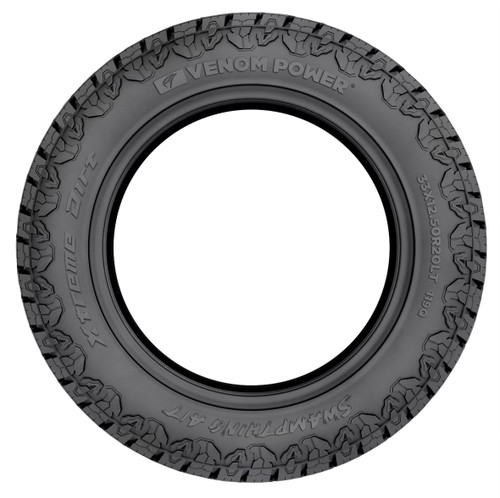
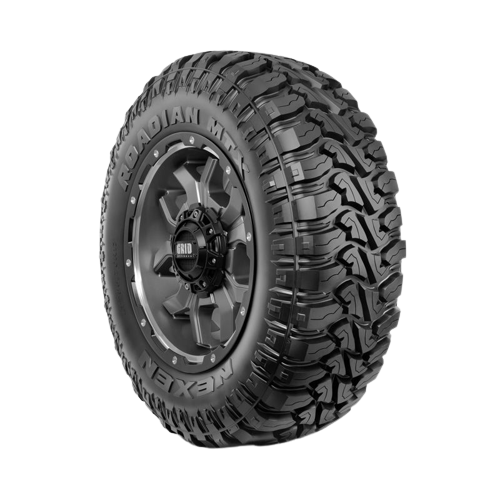
Mud-terrains earn their place if you routinely deal with deep clay, sharp rock or heavy sand and you accept the efficiency hit as a cost of doing business. Something like the Roadian MTX in 315/70R17 brings the deep voids and sidewall armor that matter when the trail turns ugly. There's also a growing hybrid category that splits the difference — the Venom Power Swamp Thing A/T in 315/70R17 is that kind of tire, more bite than a mild all-terrain without full mud-terrain penalties. If you're honest that 90 percent of your miles are pavement, the hybrid or the all-terrain is where you'll be happiest a year in.
The sizes worth shortlisting
Working from smallest to largest: the 285/70R17 comes in at 32.7 inches and the 33x12.50R20 at a true 33.0 — the low-drama tier. In the 35-inch class, the 315/70R17 measures 34.4 inches and is the more forgiving of the two, while the 35x12.50R20 gives you the full 35.0 and the widest tire selection. At the top, both the 37x12.50R20 and the 37x12.50R17 hit 37.0 inches and belong on a purpose-built truck. Browse the full tire range if you want to compare tread patterns and load ratings side by side before committing.
What to prioritize when you're buying
- Load index first, everything else second. On a truck this heavy, the tire that's five pounds lighter but 400 pounds short on capacity is the wrong tire.
- Buy diameter honestly. A 34.4-inch metric tire delivers most of the visual and clearance benefit of a 35 with meaningfully less risk and less efficiency loss.
- Match rim width to tread. A 12.50-wide tire wants a 9-inch rim as its practical minimum; 8.5 is legal but squeezes the tread crown.
- Keep offset inside the truck's window. Chasing clearance with aggressive negative offset trades one problem for steering, bearing and wear problems.
- Budget for the whole job. Sensors, mounting, road-force balance, an alignment afterward, and a software or service visit for tire-size configuration are all part of the real cost.
- Test fit before you commit. One wheel and one tire mounted, suspension cycled, steering swept lock to lock, tells you more than any spec sheet.
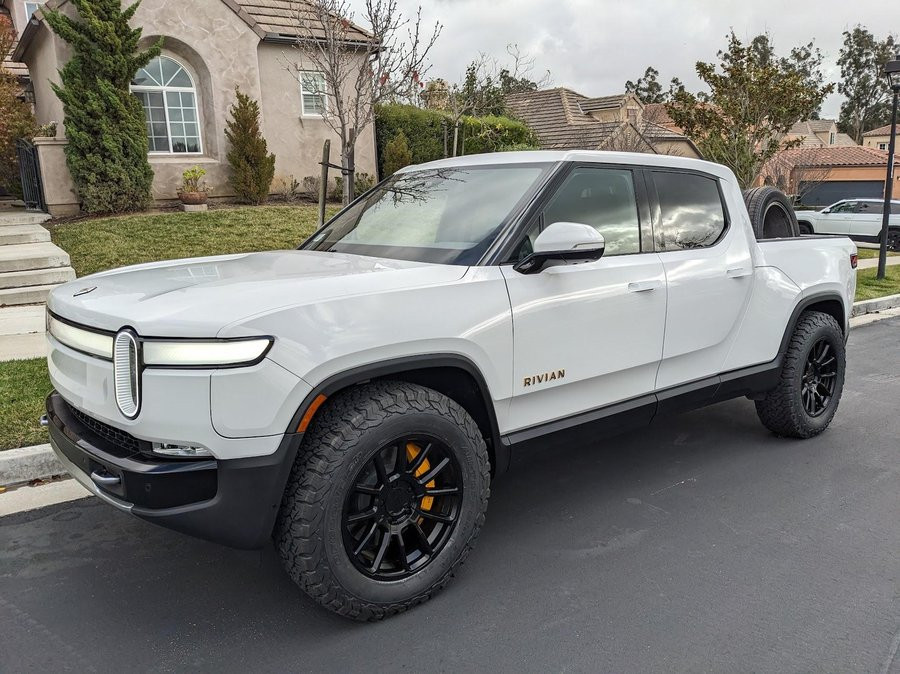
Real Rivian R1T builds running 35s and up
Actual owner builds — real photos.


Frequently Asked Questions
Do 35-inch tires fit an R1T with no modifications at all?
Realistically, no — not with confidence. The truck's plus-size wheel window supports the wheel widths and offsets that make a 35 geometrically possible, and the air suspension helps at ride height, but the front wheel well is tight at full compression and full steering lock. Most people fitting this size end up trimming or reshaping the front inner liner and cladding, running a wheel around 9 inches wide at roughly a 38–45 mm offset, and restricting the truck's lowest ride-height settings. Verify clearance on your own truck with a test fit before ordering four tires.
How much range will I lose going to a taller all-terrain?
Enough to plan around. Rolling resistance, added rotational mass and increased frontal area all work against you, and the penalty scales with how aggressive the tread is and how fast you drive. A mild 33-inch all-terrain is a modest hit; a heavy 35 or 37 in a mud-terrain pattern can be substantial, especially at 75 mph. Keeping pressures correct for your actual load recovers some of it, and choosing a metric size like the 315/70R17 over a full-width 35 helps too.
Can the axles be re-geared to compensate?
Not on this platform. The R1T uses fixed-ratio single-speed reduction gearboxes rather than conventional differentials with a swappable ring-and-pinion, so the traditional re-gearing fix isn't available. The good news is that electric motors have enough torque surplus that drivability rarely suffers noticeably; the cost shows up as reduced efficiency, less thermal headroom on long towed climbs, and slightly diminished low-speed torque multiplication at the contact patch.
Will my speedometer and odometer be wrong?
Yes, unless the new diameter is configured in software. Going from roughly a 32-inch factory diameter to a 35 introduces about a 9 percent error, meaning indicated speed reads low and recorded mileage accumulates slower than reality. Rivian has offered tire-size settings for certain supported packages, so ask a service center what applies to your model year and size. If your size isn't selectable, be aware that ABS, stability control and regen calibration continue referencing the original rolling radius.
Do I need new TPMS sensors with aftermarket wheels?
Almost certainly. The truck uses direct-reading sensors inside each wheel, so new wheels need compatible sensors installed, programmed and relearned to the vehicle before the system will report properly. You should also revisit your cold inflation pressures — the door-jamb placard was written for the factory tire's construction and load rating, and a different load range at the same pressure carries a different load.
Is a 33 or a 35 the smarter buy for a truck that mostly sees pavement?
A 33, in most cases. It clears more easily, weighs less, costs less range, keeps speedometer error small, and still transforms how the truck looks and how it handles a washboard road. Step up to a 35 when you genuinely need the extra ground clearance and sidewall for rock, ruts or deep sand — and when you're prepared to do the wheel, liner and ride-height work that makes it live properly.