
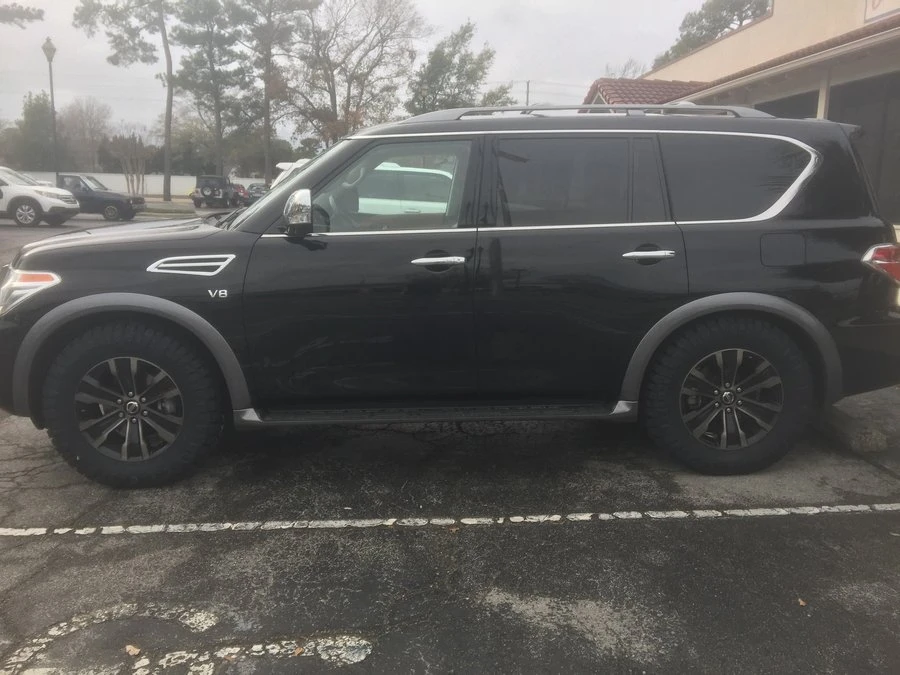

Short answer: yes, a 35-inch tire can go on a 2018-2026 Nissan Armada, but not as a simple bolt-on swap. Factory tires on most trims are already in the 32-33 inch range, so 33s are the realistic stock-height upgrade. A 35 generally needs some combination of lift, a carefully chosen wheel offset, and trimming. A 37 is a full build on a heavy, independently suspended SUV, not a weekend project. Below is what each size actually takes, what changes mechanically when you go bigger, and which sizes are worth your money.
The Armada is an unusual candidate for big tires. It sits on a stout full frame and has a strong drivetrain, but it is also a heavy luxury hauler with independent suspension at both ends, a fairly tight wheel-well package, and a lot of electronics that care about rolling diameter. Those traits decide how far you can sensibly go.
The Factory Baseline: What the Armada Starts With
Every fitment decision starts with the hub, so here are the numbers that don't change. Armadas from this era use a 6x139.7 mm bolt pattern (the same as 6x5.5 inches), a 78.1 mm center bore, and a factory wheel spec of 8x18 inches with a +45 mm offset. Higher trims and the newer generation come with larger-diameter wheels, but that +45 offset tells you Nissan tucked the wheel well inboard. That helps fender clearance and steering feel, and it matters a great deal once you add width.
The reference bolt-on wheel range for this platform is generous on paper. Widths of 8 inches in 18, 19, 20, 21, and 22-inch diameters fall in a roughly +30 to +50 mm offset window, and an 8.5x18 stretches to about +25 to +55 mm. That window describes wheels that physically mount and clear the suspension at factory tire sizes. It is not a promise that any wheel in it will clear a 35x12.50 at full steering lock with the suspension compressed. Bigger tires narrow that window quickly.
How Big You Can Realistically Go
Trim and generation shape the answer. The 2018-2024 Armada (the Patrol-based body with the 5.6-liter V8 and seven-speed automatic) and the redesigned 2025-on model (twin-turbo V6, nine-speed) share the same basic big-tire constraints: independent front and rear suspension, a heavy curb weight, and wheel wells shaped for road-going rubber. The newer truck's off-road-focused trim may give you a slightly better starting point depending on its factory tire and suspension spec, but verify that against your exact VIN and door placard.
A practical way to frame it:
- 33 inches: close to factory height on many trims. Usually the easiest upgrade, and on some setups possible with little or no lift. Offset and tire width still need care.
- 35 inches: the sweet spot most owners mean when they ask this question. Expect to need lift and some trimming, and plan around wheel offset. It is very doable, but it is a project.
- 37 inches: a dedicated build. Lift, substantial trimming, gearing concerns, and component wear all become serious, and on an IFS/IRS rig this heavy the daily-driving cost is real.
Running 33s: The Low-Drama Upgrade
Because many Armada trims ship with tires already around 32-33 inches tall, a 33 is often more about changing the tread and widening the footprint than gaining height. That is the appeal. You get a more aggressive look and better off-pavement traction while keeping clearance, gearing, and speedometer error almost where they were.
The catch is width. A 33X12.50R18 or 33X12.50R20 is noticeably wider than a typical factory metric tire, and width plus offset is what causes rubbing. With a wheel near the factory +45 offset, a 12.50-wide tire sits further inboard and can approach the upper control arm or inner fender liner. Drop toward +30 and the tire moves out, gaining inner clearance but moving the contact point toward the bumper cover and fender lip at full lock. If you want height without the width, a metric size like 285/70R17 (about 32.7 inches) is a sensible profile, but read the 17-inch note further down first.
Running 35s: What It Honestly Takes
This is the size most owners want, and it is achievable with the right parts. A true 35 is roughly 2 to 2.5 inches taller than most factory tires on this truck, which raises ride height at the axle by about half that amount. More importantly, it fills the wheel well. Expect contact at full steering lock, under suspension compression, or both. The usual trouble spots are the front bumper cover behind the tire, the lower front edge of the fender liner, the pinch weld where the fender meets the body at the rear of the front wheel opening, and sometimes the mud flap mounts.
Most 35-inch Armada builds combine three things. The first is a lift, whether a leveling kit, a coilover-based suspension lift, or occasionally a body lift, depending on budget and goals. The second is a wheel offset that balances inner and outer clearance, often lower than factory but not extreme. The third is some trimming of the bumper cover and liner. How much lift you need varies with the exact tire model, since real-world 35s vary in measured diameter and sidewall shape, as well as the wheel and how much rubbing you will tolerate off-road. We won't quote a lift height that guarantees a rub-free fit, because none exists without your exact combination. Mock it up and cycle the steering before you trim.
The trade-offs are real. A 35 adds unsprung and rotating mass, which dulls acceleration and braking and puts more load on the CV joints, ball joints, and tie rods of an independent suspension. Fuel economy falls. Steering at parking-lot speed gets heavier. In return you get real gains in ground clearance under the differentials, approach and departure angles, and soft-terrain flotation, plus a stance that suits the Armada's size. For the easiest path to the next height, consider a metric 315/70R17. At roughly 34.4 inches, it gives most of the visual and clearance benefit with a little less rubbing, as long as a 17-inch wheel clears your brakes.
Running 37s: A Committed Build
Putting 37s under an Armada is possible, but think of it as a project, not an upgrade. You are adding roughly 4 to 5 inches of diameter over stock. That typically means significant suspension lift, aggressive trimming that may include fender and pinch-weld modification, and close attention to every part that turns or articulates. Independent suspensions do not tolerate big lift as gracefully as solid axles. Steep CV angles, alignment limits, and bump-steer behavior all need to be dealt with.
Then there is power and gearing. A 37 dramatically raises effective gearing, and on a vehicle this heavy, even a strong engine will feel it in towing, highway passing, and transmission behavior. Availability is a practical concern too. Among the 37s we stock, 37X12.50R20 and 37X12.50R17 are easier to source than 37X12.50R18, which we stock only in limited quantities. If your goal is dedicated off-road use and you have budget for the supporting work, 37s can be done. For a family hauler that still tows and commutes, most owners are happier at 35.
What Actually Changes When You Go Bigger
Clearance and Where Tires Rub
Rubbing happens in two directions. Inner rub (tire against the upper control arm, sway bar end link, or inner liner) comes from too much positive offset or too much width. Outer rub (tire against the bumper cover, fender lip, or pinch weld) comes from too little offset, too much diameter, or suspension compression. The worst case is full steering lock with the suspension compressed on one side, which is why a driveway test at ride height can mislead you. Check clearance at full lock in both directions, and if you can, with a wheel up on a curb or ramp to simulate articulation.
Wheel Offset and Backspacing, Explained Properly
Offset is the distance in millimeters between the wheel's mounting face and its centerline. Positive offset moves the mounting face toward the outside of the wheel, which tucks the wheel and tire inward. The Armada's factory +45 is quite positive. Backspacing is the distance from the mounting face to the inner edge of the wheel, measured in inches, and it tells you directly how far the wheel reaches toward the suspension.
The two are linked. On a nominal 8-inch wheel (about 9 inches across the bead flanges), backspacing is roughly half the overall width plus the offset converted to inches. A +45 mm offset works out to about 6.3 inches of backspacing, and a +30 mm offset to about 5.7 inches. That half-inch shift sounds small, but it moves the whole tire outward by the same amount, trading inner clearance for outer clearance and slightly widening the track. Lower offsets also lengthen the scrub radius, which can add steering kickback and extra load on wheel bearings. That is one reason it's wise to stay within or near the platform's established bolt-on window rather than chase deep poke.
One more detail: 12.50-wide flotation tires usually have a manufacturer-approved rim width range, often favoring wider wheels than the factory 8-inch. Check the tire maker's spec sheet so the bead seats properly and the sidewall is supported correctly.
The 17-Inch Question
The 17-inch sizes (285/70R17, 315/70R17, 37X12.50R17) appeal because the taller sidewall rides well and resists damage off-road. But the Armada's factory wheels are 18-inch, and the established bolt-on references begin at 18. Large factory brakes may not clear every 17-inch wheel. Confirm caliper clearance for your specific wheel and model year before buying 17-inch tires.
Re-Gearing and Drivability
A taller tire works like a taller final drive. The engine turns fewer RPM at a given speed and has less mechanical advantage at the wheels. On a heavy SUV that shows up as sluggish launches, more frequent downshifts, transmission hunting on grades, and a noticeable towing penalty. On solid-axle trucks, re-gearing is a routine fix. On the Armada's independent front and rear differentials, aftermarket ring-and-pinion options are far more limited, and depending on generation they may be scarce or unavailable. Research this for your exact year before committing to 35s or 37s. For many owners, the lack of easy re-gearing is the strongest argument for stopping at 35, or at a slightly shorter metric size.
Speedometer and Odometer Correction
A taller tire covers more ground per revolution, so the speedometer reads low and the odometer under-counts. A 35 on a truck that left the factory near 32.5 inches puts the speedometer several percent low, enough that an indicated 70 mph is noticeably faster in reality. This also affects transmission shift logic and some stability-control calculations, which use wheel speed. Recalibration options vary by generation, so confirm what is supported for your model year. Expect to use either a dealer reprogram or an aftermarket calibration tool.
TPMS
Your factory TPMS sensors can usually move to new wheels if the valve stem design fits, or you can buy compatible new sensors. The bigger issue is pressure. Large flotation tires on a heavy rig often run a different cold pressure than the door placard calls for, and the TPMS warning threshold is set around the factory number. Some systems allow threshold adjustment and some don't. Plan for it, and always set pressures from the tire maker's load-inflation tables rather than the placard.
Load Range on a Heavy Rig
The Armada is heavy before you add passengers, gear, a roof rack, or a trailer, so load capacity is not optional. Look at the load index, not just the size. For example, the Nokian 35X12.50R18 we carry has a 128 load index, while the 20-inch version is a 125. Higher-ply-rating flotation tires carry more weight but ride firmer and need higher pressures to reach their rated capacity. As a rule, make sure the combined rated capacity of your tires comfortably exceeds the truck's gross axle ratings at the pressure you actually run. Then run that pressure.
All-Terrain or Mud-Terrain?
For most Armada owners, an all-terrain is the right call. These trucks spend their lives on pavement and highway, towing campers, hauling families, and seeing gravel, snow, sand, and fire roads. A good all-terrain stays quiet at speed, lasts longer, brakes better on wet pavement, and many carry the three-peak mountain snowflake rating for winter. The Nokian Outpost nAT in 35X12.50R18 fits that brief, and on 20-inch wheels the Nexen Roadian ATX 35X12.50R20 and GT Radial Adventuro ATX 35X12.50R20 are solid all-terrain options.
A full mud-terrain makes sense only if you regularly see deep mud, wet clay, or rocks that punish sidewalls. You pay for that traction with road noise, faster wear, and weaker wet-pavement grip, which matter more on a heavy vehicle. A rugged-terrain hybrid sits in between, and it is often the best compromise for a 35-inch Armada that gets used hard on weekends. The Falken Wildpeak R/T01 35X12.50R18 is a good example: tougher shoulders and sidewall protection than a typical all-terrain, without full mud-terrain noise.
Sizes That Fit, With Real Diameters
Here is how the realistic sizes compare, grouped by target height:
- 33-inch class: 33X12.50R18 (33.0 in), 33X12.50R20 (33.0 in), 285/70R17 (32.7 in)
- 35-inch class: 35X12.50R18 (35.0 in), 35X12.50R20 (35.0 in), 315/70R17 (34.4 in)
- 37-inch class: 37X12.50R17 (37.0 in), 37X12.50R18 (37.0 in), 37X12.50R20 (37.0 in)
We stock all of these. Supply is deepest in 285/70R17, 33X12.50R20, and the 35s, and you can browse the full range of 35X12.50R18 tires to compare tread styles. The 18-inch sizes pair naturally with factory-diameter wheels, while the 20s suit the look of higher trims. Keep in mind that nominal flotation sizes often measure slightly smaller than labeled once mounted, which helps clearance. Check each tire's published measured diameter if you are close to the limit.
What to Prioritize When You Buy
- Load capacity first. Choose a load index that covers your real-world weight, including towing, before worrying about looks.
- Match the wheel to the tire. Confirm the tire's approved rim width and pick an offset that balances inner and outer clearance. Avoid extreme poke on independent suspension.
- Be honest about gearing. If you tow heavy and can't easily re-gear, a 35, or even a 34.4-inch 315/70R17, will feel better day to day than a 37.
- Pick tread for the 90 percent, not the 10. Buy for how the truck spends most of its miles.
- Budget for the whole job: mounting, balancing (big tires may need more weight or road-force balancing), alignment after lift, speedometer calibration, and possibly TPMS work.
- Test-fit before you cut. Mount one tire, cycle the steering, and check under compression before trimming anything.
When you're ready to compare brands and tread patterns across every size, start with all tires and narrow down from there.
Real Nissan Armada builds running 35s and up
Actual owner builds — real photos.


Frequently Asked Questions
Will 35s fit an Armada without a lift?
On most 2018-2026 Armadas, not cleanly. A 35-inch tire is about 2 to 2.5 inches taller than typical factory rubber, and on a stock-height truck it will usually rub at full steering lock or under compression. Most builds pair 35s with some lift, a suitable wheel offset, and trimming. The exact amount depends on trim, wheel, and tire model, so verify fitment on your own vehicle.
What wheel offset works best with bigger tires on an Armada?
The established bolt-on range for 8-inch-wide wheels is roughly +30 to +50 mm, with about +25 to +55 mm for an 8.5x18. Going lower than the factory +45 moves the tire outward, which helps inner clearance but increases the chance of contact with the bumper cover and fender lip. Stay within a moderate range rather than pushing for maximum poke, and confirm the tire's approved rim width.
Do I need to re-gear after going to 35s?
Taller tires effectively raise your gearing, which costs acceleration and towing performance and can make the transmission hunt. Re-gearing is the usual fix, but the Armada's independent front and rear differentials have far fewer aftermarket gear options than solid-axle trucks. Research availability for your exact model year before committing to a large tire.
Can I use 17-inch wheels to run 315/70R17 or 285/70R17?
Possibly. The Armada's factory wheels are 18 inches, and its large brakes may not clear every 17-inch wheel. Confirm caliper clearance for the specific wheel and model year before buying. If a 17 fits, these sizes give a taller, more forgiving sidewall that works well off-road.
Will my speedometer be wrong with bigger tires?
Yes. A taller tire makes the speedometer read low and the odometer under-count. With 35s the error is several percent, enough to matter for speed limits and mileage records. Recalibration also helps the transmission and stability systems work as intended, so plan for it as part of the upgrade.
Should I choose an all-terrain or mud-terrain for my Armada?
For most owners, an all-terrain is the better choice. It is quieter, lasts longer, and grips better on wet and snowy pavement, which suits a heavy SUV that spends most of its life on the road. A mud-terrain only makes sense if you regularly drive deep mud or punishing rock. A rugged-terrain hybrid is a good middle ground for weekend off-roading.
35-inch tires for the Armada (in stock)


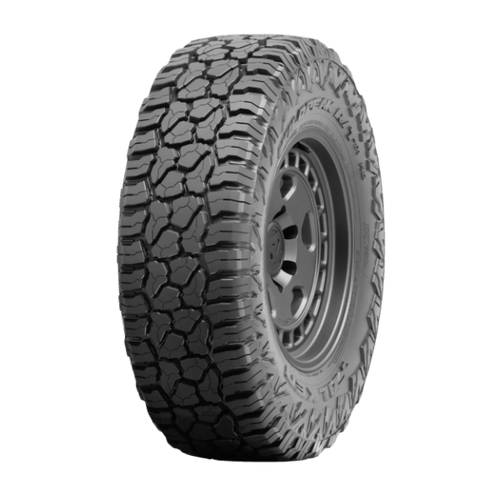


Shop 35-inch tires for the Armada (in stock) →
Try wheels on your Nissan Armada: see the Nissan Armada bolt pattern, wheel sizes by year and wheel builds in our free wheel visualizer.