
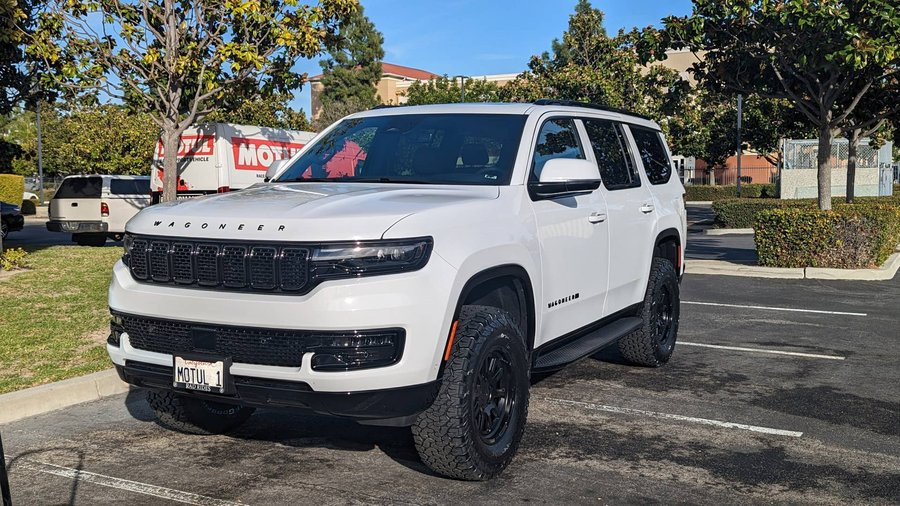
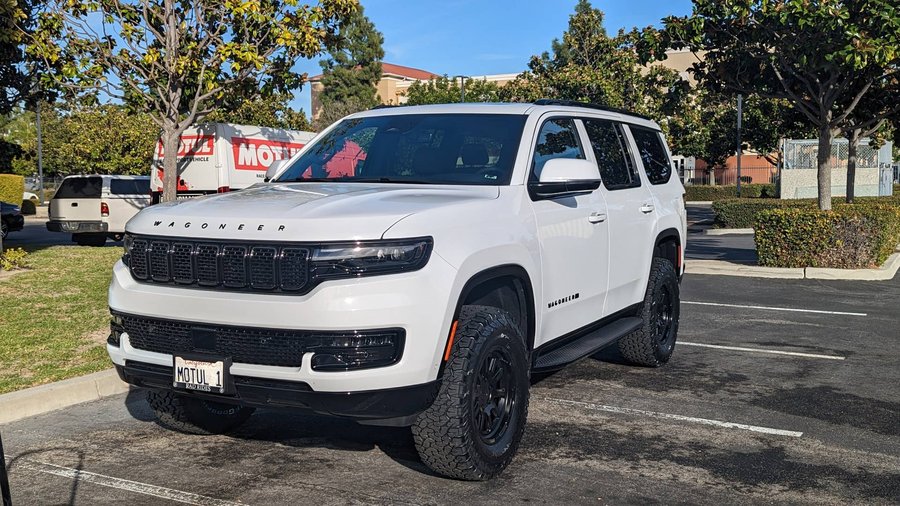
The short version: a 35-inch tire is a realistic goal on a full-size Wagoneer, but it is not a plug-and-play swap the way 33s are. Plan on a modest lift or leveling setup, a wheel with less offset than the factory 8x18 +19, some fender-liner and lower-valance massaging, and a recalibration for the speedometer. Thirty-threes are the easy, near-stock upgrade; 37s are a full build with trimming, bigger lift, and real trade-offs in gearing, braking and steering feel.
Below is the honest breakdown — what each tire height actually asks of this platform, how offset and backspacing decide whether you rub, why gearing matters more on a heavy body-on-frame SUV than most people expect, and the exact sizes that work with the wheels this truck accepts.
Start with what the factory gave you
The reference point for any fitment conversation on this chassis is the base wheel: an 8x18 with roughly +19mm offset, on a 6x139.7 bolt pattern with a 78.1mm hub bore. That's a common full-size Mopar/GM-family truck spec, which is good news — the aftermarket wheel selection is deep. Anything you buy needs to either match that 78.1mm centerbore or come with proper hub-centric rings so the wheel loads on the hub, not on the studs. Skip that step and you'll chase phantom vibrations forever.
Just as important as the numbers is the architecture. The modern Wagoneer is a body-on-frame SUV with independent front suspension, and depending on trim it may be riding on coils or on an air suspension with multiple ride heights. That IFS front end is the limiting factor for tire size, not the rear. Up front you have a tight fender liner, an inner wheelhouse, a lower control arm, a sway bar end link, plastic aero shields, and steering that swings the tire through a big arc at full lock. The rear is comparatively wide open. When people say a tire "fits," what they almost always mean is "it fits with the wheel straight ahead" — the real test is full lock plus full compression, and that's where trimming decisions get made.
How big you can realistically go
There is no single answer across the range, and anyone who gives you one without asking what you're driving is guessing. Standard-wheelbase versus the long-body variants, coil versus air suspension, 18-inch versus factory 20s or 22s, and whether your truck has the off-road package with its slightly different ride height all shift the math. Air-suspension trucks add another wrinkle: the system has entry, normal and raised modes, and a tire that clears in off-road height may contact the liner when the truck squats to entry height in a driveway. Always evaluate clearance at the lowest ride setting, not the tallest.
As a general framework for this platform: a 32.5–33-inch tire is a mild, livable step; a 34.5–35-inch tire is achievable with a lift and wheel-offset change plus some trimming; and 37s put you into serious modification territory where the vehicle stops behaving like a stock luxury SUV. Verify everything on your specific truck — trim, suspension type and lift design all move the goalposts.
33s: the sensible upgrade almost nobody regrets
If you want a more aggressive stance, real sidewall for airing down, and minimal drama, this is the height to target. A 33X12.50R18 measures 33.0 inches tall and drops onto an 18-inch wheel that clears the brakes without question; a 33X12.50R20 gives the same overall diameter with a shorter sidewall if you prefer the look of a 20. There's also 285/70R17 at 32.7 inches for anyone running a 17-inch wheel — with the caveat that a 17 may not clear the front caliper on many trims, so measure before you commit.
At this height, most owners run a modest leveling kit or a small lift and a wheel in the +10 to +20mm range. A 12.50-inch-wide flotation tire is meaningfully wider than the factory rubber, so even at 33 inches tall you may find the front tire kissing the fender liner at full lock. A liner tweak or a small trim of the lower plastic is common; a sledge to the pinch weld is not. Gearing is usually tolerable, though you'll feel the 8-speed hunting a little more on grades and while towing.
35s: the sweet spot, with homework
This is where most builds land, and it's the size that makes the truck look intentional rather than accessorized. The tires themselves are easy to source — 35X12.50R18 and 35X12.50R20 both come in at a true 35.0 inches, and 315/70R17 is the metric near-equivalent at 34.4 inches if a 17-inch wheel clears your brake package. Compared to the factory setup you're adding meaningful diameter and roughly two inches of section width, which means both vertical and lateral clearance become issues at the same time.
Realistically, plan on three things. First, suspension: enough lift to keep the tire out of the liner at compression — the exact height depends entirely on the kit and whether you're on coils or air, so follow the manufacturer's fitment guidance for your setup rather than a number from the internet. Second, wheel offset: something in the +10 to +20mm range on an 8, 8.5 or 10-inch-wide wheel is a widely used bolt-on window on this bolt pattern, and pushing the tire slightly outboard from the factory +19 buys you clearance at the inner liner and control arm at the cost of a wider track. Third, trimming: expect to modify the forward and rearward sections of the front fender liner, possibly remove or trim the lower air dam, and evaluate the mud flaps. That is a normal, reversible-ish part of running this height — nobody can promise you a rub-free fit sight unseen.
The wheel width you choose matters as much as the offset. A 12.50-inch tire on an 8-inch rim balloons the sidewall outward, which is great for airing down but can bring the shoulder into the liner earlier; on a 10-inch rim it sits squarer and tucks the shoulder in, but the wheel lip moves closer to the outer fender. Neither is wrong — just be consistent about which trade you're making.
37s: build territory, and it shows
Thirty-sevens are physically possible on a full-size Wagoneer, and you can get the tires in 37X12.50R18, 37X12.50R20 or 37X12.50R17 (again, verify caliper clearance on a 17). What you cannot get is a subtle installation. At 37 inches you're adding roughly four inches of diameter over a common factory tire, which means two inches of extra static clearance needed above the tire before you even talk about suspension travel.
That usually means a substantial lift, aggressive fender-liner removal and cutting, attention to the front crossmember and skid area, possible bump-stop extension to limit up-travel, and careful evaluation of CV axle angles on the independent front end. Very low and negative-offset wheels — the sort of 9x20, 9.5x20 or 10x22 setups in the -25 to -50mm range — will physically bolt on, but they're flagged as extreme fitment for a reason: they push the tire well outside the fender, load the wheel bearings harder, add steering effort and torque steer, and typically demand both a lift and serious trimming. If you're going that route, do it with eyes open and have an alignment shop that understands modified IFS trucks.
Be honest about use case, too. A 37 on a heavy luxury SUV degrades ride quality, braking distance, steering response and fuel economy simultaneously. It's the right call for a dedicated overland or expedition build. It's the wrong call for a truck that mostly does school runs and one dusty forest road a year.
Offset and backspacing, explained properly
Offset is the distance in millimeters from the wheel's mounting face to its true centerline. Positive offset means the mounting pad sits outboard of centerline, tucking the wheel under the vehicle; negative offset pushes it out. Backspacing is the related measurement in inches, from the mounting face to the inboard lip. A quick conversion: backspacing = (wheel width + 1 inch) ÷ 2 + (offset ÷ 25.4).
Run that on the factory 8x18 +19 and you get about 5.25 inches of backspacing. A 10x20 at +20 works out near 6.3 inches — wider, but with the extra width mostly gained inboard. Drop that same 10-inch wheel to +10 and backspacing falls to about 5.9 inches, moving the tire roughly 0.4 inch further out and away from the control arm, liner and steering components. That is the lever you pull when a tall tire rubs on the inside at full lock: less offset moves the problem outboard, where you can trim plastic instead of fighting steel and suspension.
The catch is that everything you gain inboard you lose outboard. Push too far and the tire throws rocks and spray at the paint, catches the fender lip at compression, and increases the scrub radius — which the truck communicates through heavier steering, more bump-steer, and more strain on bearings and ball joints. The bolt-on window on this chassis generally lives in the +10 to +25mm range across 8, 8.5, 9, 9.5 and 10-inch widths in 18, 20 and 22-inch diameters; the further you stray below that, the more the build stops being a wheel-and-tire swap and starts being a suspension project.
Gearing, and why it decides whether you enjoy the truck
Every inch of tire diameter effectively raises your final drive ratio. A jump from a roughly 31–32-inch factory tire to a 35 changes effective gearing by something in the neighborhood of 10 percent, and the transmission and engine calibration were tuned around the original number. On a vehicle that can approach three and a half tons before you load it, that shows up as lazier launches, more downshifting on grades, a torque converter that stays unlocked longer, higher transmission temperatures when towing, and noticeably worse fuel economy.
Modern turbocharged and V8 powertrains mask a lot of this at 33 inches. At 35 it's a real but livable change for most drivers who aren't towing near capacity. At 37 it's significant. Whether re-gearing the axles is practical on your specific truck depends on the drivetrain, axle type and available ring-and-pinion support — full-size Wagoneers are newer platforms and gear availability varies, so talk to a driveline shop before you assume it's an option. If gearing isn't on the table, size your tire so the drivability penalty is one you're happy to live with, and consider that a lighter-construction tire in the same size will hurt less than a heavy mud-terrain in load range F.
Rotating and unsprung mass is the quiet part of this equation. A 35x12.50 in an aggressive tread with a heavy carcass can weigh dramatically more than the factory tire, and that mass has to be accelerated, stopped and controlled by hardware sized for something smaller. Brake feel and stopping distance both suffer. Budget for it mentally, and don't tow at the ragged edge of capacity on a big-tire build.
Speedometer, TPMS and the electronics
Taller tires make the speedometer read low and the odometer under-count, which cascades into transmission shift scheduling, cruise control, the trip computer, oil-life monitoring, and any ADAS feature that references vehicle speed. On this generation, correction is typically handled with a programmer or a dealer-level calibration; some modules accept a tire-size entry directly. Have a plan for this before the tires go on — driving around 7 percent optimistic for months is how warranty and speeding-ticket conversations start.
TPMS is straightforward but easy to overlook. The factory sensors carry over to aftermarket wheels as long as the valve-stem geometry is compatible; otherwise you'll need matched sensors and a relearn procedure. Note that a much heavier tire in a higher load range may want a different cold inflation pressure than the door-jamb placard, and the low-pressure warning threshold is tied to the placard value — so set pressures deliberately and expect a light if you deviate far.
Load range on a heavy rig
This is the spec people skip and shouldn't. Your door jamb lists gross axle weight ratings; whatever tire you buy must carry at least half the front GAWR per tire, and the same on the rear, at the pressure the manufacturer's load table specifies. Full-size flotation tires commonly come in load range C, D, E and F. On a Wagoneer that regularly hauls people and gear or tows, load range E is the common-sense floor, and F is worth considering for heavy trailering — accepting that the stiffer sidewall rides harder when empty.
Confirm the load index printed on the sidewall against your actual ratings rather than assuming a size is adequate because it's popular. It's also worth remembering that a load range F tire only delivers its rating at high inflation pressure; running it soft for ride comfort while towing gives you the harsh ride and none of the capacity.
All-terrain or mud-terrain?
For a heavy, comfort-oriented SUV that spends most of its life on pavement, a modern all-terrain is the right default. The current generation of A/Ts gives up remarkably little in mud and rock compared to what they return in road noise, wet grip, tread life and rolling resistance. Something like the Nexen Roadian ATX in 35X12.50R18 or the Nokian Outpost nAT in 35X12.50R20 covers the overwhelming majority of real-world use, including snow, without turning the cabin into a wind tunnel.
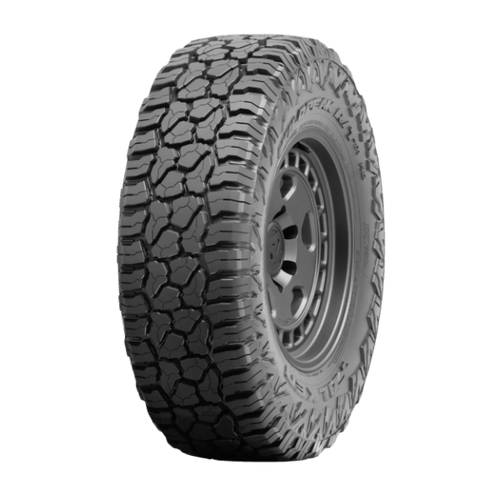
The rugged-terrain or hybrid category sits in between and has become the smart pick for people who want the look and bite of a mud tire without the highway penalty. The Falken Wildpeak R/T01 in 35X12.50R18 is a good example of that middle ground: bigger voids and tougher shoulders than an A/T, but far more civilized than a true M/T.
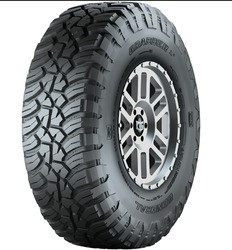
Go full mud-terrain only if you actually spend time in deep mud, clay or loose rock where self-cleaning matters. The Nexen Roadian MTX and the long-serving Cooper Discoverer STT Pro in 35X12.50R20 are proper off-road tools, and on a vehicle this heavy they'll be louder, thirstier and shorter-lived than an A/T. If you want the aggressive look with a bit more balance, the General Grabber X3 splits the difference in the same size.
The sizes that actually work, with real diameters
Overall diameter is what determines clearance, not the number in the name — so here's how the common options measure out:
- ~33-inch class: 33X12.50R18 (33.0 in), 33X12.50R20 (33.0 in), 285/70R17 (32.7 in)
- ~35-inch class: 35X12.50R18 (35.0 in), 35X12.50R20 (35.0 in), 315/70R17 (34.4 in)
- 37-inch class: 37X12.50R17, 37X12.50R18 and 37X12.50R20 (all 37.0 in)
Note that 315/70R17 is roughly six-tenths of an inch shorter than a true 35 — a useful hedge if you're right at the edge of clearance, provided your brakes accept a 17-inch wheel. The 18 and 20-inch flotation sizes are the deepest part of the market for this truck, which is why our shelves lean that way; the 35-inch fitments in particular have the broadest tread selection, while 37s are a narrower field. You can browse the full range across all tires and filter by the diameter you've settled on.
What to prioritize when you're buying
Order of operations matters. Decide the tire height first, because that dictates the suspension. Then pick the wheel — diameter, width and offset together — because that dictates whether the tire clears. Then buy the tire. Doing it backwards is how people end up with a beautiful set of wheels that need a bigger lift than they wanted.
Prioritize load rating over tread pattern; a great-looking tire that's under-rated for your axle loads is not a great tire. Prioritize honest weight next, especially if re-gearing isn't in the budget. Verify the centerbore or buy hub-centric rings. Confirm the wheel clears your brake caliper before ordering, particularly with 17s. Budget for a speedometer recalibration, an alignment after any suspension change, and the possibility that you'll be trimming plastic. And if you tow, size conservatively — the tire that makes the truck look best at a trailhead isn't always the one that makes it drive best with 7,000 pounds behind it.
Real Jeep Wagoneer builds running 35s and up
Actual owner builds — real photos.


Frequently Asked Questions
Can 35s go on without any lift at all?
On a stock-height truck it's a stretch, and we wouldn't promise it. Some owners get close with a shorter 34.4-inch option like 315/70R17, a low-offset wheel and significant liner trimming, but you're relying on limited up-travel and accepting contact at full lock or full compression. On air-suspension trucks the problem is worse because the vehicle deliberately lowers itself at entry height. A leveling kit or modest lift, sized per the kit manufacturer's guidance for your trim, is the sane path.
Do I have to re-gear for 35s?
You don't have to, but you'll feel the difference. Effective gearing changes by roughly ten percent versus a factory-size tire, which shows up as slower acceleration, more downshifting, higher transmission temps under load and worse economy. Owners who mostly drive unloaded often live with it happily. Owners who tow near capacity should either re-gear — if ring-and-pinion support exists for your axles, which varies by year and drivetrain — or pick a lighter tire in a smaller size.
What wheel offset should I be shopping for?
The factory reference is 8x18 at about +19mm. For bigger tires, offsets in the roughly +10 to +25mm range across 8 to 10-inch widths are the common bolt-on territory on this bolt pattern, with lower numbers buying inboard clearance at the cost of a wider track. Anything in the negative range will physically bolt up but is genuinely extreme fitment — expect it to require a lift, trimming, and a tolerance for heavier steering and more stress on hubs and bearings.
Will 37s actually fit, or is that marketing?
They fit, but only as part of a deliberate build. You're looking at a substantial lift, heavy fender-liner removal and cutting, possible bump-stop changes to limit up-travel, careful checks on CV angles and steering sweep, and a real conversation about brakes and gearing. The tires exist in 37X12.50R17, 37X12.50R18 and 37X12.50R20. Nobody can guarantee a rub-free result without seeing your exact combination of suspension, wheel and trim.
Will my TPMS sensors work with aftermarket wheels?
Usually yes, provided the new wheels have compatible valve holes and stem geometry; otherwise you'll need matching sensors and a relearn. Keep in mind that a heavier tire in a higher load range often wants different cold pressures than the door-jamb placard, and the warning threshold is tied to that placard number — so you may see a light if you run pressures well away from stock. Set your pressures based on the tire manufacturer's load-inflation table for your actual axle weights.
All-terrain or mud-terrain on a vehicle this heavy?
All-terrain for the vast majority of owners. On a three-ton-plus SUV, a mud-terrain's weight, noise and rolling resistance are amplified, and the tread life penalty is real. Choose a mud-terrain only if you genuinely spend time in deep mud, clay or loose rock where self-cleaning matters. If you want the aggressive appearance without the full highway cost, a rugged-terrain hybrid is the honest middle ground.
35-inch tires for the Wagoneer (in stock)



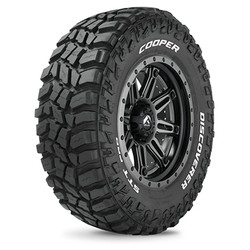
Shop 35-inch tires for the Wagoneer (in stock) →
Try wheels on your Jeep Wagoneer: see the Jeep Wagoneer bolt pattern, wheel sizes by year and wheel builds in our free wheel visualizer.