
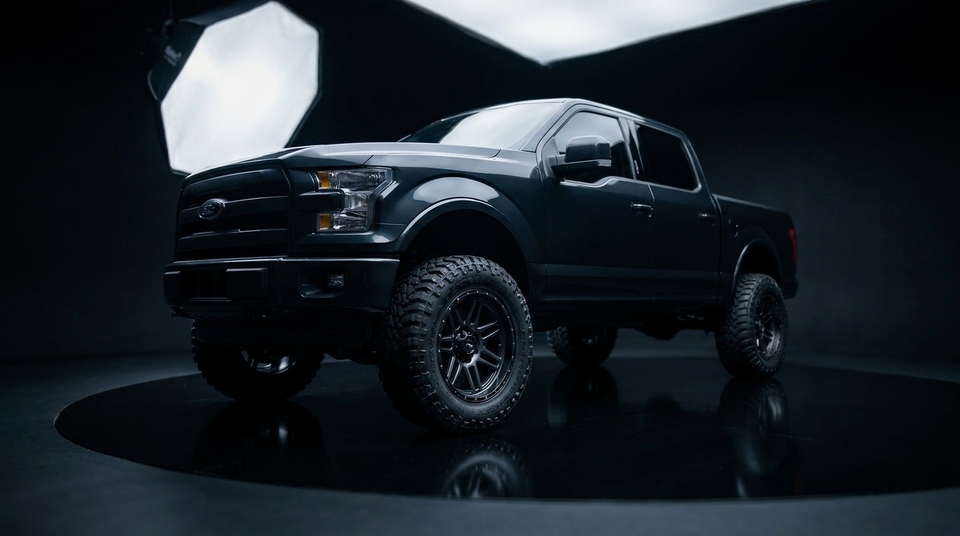
The short answer: yes, you can run 35s on an F-150, but not truly bolt-on. On a modern 2018-2026 F-150, a 35-inch tire typically wants a modest leveling kit or small lift, a wheel with more aggressive backspacing than the factory setup, and some fender-liner and pinch-weld trimming to stay rub-free at full lock and full stuff. Bump the truck to 33s and you're in far easier territory; step up to 37s and you're into real suspension work and re-gearing. Below is the honest, mechanically grounded breakdown for each size, what actually has to change, and the exact tires that fit.
The F-150 is one of the easiest full-size trucks to put big rubber under, largely because there's so much aftermarket support and because the factory wheel wells are generous by half-ton standards. That doesn't mean every combination clears — it means you have real, workable options at 33, 35, and 37 inches, each with its own price of admission. Let's walk through them the way I'd explain it to a buddy in the shop, then get specific about sizes and setup.
How big can you actually go?
Realistically, most current-generation F-150s live comfortably at 33s with minimal fuss, tuck 35s with a level and light trimming, and need a genuine lift plus gearing to carry 37s the way the factory Raptor does. But trim and generation matter a lot. A Raptor rolls off the line on 35s already, with the wide track, big offset wheels, and flared bodywork to make it work — so a Raptor owner is starting from a very different place than someone on an XLT or Lariat on the standard body.
The stock geometry is the reference point. These trucks come on a 7.5x17 wheel at roughly +44mm offset, a 6x135 bolt pattern, and an 87.1mm hub bore. That high positive offset tucks the tire in toward the strut, which is exactly why a wider, taller tire starts to interfere as you go up in size. Everything you do to fit bigger tires is, in one way or another, about managing where that larger tire sits relative to the fender, the frame, the control arms, and the sway bar.
Running 33s: the easy win
Thirty-threes are the sweet spot for most F-150 owners who want a meaner stance and better trail manners without turning the truck into a project. A 33x12.50R17 or 33x12.50R18 (both a true 33 inches tall) or the metric-equivalent 285/70R17 (about 32.7 inches) will usually fit on many trims with little more than a leveling kit to clear the front, and sometimes not even that on higher trims. The odometer and speedometer error from stock is small, gearing usually stays livable, and you keep most of your fuel economy and steering feel.
The trade-off is simply that 33s look modest next to what the platform can carry. If you're daily-driving, towing, and doing light-to-moderate trails, that's a feature, not a bug. Explore the 285/70R17 metric option if you want to stay closest to factory rolling diameter, or a flotation 33X12.50R17 if you want the wider, blockier footprint. There's also 33X12.50R18 and 33X12.50R20 for owners staying on larger factory-style wheels.
Running 35s: the classic F-150 build
This is the size most people are really asking about, and it's very achievable. A 35x12.50R17, 35x12.50R18, or 35x12.50R20 is a true 35 inches tall; the 315/70R17 metric lands a touch shorter at about 34.4 inches and is a great choice if you want a slightly smaller, lighter, more street-friendly "35." On a standard (non-Raptor) F-150, fitting 35s generally takes a leveling kit or small lift to open the front, a wheel with lower offset or more backspacing to push the tire out of the strut, and typically some trimming of the fender liner, the front of the wheel well, and possibly the pinch weld. How much trimming depends heavily on your exact trim, wheel offset, and lift — verify clearance for your rig at full lock and full compression before you commit.
Why the wheel choice matters so much here: a 35 is both taller and wider than stock, and at the factory +44 offset it will want to contact the upper control arm or strut on the inboard side. Moving to a wheel in the +5 to +30 range (or the aggressive negative-offset wheels many F-150 owners run) pulls the tire outward and buys inboard clearance — at the cost of more sidewall poking past the fender and more stress on wheel bearings. That's the fundamental balancing act of a 35 build, and it's exactly why offset and backspacing deserve real attention, covered below.
We stock a broad spread of true 35s. For the 17-inch crowd there's the aggressive hybrid Toyo Open Country R/T Pro in 35X12.50R17, the rugged-terrain Falken Wildpeak R/T01 35X12.50R17, and the all-terrain Nitto Recon Grappler A/T in 35x12.50R17. Prefer an 18? Look at the Toyo R/T Pro 35X12.50R18, the Nitto Recon Grappler A/T 35x12.50R18, or the Nokian Outpost nAT 35X12.50R18. You can browse the full range of 35X12.50R17, 35X12.50R18, and 35X12.50R20 fitments, or the metric 315/70R17 if you want that slightly shorter 35.
Running 37s: committed territory
Thirty-sevens transform the truck, but they demand commitment. A 37x12.50R17, 37x12.50R18, or 37x12.50R20 (all a genuine 37 inches) will need a real lift kit, high-clearance or aftermarket upper control arms in many cases, significant trimming, and — this is not optional if you value drivability — a gear change in the axles. The tire is tall enough and heavy enough that the factory gearing leaves the truck lethargic off the line and constantly hunting gears on the highway. Plan on 37s being a full build, not a bolt-on, and verify every clearance point for your specific lift.
If you're headed this direction, we carry 37X12.50R17, 37X12.50R18, and 37X12.50R20 options. Just go in with eyes open about the supporting mods.
What actually changes when you go bigger
Where they rub, and clearance
On the F-150, the trouble spots are predictable: the rear of the front wheel well and the plastic fender liner when the wheel is turned, the pinch weld along the bottom of the door area, and the upper control arm or strut on the inboard side at full stuff. Height opens the top of the well; offset and backspacing manage the front-to-back and inboard-to-outboard contact. Most well-executed 35 builds involve some liner trimming even with a level — that's normal, not a sign something's wrong.
Wheel offset and backspacing, explained properly
Offset is the distance from the wheel's mounting face to its centerline, measured in millimeters. A high positive number (like the factory +44) tucks the wheel in toward the truck; a lower or negative number pushes it outward. Backspacing measures the same relationship differently — the distance from the mounting face to the back lip of the wheel — and it's what really determines how close the tire sits to the strut and control arm. When you fit a wider tire, you often need less backspacing (more outward stance) so the inboard shoulder clears suspension components. The catalog fitment data shows why: the factory-style 7.5-inch wheels run +5 to +44, while wider 10-inch wheels fall into the +12 to +30 range and the aggressive stuff dips into negative offsets. Those negative-offset, wide setups are flagged as extreme fitment that check lift-kit requirements — meaning they'll poke well past the fenders and generally need trimming and a lift to work.
Re-gearing and why it matters
Every inch of tire diameter effectively raises your gearing, so a taller tire makes the truck feel sluggish, hurts throttle response, and can cause the transmission to shift busily. On 33s the effect is mild for most owners. By 35s it's noticeable, especially if you tow. At 37s, re-gearing the axles to a numerically higher ratio is close to mandatory to restore the drivability and power delivery you had from the factory. The right ratio depends on your engine, tire size, and how you use the truck, so verify the correct gearing for your setup rather than guessing.
Speedometer, TPMS, and load range
A larger tire covers more ground per revolution, so your speedometer will read low and your odometer will under-count miles until you recalibrate. Many F-150s can be corrected with a programmer or a dealer tool. Your TPMS sensors carry over, but they'll need to be re-learned to the new wheels, and you should reset target pressures to suit the new tire. Finally, load range genuinely matters on a heavy half-ton — especially if you tow or haul. A properly rated tire (many of these come in Load Range E or the appropriate flotation rating) protects against overload and heat; don't under-spec it to save a few dollars.
All-terrain or mud-terrain for the F-150?
For most F-150 owners, a strong all-terrain or a rugged-terrain hybrid is the smart default. It's quieter on the highway, wears more evenly, sheds water better, and returns better economy on a truck that spends real time on pavement — which describes the vast majority of these trucks. Something like the Nitto Recon Grappler A/T leans that direction. If your use skews toward mud, deep sand, rock, and you accept the road noise and faster wear, a mud-terrain or an aggressive hybrid like the Toyo Open Country R/T Pro or Falken Wildpeak R/T01 gives you the bite and the sidewall toughness. Be honest about the ratio of trail to tarmac; that answer picks the tire for you. When in doubt, browse the full tire lineup and compare tread patterns side by side.
What to prioritize as a buyer
Start with the diameter that matches your ambitions and your willingness to modify: 33s if you want easy, 35s if you want the classic look-and-capability balance, 37s if you're building. Then pick the wheel diameter and offset that gets that tire to clear your suspension — this is where a lot of budgets go sideways, so plan wheels and tires together. Confirm load range against how you actually use the truck. Budget for the supporting work: leveling or lift, trimming, an alignment afterward, a speedometer recalibration, and gearing if you're going tall. And verify real-world clearance for your exact trim and lift before you order, because the same tire can tuck cleanly on one truck and rub on another depending on offset and ride height.
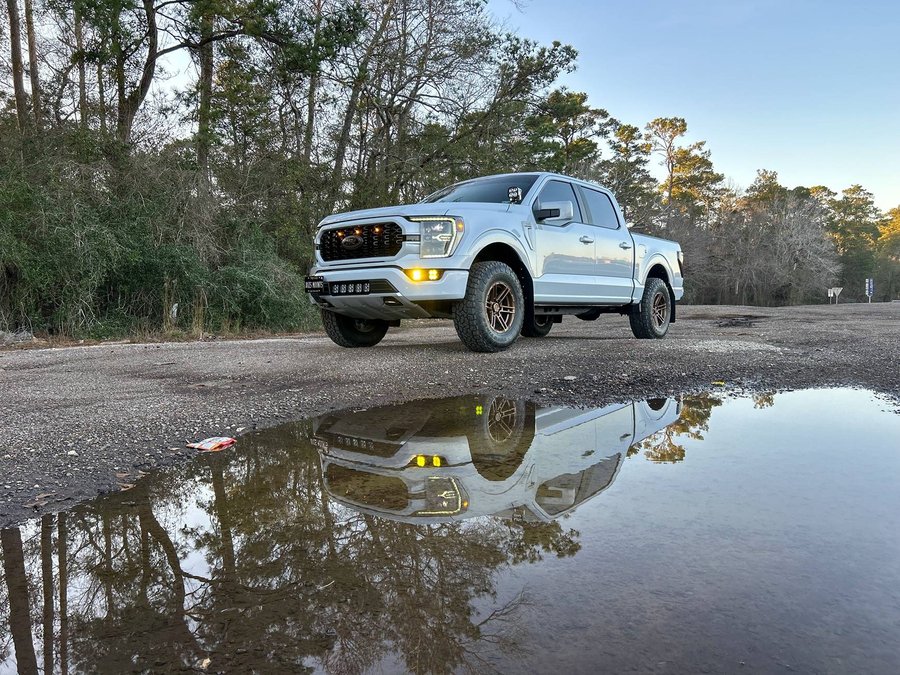
Real Ford F-150 builds running 35s and up
Actual owner builds — real photos.


Frequently Asked Questions
Do I need a lift to run 35s on my F-150? In most cases you'll want at least a leveling kit to open up the front, plus a wheel with more aggressive backspacing and some fender-liner trimming. It's not a pure bolt-on on standard trims, but it's a well-trodden path. The exact amount of lift and trimming depends on your trim, wheel offset, and how much flex you want, so confirm clearance for your rig.
Will 35s hurt my gas mileage and performance? Somewhat, yes. A taller, heavier tire raises your effective gearing and adds rotating mass, so you'll usually see a small economy hit and softer acceleration. Re-gearing the axles restores much of the lost drivability and is strongly recommended once you're at 35s and towing, and close to mandatory at 37s.
What's the difference between a 33x12.50 and a 285/70R17? Both are roughly the same class of tire, but the flotation 33x12.50 is a true 33 inches tall and wider, while the 285/70R17 measures about 32.7 inches and is a slightly narrower metric size. The metric option stays closest to factory rolling diameter, which keeps your speedometer error and gearing change minimal.
Do I need new TPMS sensors with new wheels? Usually your existing sensors transfer to the new wheels, but the system needs to be re-learned so it recognizes them, and you should set the target pressures to match your new tire. If a sensor is old or damaged during the swap, replace it then rather than chasing a warning light later.
Can I fit 37s without a full build? Not practically. Thirty-sevens on an F-150 call for a genuine lift, likely upper control arm changes, real trimming, and a gear change to keep the truck drivable. Treat it as a complete project rather than a tire swap, and verify every clearance point for your specific lift.
Should I choose an all-terrain or a mud-terrain? If your truck spends most of its life on pavement with occasional trails, an all-terrain or rugged-terrain hybrid is the more livable choice — quieter, longer-wearing, and better in rain. Go mud-terrain only if deep mud, sand, and rock are a regular part of your driving and you accept the noise and quicker wear.
35-inch tires for the F-150 (in stock)

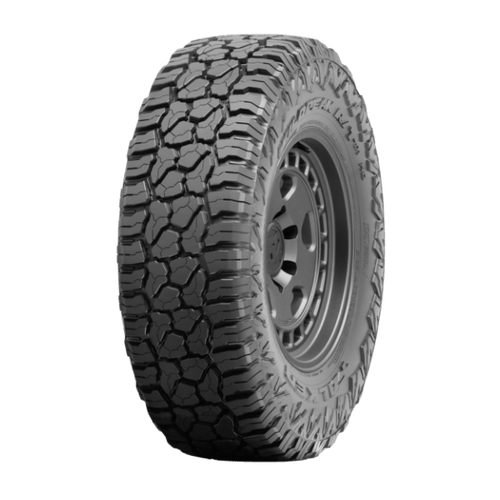
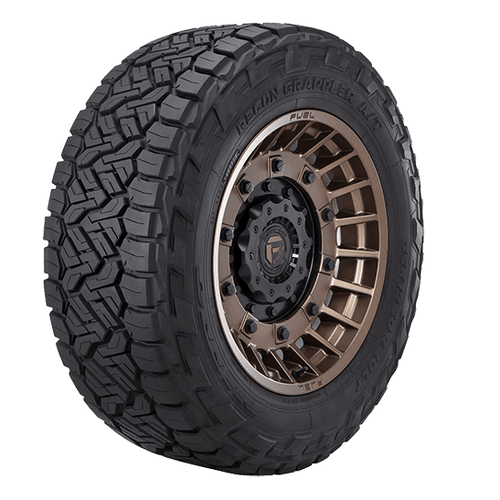


Shop 35-inch tires for the F-150 (in stock) →
Try wheels on your Ford F-150: see the Ford F-150 bolt pattern, wheel sizes by year and wheel builds in our free wheel visualizer.