
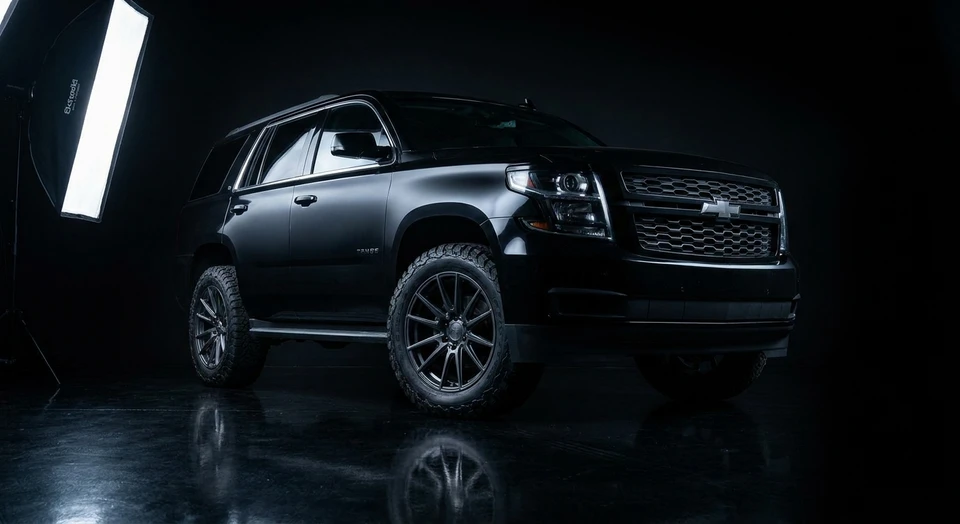
The honest bottom line: Yes, you can run 35s on a modern Chevrolet Tahoe — but it's not a bolt-on afternoon. On the 2018–2026 generation, a genuine 35-inch tire needs a suspension lift (typically a few inches, verify the exact height for your specific kit and trim), the right wheel offset to keep the tire out of the fender and control arms, some trimming, and — if you care about how it drives — a re-gear of the axles. A 33 is the easy, mild path; a 35 is the sweet spot for a lifted daily-driver; a 37 is a committed build. Here's how each shakes out and exactly what fits.
How big can a Tahoe really go?
The current Tahoe rolls on a 9x20 wheel with roughly a +28mm offset from the factory, riding a 6x139.7 bolt pattern over a 78.1mm hub bore. That's a wide, deeply-set wheel package designed around a comfortable, on-road SUV — not a rock crawler. What you can stuff under it depends heavily on your trim and how far you're willing to go with suspension and bodywork.
A stock or near-stock Tahoe swallows a 33 with modest fuss. Step up to a mild leveling or lift and 35s become realistic. Push to 37s and you're into serious lift, trimming, and re-gearing territory — the kind of build where every component has to be chosen deliberately. Z71 and off-road-oriented trims give you slightly more room and better geometry to start with, but the physics don't change: bigger tires want more clearance and a wheel that pushes the tire outboard just enough to clear the inner structure without hammering your fenders.
One thing worth understanding up front: this platform is independent front suspension, so your front clearance is governed as much by steering sweep and control-arm travel as by the fender opening. That's why offset matters so much here — more than on a solid-axle truck.
The 33-inch route: the easy win
If you want a noticeably more capable, better-looking Tahoe without turning the project into a second job, 33s are the answer. A true 33-inch flotation tire like a 33X12.50R18 or a 33X12.50R20 measures right at 33 inches overall, and on the 20-inch fitment you keep your factory-diameter wheel. If you'd rather have more sidewall for airing down and soaking up trail hits, a metric 285/70R17 comes in around 32.7 inches on a smaller, cushier 17-inch rim.
The trade-offs here are refreshingly small. Many Tahoes will take a 33 with a modest level and possibly a little liner trimming at full lock, depending on your wheel offset and how aggressive the tread lugs are. Because you're only going up an inch or two of diameter from stock, the gearing hit is mild — you'll notice slightly softer throttle response and a small speedometer error, but the truck stays perfectly livable. For a lot of owners who tow, commute, and hit gravel and mild trails, 33s are honestly the smart move.
The 35-inch route: the sweet spot for a real build
This is where most serious Tahoe builds land, and for good reason — a 35 dramatically changes the stance and capability while still being tractable as a daily driver. On this platform, a genuine 35 means a suspension lift (a few inches, and the exact height depends on the kit, your trim, and your target wheel/tire combo — verify for your rig), attention to wheel offset, and typically some trimming of the front fender liner, the lower fender, and possibly the pinch weld area to clear at full steering lock and suspension compression.
For sizes, the popular choices are a 35X12.50R18 or a 35X12.50R20, both a true 35 inches overall. The 18-inch build gives you more sidewall for trail work and airing down; the 20 keeps a taller wheel look and pairs neatly with the factory 20-inch diameter. There's also a metric 315/70R17 option at about 34.4 inches for folks who want a plush 17-inch setup that reads as a 35 without quite the full diameter.
Be honest with yourself about what a 35 asks for. Wheel choice is critical — you generally want a narrower-than-stock wheel (8 to 9 inches wide is the practical window) with an offset that tucks the tire correctly. And this is the diameter where re-gearing stops being optional if you value drivability. Going from roughly 33 inches stock to 35s meaningfully changes your effective gear ratio, and without correcting it the truck feels lazy, hunts for gears, and drinks more fuel — more on that below.
The 37-inch route: a committed platform build
37s on a Tahoe are absolutely doable, but this is a full build, not a mod. Expect a substantial lift, significant trimming, careful wheel selection, and — non-negotiable at this point — a re-gear. A 37-inch flotation tire is available as a 37X12.50R18, a 37X12.50R20, or a shorter-rim 37X12.50R17 for maximum sidewall. All measure a true 37 inches overall.
At this size the compromises are real: added unsprung and rotating mass strains brakes and driveline, steering effort climbs, fuel economy drops, and you'll be into extreme-fitment wheel offsets that demand you verify clearance against the control arms and body carefully. The wider 10-inch wheels that owners often pair with 37s show up in fitment notes with clearance flags for a reason — an aggressive, deeply-negative offset can create rubbing and requires lift and trimming to work at all. If a 37 is your goal, plan the whole system together: lift, wheels, gears, brakes, and alignment. Half-measures here just get you rubbing and disappointment.
What actually changes when you go bigger
Where they rub, and clearance
On an IFS Tahoe, the front tire rubs in predictable places: the rear of the front fender liner and lower fender as the wheel turns, the pinch weld along the rocker, and the sway bar or control arms if the offset pulls the tire too far inboard. Rear clearance is usually more forgiving but watch the inner wheel well and the rear pinch area on compression. Trimming plastic liners and rolling or trimming the pinch weld is normal and expected on 35-plus builds.
Offset and backspacing, explained properly
Offset is the distance from the wheel's mounting face to its centerline, in millimeters. A higher positive number (your factory ~+28) tucks the wheel inboard, toward the suspension; a lower or negative number pushes it outboard, toward the fender. Backspacing measures the same idea from the back edge of the wheel to the mounting face, in inches. They describe the same geometry from different reference points.
Why it matters: on a wide tire, too much positive offset shoves the tire into the control arms and sway bar; too little (or negative) offset throws it into the fender and loads your wheel bearings and ball joints harder. The bolt-on wheel widths that work cleanly on this Tahoe run roughly 8 to 9 inches wide across 20- and 21-inch diameters at offsets in the +18 to +35 range. Go wider (10 inches) or into aggressive negative offsets and you move into check-fitment/extreme territory where a lift and trimming become prerequisites — so pick your offset to sit the tire where it clears both the inner structure and the fender, and verify against your specific tire width and lift.
Re-gearing: the drivability multiplier
This is the single most underrated part of a big-tire build. Your axle gears were chosen around the stock tire diameter. Fit taller tires and you effectively lower (numerically) your gearing, which blunts acceleration, hurts towing, forces more downshifting, and can knock your transmission out of its happy operating range. Re-gearing to a numerically higher ratio restores the mechanical advantage the taller tire took away, bringing back throttle response and letting the engine and transmission behave the way GM tuned them. For 33s the hit is mild and many owners live with it; by 35s a re-gear is strongly advisable; at 37s it's essential. Match the new ratio to your tire diameter and how you use the truck — heavier towing wants a numerically higher gear.
Speedometer, odometer, TPMS and load range
Taller tires cover more ground per revolution, so your speedometer will read slow and your odometer will under-count miles unless you recalibrate. On this generation that's typically a software correction (a tuner or dealer recalibration), and it also matters because your transmission shift points and cruise control key off vehicle speed. Get it right.
TPMS sensors carry over on this platform, but any new wheels need sensors installed and the system relearned so pressures report correctly. And on a rig as heavy as a Tahoe — especially if you tow — load range is not a detail to skip. Look at the load index and the ply/load range stamped on the tire; heavier E-rated or purpose-built loads (you'll see markings like 128R or 125Q on 35s) give you the carrying capacity and sidewall stiffness a big SUV wants. Don't under-tire a heavy truck for the sake of a softer ride.
All-terrain vs mud-terrain for a Tahoe
For the vast majority of Tahoe owners, an all-terrain is the right tire. A/Ts deliver quiet highway manners, good wet and winter behavior, long tread life, and plenty of grip for dirt roads, gravel, sand, and moderate trails — all while keeping the fuel and noise penalties reasonable on a vehicle that spends most of its life on pavement. Something like a Nitto Recon Grappler A/T in 35x12.50R18, a Nokian Outpost nAT, or a Kumho Road Venture AT52 in 35x12.50R20 covers that mission beautifully.
A dedicated mud-terrain only makes sense if you genuinely spend time in deep mud, loose rock, and technical terrain and you accept the trade-offs: more road noise, softer wet-pavement grip, faster wear, and a small economy hit. If your build lands between the two — you want serious bite but still daily the truck — a rugged-terrain hybrid like the Toyo Open Country R/T Pro in 35x12.50R18 or the R/T Pro in 35x12.50R20 splits the difference nicely with aggressive looks and traction that's still tolerable on the highway.
Which sizes fit, and what to prioritize
To recap the diameters that make sense on this Tahoe: for a 33-inch look, the true-33 33X12.50R18 and 33X12.50R20, or the ~32.7-inch metric 285/70R17. For a 35, the true-35 35X12.50R18 and 35X12.50R20, or the ~34.4-inch 315/70R17. For a 37-inch build, the 37X12.50R17, 37X12.50R18, and 37X12.50R20, all true 37s.
When you're choosing, prioritize in this order: load capacity first (get a load range that respects the Tahoe's weight and your towing), then the right offset and wheel width for your target diameter and lift, then tread type matched to how you actually use the truck, and finally cosmetics. Smaller rim diameters (17s and 18s) give you more sidewall — better for airing down and cushioning trail impacts — while 20s and up look modern and pair with the factory diameter. Browse the full range on our tires hub and match a set to your build; if you're on the fence about clearance, verify the exact lift and offset for your specific trim before you commit.
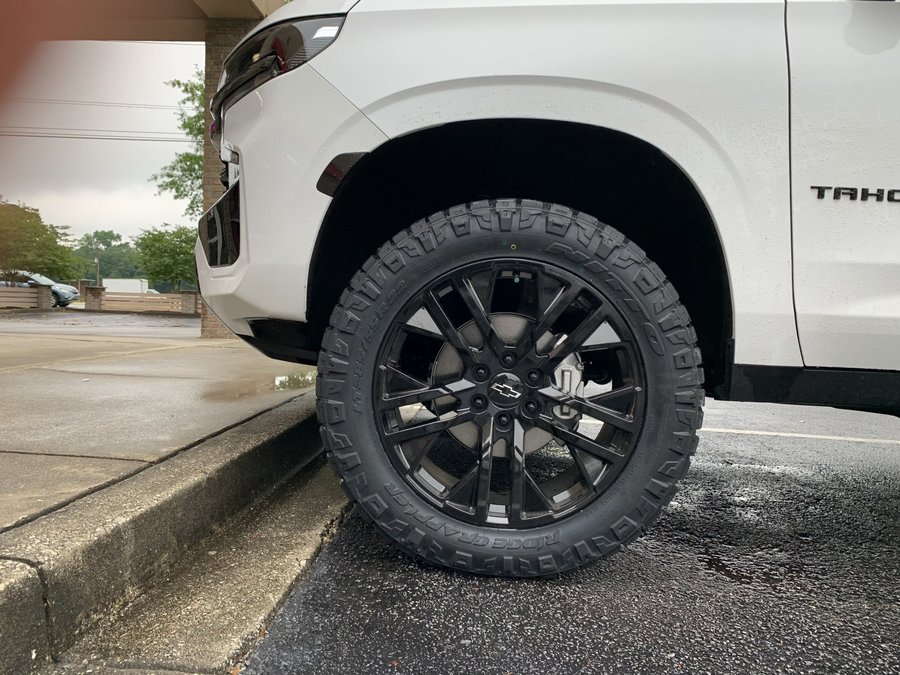
Real Chevrolet Tahoe builds running 35s and up
Actual owner builds — real photos.


Frequently Asked Questions
Do I need a lift to run 35s on my Tahoe? In practical terms, yes. A true 35-inch tire needs a suspension lift on this platform to clear at full steering lock and suspension compression, and you'll typically pair that with fender liner and pinch-weld trimming. The exact lift height depends on your kit, trim, and wheel offset, so confirm the combination for your specific rig rather than assuming a fixed number.
Will 35s hurt my gas mileage and acceleration? Yes, some. Taller, heavier tires add rotating mass and effectively lower your gearing, which softens acceleration and drops fuel economy. Re-gearing the axles to a numerically higher ratio restores most of the lost responsiveness and towing muscle, which is why a re-gear is strongly recommended once you go to 35s and considered mandatory at 37s.
What wheel offset should I run? Aim for an offset that tucks the tire enough to clear the control arms and sway bar without slamming it into the fender. On this Tahoe, wheels roughly 8 to 9 inches wide in the +18 to +35 offset range bolt on cleanly, while wider or more negative setups move into check-fitment territory that needs lift and trimming. Verify against your exact tire width and lift.
Do I have to recalibrate the speedometer? You should. Bigger tires make the speedometer read slower than your true speed and undercount your odometer, and they can affect shift points and cruise control. A software recalibration through a tuner or the dealer corrects it so your gauges and transmission behave correctly.
Should I choose all-terrain or mud-terrain? For most Tahoe owners, all-terrain. A/Ts stay quiet, wear well, and grip in rain and snow while still handling dirt and moderate trails. Choose a mud-terrain only if you regularly tackle deep mud and technical terrain and accept more noise, faster wear, and a small economy penalty — or split the difference with a rugged-terrain hybrid.
Do I need new TPMS sensors with new wheels? If you're buying a new set of wheels, plan on installing TPMS sensors and having the system relearned so pressures report accurately. The sensors carry over conceptually on this generation, but each wheel needs one and the vehicle has to register them.
35-inch tires for the Tahoe (in stock)


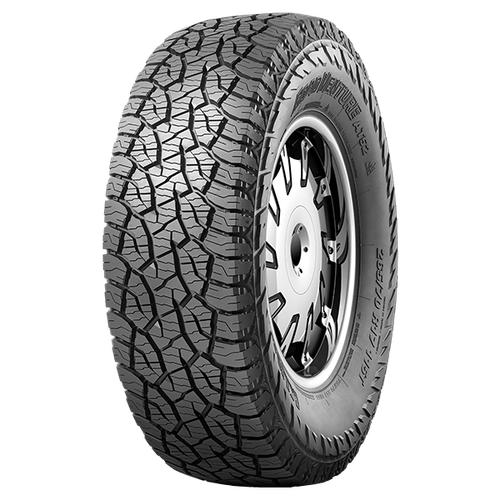
Shop 35-inch tires for the Tahoe (in stock) →
Try wheels on your Chevrolet Tahoe: see the Chevrolet Tahoe bolt pattern, wheel sizes by year and wheel builds in our free wheel visualizer.