

993 Turbo vs 996 Turbo: Which Air-Cooled Dragon Wins?
The Porsche 993 Turbo is the last air-cooled 911 with forced induction — a 400 hp twin-turbo widowmaker with zero electronic safety net and a chassis that demands every ounce of your attention. Owners call it visceral, taut, and terrifying. The 996 Turbo crowd will tell you their car is faster, more livable, and half the entry price. They're right about all of it. But this debate has never been about spreadsheets — it's about which dragon you want to fight.

Quick links
- Why the 993 Turbo wants to hurt you
- The 996 Turbo crowd has receipts
- Different dragons, same legend
- Wheel fitment: 993 vs 996 Turbo
- Suspension before power — always
- Which dragon are you fighting?
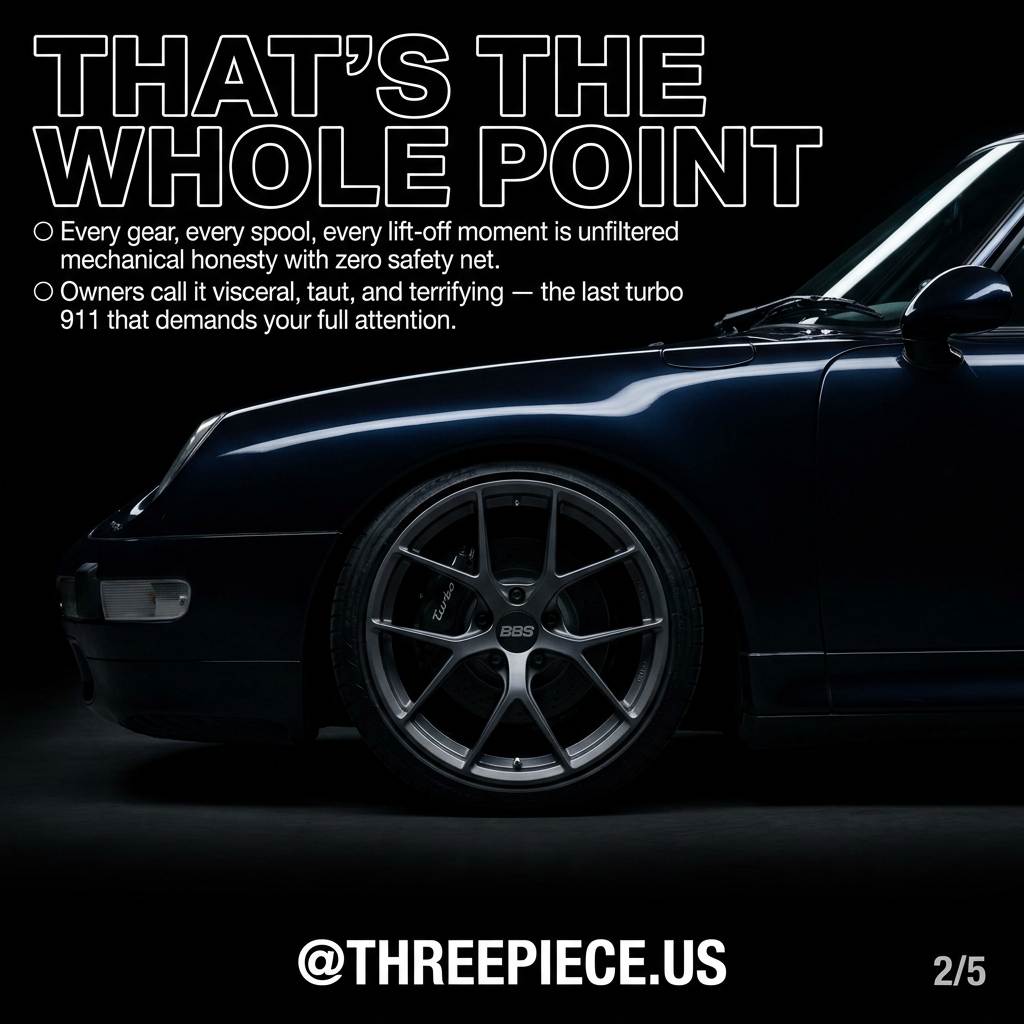
Why the 993 Turbo Wants to Hurt You
Every gear, every spool, every lift-off moment in a 993 Turbo is unfiltered mechanical honesty with zero safety net. The 3.6L twin-turbo flat-six makes 400 hp stock and responds to stage modifications with terrifying enthusiasm — 450 hp is achievable for roughly $15,000 in turbo, exhaust, and ECU work. Long-term owners on Rennlist describe the experience as "visceral, taut, and trouble-free" when maintained, with doors that "thump with air-tight certainty." The mechanical sounds, the turbo spool, the smell of heat bleeding through the engine bay — nothing water-cooled replicates any of it.
But the 993 also demands respect in ways modern cars have engineered away. Snap oversteer on lift-off mid-corner is real. Oil starvation in sustained hard cornering is real. Worn rear tires catching you off guard at seven-tenths is real. The car rewards mechanical sympathy and punishes complacency — and that's exactly what makes it a grail for a specific kind of driver. If you've never felt a 993 Turbo light up boost in second gear, you haven't lived yet.
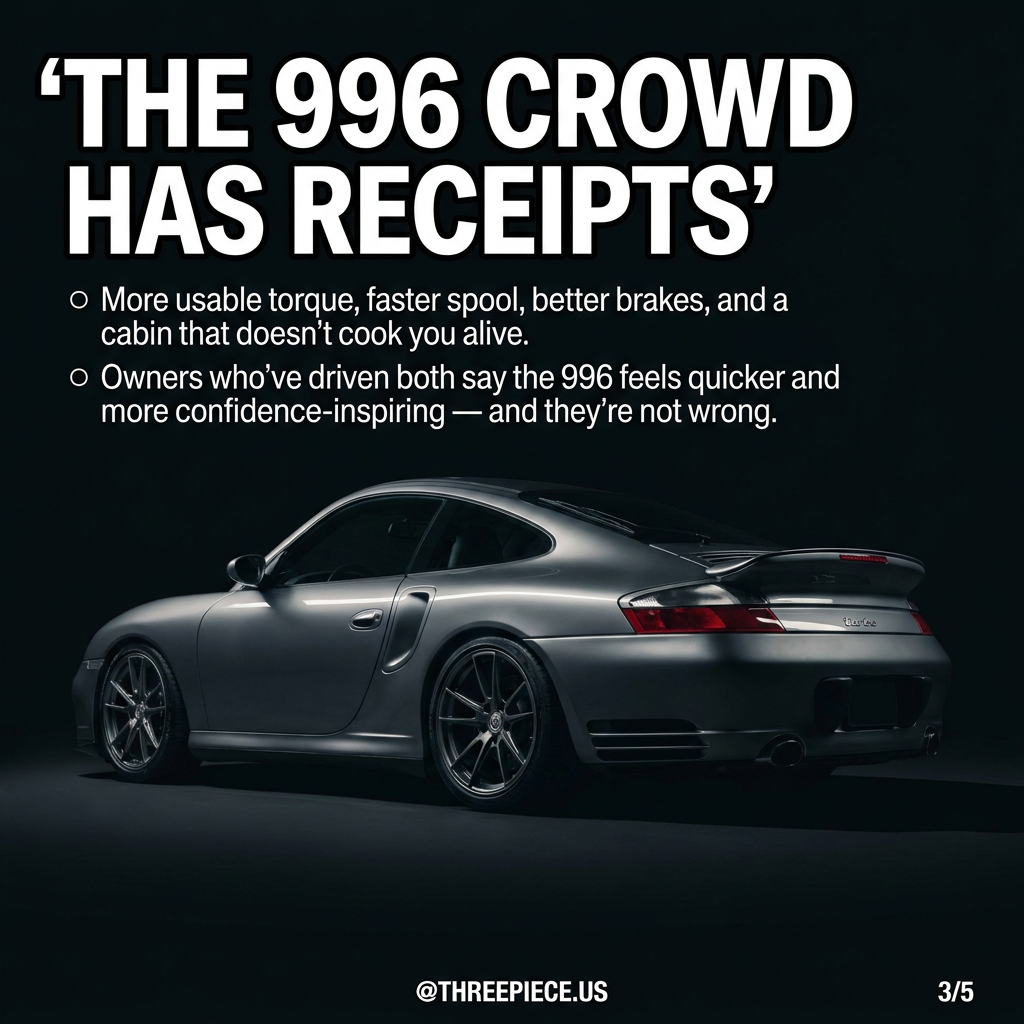
The 996 Turbo Crowd Has Receipts
Here's the thing 993 purists don't love hearing: the 996 Turbo is objectively faster, more usable, and significantly cheaper to buy. It spools faster, makes more torque in the mid-range, has better brakes, and the cabin doesn't cook you alive on a summer highway pull. Owners who've driven both say the 996 feels quicker and more confidence-inspiring — and the data backs it up. The Mezger motor in the 996 Turbo is one of the most robust engines Porsche ever built, with real aftermarket headroom past 525 hp on a tune alone.
Daily livability is where the 996 pulls away completely. Better insulation, modern ergonomics, functional climate control, and driving behavior that inspires trust at speed rather than demanding vigilance. The 996 Turbo is the car that lets you extract more performance with more confidence, and for significantly less money at entry. If raw lap times and comfortable power are your metrics, the 996 Turbo is the most underappreciated Porsche Turbo ever built. The same problems-first approach we used in our N54 335i breakdown applies here — know what you're getting into before you sign.
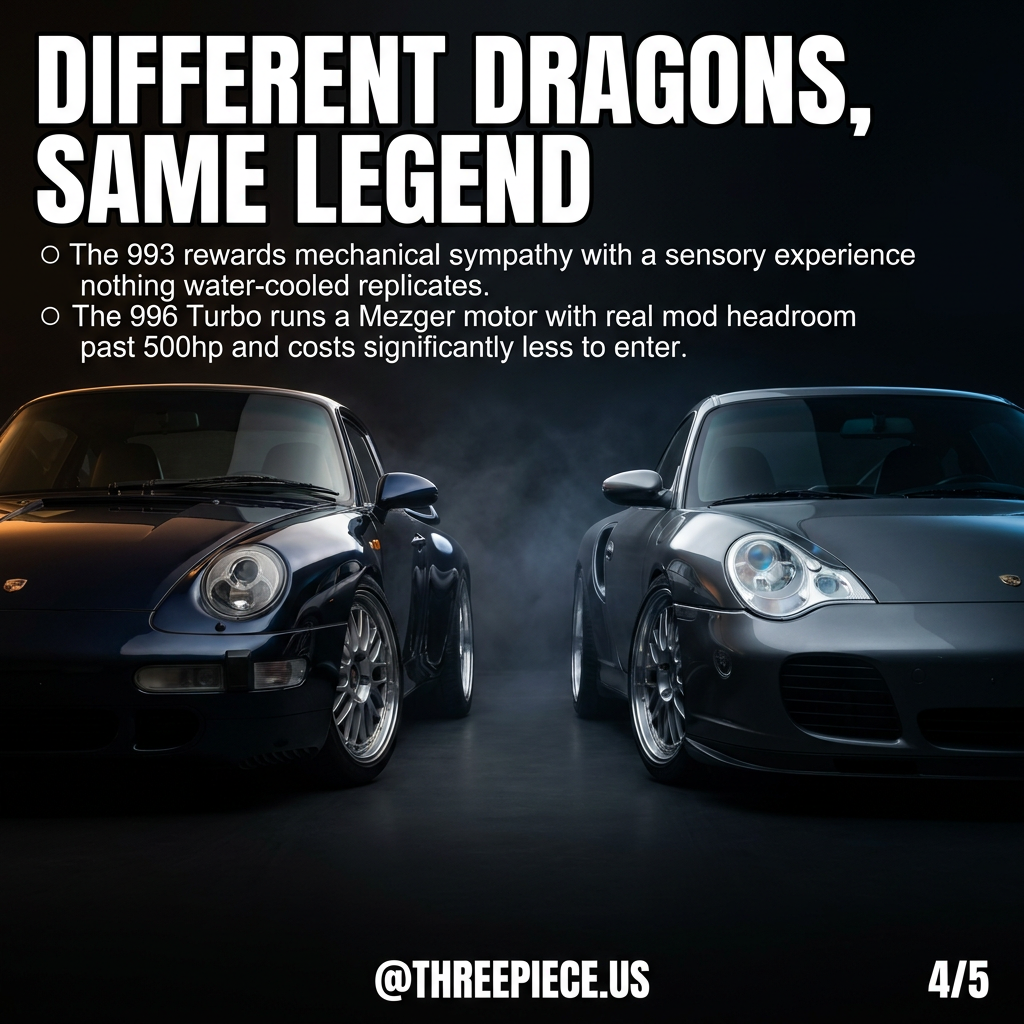
Different Dragons, Same Legend
This isn't a better-or-worse argument. It's a character argument. The 993 Turbo rewards mechanical sympathy with a sensory experience that has no modern equivalent — the analog feedback, the heat, the danger. The 996 Turbo runs a Mezger motor with serious mod headroom and costs significantly less to enter, maintain, and push hard. Both are rear-engine, twin-turbo, all-wheel-drive 911s. Both are legendary. The split is about what you value in the driver's seat.
Where the debate gets spicy is the value conversation. 993 Turbos command collector-grade premiums now. Parts are rarer. Maintaining air-cooled turbo systems — valve guides, heat management, turbo oil return lines, anti-siphon valves — costs real money. The 996 Turbo is cheaper to run if you handle the IMS bearing proactively and stay on top of aging rubber and seals. Neither car is cheap to own, but the 996 lets you spend your money on going faster instead of just staying alive. That same Porsche budget-build mentality applies — know where the money actually goes before you commit.
Wheel Fitment: 993 vs 996 Turbo
Both platforms run 5x130 bolt patterns, but fitment diverges significantly because of their different fender widths, suspension geometry, and brake packages. The 993 Turbo's wider rear fenders swallow 18x10 +40 rears comfortably, with 18x8 +52 fronts being the safe OEM-plus starting point. The 996 Turbo opens up slightly more aggressive options — 18x8.5 +50 front and 18x11 +40 rear is a proven street setup that clears the factory Brembo calipers.
If you're running a 3-piece wheel, the advantage is dialing offset to the millimeter — critical on a car where an extra 5mm of poke changes the entire stance and steering feel. Browse 18-inch wheels in 5x130 for options that fit both platforms. For that classic Porsche mesh look, the Work Brombacher Mesh starting at $684 was literally designed for air-cooled 911s — the name isn't subtle about it. If you're chasing a more modern multi-spoke, the Work Emitz at $711 fills wide fenders with serious depth. Check the vehicle gallery for real-world fitment examples on both platforms.
Understanding how different wheel constructions affect weight and performance matters here — on a rear-engine car, every gram of unsprung weight behind the rear axle changes the handling balance. Forged and 3-piece construction isn't just about looks on a 911; it's a functional decision. Our full Work Wheels catalog covers everything from flow-formed to full 3-piece for Porsche bolt patterns.
Suspension Before Power — Always
This is the part that 993 and 996 Turbo build threads agree on universally: suspension is the first mod, not the last. The 993's stock dampers are tired on every example at this point, and the chassis flex combined with turbo lag makes the car genuinely unpredictable if you're still riding on 25-year-old rubber and worn Bilsteins. PSS9 coilovers, RS sway bars, adjustable drop links, and camber plates are the most frequently cited first upgrades in Rennlist build threads.
For the 993 Turbo, the Function and Form Type 3 Coilovers for the 993 Turbo (95-98) at $1,590 are a strong entry point — 32-level damping adjustment and full height adjustability on a platform where ride height changes the aerodynamic balance dramatically. For the 996 Turbo, the Fortune Auto 500 Series Coilovers for the 996 Carrera 4S & Turbo at $1,799 include front endlinks and are a proven choice for street-to-track duty. If you want the step up in damper technology, the Fortune Auto 510 Series at $2,399 adds external reservoirs for consistent performance during extended track sessions.
The point is the same for both cars: get the suspension sorted before you chase power. A 993 Turbo on fresh coilovers and good summer performance tires is a completely different animal than one bouncing on blown dampers with hardened OEM rubber. The car that "wants to hurt you" becomes significantly more communicative — and trustworthy — with proper suspension underneath it.
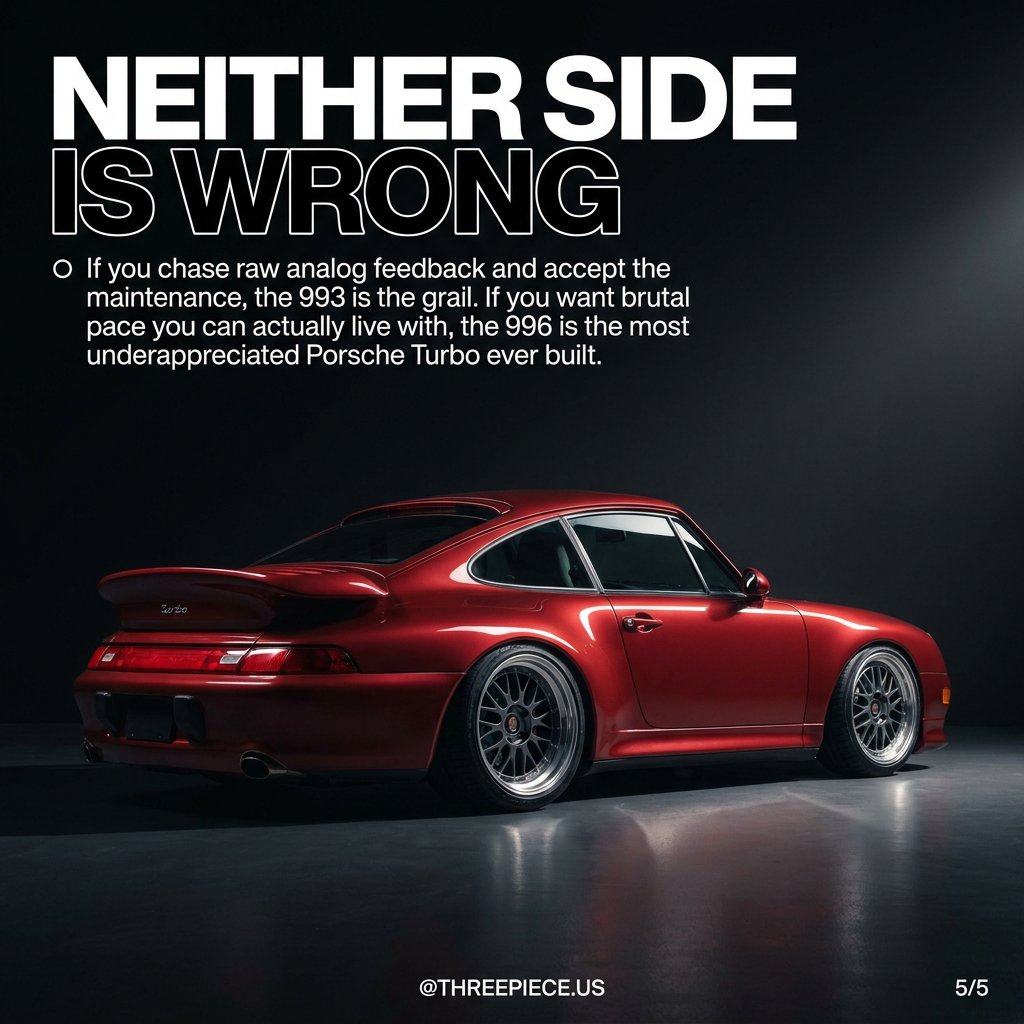
Which Dragon Are You Fighting?
Nobody's putting a 996 Turbo poster on their wall, and you know it. But nobody's daily-driving a 993 Turbo through August in Phoenix without questioning their life choices, either. The 993 is the grail — the end-of-era, air-cooled, analog turbo experience that nothing else replicates. The 996 is the sleeper value play — brutally fast, surprisingly livable, and still carrying a Mezger motor that the aftermarket has figured out completely.
Both cars deserve proper wheels. A set of Work VS series wheels on a 993 Turbo is the kind of build that stops a car show. Finish them with Red/Gold Work VS Center Caps at $120 each for the full period-correct Japanese wheel look on a German icon. If you're already running 3-piece wheels and need hardware, our assembly bolt catalog covers M6, M7, and M8 sizing for every major barrel manufacturer.
This isn't about which car is better. It's about which dragon you want to fight. One is trying to hurt you. The other just wants to embarrass you with competence. Both are legendary, and you don't have to pick a side to be a real Porsche person.
You're importing one tomorrow — 993 Turbo or 996 Turbo, and why?