
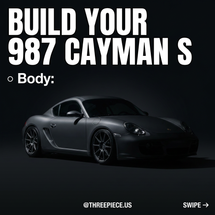
987 Cayman S Build Guide: Mod Order for the 3.4L 6MT
The 987 Cayman S is the mid-engine Porsche that Stuttgart didn't want to outshine the 911 — so they sandbagged it with a lower redline and smaller intake. Fifteen years later, the enthusiast market has figured out every way to undo those restrictions, and a properly built 987.1 Cayman S with the 3.4L M97 flat-six and 6-speed manual is one of the most capable driver's cars you can own for under $40,000 all-in. Here's the mod order that actually works, pulled directly from documented Rennlist builds, Reddit rebuild threads, and real dyno results.
Quick links
- Finding the right donor car
- Preventive maintenance before any mods
- The bolt-on power path: IPD plenum to ECU tune
- Suspension, chassis, and geometry correction
- Wheel fitment: sizes, offsets, and tire pairing
- Budget breakdown and the finished car
Finding the right donor car
The 987.1 Cayman S ran from 2006 to 2008 with the M97.21 3.4L flat-six making 295 hp and 251 lb-ft from the factory. You want the 6MT — the Tiptronic robs the car of everything that makes it special. Expect to pay $25,000–$32,000 for a clean, documented example with reasonable miles. That's a fraction of what a comparable 997 costs, and the Cayman's mid-engine balance is objectively better for track work.
The 2006+ cars received the revised IMS bearing, which dramatically reduced — but didn't eliminate — the failure risk. Always verify service records. If the previous owner can't tell you when the AOS (air-oil separator), water pump, and rear main seal were last addressed, assume they haven't been. These aren't optional maintenance items; they're the foundation your entire build sits on. If you're cross-shopping this against a front-engine coupe, read our 987 Cayman vs E46 M3 comparison — the Cayman wins on chassis, the M3 wins on aftermarket depth, and both are excellent starting points.

Preventive maintenance before any mods
This is where most 987 builds go wrong. People bolt on headers and a tune before addressing the M97's known weak points, then wonder why they're rebuilding a bottom end six months later. Forum threads on Rennlist are full of spun rod bearings — typically cylinders 4 and 6 — on cars that were modded before the cooling and oiling systems were sorted.
Before you touch anything performance-related, handle these items:
- Oil pump control piston — inspect and replace if worn. This is the single most overlooked failure point on the M97.
- AOS (air-oil separator) — if it's the original unit, replace it. A failed AOS causes oil consumption and fouled plugs.
- Water pump and thermostat — the plastic impeller water pumps fail without warning. Replace with an updated unit.
- Rear main seal — a common leak point. Much easier to address with the engine out or before you've installed performance exhaust.
- IMS bearing cover seal — not the bearing itself, but the seal around it. A cheap insurance item.
Budget $1,500–$2,500 for this preventive work depending on whether you're doing it yourself or paying a Porsche-specialist shop. This isn't glamorous, but it's the difference between a build that lasts 100,000 miles and one that ends with a tow truck. If you're curious about how multi-plate LSD wear works, the Cayman's limited-slip differential follows similar principles — inspect the diff while you're in there.
The bolt-on power path: IPD plenum to ECU tune
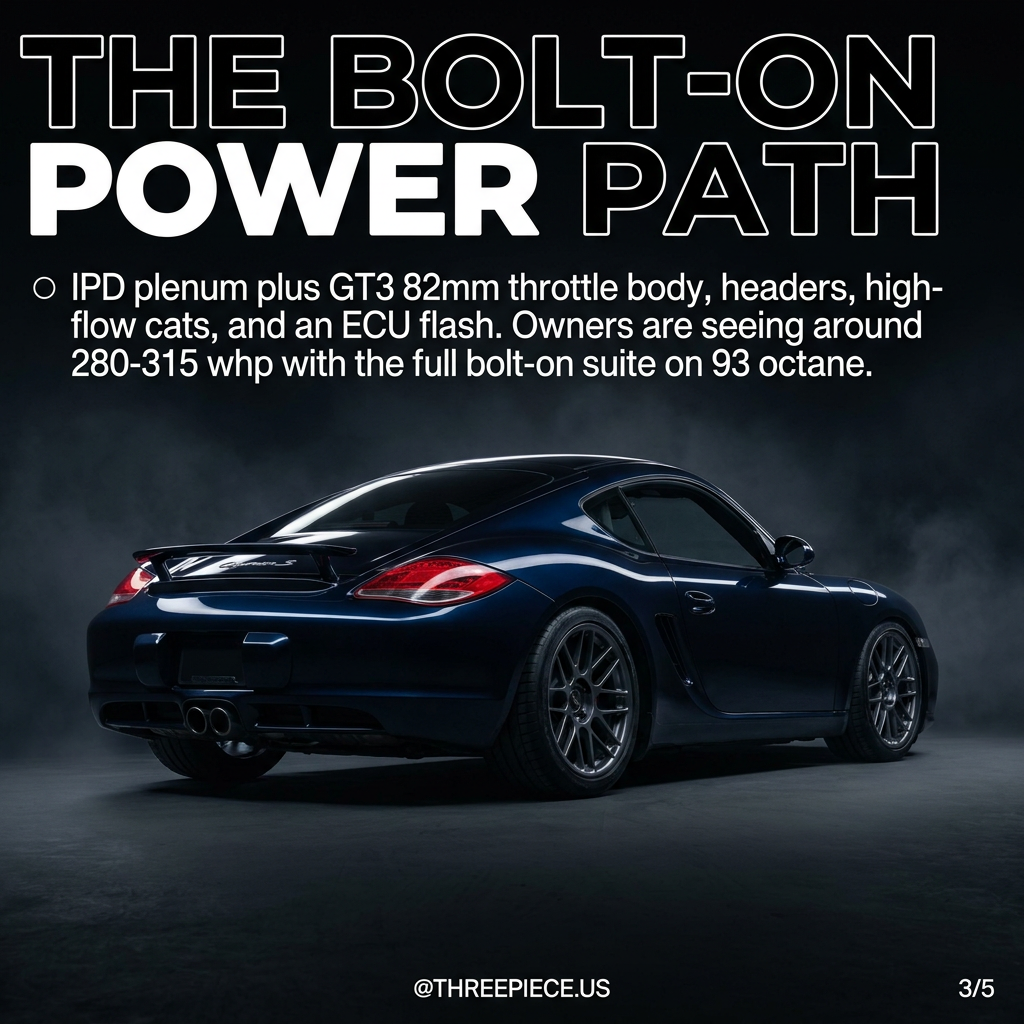
Here's where the 987 Cayman S gets interesting. Porsche intentionally restricted the intake tract to keep the Cayman below the 997's output. Undo those restrictions in the right order and you're looking at 280–315 whp on 93 octane with zero internal engine work.
The correct sequence matters:
- IPD competition plenum + GT3 82mm throttle body — this is the single biggest bolt-on gain on the M97. The factory plenum is a known bottleneck. The IPD unit with the larger GT3 throttle body is documented across dozens of Rennlist builds as the first mod that actually moves the needle. Expect 12–18 whp from this alone.
- Headers — Fabspeed sport headers are the most common choice in documented builds. Long-tube designs pick up more than shorties on this platform. Budget $1,200–$1,800 for quality headers.
- High-flow catalytic converters or test pipes — the factory cats are restrictive. High-flow cats keep you street-legal while freeing up exhaust flow. Catless is more power but comes with emissions complications worth understanding.
- ECU tune — this comes last, not first. The tune optimizes fueling and timing for the new intake and exhaust hardware. Tuning before the hardware is installed leaves power on the table and forces a re-tune later.
One build documented on Rennlist paired the IPD plenum, GT3 throttle body, Fabspeed headers, and an ECU flash to hit 310 whp on a bone-stock bottom end. That's 997 Carrera S territory from a car that cost half as much.
For the clutch, the stock unit will hold up to bolt-on power levels, but if you're planning to track the car or push past 300 whp, a Sachs Performance clutch paired with a lightweight billet aluminum flywheel (Aasco is the go-to) sharpens throttle response and handles the additional torque. The lighter flywheel alone changes the character of the car — the flat-six revs faster and the 6MT feels more direct.
Suspension, chassis, and geometry correction
The 987 Cayman S already has one of the best chassis in the Porsche lineup. The goal with suspension modifications isn't to reinvent the car — it's to sharpen what's already there and correct the geometry changes that come with lowering it.
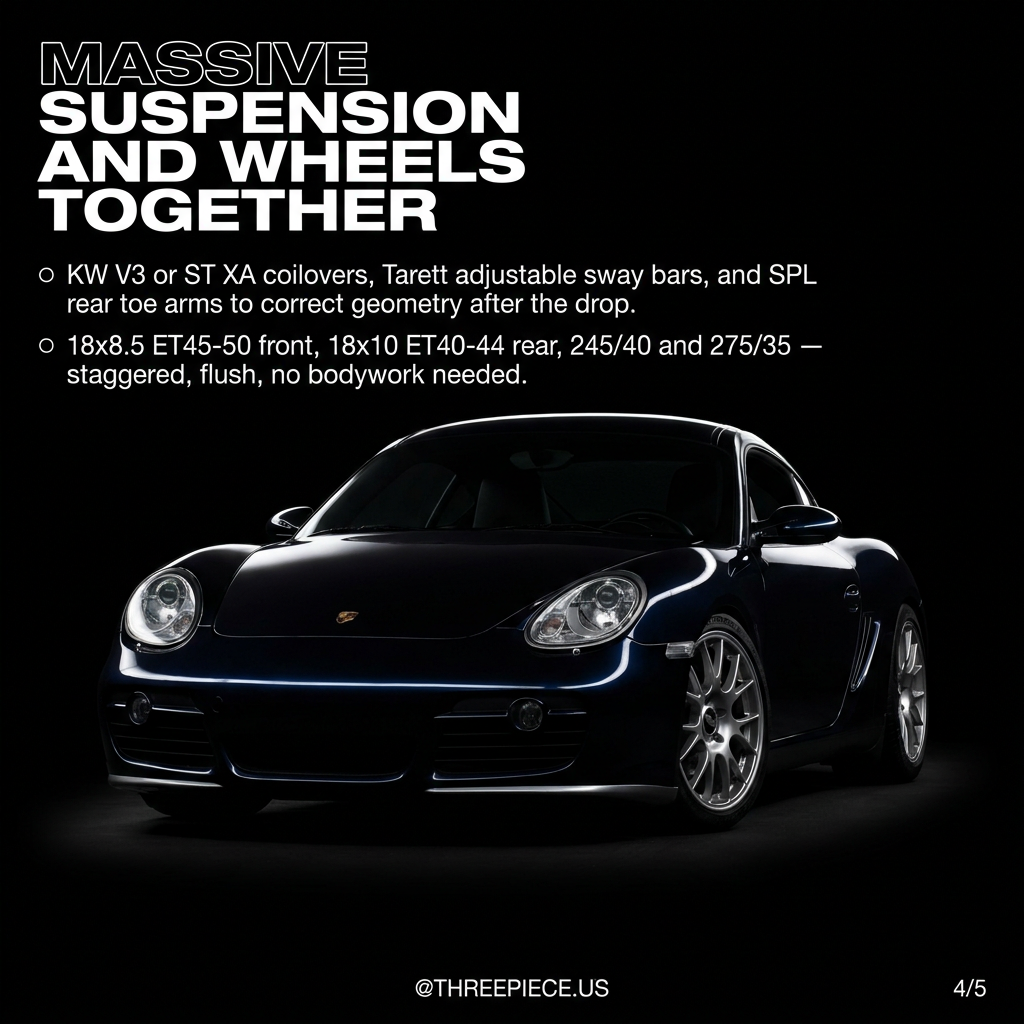
Coilovers: The KW V3 and ST XA are the most popular choices for street/track dual-duty builds. JRZ RS-2 coilovers show up in the more serious track builds documented on Rennlist. The KW V3 hits the sweet spot of adjustability and street comfort for most owners at around $2,200–$2,800. Browse coilover options to see what's available for your platform.
Sway bars: Tarett Engineering 5-position adjustable sway bars are the documented standard on this platform. They show up in nearly every serious 987 build thread. The adjustability lets you dial out understeer or oversteer depending on your driving style and tire setup. Pair them with Tarett drop links — the stock ones don't have enough travel for the lowered ride height.
Geometry correction: This is the step most people skip, and it's the one that matters most. When you lower a 987, the rear suspension geometry changes — you get toe and camber shifts that destroy tire wear and compromise handling. SPL rear toe arms (or Tarett equivalents) let you correct rear toe after the drop. Without them, you're driving a worse car than stock. A proper alignment on this platform should target -2.0° to -2.5° camber front, -1.5° to -2.0° rear for street/track use.
If you're going full track, the documented builds add Tarett bump steer correction kits and Wevo semi-solid engine mounts to reduce drivetrain compliance under load. For street builds, the stock engine mounts are fine — semi-solid mounts transmit significantly more vibration to the cabin.
Wheel fitment: sizes, offsets, and tire pairing
This is where the build comes together visually and mechanically. The 987 Cayman S runs a 5x130 bolt pattern with a 71.6mm center bore — the same as the 997. That opens up a huge range of Porsche-specific wheel options.
The proven fitment that clears stock brakes and sits flush without bodywork:
- Front: 18x8.5 ET45–50 with 245/40R18 tires
- Rear: 18x10 ET40–44 with 275/35R18 tires
This staggered setup fills the fenders properly and gives the rear axle the extra width it needs to put power down out of corners. If you're unfamiliar with how wheel offset affects handling and lap times, the short version is: too much positive offset tucks the wheel inboard and narrows your effective track width. On the 987, you want to push the rear wheels outward within the fender — ET40–44 does exactly that.
Browse 18x8.5 wheels in 5x130 for the front and 18x10 wheels in 5x130 for the rear. For tire sizing, search 245/40R18 fronts and 275/35R18 rears. Michelin Pilot Sport 4S is the documented go-to on builds like TheGrrrrr's Rennlist Cayman S — they offer the best balance of dry grip and wet-weather confidence for a car that sees both street and track duty.
If you're running three-piece wheels, make sure your assembly hardware is in good shape. M7x32 chrome assembly bolts at $10 each or M8x32 chrome assembly bolts at $10 each are the standard replacement hardware depending on your wheel brand. For a premium touch, M7x32 24k gold bolt/nut sets at $15 are a detail that separates a built car from a modified one. And don't forget 90-degree valve stems at $3.80 — deep-dish wheels with straight stems are a nightmare to air up at the track.
Some of the higher-power builds run 19s or even 20s — the 572 hp turbo build documented on MartiniWorks ran BBS CI-R 20x8.5 +46 front and 20x10.5 +38 rear — but for a naturally aspirated street/track car, 18s are the right call. They're lighter, offer better tire selection, and absorb road imperfections that 20s transmit straight into the chassis.
Budget breakdown and the finished car
Here's what a complete, sensible 987 Cayman S build actually costs:
- Donor car (2006–2008 3.4L 6MT): $25,000–$32,000
- Preventive maintenance (AOS, water pump, seals, fluids): $1,500–$2,500
- Bolt-on power (IPD plenum, GT3 TB, headers, cats, tune): $3,000–$4,500
- Suspension (coilovers, sway bars, toe arms, alignment): $3,500–$5,000
- Wheels and tires (18" staggered setup): $2,500–$5,000+
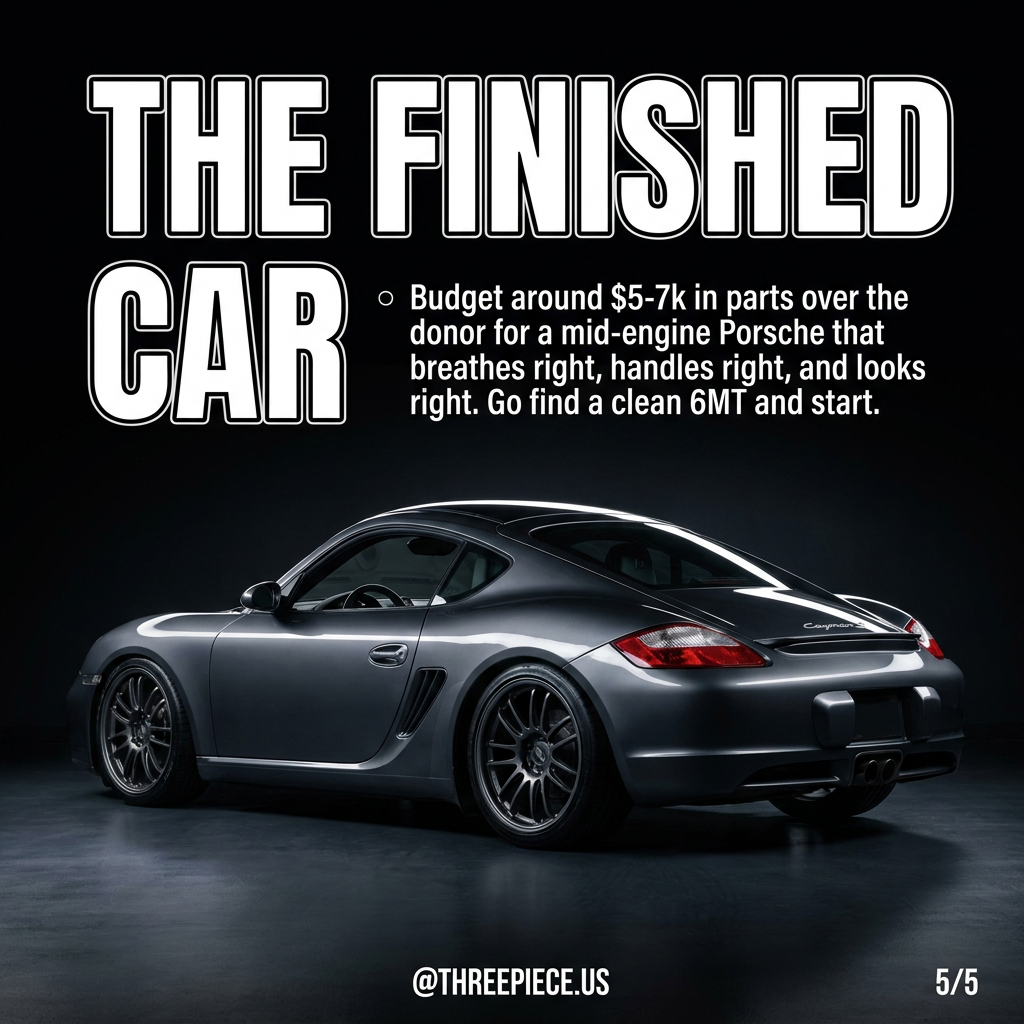
Total build cost over the donor: roughly $5,000–$7,000 in parts for the mechanical work, plus wheels and tires. That gets you a mid-engine Porsche making 280–315 whp through a 6-speed manual, sitting on properly sorted suspension with corrected geometry, wearing wheels that actually fit. For context, that's less than the cost of a single option package on a new 718.
The 987 doesn't need a widebody. It doesn't need a turbo kit. The best builds on Rennlist and Reddit are the ones that respect what Porsche got right — the mid-engine balance, the hydraulic steering, the mechanical connection — and just sharpen every edge. The IPD plenum removes the artificial intake restriction. The headers let the flat-six breathe properly. The coilovers and geometry correction let the chassis do what it was always capable of. And the right wheel and tire package puts the power down while making the car look like it was always supposed to look this way.
Check out the ThreePiece vehicle gallery for build inspiration, and browse new wheels when you're ready to finish yours. The Work VS series and Work Meister series both look exceptional on the 987's proportions — the deep concave faces fill the Cayman's arches in a way that monoblock wheels simply can't replicate.
If you're still deciding on a platform, our best manual sports cars under $20K guide covers cheaper entry points, and the Alfa Romeo 4C buying guide is worth reading if you're drawn to lightweight mid-engine cars but want something even more raw. The 987 Cayman S splits the difference perfectly — civilized enough to daily, sharp enough to embarrass cars costing twice as much on a back road.