
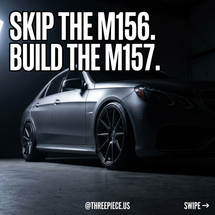
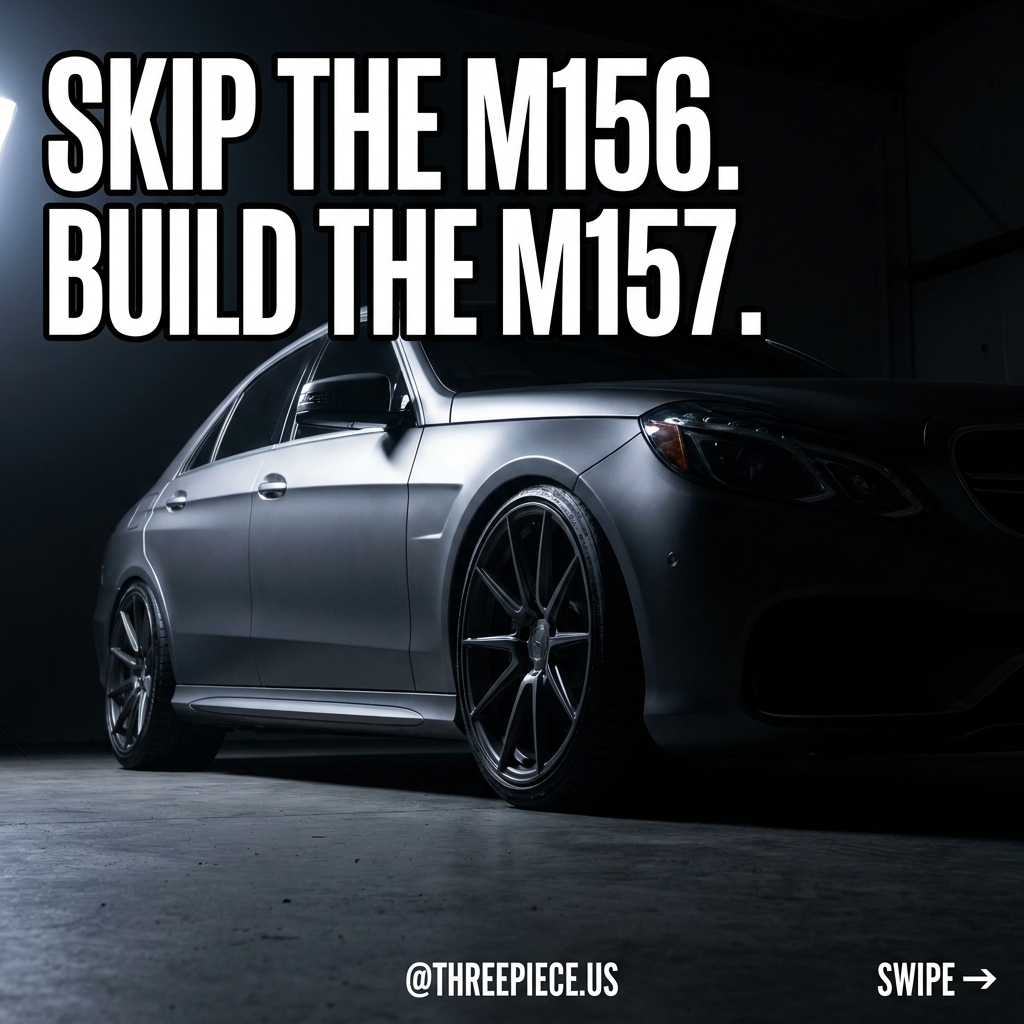
W212 E63 AMG Build Guide: Skip the M156, Build the M157
The W212 E63 AMG is the last big-bore AMG sedan you can still buy for used-Camry-plus money, and almost everyone shopping one buys the wrong engine. The 2010-2011 cars run the M156 6.2L NA V8 and they sound incredible. The 2012+ cars run the M157 5.5L biturbo, make the same power stock, and respond to software the way the 6.2 never will. This W212 E63 build guide walks the mod order that actually works: engine choice first, tune second, transmission service before boost, suspension before wheels, and 5x112 fitment that clears the AMG brakes instead of fighting them.
Quick links
- Buy the biturbo car, not the cheap car
- The tune is the build
- Service the MCT before you add boost
- Front springs, rear air: don't guess on this chassis
- W212 E63 wheel fitment: 5x112, 66.5 bore, staggered
- Tires, studs, and the details that finish it
- Tune it, drop it, wheel it — in that order
Buy the biturbo car, not the cheap car
Here's the split that decides your entire build: 2010-2011 W212 E63 = M156 6.2L naturally aspirated at roughly 518 hp. 2012-2016 = M157 5.5L biturbo, also around 518 hp in base trim, 550 hp / 590 lb-ft in S-Model trim, and 577 hp in the 2014+ facelift E63 S 4Matic. Same badge, completely different ownership experience.
The 6.2 is a documented head-bolt car with cam and lifter wear on any example that got lazy oil changes, and the repair bill is a heads-off job. The biturbo asks more up front and every dollar of that gap comes back the first time you don't pull heads. This is the same logic we used on the N55-era 335i buyer's guide — the later, boosted, better-sorted version of the same car is almost always the smarter used purchase. If you want the counter-argument for keeping a big NA V8, our E92 M3 vs E46 M3 breakdown is where that fight lives.

The tune is the build
The M157 is boost-limited from the factory, not hardware-limited. Stock turbos, stock injectors, stock fuel system — the ECU is just leaving a huge amount on the table for warranty and emissions reasons. A proper e-tune with datalogs on a healthy motor is worth roughly 150 hp, and it happens in an afternoon with the car sitting in your driveway. Nothing you bolt to this engine moves the needle like that first flash.
So the order is software first, supporting hardware after: downpipes, intake, intercooler capacity, then fresh plugs on a tighter heat range and a full fluid service. Bolt-ons before the tune is the classic backwards move — the same mistake we call out in the 370Z VQ37VHR mod order and the FC1 Civic Si build guide. On a turbo motor it's worse, because you're paying for airflow the ECU has no permission to use.
Service the MCT before you add boost
The 7-speed MCT is a wet start-off clutch instead of a torque converter, and it's the component every W212 E63 shopper forgets exists until it starts flaring between gears. Fluid, filter, and an adaptations reset before you tune — do it while the car is stock so you know what a good shift feels like and have a baseline to compare against once the torque number jumps by a few hundred lb-ft.
Skip this and you'll spend the next six months arguing with yourself about whether the tune "broke" the transmission. It didn't. The 12-year-old fluid did.

Front springs, rear air: don't guess on this chassis
The W212 E63 runs steel springs up front and air out back. That's why generic coilover kits are the wrong tool here — you're not dealing with a conventional four-corner setup like a Mk7 GTI or a VA WRX, where a set of coilovers is the obvious answer.
The right approach is front springs matched to the AMG damper rates and a drop through the rear air setup via links or a module. Do it that way and the car keeps its factory composure loaded up — which is the entire reason you bought a big AMG sedan instead of something lighter. Budget for rear air struts while you're in there: 12-year-old bladders leak, and there is no such thing as a $400 air suspension repair. Browse the suspension catalog and price the whole job before you commit to a ride height.

W212 E63 wheel fitment: 5x112, 66.5 bore, staggered
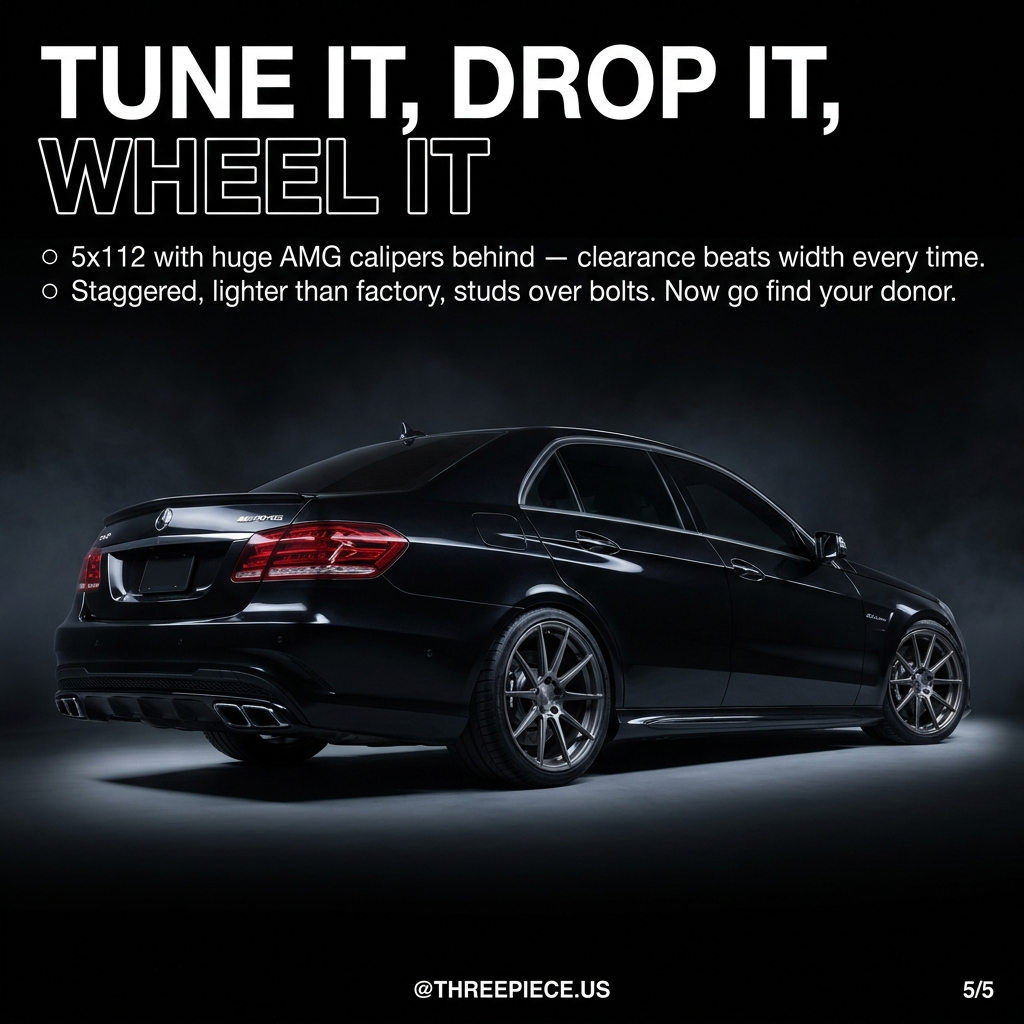
Specs first: 5x112 bolt pattern, 66.5mm hub bore, M14x1.5 factory bolts. Factory rubber is 255/35-19 front and 285/30-19 rear. The AMG front calipers are enormous, so on this chassis barrel clearance beats width every single time — a wheel that fits on paper and rubs a caliper on the lift is a two-week detour.
The safe window on a mild drop is 20x9 +35 to +42 front and 20x10.5 +38 to +45 rear. Go wider than that and you're rolling fenders on a sedan that looks best with factory bodywork intact. Start with 20-inch 5x112 wheels, or step down to 19s in 5x112 if you want more sidewall for broken pavement. Our A6 Quattro 5x112 fitment guide and the RS6 Avant guide are useful cross-references for how heavy German 5x112 platforms behave at the same widths.
Style-wise, this car wants a euro mesh or a clean multi-spoke, not a deep-dish drift face. The Work Brombacher Mesh at $684 is the natural fit for a German sedan, and the Work Emitz at $711 gives you a more modern face with real width available. If you're going full 3-piece, the Work Emotion CR 3P at $895.50 lets you spec the exact lip and offset this chassis needs instead of accepting whatever the catalog offset happens to be. Check drilling and clearance for 5x112 with big AMG calipers before you order — that's the one call worth making. Browse the full Work Wheels lineup or read our Work Meister S1 3P review if you want to understand what you're paying for with a true three-piece.
Tires, studs, and the details that finish it
Order the tires with the wheels. Always. That "they'll be here Thursday" install becomes a two-week hostage situation otherwise, and you'll be driving on the spare with a $3,000 set of wheels sitting in your living room. For a 20-inch setup, look at 265/35R20 up front and 295/30R20 out back. A 4,000-lb sedan with 550+ lb-ft needs a real summer tire, not a treadwear-500 all-season — our guides on reading UTQG ratings and choosing between track and street tires will keep you from buying rubber that turns to soup on the first hot lap.
Then the small stuff that separates a finished car from a project: run a stud conversion instead of fighting factory bolts every time a wheel comes off, verify your hubcentric rings for the 66.5mm bore, and match lug nuts to the new seat type. Add 90-degree valve stems at $3.80 so you can actually reach the valve behind a concave face. If you go three-piece, keep spare M7x32 assembly bolts at $10 and a tube of silicone sealant at $10.99 on the shelf — you'll need both eventually. Curbed a barrel? That's what refinishing exists for.
Tune it, drop it, wheel it — in that order
The 6.2 sounds better. That is the entire argument for the M156, and it costs about eleven grand to lose it. The M157 W212 E63 is the version of this car that rewards a laptop, survives being driven, and still has the presence that made you want a big AMG sedan in the first place. Buy the 2012+ car, service the MCT, flash it, sort the rear air, then put the money into wheels — because a stock-wheeled E63 reads as a lease return and a properly fitted one reads as a build.
Ready to spec it out? Start with the full wheel catalog, pull ideas from the vehicle gallery, and if you're stuck between a 20x10.5 +38 and a +42 on a lowered car, message us the drop and the tire size — that's a five-minute answer that saves a return shipment.
So: you're buying a W212 E63 tomorrow. Are you hunting a 2014+ S 4Matic at 577 hp, or a 2012-2013 RWD car because you want the tail to move?