Lexus LC500 Build Guide: Mod Order That Works (2018-2026)
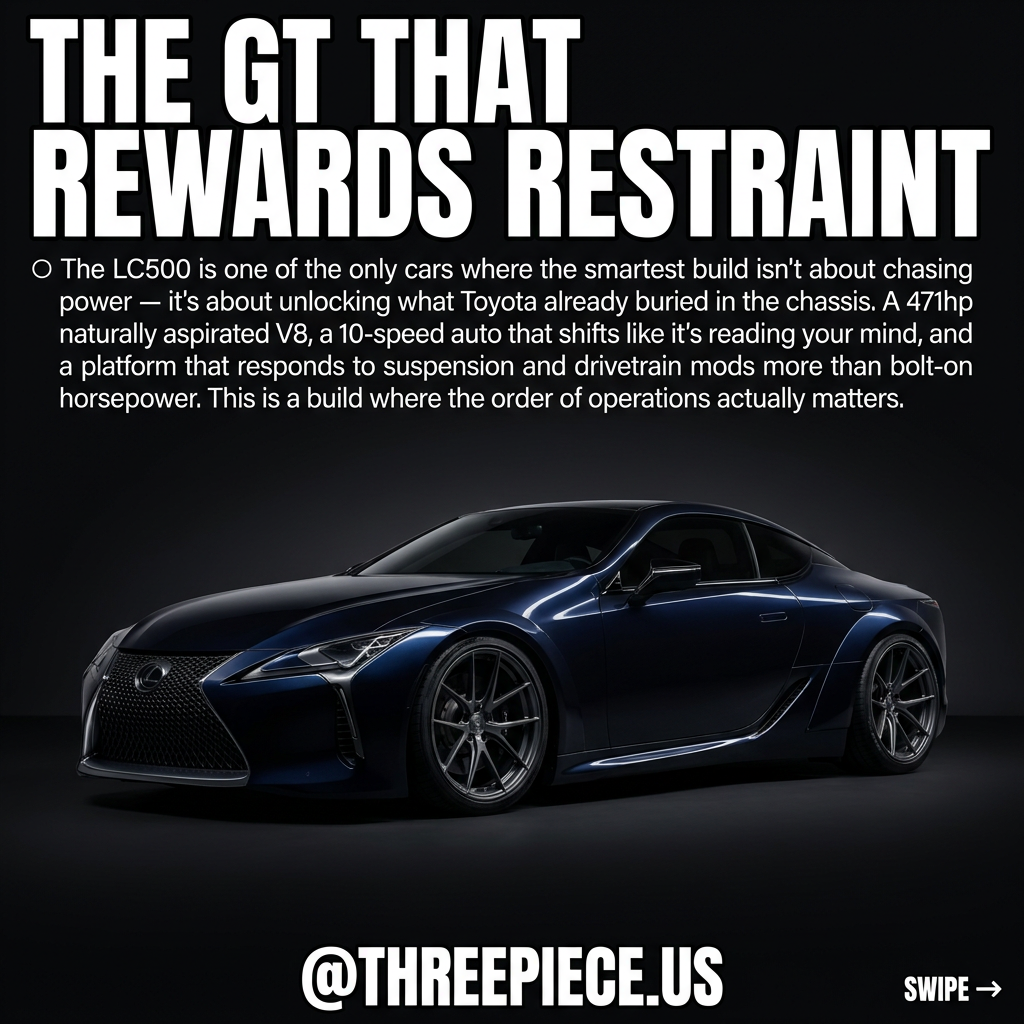
The Lexus LC500 is the most underbuilt GT car on the market right now — and the owners who understand it aren't chasing horsepower. Toyota handed us a 471 hp naturally aspirated 5.0L V8 on a platform that shares structural DNA with the LFA, wrapped in one of the best production designs of the last decade. The LC500 build that actually works isn't about bolt-on power. It's about unlocking what's already buried in the chassis, in the right order. Here's the real build roadmap for the 2018–2026 LC500, pulled from documented owner builds and forum threads.
Quick links
- The Diff Swap That Changes Everything
- Exhaust: Wake Up the 2UR-GSE
- AVS Is the Suspension Decision
- 21s Flush, No Bodywork Required
- The NA Power Ceiling and Why It Matters
- Build Smart, Drive It Forever
The Diff Swap That Changes Everything
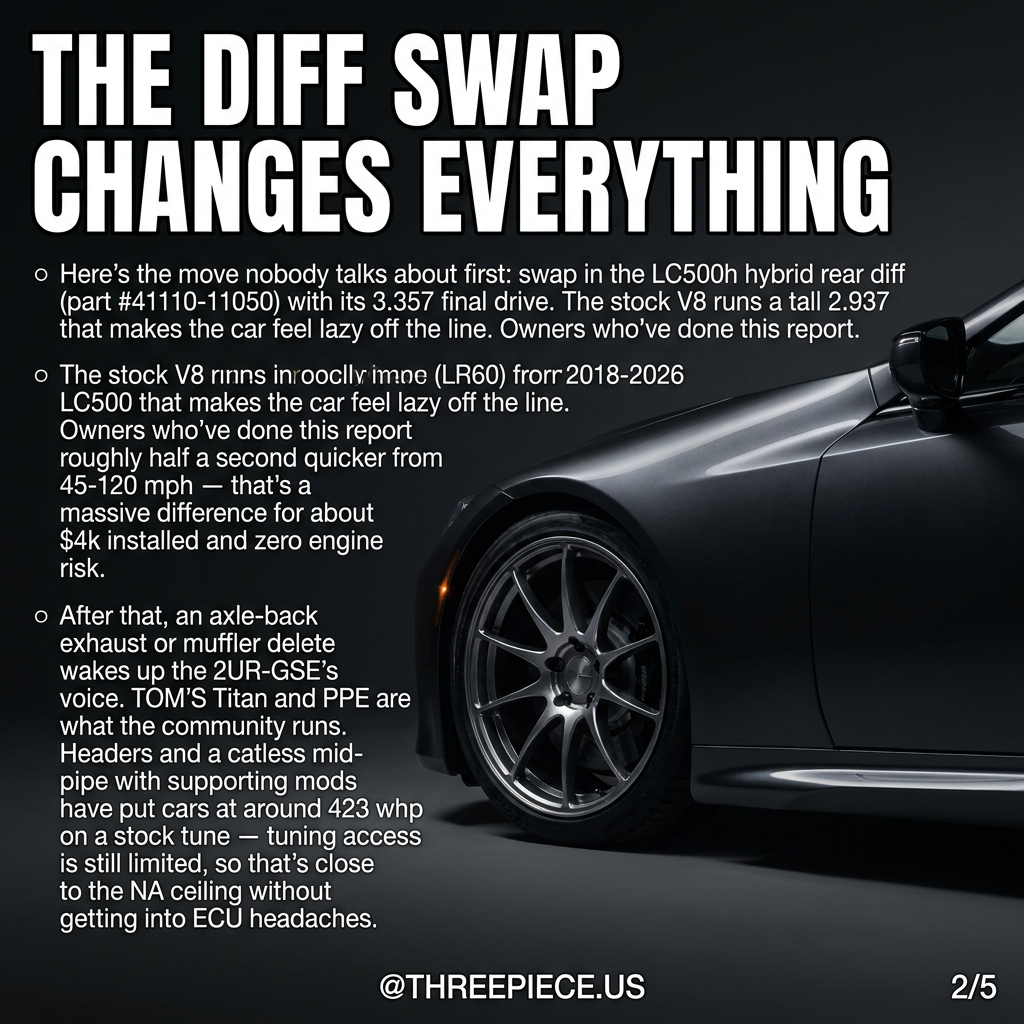
Here's the move nobody talks about first, and it should be your very first modification: swap in the LC500h hybrid rear differential (part #41110-11050) with its 3.357 final drive ratio. The stock V8 LC500 runs a tall 2.937 final drive that makes the car feel lazy off the line and sluggish in mid-range pulls. Owners who've completed this swap report roughly half a second quicker from 45–120 mph — that's a massive, seat-of-the-pants difference for about $4,000 installed and zero engine risk.
The LC500's 10-speed Direct Shift automatic already shifts like it's reading your mind. Shorter gearing lets the transmission keep the 2UR-GSE in its powerband longer, and the car finally launches with the urgency its 471 hp deserves. This is the single highest-impact mod on the platform, and it requires no ECU tuning, no wiring changes, and no warranty-voiding engine work. If you've been looking at affordable V8 platforms to build, the LC500 with this swap is in a different league.
Exhaust: Wake Up the 2UR-GSE
After the diff swap, an axle-back exhaust or muffler delete wakes up the 2UR-GSE's voice. The community runs two primary systems: the TOM'S Titan exhaust with titanium tips and the PPE equal-length race headers paired with a catless mid-pipe. The TOM'S system is the refined choice — deeper tone, no drone, bolt-on install. PPE headers with a catless mid-pipe are for owners who want maximum NA output and don't mind the volume.
A documented LC500 with PPE headers, catless mid-pipe, TOM'S axle-back, and TOM'S drop-in air filters put down 423 whp / 373 wtq on a stock tune. That's impressive for a naturally aspirated V8 with no ECU reflash. But understand that's close to the NA ceiling — tuning access on the LC500 remains limited, with only a handful of tuners like TunebyoLoi and Reflash RD offering support, and primarily on pre-2021 models. The 2UR-GSE's D4-S dual injection, high compression, and complex valve timing make deep ECU access a challenge that the aftermarket hasn't fully cracked. For context on how exhaust modifications translate to real power, our breakdown of whether downpipes are worth it covers the same principles at play here.
AVS Is the Suspension Decision
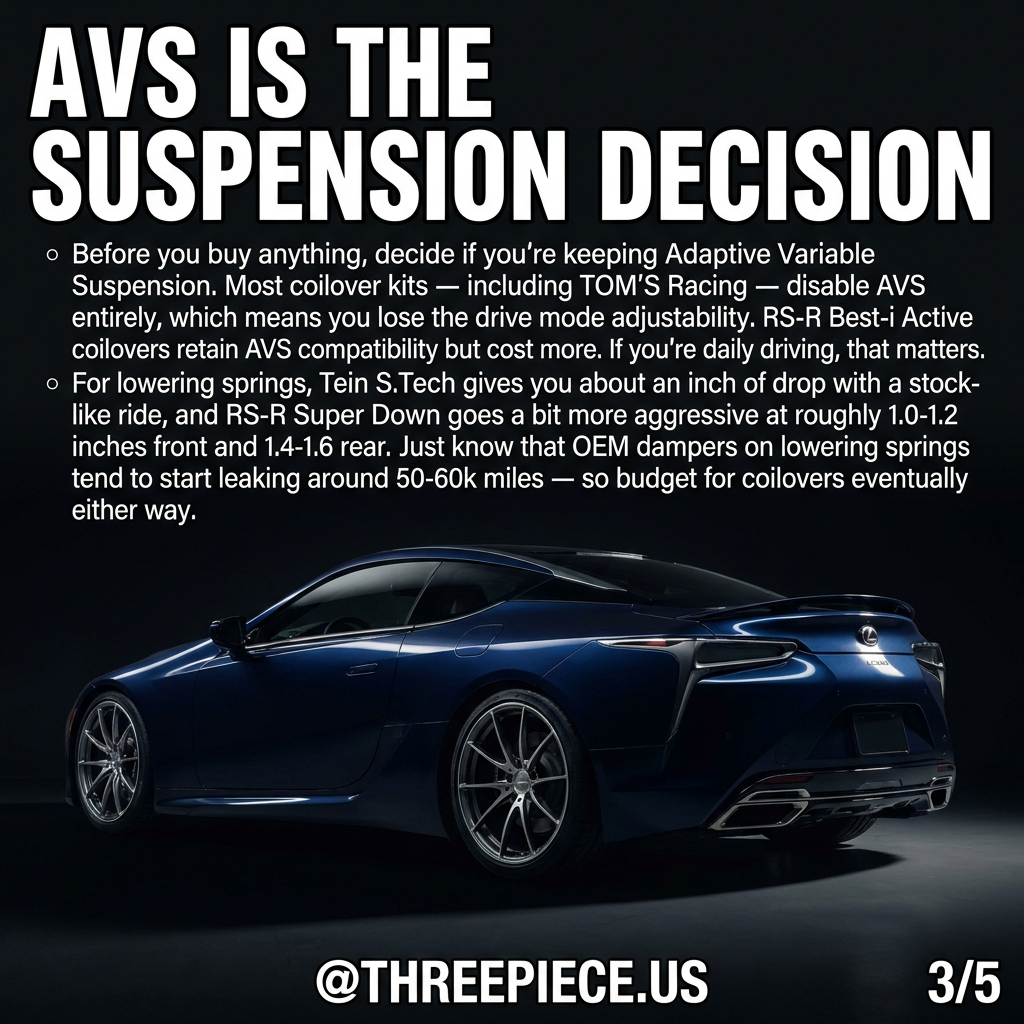
Before you buy anything for the LC500's suspension, decide if you're keeping Adaptive Variable Suspension (AVS). This is the fork in the road that most owners get wrong. Most coilover kits — including the popular TOM'S Racing coilovers — disable AVS entirely, which means you lose drive mode adjustability across Comfort, Normal, and Sport S+. That's a significant trade-off on a daily-driven GT car.
RS-R Best-i Active coilovers retain AVS compatibility but cost more. If you're daily driving the LC500 and value the mode switching, they're the only real option. For lowering springs, Tein S.Tech gives you about 1 inch of drop with a stock-like ride, and RS-R Super Down goes more aggressive at roughly 1.0–1.2 inches front and 1.4–1.6 inches rear. Just know that OEM dampers on lowering springs tend to start leaking around 50,000–60,000 miles — so budget for coilovers eventually either way.
If you're lowering the car, you'll also want to understand why rear camber arms matter on a lowered car — the LC500's multi-link rear suspension is sensitive to ride height changes, and uncorrected camber will eat through rear tires fast. Browse our suspension catalog for coilover and spring options across platforms.
21s Flush, No Bodywork Required
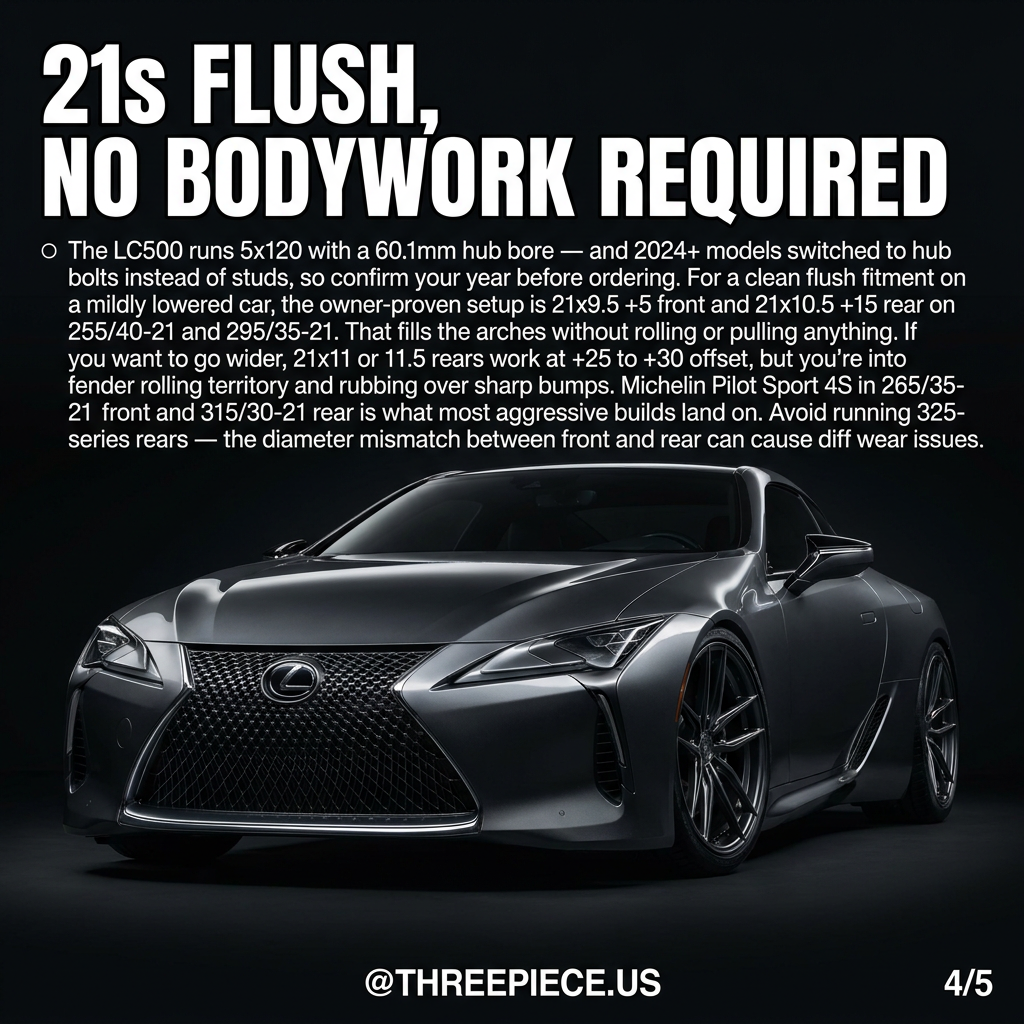
The LC500 runs 5x120 with a 60.1mm hub bore — and 2024+ models switched to hub-centric bolts instead of studs, so confirm your year before ordering wheels. This is a critical detail that gets overlooked. If you're running aftermarket wheels on a 2024+, you need to verify lug bolt compatibility. For any wheel that doesn't match the 60.1mm bore exactly, hubcentric rings are non-negotiable to eliminate vibration at speed.
For a clean flush fitment on a mildly lowered car, the owner-proven setup is 21x9.5 +5 front and 21x10.5 +15 rear on 255/40-21 and 295/35-21 tires. That fills the arches without rolling or pulling anything. If you want to go wider, 21x11 or 11.5 rears work at +25 to +30 offset, but you're into fender rolling territory and rubbing over sharp bumps.
For tires, Michelin Pilot Sport 4S in 265/35-21 front and 315/30-21 rear is what most aggressive builds land on. If you're running 19-inch wheels on a track-oriented setup, the Michelin Pilot Sport 4 S 315/30ZR19 at $509 is an excellent rear tire choice, and the Michelin Pilot Sport 4 S 245/35ZR19 at $363 works up front. For 18-inch setups on winter or spare wheels, the Michelin Pilot Sport 4 S 275/35ZR18 at $324 is worth considering. Avoid running 325-series rears — the diameter mismatch between front and rear can cause diff wear issues over time.
Browse 21-inch wheels in 5x120 to see what fits the LC500 platform. If you're exploring 3-piece options, Work Wheels and Weds Kranze both offer deep-lip designs that suit the LC500's wide fenders perfectly. For understanding how hub-centric fitment works and why it matters at 21 inches, read our guide on hub-centric vs. lug-centric wheels.
The NA Power Ceiling and Why It Matters
The LC500 community is split on forced induction, and for good reason. The 2UR-GSE makes 471 hp and 398 lb-ft from the factory with cast pistons, high compression, and D4-S dual injection. Club DSPORT built a stroked/bored 2UR-GSE — bored from 94mm to 99.5mm, displacing 5.6L — producing about 525 hp and 440 lb-ft with forged internals, titanium valves, and high-lift cams. That's the kind of money and effort required for meaningful NA gains beyond bolt-ons.
Most owners who've been through the math agree: 30–50 hp of NA gains costs a steep amount for minimal real-world benefit. Big gains require forged internals, and the 10-speed Direct Shift automatic's torque converter and clutch packs become a question mark beyond ~500 hp. There aren't many public cases of transmission breakage, but it's widely viewed as the next weak link. If you're coming from a platform where forced induction is straightforward, read our air-fuel ratio explainer to understand why the 2UR-GSE's dual injection system makes boost tuning so complex.
The smart money stays naturally aspirated. The LC500's character — that high-revving V8 bark, the throttle response, the mechanical directness — is what separates it from turbocharged GTs. Boosting it doesn't just risk reliability; it fundamentally changes what makes the car special.
Build Smart, Drive It Forever
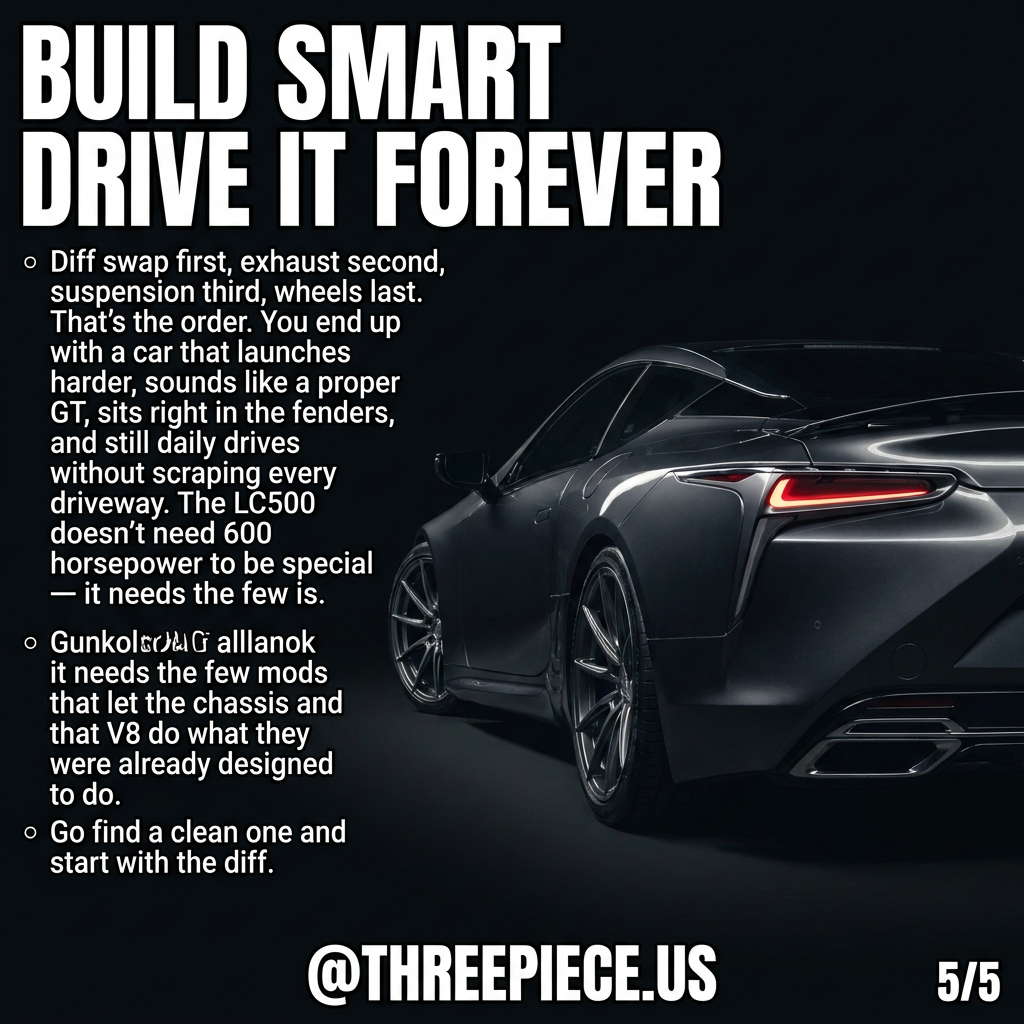
Diff swap first, exhaust second, suspension third, wheels last. That's the order. You end up with a car that launches harder, sounds like a proper GT, sits right in the fenders, and still daily drives without scraping every driveway. The LC500 doesn't need 600 horsepower to be special — it needs the few mods that let the chassis and that V8 do what they were already designed to do.
For wheel finishing and customization, 3-piece wheels give you the flexibility to change lip sizes and finishes as your build evolves. Work step lips and Work reverse lips start at $399, letting you rebuild or resize your wheels without buying an entirely new set. Pair them with Work step barrels at $399 for a complete refresh. If you're running Weds Kranze, Kranze reverse lips start at $230. Don't forget 90-degree valve stems at $3.80 — on deep-dish 3-piece wheels, standard straight stems make inflation a nightmare.
Check the ThreePiece vehicle gallery for real-world LC500 wheel inspiration, and browse our full wheel catalog for options that fit the platform. If you're weighing forged vs. cast for a car at this price point, our TE37 replicas vs. real Volk TE37 comparison breaks down exactly why wheel construction matters. The LC500 deserves the real thing. Go find a clean one and start with the diff.