
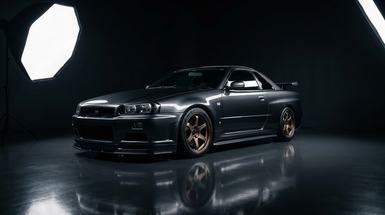
I Built an R34 GTT for Under $2000 (Here's Proof)
R34 GTT Wheel & Tire Fitment Guide: Building Grip on a $2,000 Budget
The Nissan Skyline R34 GTT already costs real money to own — clean examples are trading from roughly $25,000 to $60,000+ depending on series, mileage, and import status. This guide assumes you already have the car. The $2,000 here is strictly a wheel, tire, and fitment-adjacent budget: what to spend it on, what to skip, and why the smartest move on a 20-plus-year-old chassis is rubber, not rims.
Quick Navigation
- Quick Answer
- Key Takeaways
- Why This Budget Keeps the Factory Wheels
- Stock R34 GTT Wheel Specs
- Recommended Tire Sizing
- Tire Brand Options at This Price Point
- Wheel Refurbishment vs. New Rubber
- How Suspension Bushings and HICAS Affect Fitment and Alignment
- Install Order: Getting Alignment Right
- Fitment Mistakes That Cost You Twice
- Alternatives: Scaling the Wheel/Tire Budget Up or Down
- Where to Go Next: Aftermarket Wheels and ThreePiece.us
- Bottom Line
Quick Answer
Keep the factory wheels. Spend the budget on correctly sized tires, a proper alignment, and bushing work that keeps the rear geometry honest. Stock R34 GTT wheels run 17x7.5" front and 17x8" rear on a 5x114.3 bolt pattern — a solid platform for 225/45R17 front and 245/40R17 or 245/45R17 rear rubber. New wheels, coilovers, and a Brembo brake swap are all real upgrades, but none of them fit inside $2,000 without gutting the tire budget that actually delivers the grip improvement.
Key Takeaways
- Stock GTT wheel sizing: 17x7.5" front, 17x8" rear, bolt pattern 5x114.3 — confirm the actual stamped offset on your car, since factory specs vary by market and wheel design across the production run.
- Recommended tire sizing: 225/45R17 front, 245/40R17 or 245/45R17 rear, depending on stock offset and fender clearance.
- Budget tire options run $120–160/tire: Falken Azenis FK510, Federal 595 RS-R/RS-RR, or Nankang NS-2R/AS-2.
- Tires consume the largest single line item — roughly $560 including mount and balance — and forum consensus says this is the highest-value dollar spent on the car.
- Changing wheel width or offset interacts with the HICAS rear-steer system and can cause rubbing under compression — a real reason to stay stock here.
- Alignment (~$120) is non-negotiable after any bushing or tire work; skipping it wastes the tire purchase within a few thousand miles.
- Aftermarket wheels (Enkei RPF1, Work Emotion, used market $700–1,200/set) and custom forged options like ThreePiece.us ($2,500–4,000+) are real, but they're phase-two and phase-three purchases, not part of this budget.
Why This Budget Keeps the Factory Wheels
The single biggest "don't waste the money" decision in this build is skipping new wheels entirely. A quality tire on a stock wheel outperforms a cheap or ill-fitting wheel-and-tire combo every time, and on the R34 chassis specifically, wheel changes carry a fitment risk that doesn't exist on more generic platforms: the HICAS rear-steer system. Altering width or offset away from factory spec changes how the rear tire clears the fender and subframe under compression, and a poorly matched staggered or square setup can introduce rubbing that a stock-width tire never would. Until the suspension and HICAS situation is addressed (see below), gambling on cheap aftermarket wheels is a fitment problem waiting to happen.
Stock R34 GTT Wheel Specs
- Front: 17x7.5"
- Rear: 17x8"
- Bolt pattern: 5x114.3
- Exact factory offsets vary by trim, series, and market — GTT wheel specs are reported inconsistently across sources, so verify the stamped offset on the actual wheel in hand rather than assuming a universal figure.
- Series 1 (1998–2000) and Series 2 "Neo" (2000–2002) cars were fitted with a few different factory wheel designs across the run, which is part of why confirming your specific set matters before ordering rubber.
Recommended Tire Sizing
- Front: 225/45R17
- Rear: 245/40R17 or 245/45R17 — the choice depends on your car's stock offset and available fender clearance
- Confirm sizing against the actual wheel width and offset before ordering; the GTT's mix of factory wheel designs means a size that clears one car's fenders may rub on another.
Tire Brand Options at This Price Point
At a $120–160/tire budget, four options dominate enthusiast and Skyline forum discussion:
- Falken Azenis FK510 — widely recommended as a strong value performance tire with predictable breakaway characteristics; the safest default pick for this build.
- Federal 595 RS-R / RS-RR — a popular budget "semi-track" option, stickier than the FK510 but with shorter tread life.
- Nankang NS-2R or AS-2 — the cheapest of the performance-oriented options, better suited to fair-weather/spirited-street use; wet performance sentiment is mixed.
- UHP all-season alternative (Yokohama or Kumho equivalent, $130–150/tire) — a reasonable substitute if daily comfort matters more than outright grip, though it sacrifices the cornering gain that's the whole point of this line item.
Wheel Refurbishment vs. New Rubber
If the factory 17-inch wheels are curbed or corroded, a basic strip-and-repaint or single-stage refinish runs roughly $250–400 for a set of four. This is a legitimate option if the wheels genuinely need it — but it competes directly with tire budget in a $2,000 build. Prioritize tires if forced to choose; a clean-looking curbed wheel with a bad tire is a worse car than a slightly tired wheel with fresh rubber.
How Suspension Bushings and HICAS Affect Fitment and Alignment

Two suspension items directly change how your wheel/tire package sits and behaves, even though neither is a wheel or tire purchase itself:
- Bushing kit (Whiteline or SuperPro, front and rear, focused on the most failure-prone positions — front control arm, rear subframe/differential mount) runs $300–400 for a partial kit. Replacing these bushings changes suspension geometry slightly, which is why alignment must come after, not before, this work.
- HICAS lockout / rear subframe brace ($150–250, optional) — a leaking or worn HICAS rack undermines any alignment or tire work done around it, since the rear-wheel steering system directly affects how the rear tire tracks through compression. Inspect HICAS condition before ordering bushings; the lockout brace changes which bushing positions are even relevant.
- Skip entirely: full coilovers. BC Racing BR series or Tein Flex Z run $700–1,000 alone — half this budget — and stock struts/springs in good condition don't need replacing just to make room for a wheel/tire upgrade.
Install Order: Getting Alignment Right
The sequence matters specifically because of how bushings, tires, and alignment interact:
- Inspect HICAS and rear subframe condition before touching bushings — decide lockout vs. repair first, since it changes which bushing positions matter.
- Install the bushing kit before the alignment appointment — bushing work shifts suspension geometry and will throw off any alignment done beforehand.
- Mount tires on the existing wheels as the last mechanical step before alignment.
- Alignment last, always. Doing it before bushing or tire work wastes the money, since geometry shifts again once bushings are replaced.
Fitment Mistakes That Cost You Twice
- Unbranded "full coilover kits" under $300–400 from marketplace sites — inconsistent damping and poor spring-rate matching on a 20-plus-year-old chassis, with frequent premature seal failure within a year or two. If quality coilovers (BC Racing BR-tier or better) aren't in budget, keep the stock struts.
- Skipping the post-suspension-work alignment to save $120–150 — the most common false economy in this build; uneven wear on a fresh $560 tire purchase erases the savings within a few thousand miles.
- Buying used JDM wheels sight-unseen, particularly without inspecting the barrel for cracks or prior repairs — common in Facebook Marketplace and forum classifieds, and a real risk on wheels this old.
- Changing wheel width/offset without checking HICAS clearance — a cheap, ill-fitting square or staggered setup can introduce rubbing under compression that stock sizing avoids entirely.
- Ignoring HICAS wear and blaming "worn suspension" generally — several community threads specifically trace rear-end vagueness back to the HICAS rack, not the bushings owners initially suspect.
Alternatives: Scaling the Wheel/Tire Budget Up or Down
- Tires, lower cost: budget all-season UHP tires at $100–120/each instead of Falken/Federal semi-track options — saves roughly $150–200 across a set of four, at the cost of ultimate grip.
- Tires/wheels, higher cost: a used aftermarket set — Enkei RPF1, Work Emotion, or similar — runs roughly $700–1,200 for four wheels in decent condition. That alone consumes more than half this entire budget, which is why it's excluded here and flagged as the natural next major purchase.
- Suspension, lower cost: skip the HICAS lockout brace and only address the worst-degraded bushings individually rather than a full kit, saving $150–200 that can redirect straight to tires.
- Suspension, higher cost: BC Racing BR (~$700–900) or Tein Flex Z (~$800–1,000) coilovers essentially double the total spend to $3,500–4,000 all-in — the real "phase two" most owners move to next.
Where to Go Next: Aftermarket Wheels and ThreePiece.us
Once the tire, alignment, and HICAS fundamentals are sorted, the next real wheel decision is a used aftermarket set like Enkei RPF1 or Work Emotion in the $700–1,200 range for four. Beyond that sits the aspirational end of the spectrum: ThreePiece.us, a builder of custom forged three-piece wheels popular in the Skyline/JDM space for bespoke fitments — widths and offsets dialed specifically to a car's fenders and eventual coilover setup. A set for an R34 GTT realistically runs $2,500–4,000+ depending on size and finish. It's nowhere near this budget, but it's the honest answer to where a properly sorted GTT's wheel package eventually lands once the fitment fundamentals — tires, alignment, HICAS — are handled first.
Bottom Line
On an R34 GTT, $2,000 buys a meaningful grip upgrade, not a wheel upgrade — and that's the correct order of operations. Stock 17x7.5"/17x8" wheels on 5x114.3, paired with properly sized 225/45R17 front and 245/40–45R17 rear rubber from Falken, Federal, or Nankang, deliver a bigger real-world handling improvement than a cheap wheel swap ever would, especially once HICAS geometry is factored in. Fix the bushings, sort the HICAS, get the alignment right, and mount the right tire — the wheel upgrade, whether it's a used RPF1 set or a custom ThreePiece.us forged fitment, is a conversation for the next budget.