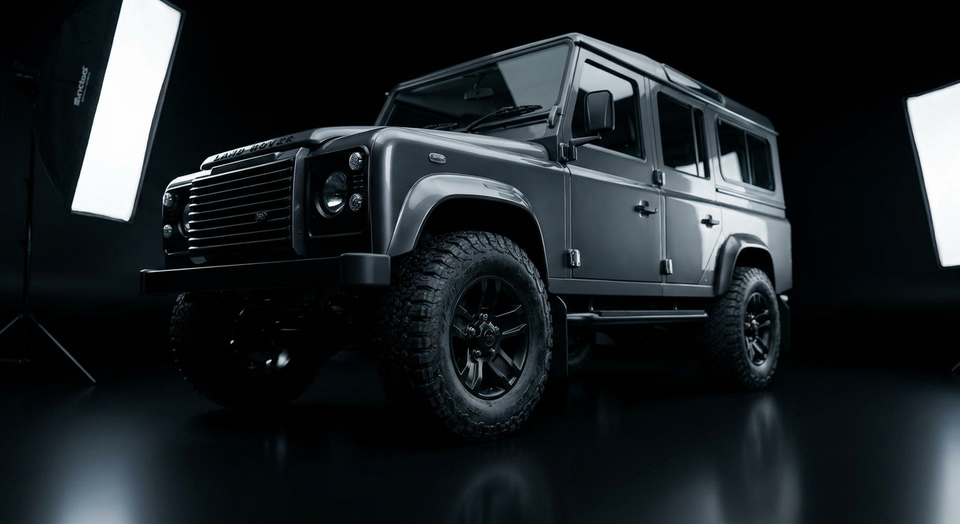
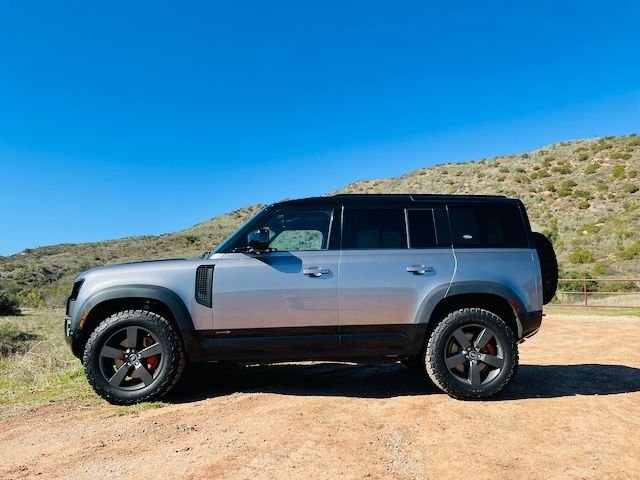
The honest bottom line: yes, a modern Defender 110 (2018+) can run 35s, but not on the factory setup as-delivered. Realistically you're looking at a modest lift or air-suspension raise, a wheel with more backspacing than stock, some liner and pinch-weld attention, and a plan for gearing and recalibration. On the standard ride height with OE wheels, a 32-33" tire is the comfortable, no-drama ceiling — 35s ask for real work, and 37s are a serious build.
What follows is the straight version — how far you can push this platform, what each tire size actually costs you in effort, and how to make it drive right once the big meats are bolted on. This generation of Defender is a clever thing: independent front suspension, available electronic air springs, and a monocoque body rather than the old ladder frame. That changes the fitment math compared to the classic Defenders, so let's treat it on its own terms.
How big can you actually go?
The ceiling depends heavily on your trim and whether you have coil springs or the air suspension. Air-sprung trucks give you a bit of extra articulation clearance at the raised setting, and the aftermarket has grown up around lift and lift-lockout modules that let you keep the rig up. Coil-sprung 110s are simpler to lift with a spacer or spring package but give you a fixed ride height to design around.
Broadly: a 33-class tire is a bolt-on-friendly upsize for most 110s, 35s are achievable with a lift and the right wheel, and 37s move you into a dedicated build with trimming, re-gearing, and careful geometry work. None of that is a promise for your exact truck — trims, wheel choices, and lift combinations vary enough that you should always verify the final stack on your own rig before you commit.
33s: the easy, livable upsize
If you want more sidewall and a meaner stance without turning your Defender into a project, 33s are the sweet spot. Something like a 285/70R17 comes out around 32.7 inches tall, and a true flotation 33X12.50R20 lands right at 33.0. On many 110s this class fits with little or no lift, though wider flotation sizes can want a touch of clearance work at full stuff or full lock.
The trade-offs here are mild. You gain ground clearance under the axles and diffs, a more forgiving sidewall for airing down, and a genuinely better look — all without the drivetrain drama of the taller sizes. Speedometer error is small enough that many owners live with it, though I'd still recommend correcting it. For a daily-driven 110 that sees dirt roads, snow, and the occasional trail, 33s are the smart-money answer.
35s: the popular goal, and what it really takes
This is the size everyone asks about, and the honest answer is that 35s work well on a 110 — once you commit to the supporting mods. A 315/70R17 measures roughly 34.4 inches and behaves like a slightly conservative 35, while a full 35X12.50R20 flotation tire is a true 35.0. Both are legitimate paths; the metric 315 is a hair shorter and often a little easier to tuck.
To make 35s live happily you'll generally need a lift or a raised air-suspension setting, a wheel with appropriate offset/backspacing to pull the tire out of the strut and liner, and some fender-liner and pinch-weld attention. The front is where a 110 rubs first — at full steering lock and compression, the leading edge of the wheel well and the plastic liner are the usual contact points. The exact combination that clears is setup-specific, so plan on test-fitting and trimming as needed rather than assuming a bolt-on. Re-gearing becomes worth a serious look at this size (more on that below), because a 35 noticeably changes your effective final drive.
37s: a real build, not a bolt-on
Thirty-sevens absolutely go on a 110, but this is the deep end. A 37X12.50R20 or the shorter-sidewall-friendly 37X12.50R17 — both true 37s — demand a proper lift, aggressive liner and body trimming, careful attention to CV and driveshaft angles on this IFS platform, and almost certainly re-gearing to keep the truck drivable. Body modification is on the table at this size; some wider wheel-and-tire packages on this chassis are explicitly flagged as needing it.
At 37s the whole vehicle has to be considered as a system: steering effort, brake feel, wheel-bearing and CV load, and the strain on the air struts or coils all climb. It's a fantastic-looking, hugely capable setup when done right — but treat it as a considered build with the budget and fabrication to back it up, and verify clearances at every stage.
What actually changes when you go bigger
Where they rub, and clearance
On the 110, the front inner liner, the pinch weld along the rocker, and the leading corner of the wheel arch are the usual suspects. Rub shows up at full lock, over big compressions, or with the two combined. A trimmed and, ideally, high-clearance liner plus a rolled or massaged pinch weld solves a lot. Clearance is always a function of tire width, wheel offset, lift, and steering angle together — change one and you change the outcome.
Offset and backspacing, explained properly
The factory 110 wheel is an 8.5x19 with roughly a +41.5mm offset on a 5x120 pattern and a 72.6mm hub bore. Offset is how far the mounting face sits from the wheel's centerline — a high positive number tucks the wheel inboard, toward the strut. Backspacing is the related real-world measurement: the distance from the mounting face to the back lip of the wheel. When you fit a wider or taller tire, you usually want a lower offset (more backspacing reduced, tire pushed outboard) so the tire clears the strut and inner liner instead of jamming into them.
Common bolt-on friendly setups on this platform land in the +30 to +45mm range across sizes from 8x19 up through 10x20 and 10x21, which is why so many aftermarket Defender wheels cluster there. Go too aggressive on a low offset and you increase scrub, load the wheel bearings differently, and push the tire into the outer liner and arch — so it's a balancing act, and the right number depends on your exact tire width and lift. Some wider or specific-offset combinations are flagged for fitment checking on this chassis, which is your cue to verify rather than assume.
Re-gearing and drivability
Taller tires effectively raise your gearing — the engine spins slower for a given road speed and has to work harder to turn the bigger rolling mass. On the 110's transmissions this shows up as lazier throttle response, more downshifting, and worse fuel economy, especially with 35s and unavoidably with 37s. On many Defenders the axle ratios aren't easily swapped the way a solid-axle truck's are, so the practical fixes lean on transmission tuning and simply accepting some behavior change; where axle re-gearing or a controller solution is available for your drivetrain, it's worth pricing out. The point is to restore something close to the powerband you started with so the truck stays pleasant to drive.
Speedometer, odometer, and TPMS
Bigger tires cover more ground per revolution, so your speedometer will read low and your odometer will under-count. A 35 versus a ~32" original is a meaningful error — enough to matter for speed limits and service intervals. Correct it with a proper recalibration or a programmer suited to your model year. TPMS also needs planning: the 110 runs direct sensors, so new wheels need sensors transferred or cloned and re-registered so you don't live with a dash light. Budget for it up front.
Load range on a heavy rig
The Defender 110 is a hefty vehicle, and it gets heavier with armor, drawers, and gear. Don't under-tire it. Many purpose-built off-road tires in these sizes come in load range E (or a 125-series load index on flotation sizes) precisely because heavy 4x4s need that carcass strength. Match the tire's load rating to your loaded weight and set pressures to the tire and vehicle, not to the sticker for the original size.
All-terrain or mud-terrain?
For most 110 owners, a quality all-terrain is the right call. It's quieter on-road, wears better, handles rain and snow more predictably, and still covers dirt, gravel, and moderate trails with ease. If your Defender is primarily a road-and-overland truck that occasionally gets muddy, stay all-terrain and enjoy the refinement — this vehicle is too nice inside to punish with unnecessary tire roar.
Step up to a mud-terrain only if you genuinely spend time in deep, sticky, rocky terrain where the open, self-cleaning tread and tougher sidewalls earn their keep. You'll pay for it in road noise, some wet-road manners, and tread life. Hybrid rugged-terrain designs split the difference nicely and have gotten very good. Browse the full range across the tire lineup and weigh how you actually use the truck, not how you imagine using it.
The sizes that fit — and what we stock
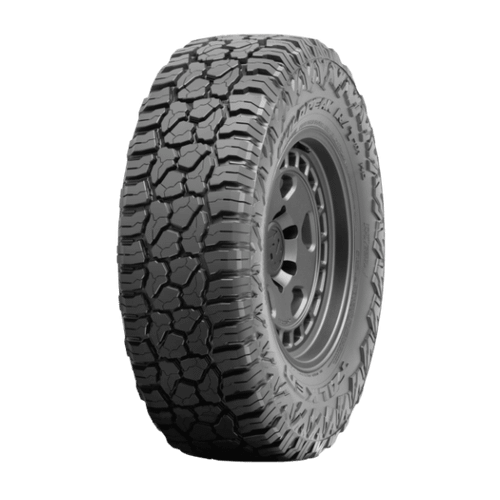
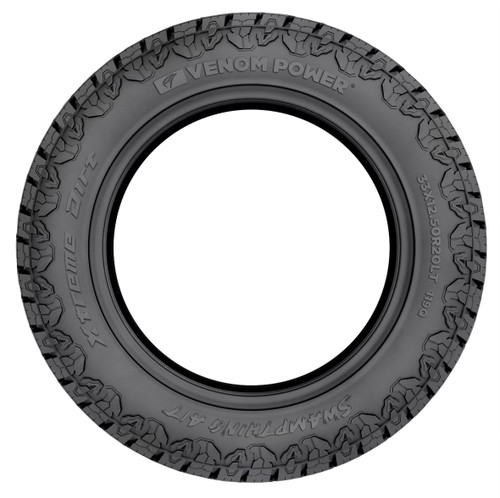
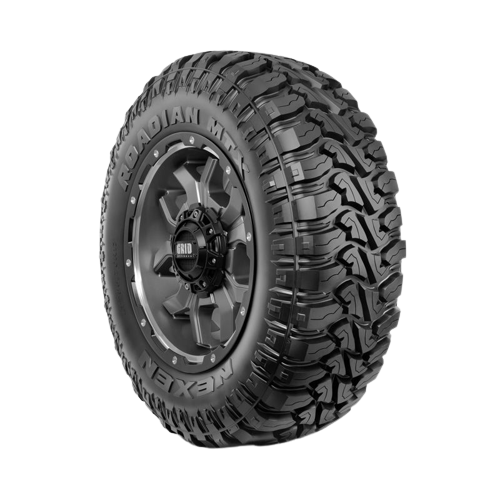
Here's the practical menu by height. In the 33 class, the 285/70R17 (about 32.7") and the flotation 33X12.50R20 (33.0") are both well-stocked and the least-fuss upsizes. For 35s, we carry the metric 315/70R17 (34.4") and the true 35X12.50R20 (35.0") in good depth — options like the Nexen Roadian ATX 35X12.50R20 for a refined all-terrain, the Falken Wildpeak R/T01 35X12.50R20 for a rugged-terrain middle ground, and the Nokian Outpost nAT 35X12.50R20 if all-weather grip is a priority. If you're building on 17s, the Accelera MT-01 315/70R17, the Venom Power Swamp Thing A/T 315/70R17, and the Nexen Roadian MTX 315/70R17 cover mild to aggressive tread in the 35-ish class. For a full 37 build, both the 37X12.50R20 and the 17-inch 37X12.50R17 are available, though stock is naturally tighter at that size.
How to prioritize your build
Start with how you use the truck, then buy in this order. First, pick the tire size that matches your real driving — resist the urge to over-tire a road-biased rig. Second, choose a wheel with an offset and backspacing appropriate to that tire and your lift, keeping the load rating and the 72.6mm hub bore in mind (hub-centric fitment matters on this platform). Third, budget the supporting work honestly: lift or air-suspension solution, liner and pinch-weld trimming, TPMS, and speedometer correction are not optional extras at 35s and up. Fourth, plan for re-gearing or a tuning solution if you're going tall and want the drivability back. Get those four right and the truck rewards you; skip them and you'll chase rubs and a lazy throttle forever. When in doubt, verify the final stack for your specific trim and lift before you spend.
Real Land Rover Defender 110 builds running 35s and up
Actual owner builds — real photos.


Frequently Asked Questions
Do 35s fit a Defender 110 without a lift? Generally, no — not cleanly. On the standard ride height with a stock-offset wheel, a true 35 will contact the front liner and pinch weld at lock and compression. Most owners run some lift or a raised air setting plus a wheel with more outboard offset and trimmed liners. A slightly shorter 315/70R17 is a touch easier to tuck than a full 35x12.50, but plan on supporting mods either way and verify for your rig.
What's the biggest tire I can run with no modifications? A 33-class tire — roughly a 285/70R17 at about 32.7" — is the realistic no-drama ceiling for many 110s, sometimes with only minor clearance attention on wider flotation sizes. It gives you more sidewall and ground clearance while keeping the speedometer error, gearing change, and rubbing minimal. It's the size I'd steer a daily-driven Defender toward.
Will bigger tires ruin my fuel economy and acceleration? They'll dull both, and the effect grows with tire height and mass. Taller tires effectively raise your gearing, so the engine works harder and downshifts more. A 33 is barely noticeable to most people; 35s are clearly felt; 37s really want a tuning or gearing solution to feel normal again. Correcting for it makes the truck pleasant rather than sluggish.
Do I need to re-gear a Defender 110 for 35s? It depends on your drivetrain and how sensitive you are to the change. Many owners run 35s and address drivability with transmission tuning rather than a traditional axle swap, since the axle ratios on these aren't as freely swapped as on a solid-axle truck. If a gearing or controller solution exists for your specific model, price it out — it's most worthwhile as you climb toward 37s.
What offset wheel should I run for 35s? The factory wheel sits near +41.5mm, which tucks the tire inboard toward the strut. For wider or taller tires you generally want a lower offset — commonly in the +30 to +45mm window on this platform — to pull the tire out of the liner and strut. The exact number depends on your tire width and lift, and some combinations are flagged for fitment checking, so confirm the final setup before buying.
All-terrain or mud-terrain for a 110? For most Defenders, an all-terrain or a rugged-terrain hybrid is the better everyday choice — quieter, longer-wearing, and more sure-footed in rain and snow, while still very capable off-road. Choose a full mud-terrain only if you regularly tackle deep mud and gnarly rock, and accept the road noise and shorter tread life that come with it.