Can You Run 35s on a Ford Ranger? (Fitment Guide)
The honest bottom line: yes, you can run 35s on a modern Ford Ranger, but not as a bolt-on swap. Getting a true 35-inch tire under a 2019-and-up Ranger takes a suspension lift, the right wheel offset to push the tire out of the frame and firewall, and usually some fender-liner and pinch-weld trimming. Thirty-threes are the sweet spot most owners land on with a mild leveling kit, 35s are absolutely doable with a proper lift and re-gearing, and 37s are a committed build that most people should leave to dedicated rigs. Here's how each option really shakes out.
How big can you actually go?
The current-generation Ranger (2018-2026 globally, 2019-up in North America) ships on a 7.5x17 wheel with a fairly high +55mm offset. That offset number matters more than most people realize, because it tucks the tire deep into the wheel well toward the suspension. A tall, wide tire on that stock wheel will kiss the upper control arm, the coil bucket, or the frame long before it ever touches the fender. So the honest answer to how large you can go is always a conversation about three things at once: tire diameter, tire width, and how far the wheel pushes that tire outboard.
Trim and generation nuance matters, too. A Ranger Raptor and the Tremor-style off-road packages already come with more articulation, wider track, and beefier fender clearance from the factory, so they tolerate meat that a base XL or XLT on street suspension won't. A Lariat that spends its life on pavement is a different animal than a stripped-down work truck you plan to lift. Whatever your trim, treat every fitment below as a starting point and verify clearance on your specific rig at full stuff and full lock — no two builds with different lifts and offsets rub in exactly the same place.
Running 33s: the easy, livable upgrade
If you want a noticeably tougher stance without turning your Ranger into a project, 33s are where to start. A 33x12.50R17 (a true 33.0-inch flotation size) or the metric-friendly 285/70R17 — which comes in at about 32.7 inches — will usually clear with nothing more than a modest leveling kit or a small lift, plus maybe a little massaging of the front fender liner and the plastic mud-flap area. The tire is only an inch or two taller than a factory all-terrain, so the geometry stays close to stock and the truck still drives like a truck.
The nice thing about this size is how forgiving it is. Because you're not adding a ton of diameter, you can often keep a fairly conservative wheel offset and still avoid rubbing the frame at full lock. The 285/70R17 is genuinely popular here because it's a common OE-replacement footprint, it rides well, and it doesn't demand re-gearing to stay drivable. If you want the chunkier flotation look and a wider contact patch, the 33x12.50R17 is the move, and it's also available in 18-inch and 20-inch fitments if you're matching a bigger wheel. Expect mild speedometer error and minimal, if any, need to re-gear at this diameter.
Running 35s: the real answer, and what it takes
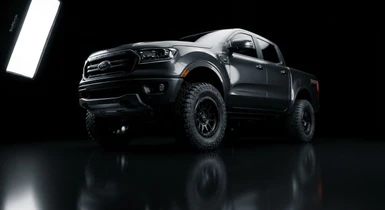
This is the size everyone asks about, so let's be straight. Thirty-fives — a 35x12.50R17 at a true 35.0 inches, or the slightly shorter 315/70R17 at about 34.4 inches — will fit a current Ranger, but they are not a bolt-on. Plan on a genuine suspension lift (not just a leveling kit), a wheel with a lower offset to pull the tire out of the frame and away from the upper control arm, and trimming at the front of the wheel well and the pinch weld. Depending on your trim and how much lift you run, some builds also relieve or roll the pinch seam and add crash-bar clearance up front.
The wheel choice does a lot of heavy lifting here. Dropping from that +55mm factory offset toward something in the +40mm to +45mm range — which is exactly the offset band that pairs well with wider aftermarket wheels on this platform — moves the tire outboard so a wide 35 can articulate without carving into the frame. Push it too far out and you invite fender rub and load the wheel bearings harder; keep it too tucked and the tire fights the suspension. That's the balance you're tuning. Because the exact rub points shift with lift height and offset, verify your combination for your rig rather than assuming a rub-free result.
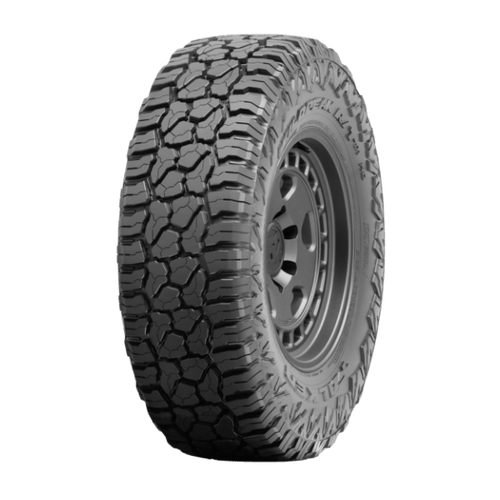
There's a lot of good rubber in this size. On the 17-inch side, the Nokian Outpost nAT in 35x12.50R17 is a stout Load Range F all-terrain, the Falken Wildpeak R/T01 splits the difference between all-terrain and mud, and the Toyo Open Country R/T Pro brings serious off-road bite. If you're on 18s, the Nokian Outpost nAT in 35x12.50R18, the Nexen Roadian ATX, and the Nitto Recon Grappler A/T are all available in this fitment. You can browse the full spread of 35x12.50R17, 35x12.50R18, and 35x12.50R20 options to match your wheel diameter.
Running 37s: a committed build
Can a Ranger wear 37s? Physically, with a big lift, wide low-offset wheels, aggressive trimming, and possibly some fabrication, yes — but be honest with yourself about what that means. A 37x12.50R17 is a full four inches taller than a factory-ish tire and dramatically heavier, and on the Ranger's compact platform that translates into serious changes to steering geometry, driveline angles, and clearance. This is dedicated-rig territory, not a daily-driver tweak, and it will not come together without meaningful suspension and drivetrain work.
At this size, re-gearing isn't optional — it's the difference between a truck that drives and one that feels gutless and abuses its transmission. The extra rotating mass also stresses brakes, bearings, and axles. If you're set on going this big, we stock 37s in 37x12.50R17, 37x12.50R18, and 37x12.50R20, but plan the whole build — lift, wheels, gears, and trimming — before you buy the tire.
What actually changes when you go bigger
Where they rub and how clearance works
On this Ranger, the trouble spots are predictable: the tire contacts the frame or upper control arm at full steering lock, hits the front of the wheel-well liner and pinch weld when the suspension compresses, and can catch the rear of the front fender on articulated terrain. A lift adds vertical room; the right offset adds lateral room; trimming removes the plastic and metal that's in the way. You need all three working together, and the exact clearance depends on your lift height and wheel — so test at full lock and full compression before you call it done.
Offset and backspacing, explained properly
Offset is the distance from the wheel's mounting face to its centerline, in millimeters. A high positive offset like the factory +55 tucks the wheel inward toward the suspension; a lower offset (say +40 to +45) pushes it outward. Backspacing is the related measurement from the mounting face to the back lip of the wheel — less backspacing means more room between the tire and the frame or control arm. When you fit a wider 35, you generally want a wheel with a lower offset and less backspacing so the tire clears the inner suspension. The trade-off: pushing the tire out widens your track, can create fender rub, and increases leverage on the wheel bearings and steering components. Match your wheel to the tire width and your lift, and keep the hub bore (93.1mm on this truck) properly centered.
Re-gearing and drivability
Taller tires effectively raise your final drive ratio, which dulls acceleration, hurts fuel economy, and makes the transmission hunt for gears — especially with the turbocharged four-cylinder that's asked to move more rotating mass. Re-gearing the axles with numerically higher gears restores that lost mechanical advantage and brings drivability back to something close to stock. At 33s many owners get by without it; by 35s it's strongly worth considering; at 37s it's essentially mandatory. Pick a ratio that matches your tire diameter and how you use the truck, and verify the right gear for your setup with a driveline shop.
Speedometer, odometer, and TPMS
Bigger tires travel farther per revolution, so your speedometer will read low and your odometer will under-count miles once you go up in diameter. That needs a recalibration — either through a programmer or a dealer flash — to keep your speed accurate and your mileage honest. Don't forget the tire-pressure monitoring system, either: new wheels need functioning sensors, and they may require a relearn or new sensors to talk to the truck properly.
Load range on a heavy rig
The Ranger is a real truck with a real payload rating, so tire load range matters, particularly if you tow, carry gear, or run a bumper and winch. Heavier-duty tires in higher load ranges (you'll see options up to Load Range F in these sizes) carry more weight and resist puncture better off-road, at the cost of a firmer ride and more weight. Match the load rating to how you actually load and use the truck rather than defaulting to the beefiest tire available.
All-terrain or mud-terrain for a Ranger?
For most Ranger owners, an all-terrain is the smarter choice. It's quieter on the highway, wears more evenly, and handles the mix of pavement, gravel, sand, and light-to-moderate trails that this truck excels at. Something like the Nokian Outpost nAT or the Nitto Recon Grappler A/T gives you real off-road capability without punishing your commute. If you spend genuine time in deep mud, rocks, or sticky clay, a mud-terrain or a rugged-terrain hybrid — the Toyo Open Country R/T Pro or the Falken Wildpeak R/T01 — clears sludge and bites better, at the cost of road noise and tread life. Be honest about the split between road miles and trail miles, and buy for the driving you actually do, not the trip you take twice a year.
What to prioritize as a buyer
Start by choosing the diameter that matches your commitment level — 33s for an easy, livable upgrade, 35s for a proper build, 37s for a dedicated rig. Then get the wheel right, because offset and backspacing determine whether your chosen tire clears without hacking your truck apart. Budget for the supporting mods that make the size drivable: the lift, the trimming, the re-gearing at 35s and up, and the speedometer recalibration. Pick tread and load range for how you use the truck, not for looks alone. And when you're comparing options, browse the full range of available tires so you can weigh tread pattern, load range, and rim diameter side by side before you commit.
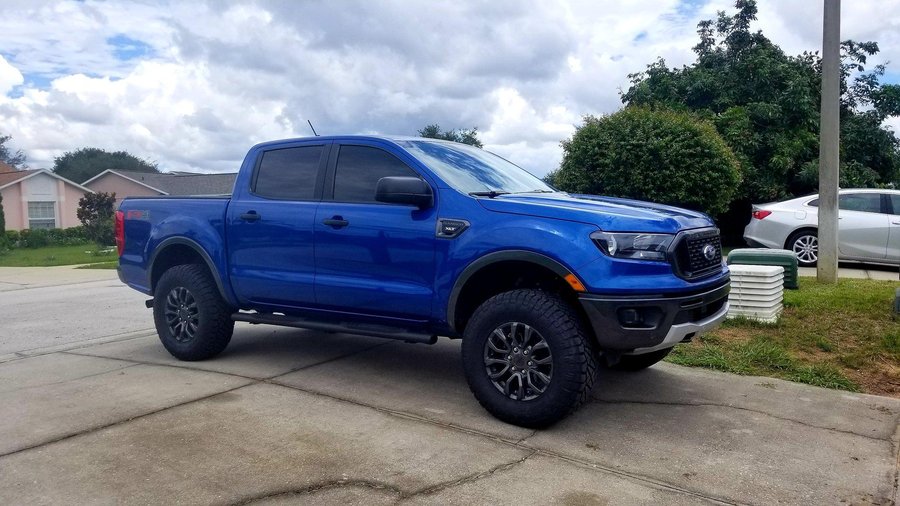
Real Ford Ranger builds running 35s and up
Actual owner builds — real photos.


Frequently Asked Questions
Do I need a lift to run 35s on a Ranger? In practical terms, yes. A true 35-inch tire needs real vertical and lateral clearance that a leveling kit alone won't provide on this platform. Plan on a genuine suspension lift, a lower-offset wheel to pull the tire out of the frame, and some fender and pinch-weld trimming. The exact height depends on your wheel and trim, so verify the combination for your rig rather than assuming a specific lift guarantees a rub-free fit.
Will 33s fit without a lift? Often close to it. A 33x12.50R17 or a 285/70R17 (about 32.7 inches) will usually clear with a modest leveling kit and light trimming of the front liner and mud-flap area. Because you're only adding an inch or two of diameter, the geometry stays near stock and you typically won't need to re-gear. Still, check clearance at full lock and full compression on your specific truck.
Do I have to re-gear for bigger tires? It scales with diameter. At 33s, most owners are fine on stock gears. By 35s, re-gearing is strongly worth it to restore acceleration and keep the transmission from hunting, especially with the turbo four. At 37s it's essentially required. Choose a ratio that matches your tire size and driving style, and confirm the right gearing with a driveline shop.
What offset should I run with 35s? A lower offset than the factory +55 helps a lot — something in the roughly +40 to +45 range pairs well with wider aftermarket wheels on this truck and pushes the tire outboard so it clears the frame and control arm. The trade-off is a wider track and possible fender rub, plus more load on the wheel bearings. Match the wheel to your tire width and lift, and test-fit before finalizing.
Will bigger tires mess up my speedometer? Yes. Taller tires make the speedometer read slower than you're actually going and cause the odometer to under-count miles. You'll want to recalibrate with a programmer or a dealer flash so your speed and mileage stay accurate. While you're at it, make sure your new wheels have working TPMS sensors and complete any required relearn.
Should I get all-terrains or mud-terrains? For most Ranger owners who mix pavement with weekend trails, an all-terrain is the better all-around pick — quieter, longer-wearing, and plenty capable. If your driving leans heavily toward deep mud, rock, or sticky terrain, step up to a mud-terrain or a rugged hybrid for better bite and self-cleaning, accepting more road noise and faster wear in return.
35-inch tires for the Ranger (in stock)