

Posted by THREEPIECE.US on Apr 22nd 2026
W204 C63 AMG Buying Guide: M156 V8 Ownership in 2026
The 2008–2011 Mercedes-Benz C63 AMG (W204) is a hand-built, naturally aspirated 6.2-liter V8 in a midsize sedan — no turbos, no hybrid assist, no fake exhaust noise piped through speakers. The M156 makes 457 horsepower and 442 lb-ft of torque, revs to 7,200 RPM, and sounds like nothing Mercedes will ever produce again. In 2026, clean examples are still trading under $30,000, which makes this one of the most compelling performance sedan buys on the market — if you know what to look for and what to budget for. This is your complete guide.

Quick links
- Why the M156 V8 is a once-in-a-generation engine
- The driving experience modern AMGs can't replicate
- Known failure points: what actually breaks
- Pre-purchase inspection checklist
- Tuning path: bolt-ons to 500 WHP naturally aspirated
- Wheel fitment and stance
- Real ownership costs and budgeting
- Final verdict: stop waiting
Why the M156 V8 Is a Once-in-a-Generation Engine
The M156.985 is a 6,208cc naturally aspirated V8 that AMG hand-assembled in Affalterbach — one technician per engine, signed plaque on the intake manifold. It shares almost nothing with the standard M273 V8 that went into regular Mercedes models. Forged internals, dry-sump oiling on the Black Series variant, and a flat-plane-like willingness to rev that has more in common with the BMW S65 V8 than anything else Mercedes was building at the time.
Performance Pack Plus (PPP) cars from 2009 onward pushed output to ~487 horsepower with revised ECU mapping and improved breathing. Even base C63s make enough power to embarrass cars costing three times as much. The M156 was used across the C63, E63, SL63, CLK63, and ML63 — but the W204 sedan is where it makes the most sense. Lightest chassis, most direct steering feel, and the best power-to-weight ratio of the bunch.
Mercedes replaced this engine with the M157 twin-turbo 5.5L, then the M177 twin-turbo 4.0L, and now a hybrid four-cylinder. The trajectory is clear: the M156 was the peak of AMG's naturally aspirated philosophy, and it's never coming back. If you appreciate what makes a great naturally aspirated V8 special, this is the one to own.
The Driving Experience Modern AMGs Can't Replicate
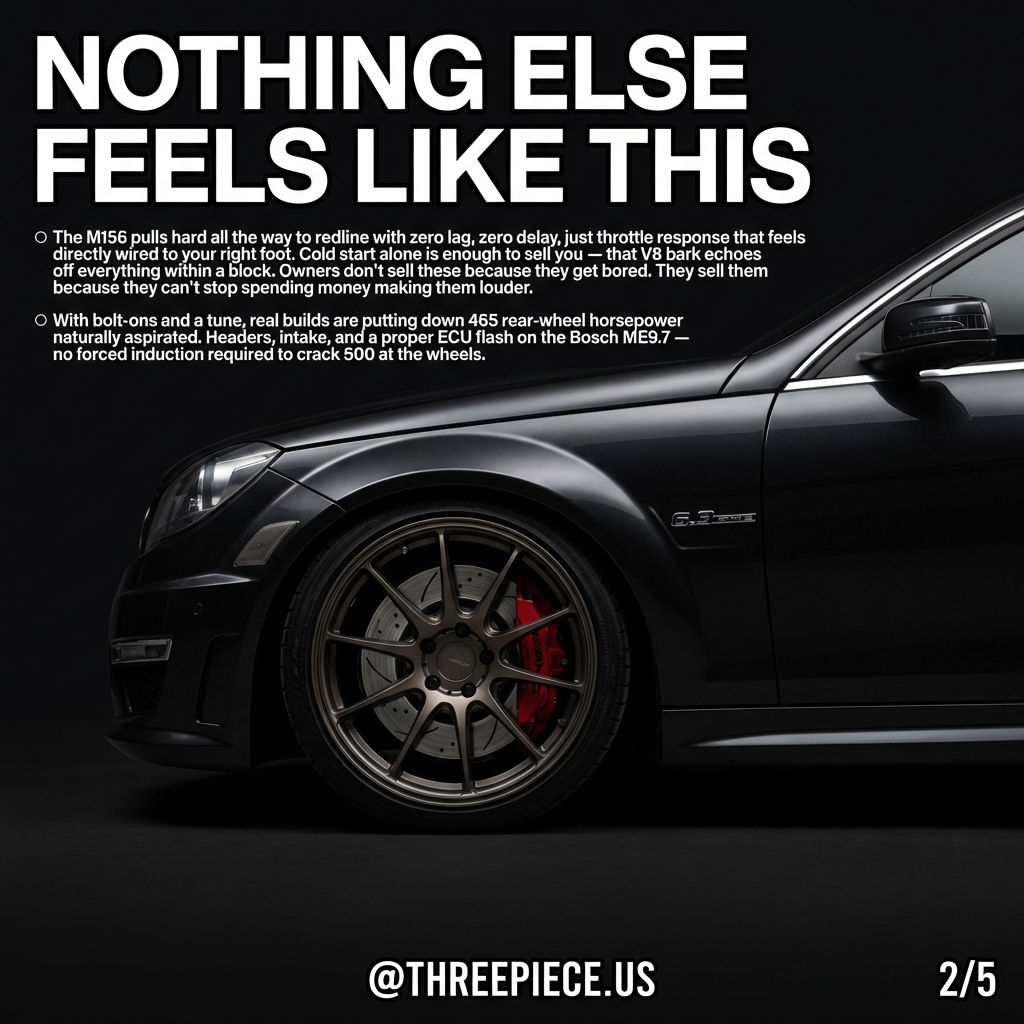
Cold start alone is enough to sell you. That V8 bark echoes off everything within a block — no synthetic augmentation, no active exhaust valves trying to fake a personality. Just displacement and mechanical honesty. The M156 pulls hard all the way to redline with zero lag, zero delay. Throttle response feels directly wired to your right foot because it literally is — there's no turbo spool to wait for, no torque management softening the hit.
The 722.9 seven-speed automatic isn't a dual-clutch, and it won't shift as fast as a PDK. But in Sport+ mode, it's responsive enough, and the torque converter smoothness actually makes this a better daily driver than most track-focused alternatives. The rear-wheel-drive chassis with a limited-slip differential gives you a car that rotates on throttle in a way that the newer turbocharged sport sedans in this price range simply don't.
Owners don't sell these because they get bored. They sell them because they can't stop spending money making them louder. That tells you everything about the emotional hook this car has.
Known Failure Points: What Actually Breaks
The W204 C63 has a reputation for being expensive to maintain, and that reputation is earned — but it's also well-documented and entirely manageable if you buy smart. Here's what actually fails and what it costs.
Head Bolt Failures (Pre-2012 Production)
This is the big one. On 2008–2011 cars, the factory head bolts can stretch or corrode, leading to coolant mixing with oil, misfires, overheating, or complete head failure. Mercedes revised the head bolt design in 2011 — engine serial numbers above M156 #60658 received the updated hardware. If the car is pre-revision without documentation of a retrofit, you're gambling. ARP studs are the definitive aftermarket fix. Budget $8,000–$10,000 for a full top-end rebuild if heads need to come off, including machining and labor.
Camshaft Adjuster, Locking Plate, and Lifter Wear
Cold-start rattle — a loud ticking from the intake side in the first few seconds — is the telltale sign. This typically shows up between 60,000–90,000 miles depending on oil quality and driving habits. The factory locking plates are softer than the pins that engage them, so they gouge over time. Intake and exhaust cam adjusters wear early, and hydraulic lifters can fail. OEM replacements run ~$800 per adjuster and are the same low-quality steel. Aftermarket options from companies like 63Motorsports — hardened lock plates, coated components, Black Series-spec lifters — are the move. Combined top-end work (adjusters, lifters, possible cam replacement) runs $3,000–$5,000.
Magnesium Intake Manifold
The intake manifold is made of magnesium and cracks with age and heat cycling. Symptoms include misfires, rich running, and check engine lights. Dealership quotes run $6,000 parts and labor; independent shops with aftermarket or used manifolds can bring it closer to $4,500. Parts are getting harder to source — some are back-ordered or discontinued. This is worth inspecting on any pre-purchase.
Transmission (722.9 Seven-Speed)
The 722.9 can develop shifting issues — slipping, delayed engagement especially from 4th to 5th, or harsh downshifts. Valve body and conductor plate failures are the most common culprits. Complete transmission failure is reported at higher mileage (70,000–100,000 miles), often on tuned cars with poor maintenance history. Regular fluid changes are non-negotiable. If you want to understand how tuning stages affect drivetrain longevity, that context matters here.

Pre-Purchase Inspection Checklist
The pre-purchase inspection is everything on a W204 C63. Here's what to verify before you hand over money:
- Head bolt revision status: Confirm the engine serial number is above M156 #60658, or request documentation of an ARP stud retrofit. No documentation? Negotiate hard or walk.
- Cold-start cam adjuster rattle: Start the car from cold. A few seconds of loud ticking or rattle from the intake side indicates adjuster or locking plate wear. This is a negotiation point, not necessarily a deal-breaker — but it's a $3,000–$5,000 repair.
- Intake manifold condition: Inspect for cracks. Ask whether the manifold has been replaced and check for receipts.
- Transmission behavior: Test in Comfort, Sport, and Sport+ modes. Shifts should be crisp with no slipping, jerking, or delayed engagement. Pay attention to the 4-5 upshift under light throttle.
- Service history: Oil changes every 3,000–5,000 miles with full synthetic. Transmission fluid changes documented. Poor maintenance accelerates every failure mode on this list.
- Engine and transmission mounts: Clunks during acceleration/deceleration transitions suggest worn mounts — common by 75,000 miles. Flex disc wear causes driveline vibration.
A thorough PPI from a Mercedes specialist (not a general mechanic) is worth every dollar. This car rewards informed buyers and punishes lazy ones.
Tuning Path: Bolt-Ons to 500 WHP Naturally Aspirated
The M156 tuning ecosystem is deep and mature. MBH Motorsports, AMR Performance, and VF Engineering all offer proven ECU flashes for the Bosch ME9.7 with documented dyno results. The path is straightforward:
- Stage 1 ECU flash: Meaningful power pickup with no hardware changes. Revised fuel and ignition maps, raised rev limiter on some tunes.
- Long-tube headers + tune: This is where the M156 wakes up. Headers are the single biggest bolt-on gain on this engine. Combined with a proper ECU calibration, real builds are putting down 465+ rear-wheel horsepower naturally aspirated.
- Full bolt-on (headers, intake, tune): Documented builds are cracking 500 wheel horsepower with no forced induction. That's territory that embarrasses newer turbo AMGs on feel alone — and it does it with linear power delivery and an exhaust note that sounds like the apocalypse.
If you're curious about what cold air intakes actually do on a performance engine, the M156 is one of the platforms where intake improvements translate to real gains because the stock airbox is restrictive. The community has also solved every reliability concern this engine has — aftermarket cam adjusters, hardened locking plates, ARP head studs. Companies like 63Motorsports exist specifically because owners refuse to let this platform fade.

Wheel Fitment and Stance
The W204 C63 runs a 5x112 bolt pattern with a 66.6mm center bore. Stock wheels are 18x8.5 ET30 front / 18x9.5 ET33 rear on the AMG-specific setup. The staggered fitment from factory is one of the things that gives the C63 its aggressive rear stance, and upgrading wheels is the single most impactful visual modification you can make.
Popular aftermarket fitments push to 19x8.5 +35 front / 19x9.5 +40 rear for a flush look without fender work, or 19x9 +25 front / 19x10.5 +25 rear for more aggressive builds running spacers or rolled fenders. If you're new to running different sizes front and rear, our breakdown of wheel spacer safety is worth reading before you finalize specs.
For tire sizing, 245/35R19 front / 275/30R19 rear is the sweet spot on a 19-inch staggered setup. Browse 245/35R19 tires and 275/30R19 tires for options. If you're staying on 18s, 255/35R18 square is a solid track-day setup.
Three-piece wheels suit this car exceptionally well — the ability to customize width, offset, and lip depth means you can dial in fitment perfectly for the W204's fender lines. The Work VS series and Work Meister line are both proven on German sedans, and the Work Emotion series offers a more modern spoke design if that's your direction. Browse 19-inch wheels in 5x112 to see what fits. Check out our vehicle gallery for build inspiration on similar platforms.
If you're running three-piece wheels and need to replace hardware, M7x32 chrome assembly bolts at $10 and M7 assembly nuts at $3.80 are available individually. For a cleaner look, the M7x32 24K gold bolt/nut set at $15 adds a subtle detail. And don't forget 90-degree valve stems at $3.80 — essential for deep-dish rear lips where straight stems won't clear brake calipers.

Real Ownership Costs and Budgeting
Here's the honest math. If you buy a W204 C63 with the head bolt revision already done and a clean service history, your ongoing costs are manageable. If you buy one blind, you're rolling dice on five-figure repairs. The difference between a great ownership experience and a financial disaster is entirely in the pre-purchase.
Budget these potential expenses in year one:
- Cam adjusters + locking plates + lifters: $3,000–$5,000
- Intake manifold replacement (if cracked): $4,500–$6,000
- Head bolt / ARP stud job (if not already done): $8,000–$10,000+
- Transmission valve body refresh: $1,500–$3,000
- Wear items (mounts, belts, pulleys, flex disc): $1,000–$2,500 every 50–75K miles
The smart move is setting aside $8,000 as a reserve fund. Front-load the known maintenance in year one — cam adjusters, lifters, head bolt verification — and you're set for years of trouble-free ownership. DIY capability or a good independent Mercedes specialist (not the dealer) makes a massive difference in cost. This car's community knowledge base means you'll never be guessing at a repair — every failure mode has a documented fix with parts readily available.
Compare this to the E46 vs E92 M3 ownership equation and the C63 actually comes out ahead in many scenarios — the M156's issues are well-known and solvable, while rod bearing anxiety on the S65 never fully goes away. If you want to understand how suspension upgrades factor into daily driving costs, that's another consideration for long-term budgeting on this platform.
Final Verdict: Stop Waiting
If you've been circling a clean W204 C63 with service history and the head bolt revision documented, stop overthinking it. This is a hand-built naturally aspirated AMG V8 at depreciated money with a proven tuning path to 500 wheel horsepower on bolt-ons. The sound, the throttle response, the mechanical honesty — none of that is coming back. Mercedes is building hybrid four-cylinder AMGs now. The M156 was the end of an era, and the W204 is the most accessible way to own one.
Prices aren't going down from here. The cars that have had their top-end work done are the ones appreciating, and the supply of clean, sorted examples shrinks every year. Do your homework, get the PPI, budget for the known issues, and go get one. Then finish the build with a proper set of staggered wheels — because a W204 C63 on the right fitment is one of the best-looking German sedans of the last twenty years. Browse the full Work Wheels catalog and the wheel parts and accessories collection to start planning your setup.