

Mazdaspeed3 Build Order: The 400whp Sleeper Hatch
The Mazdaspeed3 is the cheapest honest path to 400whp in a car with four doors, a hatch, and an interior that still smells like a 2009 lease return. Nobody screenshots a Mazdaspeed3 listing. Nobody at the meet knows what they're looking at. That's exactly why the MZR 2.3 DISI turbo crowd is quietly running 11s on a grocery-getter while the Evo and STI crowd argues about which badge deserves which tax bracket. This is the build order that actually works — and the order matters more than the parts.

Quick links
- Why the MS3 got skipped
- Step 1: rear motor mount, before anything
- Step 2: the HPFP cam lobe inspection
- Step 3: turboback, tune, and E85
- Step 4: cooling, because your logs are lying
- Step 5: clutch and the passenger axle
- Mazdaspeed3 wheel fitment: 5x114.3, 67.1mm
- The verdict
Why the MS3 got skipped
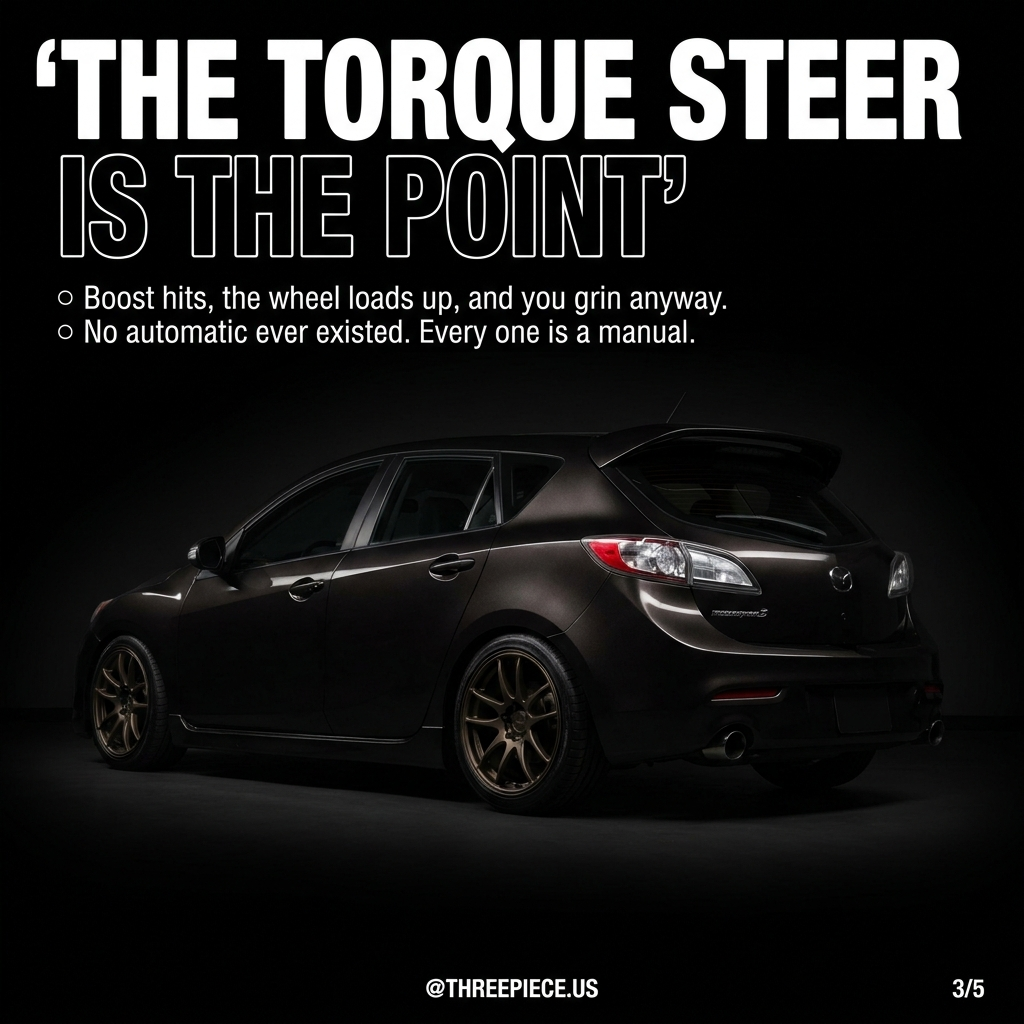
Front-wheel drive, no AWD rally lineage, and a smirking front bumper on the Gen2 cars. That combination kept the 2007-2013 Mazdaspeed3 off every poster wall in America, and it's the only reason a clean one still trades in the $9,000-$15,000 range while comparable-era AWD turbo sedans have doubled. The mechanical facts don't care about the bumper: 263 hp and 280 lb-ft from the factory, a direct-injected 2.3 with a K04, and a six-speed manual in every single one built. No automatic ever existed. That's a rarer statement than most "manual-only" enthusiast cars can make.
If you're weighing it against the usual suspects, read our takes on Focus ST vs Mk7 GTI and Legacy GT vs WRX — the MS3 undercuts both on entry price and out-torques both on a stock turbo.

Step 1: rear motor mount, before anything
Before power. Before wheels. Before you open a browser tab for a turbo. The factory rear motor mount is a liquid-filled apology, and it is why your car headbutts you in second gear. A solid or poly RMM changes how the chassis behaves more than 40whp ever will — shifts get crisp, wheel hop calms down, and the torque steer turns from a slap into a handshake.
Do the rest of the mounts and your suspension in the same weekend and you've fixed the car's actual personality problem. Just don't repeat the classic install errors we broke down in the Civic Si coilover install mistakes piece — slamming an MS3 without corner balancing or bump-stop math gives you a hatch that rides like a shopping cart and eats the inside edge of every tire you buy.
Step 2: the HPFP cam lobe inspection
This is the step people skip and regret. On Gen1 (2007-2009) cars especially, the high-pressure fuel pump rides a lobe on the exhaust cam, and a worn follower turns into metal in your fuel system. Pull the valve cover and look at the lobe before you load a single tune. Ten minutes with a flashlight now, or a full top-end teardown later. Your call.
Direct injection is the whole reason this platform makes big torque low — it's also the fragile part of the recipe. Sort fueling first, tune second. That's the entire roadmap, and it's the same discipline that separates a healthy build from a $6,000 paperweight. Owners of other DI turbo platforms learned it the hard way too; see 5 things every Evo X owner wishes they knew sooner.
Step 3: turboback, tune, and E85
A 3-inch downpipe, a catback, a bigger turbo inlet to replace the factory crush pipe, and a real tune. That's most of the low-hanging power on the stock K04. On pump gas you're looking at roughly 280-300whp; on E85 the factory turbo makes numbers that embarrass people who spent triple on badge value. Push past that and you're into a bigger frame turbo, upgraded HPFP internals, and often port injection — which is how the scene lands on 400whp on the factory block as the accepted ceiling before rods become the conversation.
Spend in that order. If you want a worked example of mod money spent well versus wasted, our Focus RS mod ranking and Veloster N mod ranking both apply almost one-for-one to this car.
Step 4: cooling, because your logs are lying
The top-mount intercooler heat soaks in traffic, and once it does, your logs will tell you a comfortable lie about what the engine actually saw. Either a serious TMIC upgrade or a front-mount, plus a proper oil cooler if you see track days — do it before you chase timing. Heat-soaked timing pulls are what turn a fast street hatch into a slow, sad one halfway through a canyon run. The same rule shows up in every boosted-Subaru discussion in our WRX STI generations ranked breakdown.
Step 5: clutch and the passenger axle
280whp will chew through the stock disc, and on this platform the passenger-side axle is the one that surrenders first. Buy the spare now, while you're calm and the car is moving. The "I'll knock it out next weekend" install is how you spend a Saturday discovering your press won't fit in your garage, followed by two trips to the parts store and one very expensive phone call to a shop.

Mazdaspeed3 wheel fitment: 5x114.3, 67.1mm
The MS3 runs 5x114.3 with a 67.1mm hub bore and M12x1.5 studs — the friendliest bolt pattern in the hobby, which is great news for anyone shopping used JDM sets. Factory is a sleepy 18x7 +52.5 on 215/45R18. That offset is why a stock MS3 looks like a rental.
The setups that actually work:
- 18x8.5 +35 with 235/40R18 — the no-excuses daily setup, no fender work, no rubbing at sane ride height.
- 18x9 +35 with 245/40R18 — the enthusiast sweet spot. Browse Volk Racing NE24 5x114.3 18x9.5+22 Matte Gun Black and pair them with 245/40R18 tires.
- 18x9.5 +30 with 255/35R18 — expect a fender roll and some camber. Start at 255/35R18 tires.
- Track duty: 17x9 +35 on a 255/40R17 for cheaper rubber and more sidewall.
For lightweight flow-formed options that suit a 3,200 lb front-drive hatch, the Work Emotion T5R at $396 and the Work Emotion T7R at $432 are the honest value picks in the Work Emotion lineup. Want a step up the ladder without going full 3-piece? The Work Emotion T7R 2P at $531 gets you a real barrel and a deeper face. Going all the way, the Work Emotion CR 3P at $895.50 is the endgame set for a car nobody expects to have endgame wheels. Budget-conscious? The Work Emotion CR Kiwami at $270 is the entry point that still looks correct.
Finish it properly: hubcentric rings for the 67.1mm hub, proper lug nuts, 90 degree valve stems at $3.80 for tight-spoke clearance, and a Work VS reproduction center cap at $50 if you scored a used set missing its caps. Running a genuine 3-piece? Fresh M8x32 assembly bolts in satin black at $10 each and silicone sealant at $10.99 are the difference between a rebuilt set and a leaking one — and our refinishing service handles the faces. Need fitment inspiration on the same bolt pattern? The 5x114.3 Mustang fitment guide and the vehicle gallery are both worth an hour.

The verdict
The torque steer isn't a flaw to engineer out — it's the car reporting that it's making power. Fix the mounts, keep the attitude. Do it in order: RMM, fuel system inspection, turboback and tune, cooling, driveline. Then wheels, because a 400whp hatch on stock 18x7 +52.5 is a joke told badly.
The MS3 will not appreciate like a GC8 and it will never get a magazine retrospective. It will, however, humiliate cars worth three times as much on a back road while carrying a full set of tires in the hatch. That trade has never been more available than it is right now.
So: what's the one thing you sorted on your Speed3 before you ever touched boost — the rear motor mount, or the fuel pump lobe you were scared to look at?