
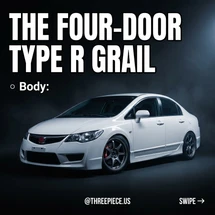
How to Build a Honda Civic Type R FD2 (2007-2011)
The 2007-2011 Honda Civic Type R FD2 is the only Type R that seats four adults and still ruins their weekend, and the people hunting one right now know exactly what they're sitting on. This isn't an FA5 Si with a red badge — the FD2 got a 225 PS K20A spinning to an 8,400 rpm redline, a close-ratio six-speed, a helical LSD, Brembo four-piston front calipers, extra seam welding, and a factory suspension tune so aggressive that Japanese owners complained about it in period. So the FD2 build guide is short on purpose: this is a scalpel job, not a sledgehammer job.

Quick links
- Why the FD2 got skipped
- Honda already did the hard part
- Don't "fix" the factory ride
- FD2 wheel fitment: width first, diameter never
- Tire sizes that actually work
- The build order
- Final verdict
Why the FD2 got skipped
While everyone in North America argued about whether the FK8 Type R was too aggressive-looking, the FD2 sat in Japan being the sharpest front-drive sedan Honda ever built and nobody outside forums cared. It never came here. It doesn't hit the US 25-year exemption until 2032 for the earliest 2007 cars, while Canada's 15-year rule already opened the gates — which is exactly why clean Canadian-landed FD2s stopped being cheap.
The result is a car with a genuine Type R drivetrain that hasn't been picked over by the mainstream yet. Same energy as the undervalued Acura sedan crowd, except this one has a helical diff and a Suzuka-developed damper tune. See how people are actually finishing these builds in our vehicle gallery.

Honda already did the hard part
The K20A in the FD2 is not the K20Z3. Higher compression, more aggressive cams, a better head — it's the closest thing to a factory race engine Honda put in a family sedan. Which means bolt-ons here chase throttle response and top end, not peak numbers. A well-sorted intake, a proper header, a cat-back that doesn't drone, and a real tune. That's the recipe, and it's worth maybe 15-25 whp honestly measured.
What it does buy you is the top 1,500 rpm feeling sharper, which on a car that lives above 6,000 rpm is the whole point. If you want the general logic of mod sequencing on a high-revving naturally aspirated engine, our VQ37VHR mod order breakdown follows the same rule: fix airflow and tune, ignore the dyno-queen parts. And before you buy a cone filter for it, read why half the popular bolt-ons on a modern NA platform are money pits.
Chasing turbo power on an FD2 is legitimate — but understand you are then building a different car, and the resale premium on a JDM-honest FD2 goes away the moment the K20A stops sounding stock at 8,000 rpm.
Don't "fix" the factory ride
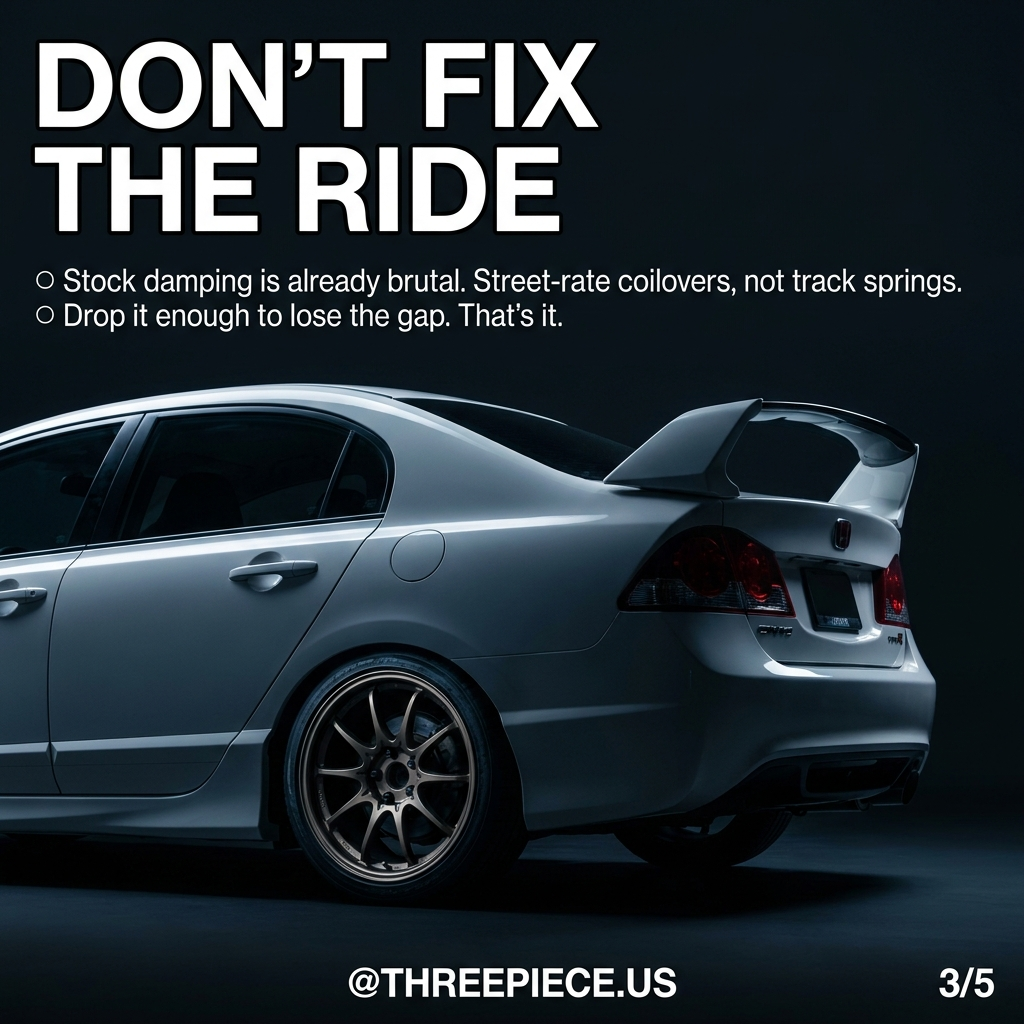
Here's the argument in every FD2 thread: the factory damping is already brutal, so do you respect it and spend everything on wheels, tires and alignment — or is a 2007 Honda damper tune something you should have replaced a decade ago?
Our position: after 15+ years, the OEM dampers are cooked regardless, so replace them — but replace them with street rates, not track springs. The FD2 shell is stiff and the geometry is already sorted. Adding spring rate on top of Honda's factory Type R tune gets you a car that skates over mid-corner bumps. A quality monotube set, run soft, sitting about 1 inch lower than stock, is the correct answer.
The Fortune Auto 500 Series for the 2006-2011 Honda Civic 8 (FA/FG) with separate-style rear at $1,799 is the platform to start from — custom valving and revalvable, which matters on a chassis this specific. Confirm FD2-specific application before ordering, since the JDM car does not share every bracket with a USDM Civic. Browse the full suspension catalog, and if you're cross-shopping Honda chassis for a different project, the DC5 RSX 500 Series set at $1,999 and the EK Civic set at $1,918.36 use the same architecture. For how much damper quality actually changes a car, our 370Z coilover comparison is the useful reference.
FD2 wheel fitment: width first, diameter never
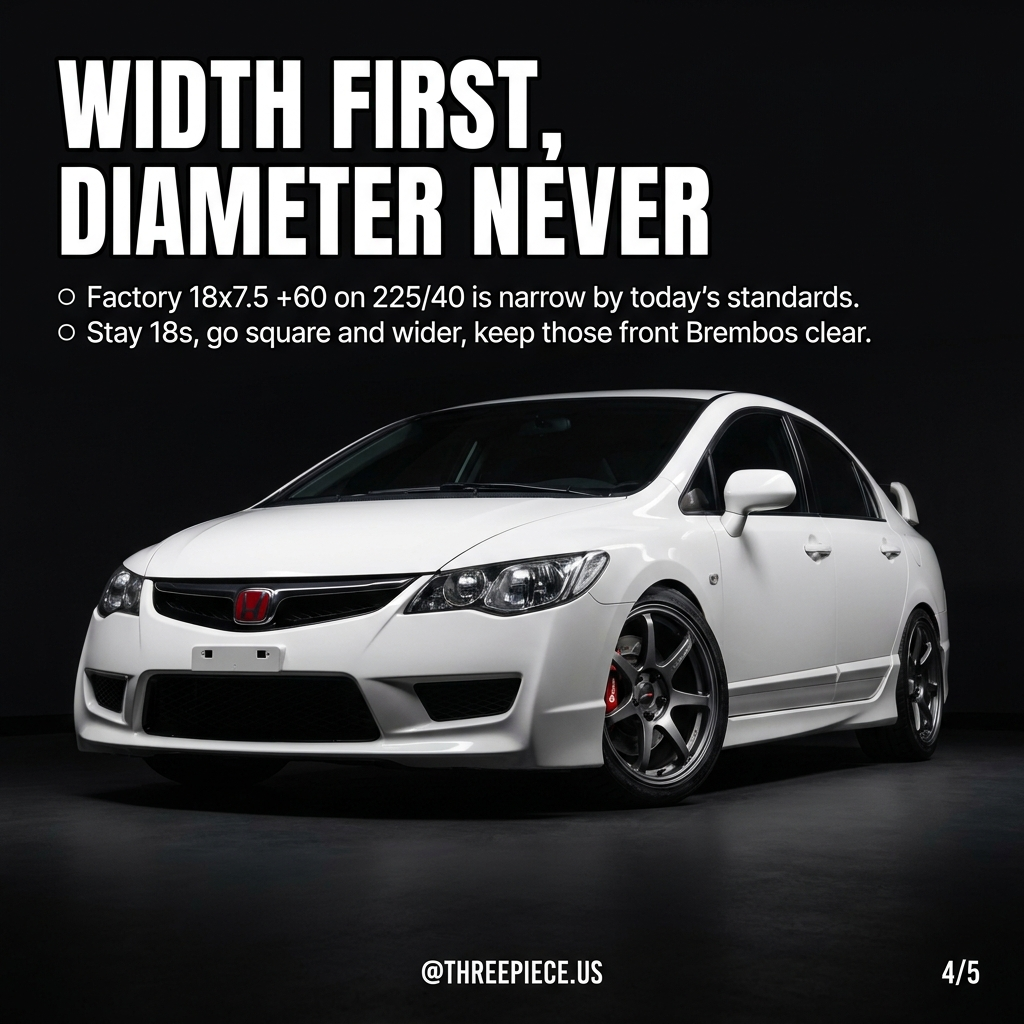
Factory fitment is 18x7.5 +60 on 225/40R18, 5x114.3, 64.1mm hub bore. That +60 offset is the single most conservative decision on the entire car — a 7.5-inch-wide wheel tucked deep under an arch that has room for far more.
The move is width, not diameter. 18x8.5 to 18x9.5 in the +35 to +45 window is the FD2 sweet spot. Going from +60 to +40 pushes the face out 20mm, which is the difference between "factory JDM sedan" and "fills the fender." Start with 18x9.5 wheels in 5x114.3, or step back to 18x8.5 in 5x114.3 if you want to stay on stock camber.
Two hard rules. First, stay on 18s — 19s add unsprung mass to a chassis dialed in by people driving it at Suzuka, and you lose sidewall you can't get back. Second, the front Brembos dictate spoke design. The 320mm four-piston front caliper needs real inner barrel clearance, so heavily concave faces with a shallow inner profile can foul it. Check clearance before you commit; a spacer to solve a caliper problem is the wrong fix.
For designs that historically clear big Honda front calipers, the Work Emotion series is the default. The Work Emotion T7R at $432 and the Work Emotion CR Kiwami at $270 are the two most FD2-honest picks. If you want to go endgame, the Work Emotion CR 3P at $895.50 gets you rebuildable, refinishable hardware — and our refinishing service means you never have to buy the set twice. Add hubcentric rings if your wheel bore runs larger than 64.1mm, plus proper lug nuts and a 90 degree valve stem at $3.80 for deep-lip clearance.
If you're new to reading offset changes as ride-height and camber consequences, the Evo VIII/IX fitment guide covers the same 5x114.3 math on a similarly narrow-from-factory platform.
Tire sizes that actually work
Go 235/40R18 on 8.5s or 245/40R18 on 9.5s. Both keep real sidewall, which is not a stance compromise — it's how you keep the FD2's steering feel from turning nervous. Shop 235/40R18 tires or 245/40R18 tires depending on your width.
Square setup, always. This is a front-drive car with a helical LSD and it wants matched grip at all four corners — staggered thinking belongs on rear-drive platforms. If the car sees track days, our 200TW tire selection guide will save you from buying a compound that overheats in session two.

The build order
Wheels and tires first. Alignment second. Coilovers third. Tune and intake/exhaust fourth. A front lip — Mugen or Spoon-style — whenever you find a real one. Then stop.
That's the entire list, and the discipline is the point. Every dollar past that is building a different car: heavier, louder, less resellable, and further from the thing that made you want an FD2 in the first place. The half-the-mods-are-waste principle applies harder here than on almost any other hot chassis, because Honda already spent the development budget you'd be duplicating. Finish it with the correct Work center caps — the Work VS reproduction cap at $50 is the detail that separates a finished build from an almost-finished one.
Final verdict
The FD2 is the four-door Type R grail because it's the rare enthusiast car where restraint is the correct build. Leave it JDM-honest — square 18s in the +35 to +45 range, 235/40 or 245/40, street-rate coilovers an inch down, a tune, and nothing else — and it stays the sedan everyone else wishes they'd bought at 2019 prices.
Start with the part that changes the car most for the money: pick your wheel set and your damper package, then leave the K20A alone.
So settle it: do you respect Honda's factory damper tune and put every dollar into wheels, tires and alignment — or is a 2007 Honda damper something you should have replaced ten years ago? And if you're importing one tomorrow, is it Championship White or nothing?