
Posted by THREEPIECE.US on Apr 23rd 2026
BMW E90 335i N54 6MT Build Guide: Mod Order That Works
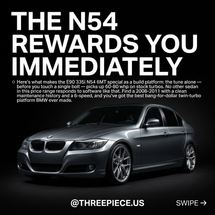
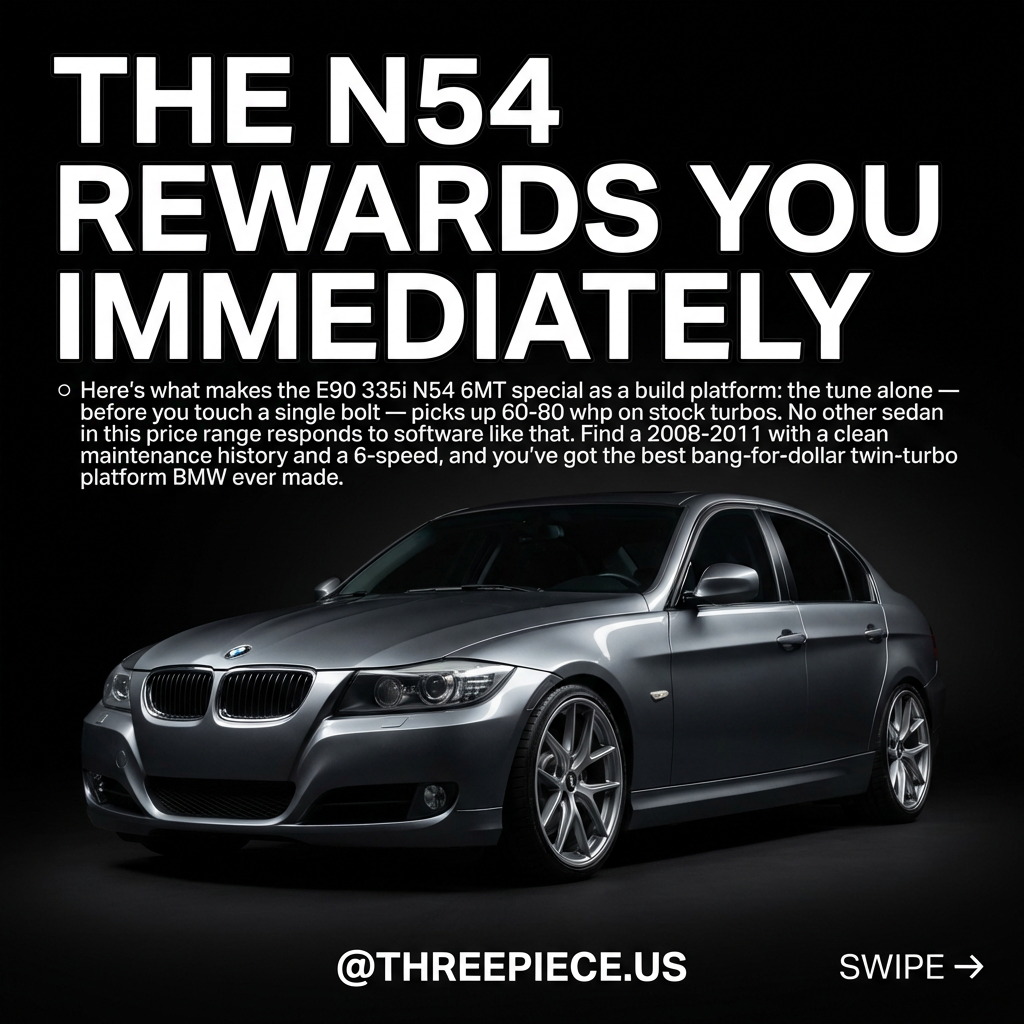
The BMW E90 335i N54 6MT is the best bang-for-dollar twin-turbo build platform BMW ever produced. A tune alone — before you touch a single bolt — picks up 60-80 whp on stock turbos. No other sedan in this price range responds to software like that. But too many owners flash MHD on day one with a cracked plastic charge pipe and index 1 injectors, then wonder why they're chasing boost leaks in a parking lot. This guide covers the correct build order: maintenance first, then power, then chassis and fitment — so every dollar actually translates to something you feel from the driver's seat.
Quick links
- Why the N54 Rewards You Immediately
- Fix It First, Then Flash
- Full Bolt-Ons: Getting Past 400 WHP
- Beyond FBO: 450-550+ WHP Territory
- Suspension and Wheel Fitment That Works
- The Build Order That Makes Sense
Why the N54 Rewards You Immediately
The N54 is a twin-turbo 3.0L inline-six making roughly 300 hp / 300 lb-ft stock. What makes it special as a build platform isn't the factory output — it's how aggressively it responds to tuning. The stock turbos have significant headroom, the ECU is well-understood thanks to MHD and JB4, and the iron block handles boost that would warp an aluminum equivalent. On pump gas alone, a basic flash tune puts you in the 350-380 whp range with zero hardware changes beyond a charge pipe.
Find a 2008-2011 with a clean maintenance history and the 6-speed manual, and you've got a platform that embarrasses cars costing twice as much. The 6MT is the key — it holds power far better than the ZF auto in this generation, and the aftermarket transmission tune support from XHP keeps shifts clean as power climbs. If you're comparing this to other turbocharged sedans in the same price bracket, read our breakdown of real Stage 1 vs Stage 2 dyno numbers to understand why the N54's software gains are genuinely unusual.
Fix It First, Then Flash
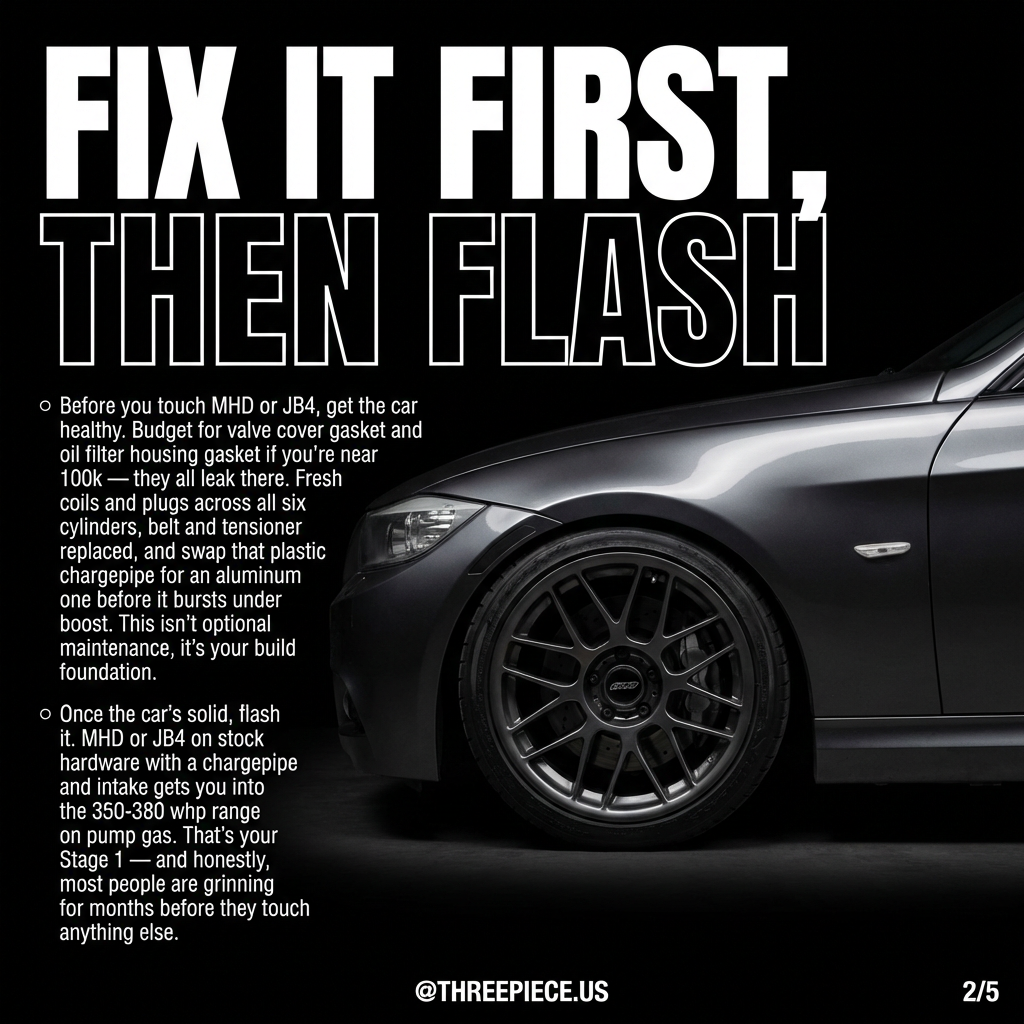
Before you touch MHD or JB4, the car needs to be healthy. The N54 has well-documented failure points that become catastrophic under increased boost. Treat this as your build foundation — not optional maintenance.
Priority items before any tune:
- Valve cover gasket — leaks on virtually every N54 near 100k miles. Oil pools around the coils and causes misfires.
- Oil filter housing gasket (OFHG) — another guaranteed leak around 100k. Oil drips onto the serpentine belt and can cause belt failure, which cascades into timing chain and oil pickup damage.
- Coil packs and spark plugs — replace all six. Plugs every 50-60k miles, coils as a set after 80-100k. Misfires under boost will wreck your catalytic converters and your tune logs.
- Serpentine belt, tensioner, and pulleys — replace before 100k. A snapped belt on the N54 isn't just a tow — it can take out critical engine components.
- Charge pipe — the factory plastic charge pipe is a ticking time bomb. Under any boost increase, it will burst. Swap it for a VRSF aluminum unit or equivalent before you flash anything. This is a $100-150 part that prevents a $0 driving experience when it lets go at full boost on the highway.
Once the car is solid, flash it. MHD or JB4 on stock hardware with the aluminum charge pipe and a cone intake gets you into the 350-380 whp range on 93 octane pump gas. That's your Stage 1 — and honestly, most people are grinning for months before they touch anything else. We covered the N55 variant of this platform in our E90 335i N55 buying guide — but the N54's twin-turbo setup gives it meaningfully more headroom than the single-turbo N55 at every stage.
Full Bolt-Ons: Getting Past 400 WHP
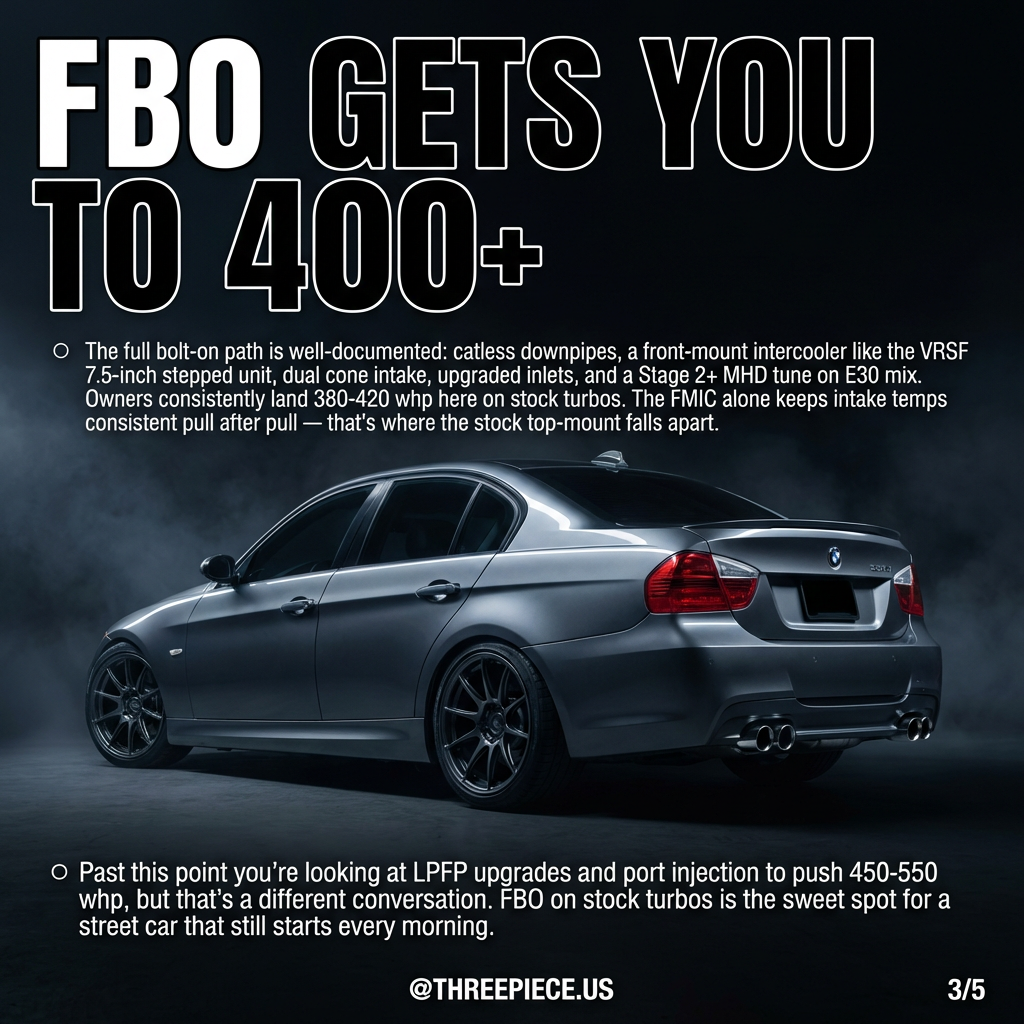
The full bolt-on (FBO) path on the N54 is one of the most well-documented in the entire BMW community. Here's the parts list that consistently puts owners in the 380-420 whp range on stock turbos:
- Front-mount intercooler (FMIC) — the VRSF 7.5-inch stepped unit is the community standard. The stock top-mount intercooler heat-soaks after two pulls; a properly sized FMIC keeps intake temps consistent lap after lap, pull after pull. That consistency is where the real power gains live. If you want to understand why intake temperature management matters so much, our cold air intake deep dive covers the thermodynamics.
- Catless downpipes — VRSF or Evolution Racewerks are the go-to options. Removing the restrictive factory catalytic converters is the single biggest exhaust-side restriction on the N54. Note: this makes the car illegal for street use in most states.
- Upgraded inlets — VRSF 2.5-inch inlets replace the restrictive factory pieces feeding the turbos.
- Dual cone intake — replaces the factory airbox with higher-flow filtration.
- Blow-off valve — Tial or Turbosmart units replace the factory diverter valve for better boost response under aggressive tuning.
- Stage 2+ MHD tune on E30 mix — ethanol blending is where the N54 really wakes up. E30 (30% ethanol blended with 93 octane) raises the knock threshold significantly, allowing more timing and boost. Owners consistently report 400-420 whp on stock turbos with this combination.
The FMIC alone is the mod that separates consistent power from heat-soaked disappointment. If you're only doing one hardware upgrade beyond the charge pipe, make it the intercooler.
Beyond FBO: 450-550+ WHP Territory
Past the FBO sweet spot, you're looking at fuel system upgrades and potentially port injection to push the stock turbos to their absolute limit — or going single turbo for serious power.
Fuel system upgrades for 450-550 whp:
- Low-pressure fuel pump (LPFP) — a Walbro 450 or 535 in a bucketed housing is the standard upgrade. The factory LPFP can't keep up with E85 or high-ethanol blends at full boost on stock turbos pushed to the limit.
- Port injection — Phoenix Racing or Evolution Racewerks PI manifolds add supplemental fueling that the direct injection system alone can't provide at 500+ whp. This is the bridge between FBO and big turbo builds.
Single turbo builds (550-800+ whp): Dedicated drag and track builds like the well-known SpoolStreet threads use DocRace top-mount single turbo kits with PSP 900 intercoolers, forged internals (pistons, rods, King rod bearings, Supertech valvetrain), and custom fueling to push 700+ whp. At this level, the stock differential becomes the weak link — the ring and pinion and output shaft flanges fail under 500+ whp with aggressive launches. The community solution is an M3 differential swap or a Ford 8.8 rear end conversion. The 6MT transmission itself holds up reasonably well to about 550 whp, but axle failures start appearing with hard launches beyond that.
For most street builds, FBO on stock turbos is the sweet spot. It starts every morning, makes 400+ whp, and doesn't require rebuilding the bottom end. If you're debating how far to push it, our "Stop Buying M3s" piece covers why the 335i platform offers more usable performance per dollar than the E9x M3 in most real-world scenarios.
Suspension and Wheel Fitment That Works
Power means nothing if the chassis can't use it. The E90's suspension geometry is solid from the factory, but the rubber bushings and dampers are finished by 80-100k miles on most examples. Here's what the community has proven works.
Coilovers:
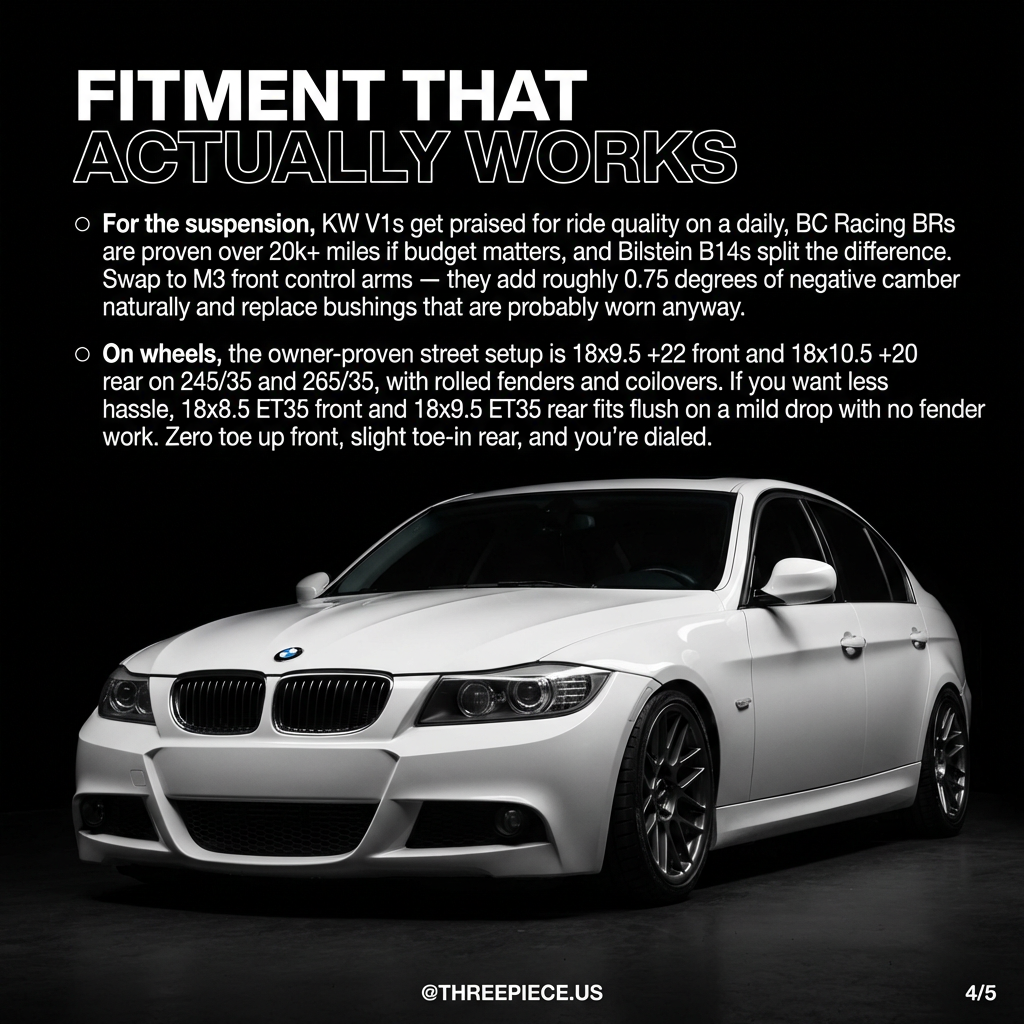
- KW V1 — the daily-driver favorite. Excellent ride quality, predictable handling, and enough drop to look right without destroying your spine on rough roads.
- BC Racing BR — proven over 20,000+ miles by multiple owners on forums. If budget matters, these are the move. Adjustable damping gives you flexibility the KW V1 doesn't.
- Bilstein B14 — splits the difference between the two. OE-quality damping with a mild spring rate increase.
If you're weighing whether coilovers make sense on a car you still daily, read our deep dive on coilovers for daily drivers. And if you're budget-conscious, our coilovers vs springs comparison explains when lowering springs actually make more sense than bottom-tier coilovers. Browse the full suspension catalog for options across multiple platforms.
Control arms: Swap to E9x M3 front control arms. They bolt directly in, add roughly 0.75 degrees of negative camber naturally, and replace bushings that are probably worn anyway. This is one of the highest-value chassis mods on the E90 platform — better turn-in, more tire contact in corners, and it costs less than most coilover kits.
Wheel fitment — aggressive staggered setup:
- Front: 18x9.5 +22 with 245/35R18
- Rear: 18x10.5 +20 with 265/35R18
- Requires rolled fenders and coilovers. This is the owner-proven setup for a street car that looks right and puts power down.
Wheel fitment — mild daily setup:
- Front: 18x8.5 ET35
- Rear: 18x9.5 ET35
- Fits flush on a mild drop with no fender work. Zero toe up front, slight toe-in rear, and you're dialed.
The E90 runs a 5x120 bolt pattern with a 72.6mm center bore. For the aggressive setup, browse 18x9.5 wheels in 5x120 for the front and 18x10.5 wheels in 5x120 for the rear. For the daily setup, 18x8.5 in 5x120 up front and 18x9.5 in 5x120 out back. Make sure you're running hubcentric rings if your wheels aren't BMW-specific — the 72.6mm bore needs to be dead-on to avoid vibration at speed.
For tires, pair the aggressive setup with 245/35R18 fronts and 265/35R18 rears. If you're running a staggered 3-piece setup, the Work Wheels lineup offers some of the best aggressive-fitment options in 5x120 — the Meister series in particular suits the E90's fender lines. For a cleaner, more understated look, the Emotion series works well on a daily that still needs to look sharp. Check the vehicle gallery for real-world E90 fitment examples.
If you're considering forged wheels for this build — and on a car making 400+ whp through the rear wheels, reducing unsprung weight actually matters — our cast vs forged wheels breakdown explains exactly where the performance difference shows up.

The Build Order That Makes Sense
Here's the E90 335i N54 6MT build path laid out in the order that actually makes sense — each stage building on the last, no wasted money, no skipped steps.
Stage 0 — Health (budget: $1,500-2,500 in parts): Valve cover gasket, OFHG, coils, plugs, belt/tensioner/pulleys, aluminum charge pipe. Non-negotiable. This is your foundation.
Stage 1 — Software (~$100-500): MHD or JB4 flash tune on 93 octane. Cone intake optional. Result: 350-380 whp.
Stage 2 — Full Bolt-Ons ($2,000-3,500): FMIC, catless downpipes, upgraded inlets, BOV, Stage 2+ MHD tune on E30 blend. Result: 380-420 whp on stock turbos.
Stage 3 — Chassis ($2,500-4,500): Coilovers (KW V1, BC BR, or Bilstein B14), M3 front control arms, proper alignment. Staggered 18-inch wheel and tire setup. This is where the car transforms from a fast sedan into a proper driver's car.
Stage 4 — Beyond (budget varies wildly): LPFP, port injection, single turbo, forged internals, differential upgrade. This is where you decide if you're building a street car or a project. For most owners, Stages 0-3 deliver everything you need.
The N54 6MT E90 is one of the few platforms where every dollar you spend comes back as something you can actually feel from the driver's seat. The community knowledge is deep, the parts are well-documented, and the results are repeatable. If you're comparing this to other 6MT build platforms, our G37 Sport 6MT build guide and E92 M3 Competition build guide cover the closest competitors. The N54 wins on power-per-dollar at every stage.
Need lighting upgrades while you're at it? The Spyder E90 LED tail lights in red smoke at $406 are a clean OEM-plus upgrade, and the Spyder 09-12 E90 projector headlights with LED turn signals at $813 completely modernize the front end on facelift models. Finish the exterior with proper valve stems and center caps that match your wheel choice — details matter on a build this intentional.
Go find a clean one and start building.