
Posted by THREEPIECE.US on Jun 2nd 2026
Are Test Pipes Worth It? Real Dyno Numbers & Honest Take
Are test pipes worth it? If you've spent any time on VQ forums or Z-car build threads, you've seen the debate. Owners swear by the throttle response and exhaust note, while others rip theirs off within a month because the rasp and drone are unbearable. The truth — backed by actual dyno sheets — is more nuanced than either side admits. Test pipes are a legitimate exhaust modification, but only under very specific conditions. Here's what the data actually says.
Quick links
- What test pipes actually do
- Real dyno numbers: 3-15 whp depending on setup
- Sound is the real mod — and the real problem
- The true cost beyond the part
- When test pipes genuinely make sense
- Why high-flow cats are the smarter first move
What Test Pipes Actually Do
A test pipe replaces the OEM catalytic converter with a straight-through section of pipe — sometimes called a cat delete. The idea is simple: remove the flow restriction that the catalytic converter creates, let exhaust gases exit faster, and theoretically pick up power. There are two types you'll encounter: non-resonated (a raw straight pipe) and resonated (includes a small resonating chamber to tame high-frequency rasp). The distinction matters more than most people realize, and we'll get into why below.
On platforms like the Nissan 350Z (Z33), 370Z (Z34), Infiniti G35, and G37, test pipes are one of the most common bolt-on modifications discussed. The VQ engine family responds well to exhaust flow improvements, which is why the VQ community has the most documented dyno data on this mod. But the lessons apply broadly — the physics of removing a catalytic converter are the same on a Genesis Coupe, an E92 M3, or any other NA platform. If you're weighing a Genesis Coupe against a 350Z, understanding how exhaust mods scale on each platform is part of the equation.
Real Dyno Numbers: 3-15 WHP Depending on Setup
Here's where the hype meets reality. On a stock or mildly modded naturally aspirated car, test pipes alone net you roughly 3-10 whp. That's not nothing, but it's not the transformation that forum posts imply.

One well-documented G35 Coupe dyno — 6-speed, stock intake and exhaust, mild-steel non-resonated test pipes at 2.25" diameter — showed 3.4 whp and 4.4 lb-ft overall, with a peak gain of about 6.5 whp and 8.6 lb-ft around 3950 RPM. Below 2800 RPM, there was actually a torque dip. The pipes aren't the bottleneck when everything else upstream and downstream is still stock.
A 350Z owner running a Japtrix straight mid-pipe and Y-pipe saw +5.2 whp and +7.3 lb-ft from the mid-pipe alone, jumping to +11 whp and +11.3 lb-ft with the full Y-pipe and mid-pipe combination. That's more meaningful, but it's also more pipe — and more money.
Where test pipes genuinely earn their keep is on a car that's already breathing. Intake, headers, cat-back exhaust, and an ECU tune — in that context, owners report 15-20+ whp as part of the total package. The test pipe removes the last restriction in a system that's already flowing. If you're curious about how this stacks up against a downpipe on a turbocharged car, our breakdown of whether downpipes are worth it covers the forced-induction side of this same question. And if you want to understand how air-fuel ratios shift when you open up exhaust flow, read our AFR explainer — it's directly relevant to why a tune matters after installing test pipes.
Sound Is the Real Mod — and the Real Problem
Let's be honest: most owners who keep test pipes long-term keep them for the exhaust note, not the horsepower. The VQ engine sounds phenomenal with cats removed — rawer, louder, more aggressive at high RPM. But the sound trade-off is real and it's the number one reason people revert.
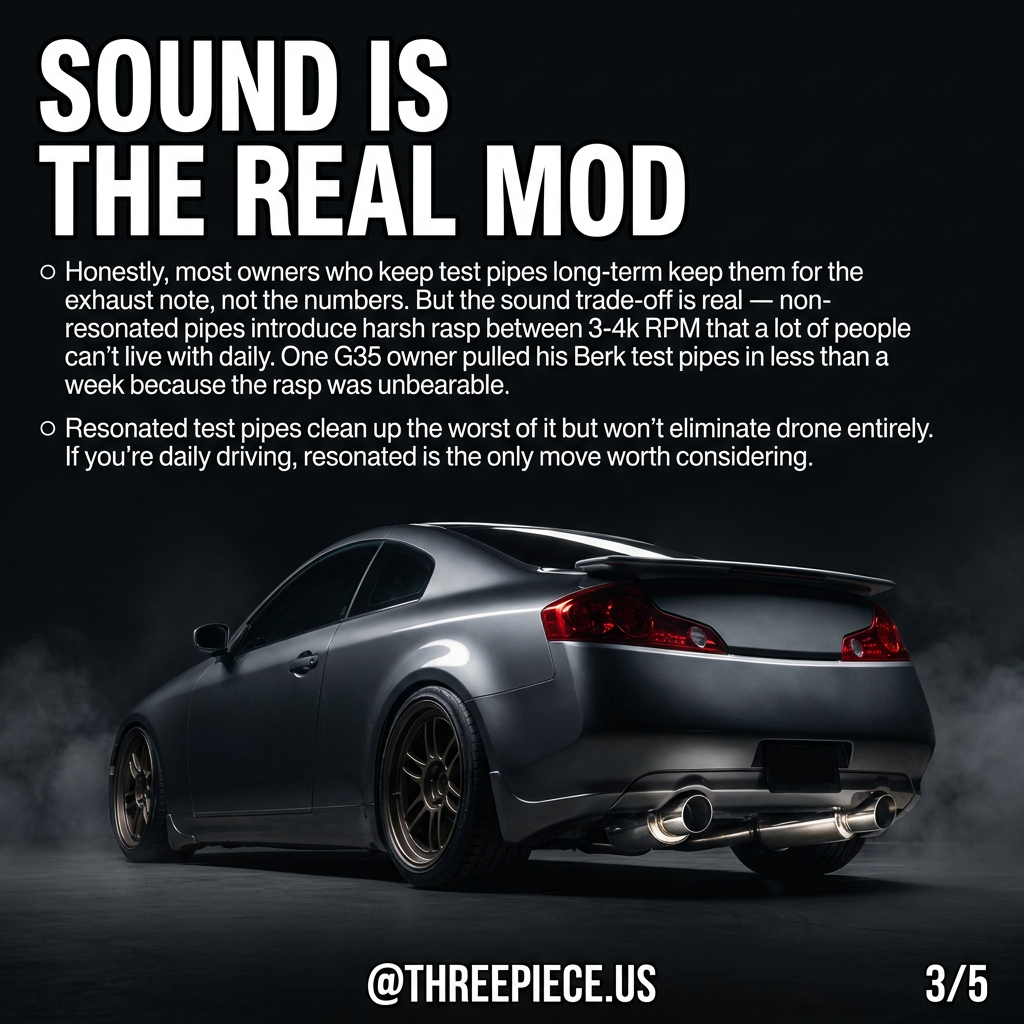
Non-resonated test pipes introduce a harsh, metallic rasp between 3,000-4,000 RPM that a lot of people cannot live with on a daily driver. One G35 owner pulled his Berk test pipes in less than a week because the rasp was unbearable at highway cruising speeds. That's not an outlier — forum threads are full of "how do I fix the rasp" posts from non-resonated test pipe owners.
Resonated test pipes clean up the worst of the high-frequency harshness, but they won't eliminate drone entirely. If you're daily driving, resonated is the only move worth considering. Budget $500-800 for a quality resonated set versus $150-400 for non-resonated. The price gap is worth it if you plan to live with the mod.
The sound character also depends on what's downstream. A resonated test pipe paired with a quiet axle-back is a completely different experience than the same pipe paired with a straight-through cat-back. If you're building out a 370Z, check our 370Z wheel fitment guide — because once the exhaust sounds right, wheels are the next thing that transforms the car.
The True Cost Beyond the Part
The sticker price of a test pipe is misleading because it's never the whole bill. Here's what the total cost actually looks like:
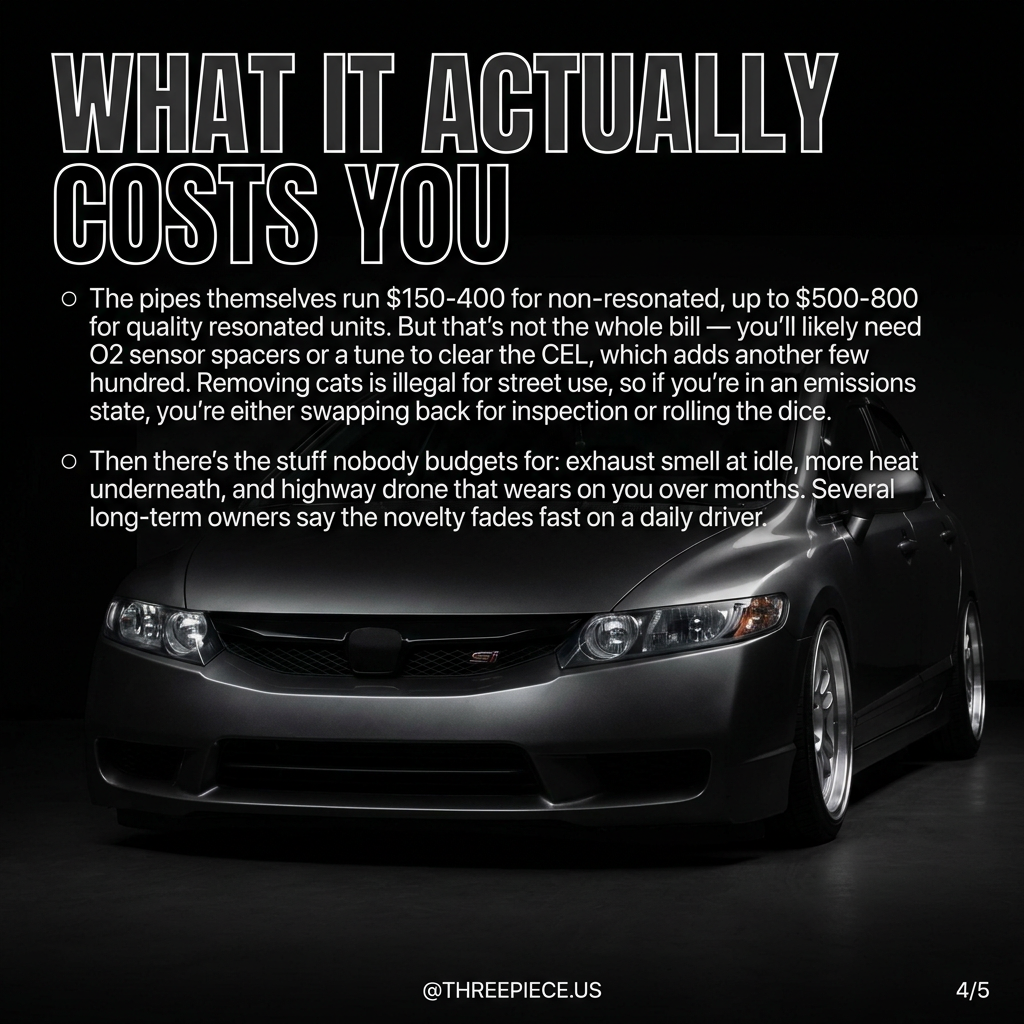
- Test pipes: $150-400 (non-resonated) or $500-800 (resonated)
- O2 sensor spacers or CEL fix: $30-80 for spacers, or $300+ for a proper tune that addresses the downstream O2 codes
- Tune (recommended): $400-700 for a quality ECU tune that recalibrates fueling for the increased flow — without this, you're leaving the real gains on the table
- Emissions compliance: Removing catalytic converters is illegal for street-driven vehicles. If you're in an emissions-testing state, you're either swapping back to stock cats before inspection or accepting the risk
Then there's the stuff nobody budgets for: exhaust smell at idle (raw, unburned fuel smell that's noticeable in traffic and in your garage), more radiated heat underneath the car, and highway drone that wears on you over months of daily driving. Several long-term owners in VQ forums report that the novelty fades fast on a daily driver — the sound that thrilled you in week one becomes the drone you can't escape by month six.
Fitment quality also matters. Cheap mild-steel test pipes can rattle against the tunnel or vibrate because they don't replicate the OEM bracket and hanger positions. Stainless steel units from reputable manufacturers fit better, last longer, and don't corrode. You get what you pay for here.
If you're spending this kind of money on exhaust modifications, it's worth considering whether that budget would go further on something with a bigger impact on your driving experience. An oil catch can protects your intake valves from carbon buildup — especially relevant on direct-injected VQ37VHR engines — and a proper set of wheels transforms the car visually and dynamically in ways that test pipes never will.
When Test Pipes Genuinely Make Sense
Test pipes aren't a bad mod — they're a contextual mod. Here's when the math actually works in your favor:
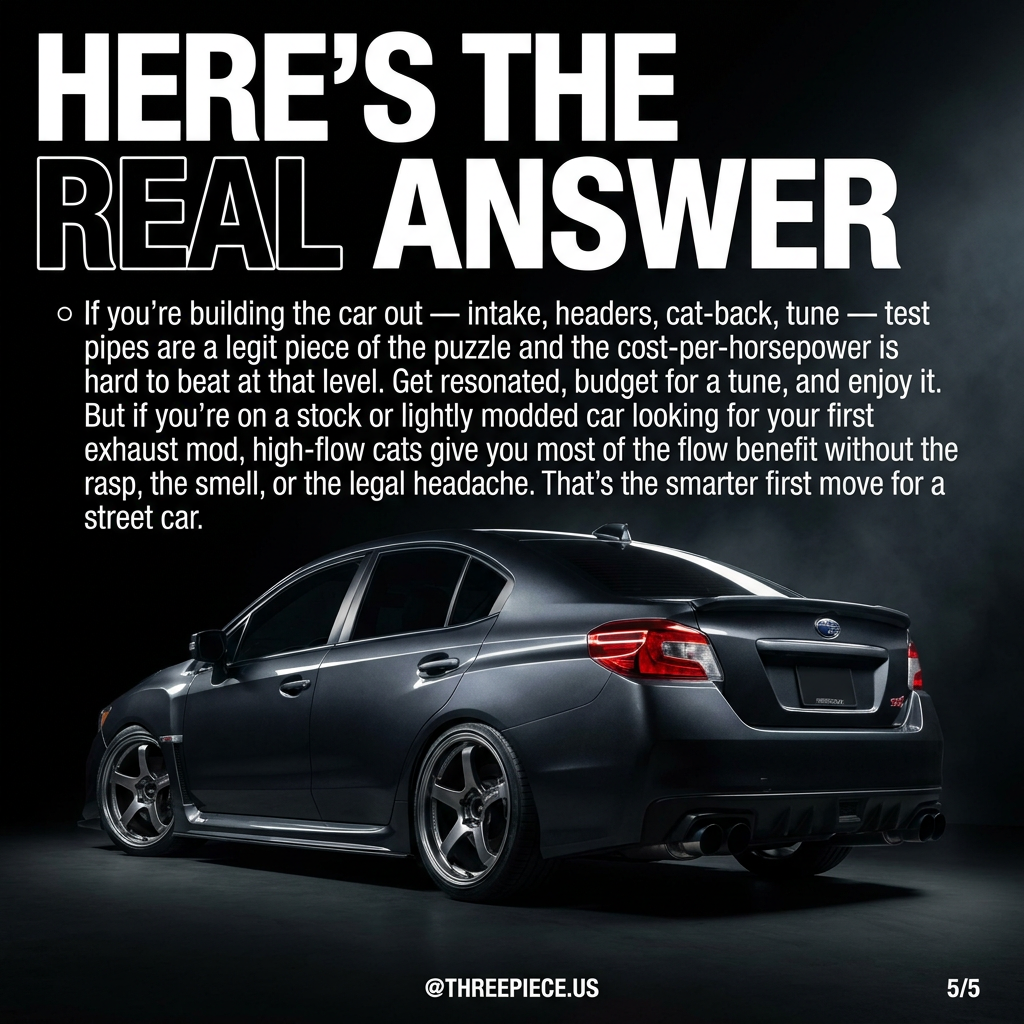
1. You're building the full exhaust system. Intake, long-tube headers, test pipes, cat-back, and a tune. In this context, test pipes are a legit piece of the puzzle and the cost-per-horsepower is hard to beat. The 15-20+ whp combined gains from a full exhaust and tune package are real, and the test pipe is the piece that ties it together. On forced-induction builds, the math is even more favorable — removing every restriction in the exhaust path matters when you're pushing boost.
2. The car is track-only or not emissions-tested. If you're never going through an inspection, the legal issue disappears. Track cars benefit from every fraction of flow improvement, and the sound/drone tradeoff is irrelevant when you're wearing a helmet.
3. You go resonated and budget for a tune. This is the minimum viable setup for a street car. Resonated pipes reduce the worst acoustic penalties, and a tune ensures the ECU is actually taking advantage of the increased flow rather than just throwing codes. Without a tune, you're paying for pipes and getting a fraction of the potential benefit.
For the G35 and G37 crowd specifically, our Infiniti G Series history covers why these platforms became the go-to for bolt-on exhaust builds. And if you're cross-shopping platforms, our Genesis Coupe 3.8 buying guide covers the BK2 Lambda engine, which responds to exhaust mods differently than the VQ.
Why High-Flow Cats Are the Smarter First Move
If you're on a stock or lightly modded car looking for your first exhaust modification, high-flow catalytic converters give you most of the flow benefit without the rasp, the smell, or the legal headache. Quality high-flow cats from brands like Berk, Motiv, or AAM use 200-cell substrates that flow dramatically better than the restrictive OEM units while still technically containing a catalyst.
You'll see 60-80% of the flow improvement of a full cat delete, with none of the CEL issues (assuming the cats are properly designed with O2 bungs in the correct positions), no raw exhaust smell, and significantly less drone. For a street car that you drive daily, that's a much better balance of performance, livability, and legality.
Save the test pipes for when you've already done intake, headers, and a cat-back — at that point, you're removing the last bottleneck in a system that's already flowing, and the gains become meaningful. Until then, high-flow cats are the smarter money.
While you're planning your build, don't overlook what's between the car and the road. A set of properly fitted wheels changes the character of a car more than any exhaust modification. Browse 18" wheels in 5x114.3 for Z33 and Z34 fitments, or explore the Work Emotion lineup for a wheel that matches the aggressive stance these cars deserve. If you're running 3-piece wheels, quality Work step lips starting at $399 let you dial in the exact width and offset your build needs. Pair them with 90-degree valve stems at $3.80 for proper fitment behind deep-dish faces, and finish the build with a Work Wheels license plate frame for $14.99. Check the ThreePiece vehicle gallery for real-world examples of Z-cars and G-cars running properly fitted setups.