
Acura TSX Build Guide: K24A2 Mods, Fitment & Coilovers
The first-gen Acura TSX (CL9) is one of the most mechanically complete sport sedans Honda ever sold in the US — and the build community is finally catching up. Underneath the luxury-commuter reputation sits a K24A2 that revs to 7,300 rpm from the factory, a 6-speed manual transmission, and double-wishbone suspension front and rear. That's a better starting platform than half the cars people pay twice as much for. Here's the exact mod order, parts, and wheel fitment specs that real TSX owners are running — pulled from documented builds on TSXClub and AcuraZine forums.
Quick links
- Why the K24A2 platform is undervalued
- Start with the tune — not the bolts
- Intake, header, and exhaust choices that matter
- Suspension: coilovers, arms, and bushings
- Wheel and tire fitment specs
- 2004-2006 vs 2007-2008: the ECU split
- The complete build list
Why the K24A2 platform is undervalued
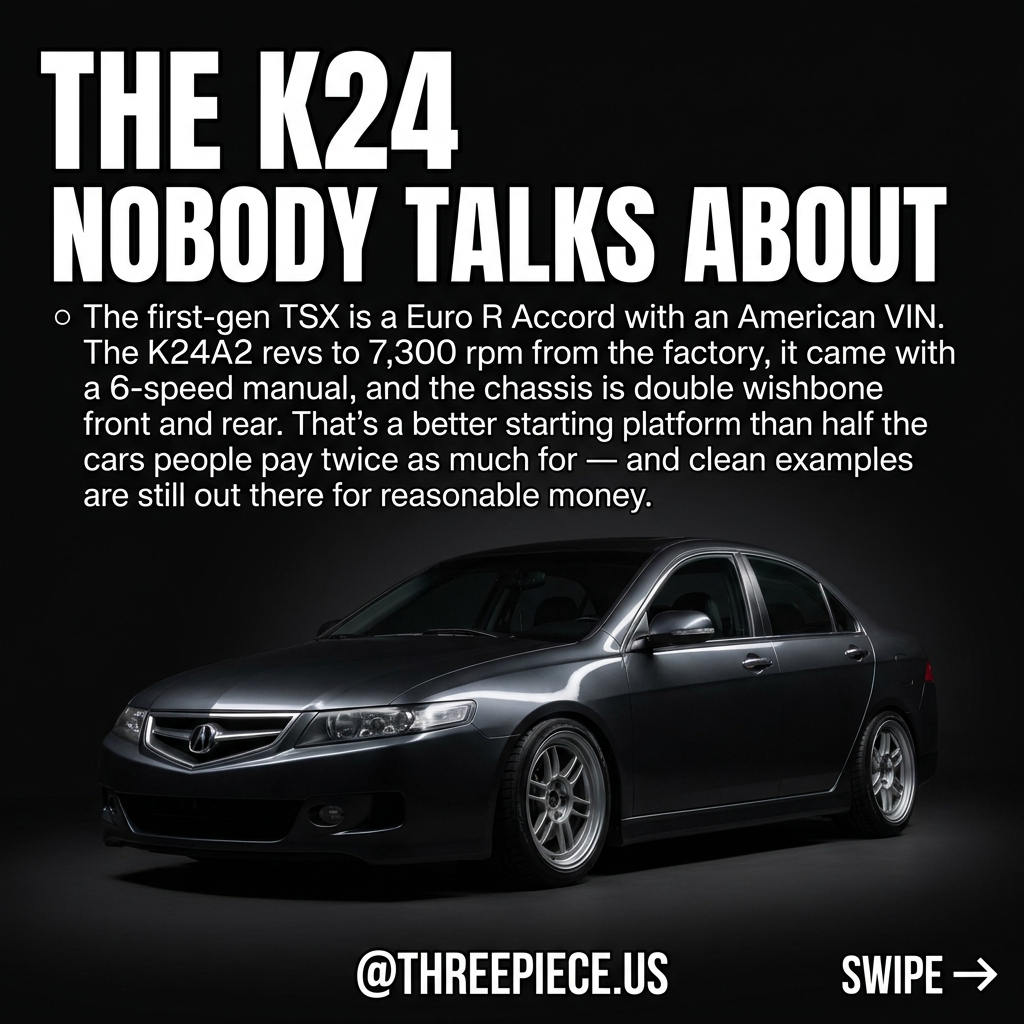
The first-gen TSX is a Euro R Accord with an American VIN. Honda gave it the K24A2 — a 2.4L i-VTEC four-cylinder making 205 hp and 164 lb-ft at the crank, with an 8,000 rpm factory redline. That number isn't a typo. While the RSX Type-S was getting all the K-series attention, the TSX was quietly offering a longer-stroke, torquier version of the same engine family in a chassis with double-wishbone suspension at all four corners, a limited-slip differential on manual cars, and a 6-speed gearbox.
Clean 6-speed examples are still findable under $10,000 — but that window is closing. The TSX shares DNA with cars people are already paying significantly more for, and the K24 responds to bolt-ons better than most owners expect. If you're shopping for a manual sports car under $20K, the CL9 deserves serious consideration.
Start with the tune — not the bolts
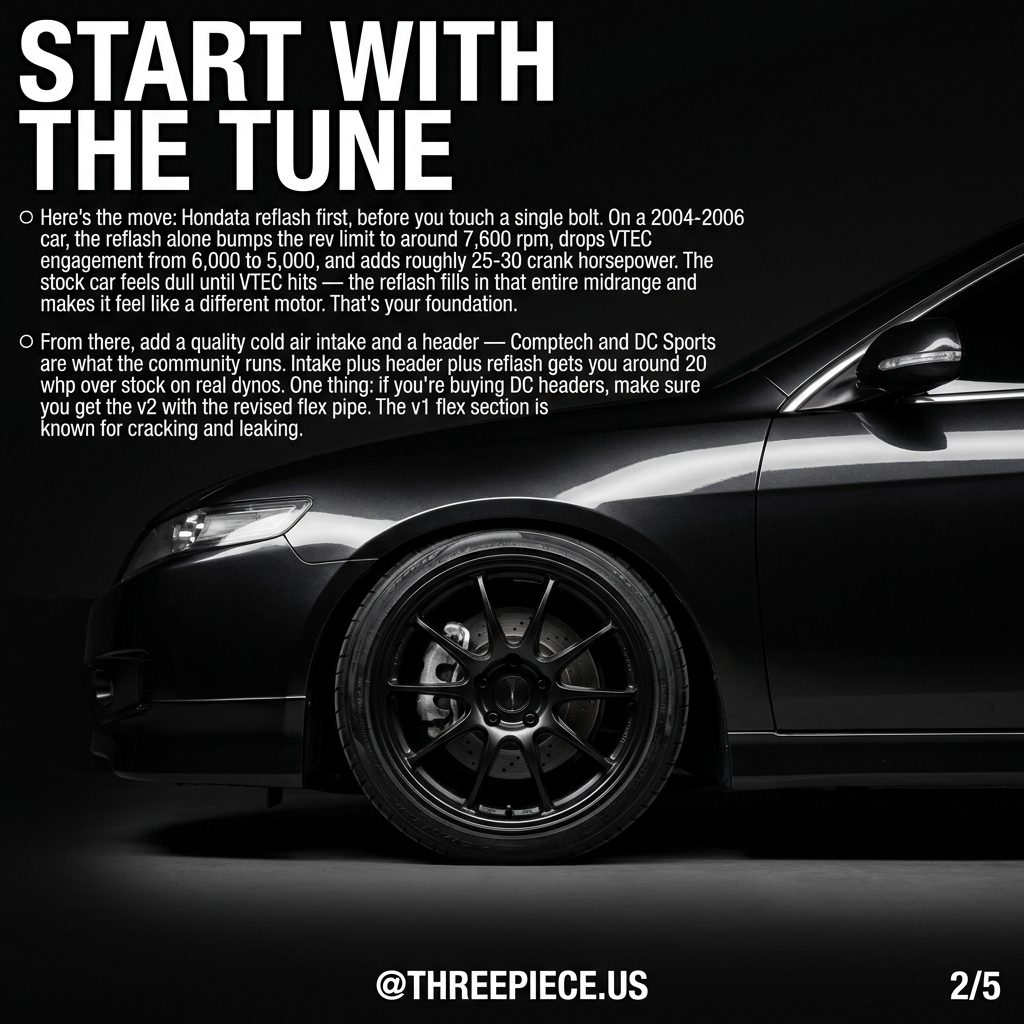
Here's where most TSX builds go wrong: owners bolt on an intake and a header first, then wonder why the car doesn't feel different. On the K24A2, the tune is the foundation. A Hondata reflash on a 2004-2006 car bumps the rev limit to around 7,600 rpm, drops VTEC engagement from 6,000 rpm down to approximately 5,000 rpm, and adds roughly 25-30 crank horsepower — all without touching a single bolt.
The stock TSX feels dull below VTEC. There's a dead zone in the midrange where the car just doesn't want to pull. The reflash fills in that entire gap, reshaping the powerband so the car actually responds from 3,500 rpm up instead of waiting until 6,000 to wake up. Forum owners consistently describe it as "feeling like a different motor." That's your starting point — everything else builds on top of it.
For the more aggressive route, FlashPro gives you full standalone tuning capability. Combined with RDX injectors, a 50-degree VTC limit cam gear, and an RSX Type-S oil pump, documented builds are seeing 210+ whp on pump gas. But the reflash alone is the single best dollar-per-horsepower mod on this platform.
Intake, header, and exhaust choices that matter
After the tune, the community has settled on a clear intake and header combination. Comptech IceBox and DC Sports headers are the two most-documented setups on TSXClub and AcuraZine. Intake plus header plus reflash gets you around 20 whp over stock on real dynos — not Instagram dyno screenshots, but repeated pulls across multiple cars.
One critical note on DC Sports headers: make sure you get the v2 with the revised flex pipe. The v1 flex section is notorious for cracking and developing exhaust leaks, and it's one of the most common complaints in build threads. The v2 resolved this. Headers install runs around $320 for the part plus $45-90 in labor depending on whether you have a lift and air tools — the center nut nearest the engine block is a well-documented struggle without them.
On the exhaust side, the Fujitsubo Legalis-R cat-back shows up on the cleanest builds. Pair it with a high-flow catalytic converter (FLP is the common choice) and you have a full exhaust path that breathes without droning on the highway. The TSX is a daily driver — exhaust note matters as much as flow.
Suspension: coilovers, arms, and bushings
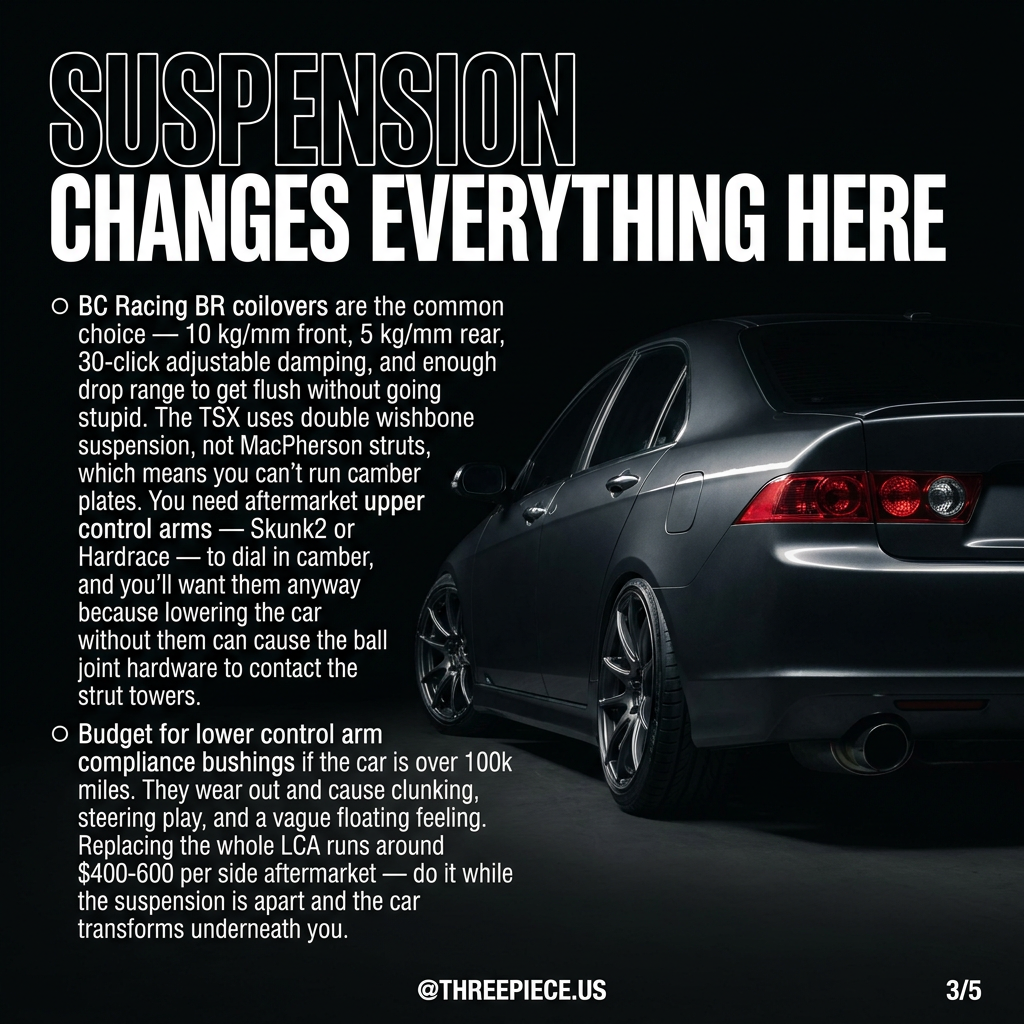
The TSX chassis transforms with proper suspension. This isn't a MacPherson strut car — it's double wishbone front and rear, which means the geometry changes when you lower it are different (and in many ways better) than most sport compacts. But it also means you can't just slap on camber plates and call it done.
The most common coilover choice in the community is BC Racing BR series — 10 kg/mm front, 5 kg/mm rear, 30-click adjustable damping. But if you want something purpose-built for the CL9 with better valving out of the box, the Fortune Auto 500 Series Coilovers for the 2004-2008 Acura TSX at $1,799 are a serious upgrade. Fortune Auto's digressive valving handles the transition from street to spirited driving better than most budget coilovers, and they're built specifically for the CL9 platform. For more aggressive lowering, the Fortune Auto 500 Super Low Series for the TSX at $2,199 gives you the drop range for a flush or tucked setup without sacrificing ride quality.
If you're working with a tighter budget, the F2 Function & Form Type 1 Coilovers for the TSX at $882 are a solid entry point, and the F2 Type 2 kit at $980 adds adjustable damping. Browse the full suspension category for more options.
Regardless of which coilovers you choose, you need aftermarket upper control arms. Lowering the TSX without them causes the ball joint hardware to contact the strut towers — Skunk2 and Hardrace are the go-to options. These also let you dial in proper camber, which you can't do with camber plates on a double-wishbone car.
One more thing the forums consistently flag: lower control arm compliance bushings. If your TSX is over 100,000 miles, these are almost certainly worn. Symptoms include clunking over bumps, vague steering, and a floating feeling at highway speeds. Replacing the entire LCA runs around $400-600 per side aftermarket. Do it while the suspension is apart — the transformation in steering precision is dramatic.
Wheel and tire fitment specs
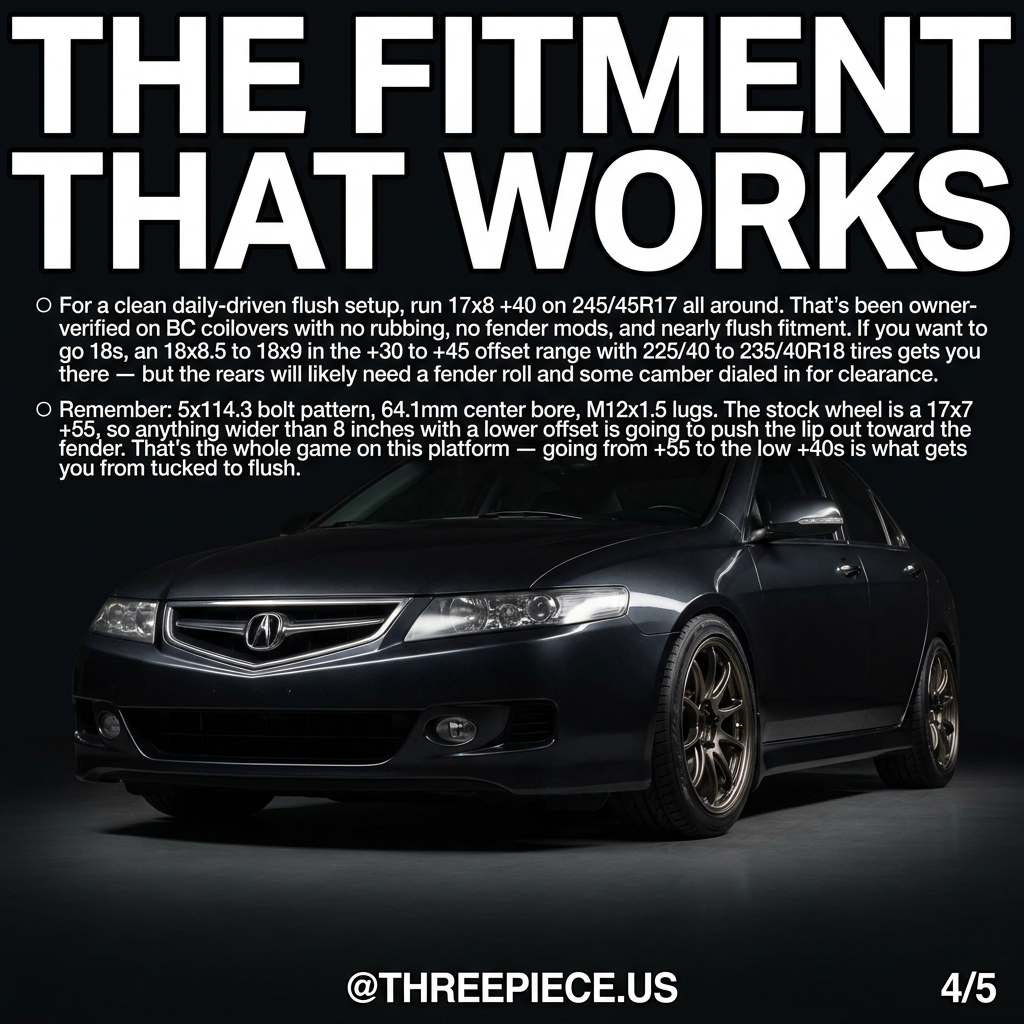
The TSX runs a 5x114.3 bolt pattern, 64.1mm center bore, and M12x1.5 lugs. The stock wheel is a 17x7 +55 — which is deeply tucked. The entire fitment game on this platform is about going from that +55 offset down into the low +40s to push the wheel face outward toward the fender.
For a clean daily-driven flush setup, the owner-verified spec is 17x8 +40 on 245/45R17 all around. On coilovers with no fender modifications, this gives you near-flush fitment with zero rubbing. If you want to run this exact tire size, the Continental ExtremeContact Sport 02 245/45R17 at $280 is an excellent performance option, or the Falken Azenis RT615K+ 245/45R17 at $206 if you want a stickier, more track-oriented compound. The Cooper Zeon RS3-G1 245/45R17 at $215 is the budget-friendly all-season choice.
If you want to step up to 18s, an 18x8.5 to 18x9 in the +30 to +45 offset range with 225/40 to 235/40R18 tires gets you there — but the rears will likely need a fender roll and some camber dialed in. The Work MCO Racing 18x8.5 +40 in 5x114.3 at $504 per wheel is a direct bolt-on for the TSX with the right offset for flush fitment. For a more aggressive look, the Work MCO Racing 18x9.5 +42 at $522 gives you serious lip with manageable poke. Pair the 18s with Continental ExtremeContact Sport 02 235/40R18 tires at $270 or the Continental ContiSportContact 6 235/40R18 at $249 for a premium performance tire.
For more 18-inch options in the right bolt pattern, browse 18-inch wheels in 5x114.3. If you're running 3-piece wheels on this platform, Work replacement lips and barrels let you customize the dish depth to dial in exactly the offset you need. Don't forget hubcentric rings — the TSX's 64.1mm center bore is smaller than many aftermarket wheel bores, and running without rings introduces vibration at highway speed.
2004-2006 vs 2007-2008: the ECU split
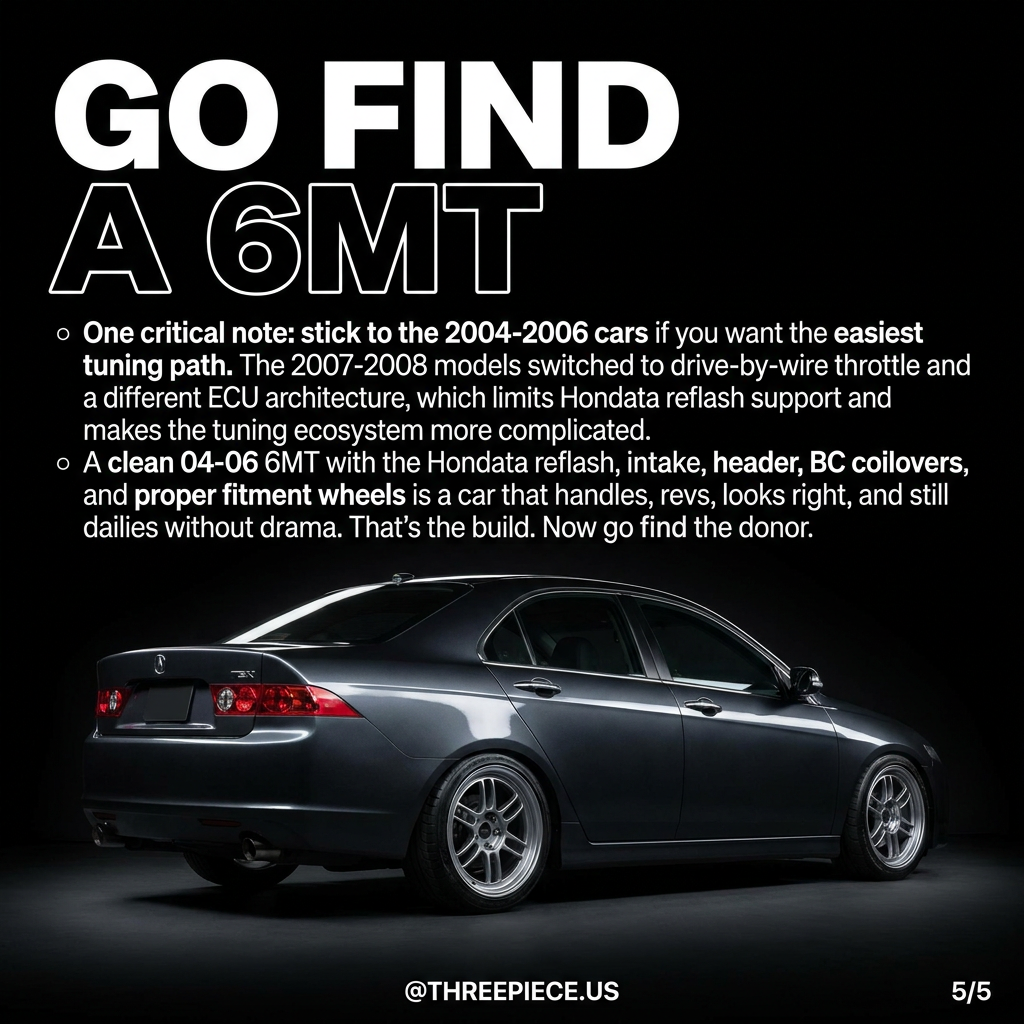
This is the single most important detail if you're shopping for a TSX to build: stick to 2004-2006 cars if you want the easiest tuning path. The 2007-2008 models switched to drive-by-wire throttle and a different ECU architecture. This blocks many off-the-shelf tuning options — Hondata reflash, for example, does not support the '08 when drive-by-wire is involved.
The 2007-2008 cars can still be tuned, but it requires FlashPro and more custom calibration work. Some owners have swapped in a 2008 ECU on earlier cars specifically for FlashPro compatibility while keeping the cable throttle body — but that's a more involved project. If you want the straightforward path of reflash → intake → header → drive, the 04-06 cars are the answer.
This is similar to the ECU complexity issues that show up on other platforms — if you've read about VW GTI tuning headaches, the TSX's model-year split is the Honda equivalent. Know what you're buying before you buy it.
The complete build list
Here's the full build order for a first-gen Acura TSX that handles, revs, looks right, and still dailies without drama:
- Hondata reflash (04-06) or FlashPro (all years) — tune first, always
- Cold air intake — Comptech IceBox or equivalent
- Header — DC Sports v2 (revised flex pipe) or CT Engineering
- Coilovers — Fortune Auto 500 Series or F2 Function & Form Type 1
- Aftermarket upper control arms — Skunk2 or Hardrace
- LCA compliance bushings or full LCA replacement (if over 100K miles)
- Wheels — 17x8 +40 or 18x8.5 +40 in 5x114.3 (the Work MCO Racing 18x8 +35 at $495 is another excellent option)
- Tires — 245/45R17 or 235/40R18
- Clutch and flywheel (if adding power) — Exedy Stage 1 + ACT Streetlite (~$500 parts, ~$900 labor)
Total cost for the full naturally aspirated build sits around $4,000-6,000 depending on coilover choice and wheel selection — on a car you can still buy for under $10K. That's the value proposition the TSX has always had. The community is finally recognizing it.
Check out the ThreePiece vehicle gallery for TSX builds with proper fitment, browse Work Wheels for the cleanest options on this platform, and explore the full wheel catalog to find the right setup for your CL9. If you're comparing the TSX against other Honda platforms, our S2000 build guide covers the other end of the K-series spectrum — and the IS350 vs TL Type-S comparison puts the TSX's bigger sibling in context.