
Paint Protection Film Problems: 3 Reasons to Skip PPF
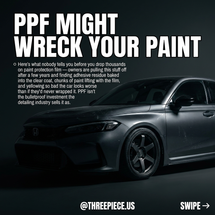
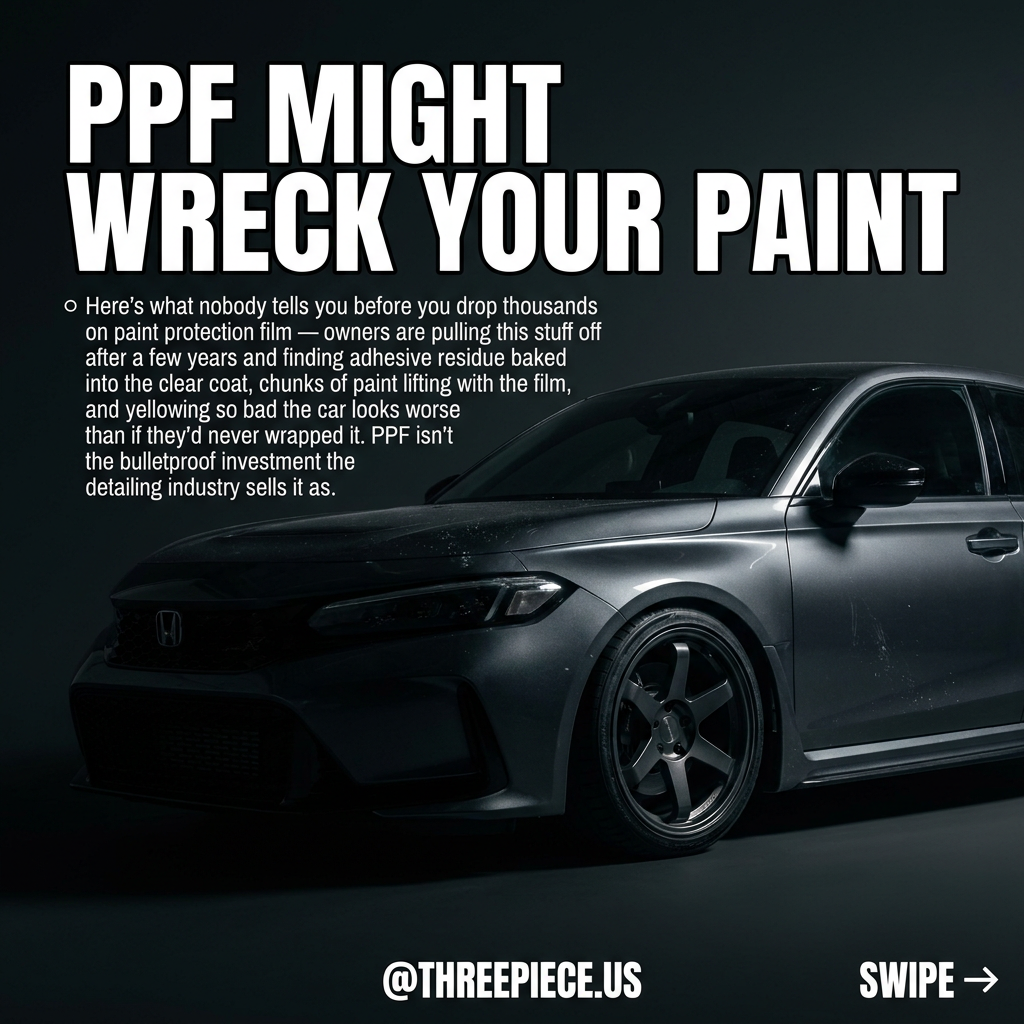
Paint protection film problems are something the detailing industry doesn't want you to think about before you hand over $3,000–$6,000+ for a full wrap. PPF was originally engineered for helicopter rotor blades and race car leading edges — high-impact, short-lifespan applications. Somewhere along the way, the marketing convinced everyday owners to wrap their entire daily driver bumper-to-bumper. Now, five to seven years later, those owners are peeling the film off and finding paint that looks worse than if they'd never wrapped it. Here are three real, documented reasons you should think twice before committing to PPF.
Quick links
- Bad Installs Can Wreck Your Paint
- It Doesn't Stay Invisible
- Removal Is the Real Trap
- You Won't Get the Money Back
- What to Do Instead
- The Bottom Line on PPF
Bad Installs Can Wreck Your Paint
The irony of PPF is that the product marketed as paint protection can be the thing that ruins your finish. A GT-R owner on GtrLife documented finding lint, dirt, and dirty water trapped under the film after a May 2024 install. When he tried to remove the compromised sections with a heat gun, he burned through the clear coat — then made it worse during the polishing attempt to fix it. That's a car that went from needing a re-wrap to needing a full respray because of a product that was supposed to prevent damage.
Super Duty truck owners on FordTremor report chronic lifting and bubbling around recessed lettering — the film between raised letters pops up within months, even when installers try every trick in the book. Many end up leaving those areas unfilmed entirely because the film creates more visual problems than bare paint ever would. Edges, embossed badges, tight compound curves, and any area where the film has to stretch aggressively are all high-risk zones for failure.
The root issue is that PPF installation is extremely labor-dependent. A good installer with proper prep, clean environment, and quality film can do excellent work. But the barrier to entry for "PPF shops" is essentially zero — anyone can buy a roll of XPEL or SunTek and start wrapping cars. You're gambling on labor quality with a product that punishes mistakes by damaging the thing it's supposed to protect. If you're putting this kind of money into your car's appearance, you're better off investing in the right wheels and proper paint correction — things that actually add visible value.
It Doesn't Stay Invisible
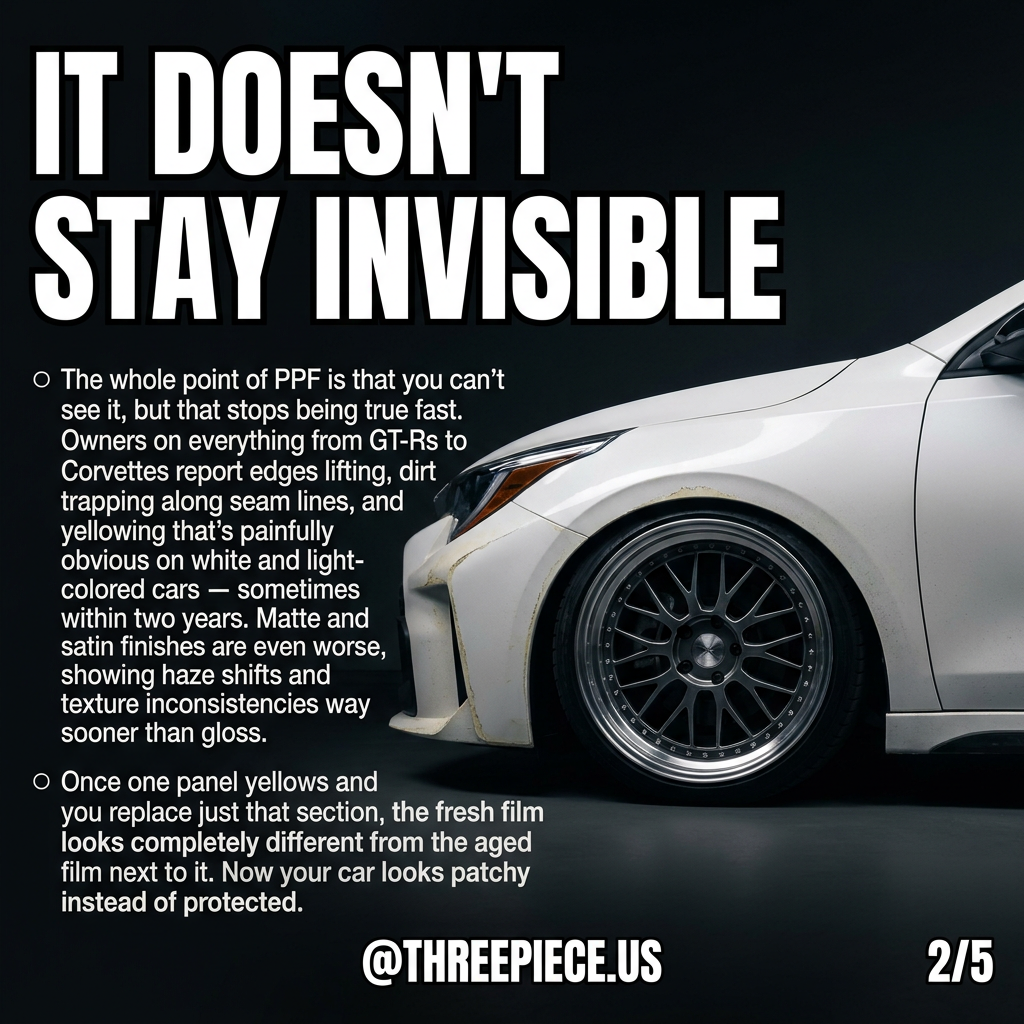
The entire sales pitch of PPF rests on one claim: you can't see it. That stops being true faster than most owners expect. A 370Z owner on Reddit's r/AutoDetailing documented SunTek Ultra film turning visibly yellow after just two years on white paint. On Rennlist, a Porsche GT3 owner reported yellowing after one year — the vendor blamed trapped dirt, not the film, but the result was the same: visible discoloration on a six-figure car.
White and light-colored cars get hit hardest, but it happens on everything. The adhesive layer itself contributes to yellowing independent of the film's top layer, which is why even premium brands like XPEL aren't immune. A Tesla owner on TMC documented edge yellowing on white paint after four years with XPEL, specifically blaming the adhesive rather than the urethane film. Once the yellowing starts, it's irreversible — you can't polish it out because it's happening under the film surface.
Matte and satin PPF is even worse. Distributors report high return rates because matte finishes reveal haze shifts, texture inconsistencies, and edge artifacts far sooner than gloss films. And here's the real problem: once one panel yellows and you replace just that section, the fresh film looks completely different from the aged film on adjacent panels. Now your car looks patchy instead of protected. You're either replacing the entire wrap or living with a mismatched finish — neither option is cheap. For the same money, you could be running a set of forged wheels that actually appreciate the car's look over time instead of degrading it.
Removal Is the Real Trap
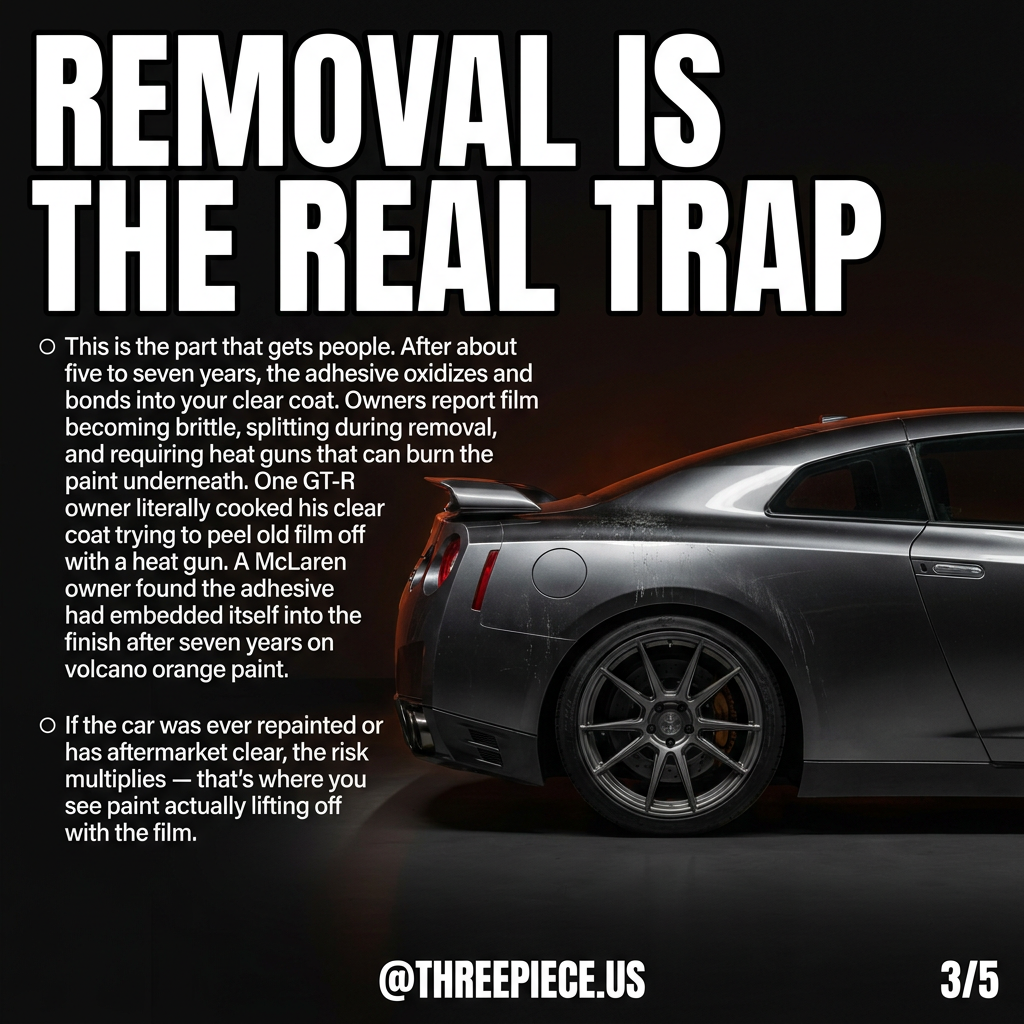
This is where PPF goes from "questionable investment" to "expensive liability." After about five to seven years, the adhesive oxidizes and begins bonding into your clear coat at a molecular level. The film becomes brittle, splits during removal, and requires heat guns that can burn the paint underneath if you're not extremely careful — which is exactly what happened to the GT-R owner mentioned above. A McLaren owner reported adhesive that had embedded itself into volcano orange paint after seven years, requiring professional paint correction that cost nearly as much as the original PPF install.
On a Team-BHP thread, a user who installed 3M PPF in 2016 described the film five years later as "completely deteriorated and hard to remove" — it had gone from glossy to matte, turned brittle, and was splitting into fragments during removal attempts. That's a film that was supposed to protect the paint, and instead it created a removal nightmare that risked the entire finish.
If the car was ever repainted or has aftermarket clear coat, the risk multiplies dramatically. Factory clear coat has a known, consistent bond strength. Aftermarket clear varies wildly, and PPF adhesive can bond more aggressively to some formulations — that's where you see paint actually lifting off with the film. A Reddit user in r/cars summed it up: "Spend $10K+ on full PPF wrap… then 10 years later they ruined their paint taking the stuff off." The protection becomes the problem. If you're the type of owner who cares enough about your car to consider PPF, you're also the type who'd be wrecked watching paint peel off during removal. Put that energy into a proper wheel setup instead — browse the vehicle gallery for inspiration on builds that actually hold up.
You Won't Get the Money Back
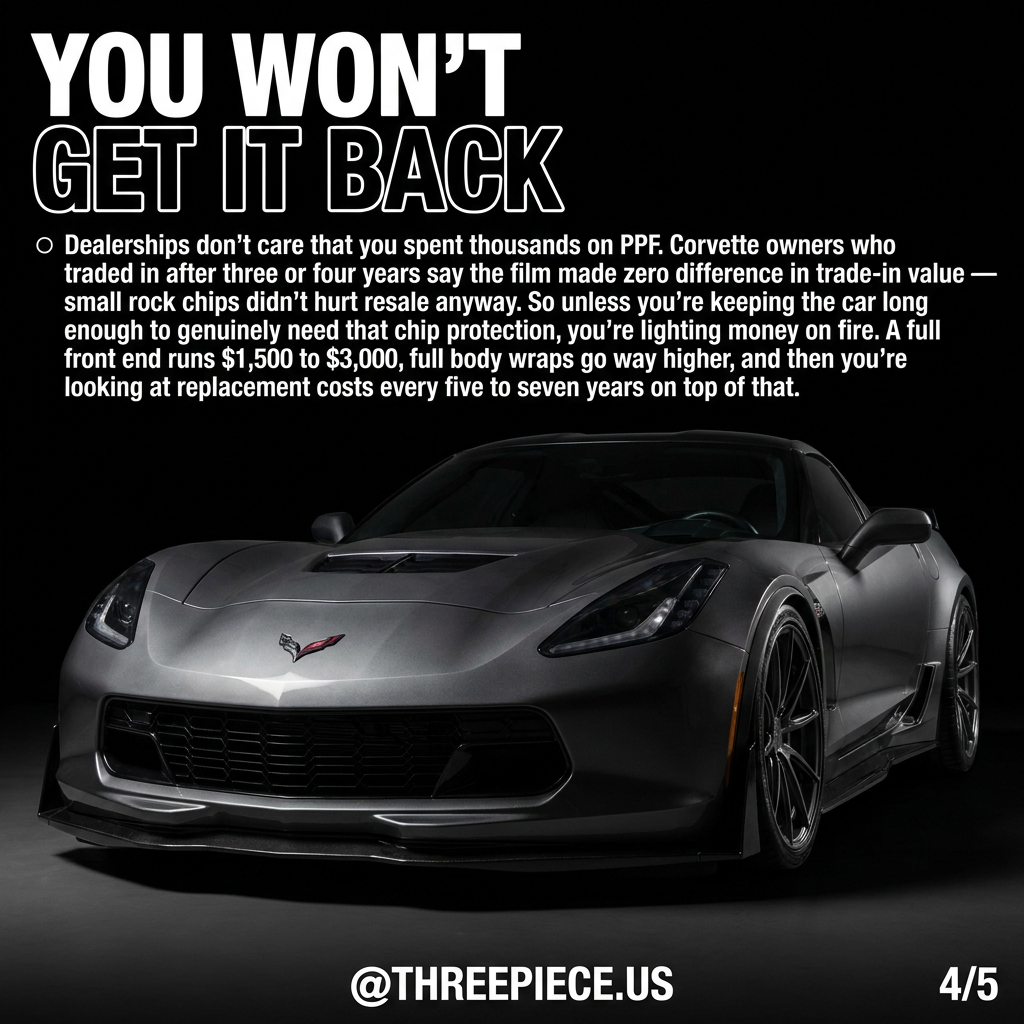
Here's the financial reality that PPF shops never mention: dealerships don't care. Corvette owners on CorvetteForum who traded in after three to four years consistently report that PPF made zero difference in trade-in value. Small rock chips don't meaningfully hurt resale on most cars, and buyers who see aged PPF often view it as a red flag rather than a feature — peeling edges and yellowing film suggest the car has problems, not that it was well-maintained.
A full front-end PPF runs $1,500–$3,000 depending on the car. Full body wraps can push well past $5,000–$6,000. Then factor in replacement costs every five to seven years if you keep the car, plus the removal risk discussed above. Over a 10-year ownership period, you could easily spend $10,000+ on film that provides no measurable return at sale time.
That same $3,000–$6,000 buys you a serious wheel upgrade that does affect how your car looks, drives, and is perceived. A set of Work Wheels or Weds Kranze wheels is a tangible upgrade that holds value on the secondary market. Replacement Work Wheel Lips start at $399, and Work Wheel Barrels at $399 — meaning you can refresh or rebuild a 3-piece set for a fraction of what a PPF replacement costs, and the wheels actually add to the car's presence and value. Warranty fine print on PPF is another issue — most warranties exclude damage from road debris (the exact thing people buy PPF for), staining, yellowing, and removal complications. Read the terms before you sign.
What to Do Instead
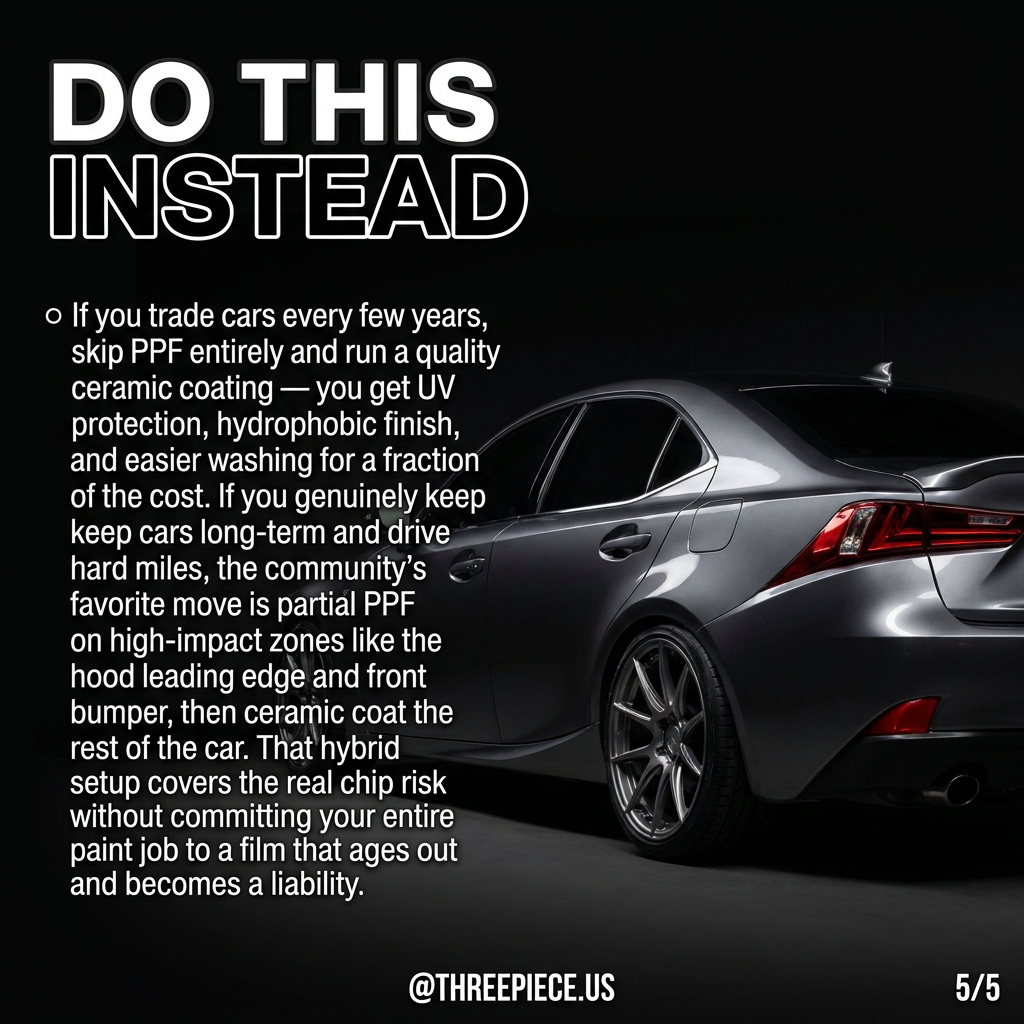
If you trade cars every few years, skip PPF entirely and run a quality ceramic coating. You get UV protection, a hydrophobic finish, and easier maintenance for a fraction of the cost — typically $500–$1,500 for a professional application versus $3,000+ for partial PPF. Ceramic coatings don't prevent rock chips, but they protect against the chemical and UV degradation that actually affects most daily drivers.
If you genuinely keep cars long-term and drive hard miles, the enthusiast community's consensus move is partial PPF on high-impact zones only — the hood leading edge, front bumper, mirror caps, and rocker panels. Then ceramic coat the rest of the car. This hybrid approach covers the real chip risk without committing your entire paint job to a film that ages out and becomes a liability. You're protecting the 20% of the car that takes 80% of the stone damage, and leaving the rest free from adhesive degradation concerns.
The money you save goes further invested in the car itself. Quality wheel parts and proper fitment transform a car's stance more than invisible film ever could. If you're running 3-piece wheels, keeping them fresh with new custom lips at $399 or proper silicone sealant at $10.99 for reassembly is maintenance that actually shows. Our breakdown of mods that aren't worth the money covers similar territory — sometimes the smartest move is knowing when not to spend.
The Bottom Line on PPF
Paint protection film isn't universally bad — it has legitimate applications on track cars, high-mileage highway commuters in gravel-heavy areas, and specific high-impact zones on cars you plan to keep for decades. But full-body PPF on a daily driver you'll trade in four years? That's lighting money on fire. The yellowing, the removal risk, the zero resale return, and the installation gamble make it one of the most oversold products in car care.
Spend that budget where it actually matters. A proper set of wheels, correct fitment, and quality tires transform how your car looks and drives every single day — not just on the day of installation. Browse Work Equip wheels or check the Work Emotion lineup for options that hold their value and make your car look better with age, not worse. Need replacement parts for an existing 3-piece set? SSR halves, BBS halves, and Work halves are all available. Your paint will survive without a $6,000 film — your car's look won't survive without the right wheels.