
Posted by THREEPIECE.US on Apr 21st 2026
Evo VIII MR Buying Guide: Why 2026 Is Your Last Shot
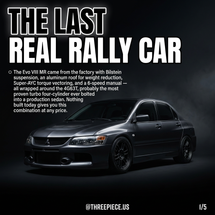
The Mitsubishi Lancer Evolution VIII MR is the most underpriced legendary AWD platform left in 2026 — and that window is closing. While Supras and GT-Rs have been bid into six-figure territory, the Evo VIII MR sits in a sweet spot where you're still getting a genuine homologation-era rally weapon with Bilstein suspension, Super-AYC torque vectoring, and the 4G63T — arguably the most proven turbo four-cylinder ever bolted into a production sedan — for money that won't require a second mortgage. But "attainable" is becoming past tense fast. Here's everything you need to know before you sign.

Quick links
- What Makes the MR Different From a Base Evo VIII
- The 4G63T Tuning Ecosystem in 2026
- Super-AYC and ACD: AWD That Actually Rotates the Car
- Known Failure Points and Real Costs
- Pre-Purchase Inspection Checklist
- Evo VIII MR Wheel Fitment and Upgrades
- Stop Circling — Go Buy One
What Makes the MR Different From a Base Evo VIII
The "MR" designation — Mitsubishi Racing — isn't marketing fluff. Mitsubishi handed you the competition parts list from the factory. The MR trim over the standard GSR gets Bilstein monotube dampers, an aluminum roof for weight reduction, a titanium-turbine turbocharger (lighter spool, faster response), and the 6-speed manual transmission with shorter gear ratios for better acceleration. The Super-AYC rear differential and ACD center differential are standard, giving you a rally-stage-ready drivetrain that nothing in today's showroom replicates at any price.
These MR-specific components are what separate it from the crowd. The Bilstein dampers alone are becoming scarce as OEM replacements — owners report difficulty sourcing exact-spec units. If you're considering whether coilovers are worth it on a daily driver, the MR's factory Bilsteins are a strong argument for keeping the OEM setup intact and spending your budget elsewhere. That said, when those factory shocks do wear out, the Function and Form Type 3 Coilovers for Evo VII/VIII CT9A (01-07) are a direct bolt-on replacement that gives you height adjustability without sacrificing ride quality.

The 4G63T Tuning Ecosystem in 2026
The motor is why people are still building these twenty years later. The 4G63T is a cast-iron block, forged-crank, seven-bolt design that was overbuilt from Mitsubishi's factory. The tuning ecosystem is fully mature: flash the stock ECU with a Cobb Accessport for 300–330 whp on bolt-ons, or go standalone with a Syvecs S7i plug-and-play kit and push 400–500 whp on E85 with forged rods and proper fueling. Owners are making real, repeatable power because every failure mode has already been mapped and solved by the community.
That's the critical advantage of the VIII MR in 2026 — you're not pioneering anything. Every weak link has a documented fix, every power level has a proven parts list. Want to understand how Stage 1 vs Stage 2 tuning actually plays out on a dyno? The 4G63 is one of the platforms where those gains are most predictable. Intake, exhaust, turbo, fuel pump, injectors, and a proper tune gets you to 350–400 whp on the stock block without immediate catastrophic failure — provided you keep maintenance aggressive. Compare that to the SR20DET or even the 2JZ and the 4G63's parts availability and community documentation is unmatched in the four-cylinder turbo space.
If you're curious whether bolt-on intake mods are worth the money on a turbocharged platform like this, our cold air intake deep dive covers the real-world gains you can expect. On the 4G63T, the answer is yes — but only when paired with a proper retune.
Super-AYC and ACD: AWD That Actually Rotates the Car
Most AWD sports cars just split power front to rear and call it a day. The MR's Super Active Yaw Control (S-AYC) actively vectors torque across the rear axle — it's genuinely rotating the car through corners, not just adding traction. Combined with the Active Center Differential (ACD), you have a system that was designed for WRC rally stages and works on backroads in a way that flat-out embarrasses cars with twice the horsepower.
This is the piece that separates the Evo from its closest competitor, the 2004–2007 Subaru STI GD. The STI's DCCD is a capable center diff, but it doesn't actively vector torque side-to-side at the rear. The Evo's system was more complex from the factory, which is both its greatest strength and — as we'll cover below — one of its most expensive failure points. The S-AYC gives the car a rotation and mid-corner adjustability that feels almost telepathic when it's working correctly. It's the reason Evo owners who've driven both platforms rarely go back.

Known Failure Points and Real Costs
Every legendary platform has weak links. The Evo VIII MR's are well-documented, and budgeting for them upfront is what separates smart buyers from forum horror stories. Here's what actually breaks, when, and how much it costs.
Transmission: 2nd and 4th Gear Synchros
The MR's 6-speed manual has shorter gear ratios for better acceleration, but it's known to be weaker at holding high power than the older 5-speed found in base Evo VIIIs. Owners building for big power often swap back to the 5-speed because it's simply stronger. Even at stock power levels, the 2nd and 4th gear synchros wear — you'll feel grinding or notchiness, especially on cold shifts. A full carbon synchro set runs around $370 in parts before labor. If 4th gear is actually gone, expect $2,000–$4,000 for a full transmission rebuild or gear conversion. Cold-shift the car through every gear during your test drive. If 2nd or 4th grind, walk away or budget accordingly.
AYC Pump Corrosion and Failure
The AYC pump sits behind the rear wheel, exposed to road grime, water, and salt. It corrodes. Symptoms include warning lights, whining noises, and loss of the torque-vectoring AWD features that make the car special. OEM replacement runs $2,500–$3,000. Rebuild kits are available for about $1,100–$1,600. If the car has lived in a winter climate, ask if a relocation kit has been installed. If it hasn't, add this to your year-one budget.
Oil Pump Front Cover Wear
The oil pump's steel drive gear wears against the aluminum front cover housing. Under hard driving — especially track use with oil surge/sloshing — the pump can draw air, lose oil film, and cause bearing failure. Stock or lightly modded engines might see issues around 150,000–200,000 miles with neglected maintenance. Heavily modded engines pushing past 40 psi of boost can see main and rod bearing failure by 70,000–100,000 miles. A performance rebuild with upgraded bearings and oil pump cover runs $4,000–$7,000.
Vacuum and Boost Leaks
These are insidious because they often don't throw codes. Failed injector insulators, throttle body shaft seals, and cracked intercooler pipe couplers allow metered air to escape post-MAF, causing lean conditions under boost. Symptoms: loss of power above 3,000–4,000 rpm, inconsistent boost, rough idle. Parts are cheap — injector insulator kits and throttle body seal kits are under $200. But if the intercooler piping needs a full overhaul plus retune, budget $1,000+.

Pre-Purchase Inspection Checklist
Budget $2,000–$5,000 in year-one deferred maintenance on any high-mileage example. Do it upfront and you're set for years. Here's your non-negotiable list:
- Compression and leak-down test — the 4G63 should show even numbers across all four cylinders. Anything below 140 psi or more than 10% variation between cylinders means the motor needs work.
- Oil pressure check — at operating temperature, you want at least 40 psi at idle and 70+ psi at 3,000 rpm. Low numbers point to worn bearings or oil pump issues.
- Cold-shift through every gear — 2nd and 4th are the canaries. Any grinding means synchro replacement is imminent.
- Inspect AYC pump — look for fluid leaks, corrosion, and listen for whining from the rear. Check if a relocation kit has been installed.
- Vacuum leak inspection — check injector seals, throttle body, intercooler piping connections. Spray carb cleaner around suspected areas at idle and listen for RPM changes.
- Boost leak test — pressurize the intake tract and listen. This catches cracked couplers and failing BOVs that visual inspection misses.
- Maintenance records — timing belt service interval on the 4G63 is every 60,000 miles. If the seller can't prove it's been done, budget for it immediately.
This platform rewards informed buyers. If you're coming from the Subaru world, our GDB STI build guide covers a similar inspection philosophy for the EJ257 — the approach is the same even if the failure points differ.
Evo VIII MR Wheel Fitment and Upgrades
The Evo VIII MR runs a 5x114.3 bolt pattern with a factory wheel size of 17x8 +38 wrapped in 235/45R17 tires. That's a conservative setup from the factory. Most owners stepping up to aftermarket wheels run 18x9 +30 to +38 square, which fills the fenders properly and allows for a meatier tire. On a car that makes this much torque through all four wheels, tire contact patch matters more than almost any other mod.
Browse 18x9 wheels in 5x114.3 to see what fits. For a more aggressive look without pulling fenders, 18x9.5 in 5x114.3 works with the right offset and minor rolling. If you want the JDM-correct look, the Work Emotion series is a natural fit for this platform — lightweight, strong, and available in the right specs. The Work Equip line is another classic choice if you're going for a period-correct early-2000s aesthetic.
For tire sizing on 18x9, 255/35R18 is the sweet spot — enough sidewall to protect the lip on rough roads, enough width to put the power down. If you're wondering whether cast vs forged wheels actually matter on a car this light, the answer is yes — unsprung weight reduction on a 3,300 lb rally car with this suspension geometry is immediately noticeable. And if you're considering 3-piece wheels, our breakdown of why 3-piece wheels cost $4K+ and whether they're worth it covers the engineering advantages.
If you're upgrading the suspension alongside wheels, the Function and Form Type 4 Coilovers for Evo VII/VIII/IX (01-07) are a step up from the Type 3, offering 32-way damping adjustment for track days. Read our guide on the expensive mistake 90% of coilover buyers make before you purchase — getting the spring rate and valving right on an AWD platform is critical.

Stop Circling — Go Buy One
OEM parts are getting scarcer and more expensive every year — the Bilstein shocks, the Brembo components, the MR-specific titanium-turbine turbo. Clean examples aren't getting cheaper or more plentiful. If you want a turbocharged, AWD, manual-transmission car with a rally pedigree and a tuning platform that can reliably make 500 whp on a solved recipe, this is it.
The Evo VIII MR sits in a category that no longer exists in new-car showrooms. It's a homologation special from an era when manufacturers built street cars to win rally championships. The GD STI is its closest analog, but the Evo's torque-vectoring AWD system and the 4G63T's tuning headroom give it an edge that the Subaru community quietly acknowledges. Every year you wait, the clean examples get rarer, the OEM parts get more expensive, and the price floor rises.
Go find one with solid maintenance history, budget for the known weak points, and drive it like it was built to be driven. Check out our vehicle gallery for build inspiration, and browse our full wheel catalog when you're ready to finish the look.